The Sound That Held Us Together
Laughter began long before jokes, and your body still obeys its oldest command.
All essays filed in this edition, newest first.
Laughter began long before jokes, and your body still obeys its oldest command.
The sound that escapes when you stub your toe is older than language, and it may quietly help you endure.
In the quietest room on Earth, people last only minutes before their own bodies grow deafening.
The sound that makes your spine crawl is not high or shrill. It is a warning older than language.
Your bedtime is not a moral failing. It is a rhythm ticking in your cells, inherited and ancient.
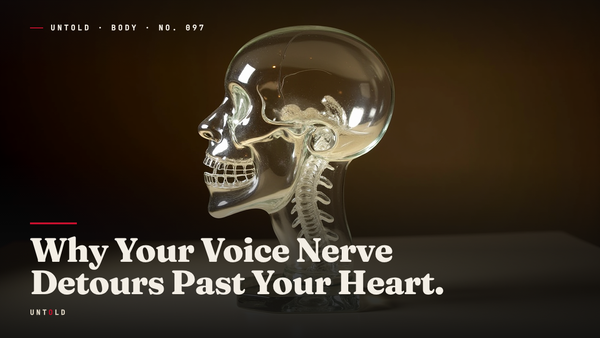
One nerve in your chest loops backward under an artery for no good reason, and that mistake is the clearest proof of evolution in your body.
The ache in your lower back is a six-million-year-old compromise finally coming due.
How a tenth of a second reveals the oldest guessing machine in your brain.
Why the mind clings to one insult and lets five kindnesses slip away.
A wound too small to bleed properly still hijacks one of the most sensitive instruments the body owns.
When illness kills your hunger, your body may be running a survival program half a billion years old.
Cancer is less a moral verdict than a statistic written into the act of staying alive.
Laughter is older than jokes, and its real job has almost nothing to do with comedy.
Every human has a chin, no other animal does, and science still cannot agree on why.
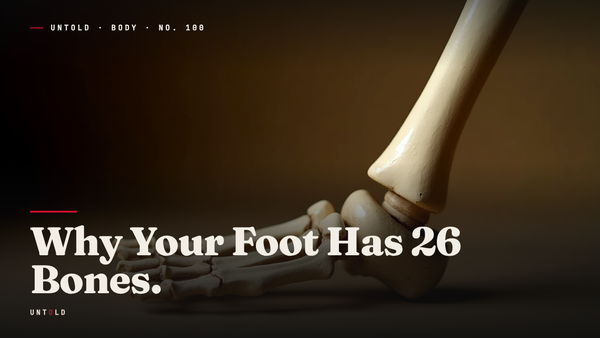
Your smallest toe is a half-finished draft, caught between a life in the trees and one spent walking upright.
Why the human jaw kept shrinking while the third molar refused to disappear.
Ancient viruses infected our ancestors millions of years ago, and they are still living inside us.
Blood types are not a quirk of biology. They are a ledger of the plagues your ancestors survived.
Before language, before tools, a flame held to raw flesh quietly rewrote what a primate could become.
Why passengers turn green while the driver, in the very same car, feels nothing at all.
Allergies may be the price we pay for winning an ancient war against parasites.
The avocado was built for an animal that has been gone for thirteen thousand years.
A reflex older than language tells us what to protect, and industries have learned to forge it.
Why panic sweat clears a room while a five-mile run barely registers.
Why most of us lurch awake just as we drift off, and what the reflex remembers.
Hiccups may be a 370-million-year-old echo of the way our ancestors once breathed underwater.
No adult mammal drinks milk except us, and the reason is written into our genes by hunger.
No other animal weeps from grief or joy. The reason hides in our faces and our long childhoods.
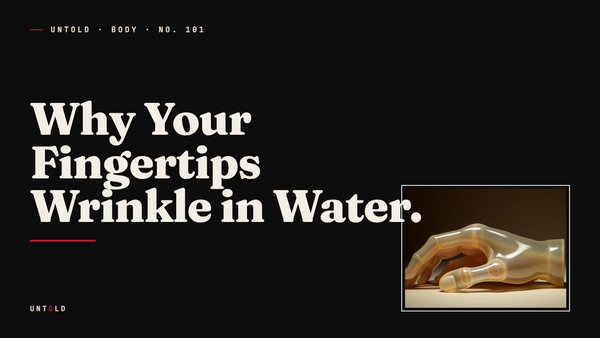
Wrinkled fingers are not soaked skin. They are a nervous system making a decision.
Bacteria learned to outlast our best medicines, and we taught them how.
Why we kept these two strips of hair when nearly every other became vestigial.
Chili heat is a chemical hoax your nervous system can't ignore, and somehow you keep asking for more.
The pop you feel on a descending plane is a 400-million-year-old structure doing the only job it knows.
Goosebumps were dismissed as evolutionary debris. Then a Harvard lab looked closer.
Why human memory was built for the village, not the dinner reservation.
A clear drop forms at the tip of your nose in winter. It is not a malfunction.
A tear gland, a ring of muscle, and the strange thermal engineering hidden in a reflex you never think about.
The hiccup makes no sense in a human body. It makes perfect sense in a tadpole's.
A 125-year-old psychological puzzle keeps yielding stranger answers about how the brain reads other minds.
For a century, medicine dismissed it as evolutionary debris. The microbiome rewrote the story.
Why two thousand years of medicine got yawning wrong, and what it actually reveals about the brain.