The Quiet Engineering of a Pruned Fingertip
Wrinkled fingers are not soaked skin. They are a nervous system making a decision.
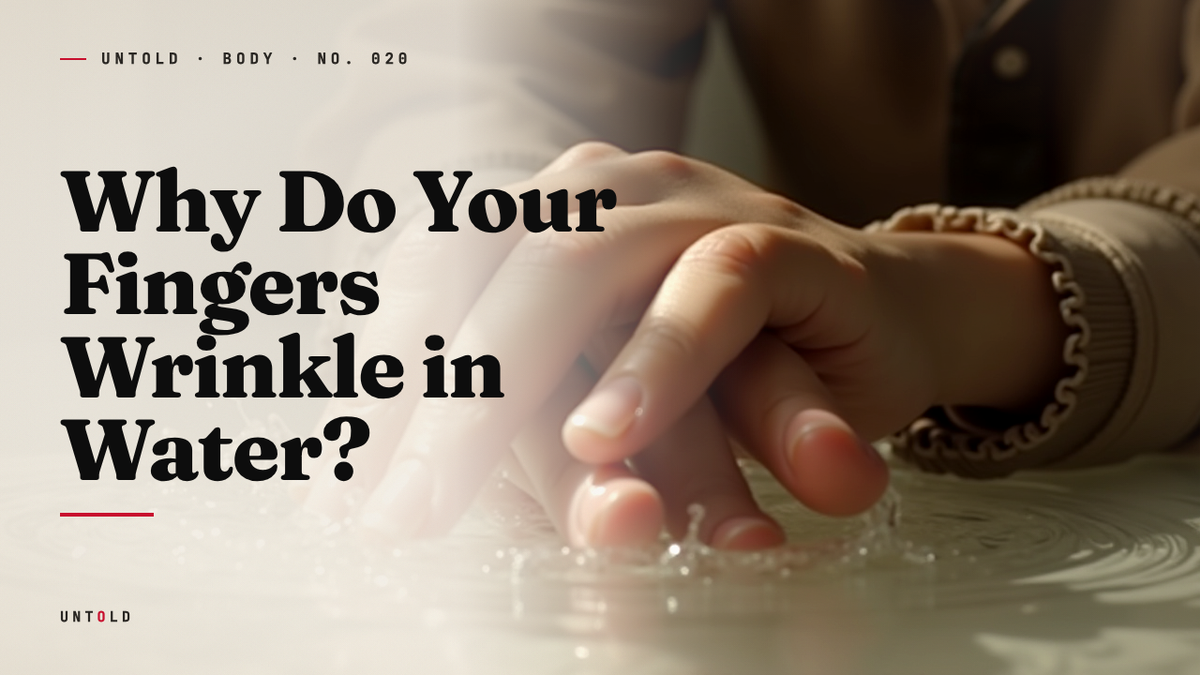
Run a bath, settle in, and wait. Somewhere around the five-minute mark, the smooth pads of your fingertips begin to change. The skin tightens into ridges, then deepens into the familiar topography of a dried plum. We have all seen it so many times that it has stopped registering as strange. It is simply what skin does in water, a small inconvenience of long baths and dishwashing, no more remarkable than the way hair clings when wet.
For most of the twentieth century, scientists agreed with that casual assumption, and they had a tidy explanation to match it. The outer layer of skin, they reasoned, absorbs water like a sponge. It swells. The dead keratin cells of the epidermis take on fluid, expand in volume, and because they are anchored at the edges to the tissue below, they have nowhere to go but up and outward. So they buckle. The surface creases. Wrinkles appear.
It is an intuitive story, and it is wrong. The truth, assembled slowly over nearly a century of clinical observation and evolutionary biology, is far stranger. Your fingers do not wrinkle because they are passive. They wrinkle because something inside you is making them do it. The folds are not the residue of soaking. They are an order, transmitted through living nerves, executed on purpose, and reversed the moment they are no longer needed.
A wrinkle that refused to appear
The first crack in the sponge theory came not from a laboratory but from a hospital ward, and it took the form of an absence. Physicians treating patients with damaged nerves in their hands noticed something that should not have been possible under the prevailing explanation. When these patients soaked their injured fingers, the wrinkles never came. The skin sat in water, absorbed it perfectly well, and remained as smooth as ever.
This was a genuine puzzle. If wrinkling were nothing more than dead cells swelling with absorbed fluid, then the state of a person’s nerves would be irrelevant. Keratin does not need instructions from a nervous system to take on water. A severed nerve should make no difference at all. And yet it made all the difference. On the side of the hand where the nerve supply had been cut, the fingertips stayed flat. On the healthy side, they puckered as usual. The same person, the same bath, two different outcomes, separated only by whether a nerve was intact.
The implication was unavoidable. Whatever produced the wrinkles required a working connection to the nervous system. The skin was not acting alone. It was being acted upon.
In 1936, two British physicians, Thomas Lewis and George Pickering, followed this clue to its source 1. Lewis was one of the most influential cardiovascular researchers of his era, a man who had spent his career mapping the behaviour of blood vessels and the nerves that govern them. He and Pickering traced the wrinkling response to the autonomic nervous system: the vast, involuntary control network that manages the parts of the body you never consciously command. Your heartbeat, your sweating, the slow churn of digestion, the widening and narrowing of your blood vessels: all of it runs in the background, under the direction of this system, without ever asking your permission.
Wrinkling, it turned out, belonged to the same family of processes. When fingertips are immersed, the autonomic nerves trigger the blood vessels beneath the skin to constrict. As those vessels narrow, the volume of tissue underneath the surface drops. The skin, anchored at its base, is drawn downward into the spaces left behind. It does not bulge upward like a soaked sponge. It is pulled inward like fabric tugged from below.
This is the detail that overturns the old picture entirely. The wrinkles are not pushed up by swelling. They are pulled down by the loss of volume beneath them. The fingertip is not puffing out. It is collapsing inward along precise lines, and it is doing so because a nerve told it to.
The shape of the channels
Lewis and Pickering had shown how the wrinkles formed. They had not explained why a body would bother to form them at all. For decades, that question sat largely untouched. The mechanism was understood, but its purpose remained a blank. Why would evolution build an active, nerve-controlled system to crumple the skin on contact with water? What was it for?
The answer arrived from an unexpected direction, and it began with someone simply looking more carefully than anyone had before. Mark Changizi, a neurobiologist with a habit of finding overlooked patterns in the ordinary world, did not ask whether fingers wrinkle. That was settled. He asked about the shape of the wrinkles themselves.
Most people, glancing at a pruned fingertip, see a random mess of folds. Changizi saw structure. The wrinkles, he noticed, were not arranged haphazardly. They formed channels that branched outward and downward, away from the centre of the fingertip and toward its edges. The pattern had a logic to it, and it was a logic he recognised from somewhere else entirely: from landscapes. The grooves resembled drainage networks, the branching channels that rain carves into a hillside as water finds its way downhill 2.
In a 2011 paper, Changizi and his colleagues proposed a hypothesis that was as simple as it was elegant. The wrinkles, they argued, were rain treads for the human hand. Like the grooves cut into a car tire, the channels exist to divert water out of the way, so that the raised skin between them can press flat against a surface and make solid contact. When you grip a wet object with a wrinkled fingertip, the water does not stay trapped between your skin and the surface, lubricating the contact and loosening your hold. Instead it runs off through the channels, draining away exactly as it would down those hillside gullies, leaving the skin free to grip.
It was a beautiful idea. It explained the otherwise pointless precision of the pattern. It connected the wrinkling response to a clear evolutionary advantage: better grip in the wet. But a beautiful hypothesis is only the beginning. Changizi had described what the wrinkles looked like and what they might do. He had not shown that they actually worked.
The test of the marbles
That test came in 2013, at Newcastle University, in an experiment whose charm lies entirely in its simplicity. Tom Smulders and his colleagues set out to measure something that sounds almost too humble to publish: whether wrinkled fingers help you pick things up 3.
The design was straightforward. Volunteers were asked to move objects, glass marbles and lead fishing weights, from one container to another, passing each item through a small hole with the other hand along the way, while the researchers timed how long the task took. Each volunteer did this under two conditions. Once with normal, smooth fingertips, and once after soaking their hands in warm water long enough to produce a full set of wrinkles.
The objects came in two varieties as well: dry, and submerged in water. This was the crucial control. If wrinkles were simply better for handling things in general, they would help with everything. If they were specifically an adaptation for wet grip, they should help only when the objects were wet, and offer no advantage at all when they were dry.
The results landed exactly where the rain-tread hypothesis predicted. When the objects were wet, wrinkled fingers won. Volunteers moved the submerged marbles and weights noticeably faster with pruned fingertips than with smooth ones, a difference of around twelve percent in handling time 3. When the objects were dry, the wrinkles made no difference whatsoever. The two conditions were indistinguishable.
That pattern is the signature of a genuine adaptation rather than an accident. A side effect would not switch itself off so cleanly when it was not needed. The wrinkles helped with wet objects and only wet objects, which is precisely what you would expect from a system designed for the wet and nothing else. The grooves were doing the job Changizi imagined: channelling water away so the skin could seize hold of slippery surfaces.
Once you see it, the strangeness of pruned skin resolves into sense. Picture an ancestor crouched at the edge of a stream, fingers in cold running water, gathering shellfish or prising loose tubers from wet mud. Picture moving across rain-slicked rock, or hauling something up out of a river. In any of these moments, a hand that grips well when wet is a hand that works, and a hand that slips is a hand that fails. Over the long arc of evolution, where the margin between eating and going hungry can be measured in small advantages, a reliable wet grip is not a trivial gift. It is the kind of feature natural selection tends to keep.
The five-minute clock
There is a final detail, easy to overlook, that quietly seals the whole argument. The wrinkles are not permanent. They take roughly five minutes of immersion to develop fully, and once your hands are dry, they fade away again within a similar span. The fingertip returns to smooth, holding nothing in reserve, until the next time water calls the response back.
That timing is itself a kind of proof. A passive sponge does not run on a clock. If wrinkling were merely the slow physics of swelling keratin, it would have no reason to reset itself, no mechanism for unwinding the change once the water was gone. But the body’s version does exactly that. It deploys the wrinkles when they are useful and withdraws them when they are not, the way you might unfold a tool, use it, and put it back in the drawer.
This on-demand quality is the behaviour of a system, not a substance. It implies a sensor, a trigger, a response, and a recovery. It implies, in other words, the very nervous-system control that Lewis and Pickering identified almost ninety years ago. The wrinkles come because they are summoned and leave because they are dismissed. Nothing about that resembles a sponge soaking and drying. Everything about it resembles a reflex.
Which raises a question that scientists are still working through. If wrinkling is good for grip, why don’t our fingers simply stay wrinkled all the time? One leading possibility is that the folds carry a cost as well as a benefit. Constricting the blood vessels and altering the skin’s surface may reduce sensitivity, or make the fingertips more vulnerable to damage. A permanently pruned hand might grip wet objects better but pay for it in lost touch and durability. The five-minute clock, on this reading, is a compromise: the advantage is held in reserve and produced only when conditions justify the trade.
A window made of water
The story has one more turn, and it leads back to where it began, in the clinic. Because the wrinkling response depends on intact nerves, its absence can signal that something has gone wrong with them. The same observation that first cracked the sponge theory, that damaged nerves produce smooth fingers, has become a quiet diagnostic clue. Some clinicians use a simple water-immersion test to assess nerve function, particularly in the hands. Soak the fingers, wait, and watch. If the wrinkles come, the autonomic nerves supplying that skin are doing their job. If they stay smooth, that absence is information 4.
There is something fitting about this. A response that evolved to help our ancestors grip wet stones now doubles, in a modern hospital, as a readout of the nervous system’s health. A bathtub becomes an instrument. The same fold of skin that once meant the difference between catching a fish and losing it can now tell a doctor whether the wiring beneath a patient’s hand is intact.
We tend to imagine the body as a thing that mostly happens to us, especially in its smaller workings. Hair gets wet. Skin gets cold. Fingers wrinkle. These feel like passive events, weather that moves across the surface of us while we attend to more important things. But the pruned fingertip turns out to be something else: a deliberate act, carried out by a nervous system that has been quietly watching for water and is ready to respond before you have consciously registered the need.
So the next time you linger in a bath and notice the ridges forming on your fingertips, you might pause over what you are actually seeing. Not skin passively drinking water. Not a sponge swelling toward its limit. You are watching a decision being made and executed in real time, an ancient reflex switching on, channels opening to drain away water that is not even there yet, a tool unfolding long before you reach to grip anything at all. The body decided first. You are simply the last to know.
Sources
- Lewis, T. & Pickering, G. W., ‘Circulatory changes in the fingers in some diseases of the nervous system,’ Clinical Science, 1936. — https://en.wikipedia.org/wiki/Thomas_Lewis_(cardiologist)
- Changizi, M. et al., ‘Are Wet-Induced Wrinkled Fingers Primate Rain Treads?,’ Brain, Behavior and Evolution, 2011. — https://www.karger.com/Article/Abstract/328223
- Kareklas, K., Nettle, D. & Smulders, T. V., ‘Water-induced finger wrinkles improve handling of wet objects,’ Biology Letters, Royal Society, 2013. — https://royalsocietypublishing.org/doi/10.1098/rsbl.2012.0999
- Wilder-Smith, E. P. V. & Chow, A., ‘Water-immersion wrinkling is due to vasoconstriction,’ Muscle & Nerve, 2003. — https://onlinelibrary.wiley.com/doi/10.1002/mus.10488
- Davis, N., ‘Why do our fingers and toes wrinkle during a bath?,’ The Guardian, 2017. — https://www.theguardian.com/science/2017/jul/24/why-do-our-fingers-and-toes-wrinkle-during-a-bath
- Smulders, T. V., Newcastle University, research on water-induced finger wrinkling. — https://www.ncl.ac.uk/biomedicalsciences/staff/profile/tomsmulders.html
Related reading