The Drugs That Forgot How to Win
Bacteria learned to outlast our best medicines, and we taught them how.
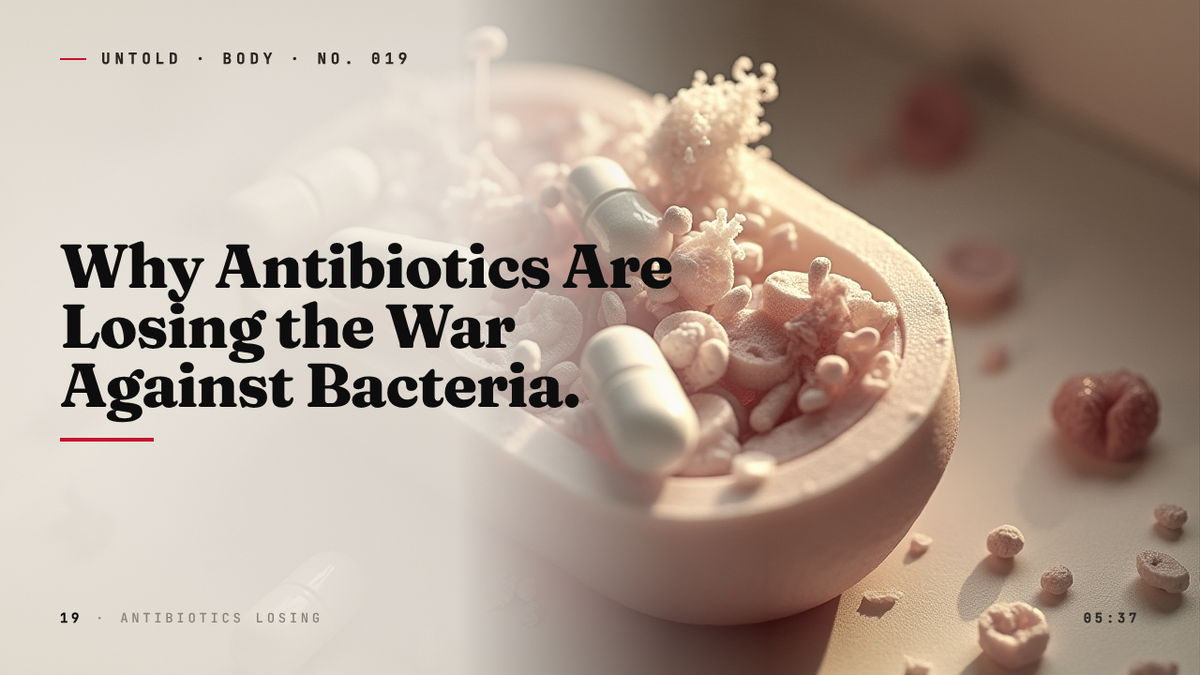
A scratched knee once killed kings. In the centuries before the 1940s, a thorn in the thumb, a blister on the heel, a tooth gone bad could open a door that no physician knew how to close. Infection moved through the blood with a logic of its own, and the most powerful people on Earth were as defenseless as the poorest. Then, for roughly eighty years, that stopped being true. A cut became a cut again. A bladder infection became an inconvenience rather than a death sentence. We forgot, almost entirely, how fragile the body had always been.
That forgetting is ending. Somewhere on Earth, a person now dies from a drug-resistant infection every few seconds. In 2019, researchers estimated that antimicrobial resistance was directly responsible for 1.27 million deaths worldwide and was associated with nearly five million more 1. These are not exotic plagues. They are the ordinary infections that defined the pre-antibiotic world: a wound that will not heal, a urinary tract infection that climbs to the kidneys, pneumonia settling into a lung. The drugs that once dispatched them in days are beginning to fail. And the uncomfortable truth at the center of this story is that we built the failure ourselves, one prescription at a time.
An accident in a messy laboratory
The miracle began with carelessness. In September 1928, the Scottish bacteriologist Alexander Fleming returned to his cluttered laboratory at St Mary’s Hospital in London after a summer holiday. He had left a stack of petri dishes seeded with Staphylococcus bacteria, and on one of them a blue-green mold had taken hold, drifting in, most likely, through a window or from a neighboring lab. Around that mold the bacteria had simply dissolved, leaving a clear halo where no colony would grow 2.
The mold was a strain of Penicillium, and Fleming realized it was releasing something that killed bacteria. He named the substance penicillin and published a paper on it in 1929. Then, for nearly a decade, almost nobody acted. Fleming was not a chemist, and purifying the compound into a usable drug proved difficult enough that the discovery languished as a laboratory curiosity. The substance that would later save tens of millions of lives sat on the shelf, waiting for the right people to notice.
Those people arrived at Oxford at the end of the 1930s. A team led by Howard Florey and the biochemist Ernst Chain took up Fleming’s forgotten observation and did the painstaking work of isolating and concentrating penicillin into something a body could use 3. Their first human trial, in 1941, involved an Oxford policeman dying of a streptococcal infection that had started with a scratch from a rose bush. The drug pulled him back from the edge before the tiny supply ran out and he relapsed. The proof of concept was undeniable. By 1942 the first American patient had been saved by mass-produced penicillin, and by the Normandy landings of 1944, wartime factories were brewing the drug in vast quantities to treat the wounded.
The age of antibiotics had begun, and it remade medicine from the inside out. Surgery became survivable because surgeons no longer feared that every incision invited fatal infection. Childbirth lost much of its old terror. Chemotherapy, organ transplantation, intensive care: all of modern medicine’s most aggressive interventions rest on the quiet assumption that if an infection takes hold, a drug will clear it. We rarely notice that floor beneath us. We are only now beginning to feel it shift.
The man who saw it coming
Fleming himself understood the danger almost from the start. In 1945, accepting the Nobel Prize in Physiology or Medicine alongside Florey and Chain, he used part of his lecture to deliver a warning that reads now like prophecy. He described how it was easy, in the laboratory, to expose bacteria to doses of penicillin too small to kill them, and how doing so would breed organisms resistant to the drug. “There is the danger,” he said, “that the ignorant man may easily underdose himself and by exposing his microbes to non-lethal quantities of the drug make them resistant” 4. The thoughtless person playing with penicillin, he warned, was morally responsible for the death of someone who might one day succumb to an infection that had learned to survive.
What Fleming was describing, in plain terms, was evolution by natural selection, unfolding inside the human body and across hospital wards. Subject a population of bacteria to a drug that kills most but not all of them, and the survivors are precisely those whose chance mutations let them withstand the assault. Those survivors multiply. The next time the drug arrives, it finds a population already hardened against it. The medicine itself becomes the selective pressure that breeds its own obsolescence.
He was right within years. By the late 1940s, hospital strains of Staphylococcus aureus were already shrugging off penicillin, and through the 1950s these resistant infections spread through wards across Europe and North America. Each new antibiotic bought a reprieve, and each reprieve proved temporary. Methicillin, a semi-synthetic penicillin designed to defeat the resistant staph, was introduced in 1959. Resistant strains appeared by 1960 5. That strain carries a name many people now recognize from hospital corridors and news reports: MRSA, methicillin-resistant Staphylococcus aureus. The pattern set in the first decade of the antibiotic era has never broken. We invent. They adapt. We invent again.
How bacteria learn so fast
The speed of that adaptation is the part that should unsettle us most, and it has a mechanism worth understanding. We tend to imagine evolution as slow, the work of geological time. Bacteria operate on a different clock. A single cell can divide every twenty minutes, compressing thousands of generations into a few days, so any advantageous mutation spreads through a population at a rate no vertebrate could match. But raw speed is only half the story.
The other half is that bacteria do not have to wait for their own mutations at all. They can acquire resistance ready-made, swapping genes the way children trade cards. Through a process called horizontal gene transfer, a bacterium can pass a packet of DNA, often a small loop called a plasmid carrying resistance genes, directly to a neighbor, sometimes one of an entirely different species. A harmless microbe living in the gut can hand its hard-won defenses to a dangerous pathogen passing through. Resistance does not have to be reinvented in every lineage. It circulates, like contraband, through the vast and interconnected world of bacteria.
This is why a problem that begins in one place rarely stays there, and it is why the microbiologist Stuart Levy’s work at Tufts University mattered so much. In the 1970s, Levy ran a now-famous study on a Massachusetts farm, feeding chickens low doses of antibiotics of the kind used to promote growth in livestock. Within weeks, the birds’ guts filled with resistant bacteria. Within months, resistant strains turned up in the intestines of the farm workers who tended them, people who had never taken the drug 6. Levy had shown, in a single controlled setting, that resistance bred in animals could move into humans. The barrier between the farmyard and the body was permeable.
That finding remains uncomfortable because of the scale at which we still ignore it. Roughly two-thirds of the antibiotics that matter to human medicine are sold not for people but for animals, much of it given to healthy livestock to speed their growth and compensate for crowded conditions 7. Every one of those doses is, in effect, a training session, a low-grade exposure that selects for the very survivors Fleming warned about. We have built an industrial system that breeds resistance as a routine byproduct of cheaper meat.
The pipeline ran dry
For a long while, the answer to resistance was simply to invent the next drug. When penicillin faltered, there was methicillin; when that faltered, others followed. The arms race was uneven but ongoing. Then the new weapons stopped coming. The last structurally novel class of antibiotics to reach patients was discovered in the late 1980s 8. For more than thirty years, the fundamental arsenal has barely grown, while resistance has compounded year on year.
The reasons are as much economic as scientific. An antibiotic is, from a pharmaceutical company’s point of view, a strange and unprofitable product. It is taken for a week or two and then the patient is cured and stops buying it, unlike a drug for blood pressure or cholesterol that a person may take for the rest of their life. Worse, any genuinely new antibiotic is likely to be held in reserve, used as sparingly as possible precisely to slow the emergence of resistance, which means it sells in small quantities. The market rewards chronic-disease medicines and punishes the very drugs we most need to keep in stock. Many large companies quietly abandoned antibiotic research altogether.
Meanwhile, on the demand side, we squandered what we already had. Antibiotics do nothing against viruses, yet vast numbers of prescriptions are written for coughs, colds, and other viral illnesses they cannot touch. In the United States, studies have estimated that roughly thirty percent of antibiotic prescriptions in outpatient settings are unnecessary 9. Each of those needless courses does nothing to cure the patient and a great deal to push the bacteria living harmlessly in and around them toward resistance. The result, accumulating over decades, is a category of infection that clinicians now sometimes call “nightmare bacteria,” organisms resistant even to the last-resort drugs held in reserve for exactly such emergencies. Occasionally a doctor confronts an infection for which there is, simply, nothing left to try.
A defense older than humanity
Here the story takes a turn that reframes everything that came before it. We tend to speak of antibiotic resistance as something modern, a side effect of the pharmaceutical age, a problem we manufactured. In one sense that is true. But resistance itself is not new. It is, in fact, far older than we are.
In 2011, a team of researchers analyzing DNA recovered from 30,000-year-old permafrost in the Canadian Yukon found genes encoding resistance to several major classes of antibiotics, including beta-lactams and tetracyclines 10. These were ancient bacteria, sealed in frozen soil since long before any human had cultured a mold, let alone manufactured a drug. They already carried the genetic machinery to neutralize the compounds we would not invent for another three hundred centuries.
The explanation is elegant once you see it. Antibiotics did not originate in laboratories. Most of them are molecules that bacteria and fungi evolved to wage chemical warfare against one another in soil and water, competing for resources over billions of years. Penicillin is itself a weapon a mold deploys against its bacterial rivals. And wherever there are such weapons, there are also defenses, evolved in the same ancient contest. The resistance genes were already there in the natural world, distributed and refined long before we showed up. We did not create resistance. We discovered nature’s weapons, deployed them at planetary scale, and in doing so we selected, amplified, and spread the defenses that had always existed alongside them.
From invention to stewardship
That reframing matters, because it changes the nature of the fight. If resistance were purely a modern accident, we might hope to engineer our way out of it indefinitely, always one clever molecule ahead. But if resistance is an ancient and inexhaustible feature of the bacterial world, then no drug will ever be permanent. Every antibiotic is a depreciating asset from the moment it enters use. The question is not whether we can win the arms race outright but how long we can keep each weapon useful, and how wisely we deploy it. The frame shifts from invention to stewardship.
None of this means the cause is lost. Researchers are hunting for new weapons in unfamiliar places. Some have returned to bacteriophages, the viruses that prey on bacteria, a line of therapy explored in the early twentieth century and then largely abandoned once penicillin arrived; phages can be exquisitely specific, targeting a single bacterial strain while leaving the rest of the body’s microbes untouched. Others are mining the genomes of soil microbes and the molecules of deep ocean sediments for antibacterial compounds no one has ever catalogued, chemistry the natural world spent billions of years developing.
The stakes of getting this right are not abstract. One widely cited 2016 review commissioned by the British government projected that, on current trajectories, drug-resistant infections could claim ten million lives a year by 2050, surpassing the toll of cancer 11. That figure is a model, not a prophecy, and it has been debated. But its purpose was never precision. It was to make vivid a future that is still unwritten, one whose shape depends on choices being made now, in clinics and farms and laboratories and regulatory offices.
Some of those choices are large and collective: reforming how livestock are raised, redesigning the economics so that companies are paid to develop antibiotics we then hold in reserve, funding the basic science of new compounds. But some are ordinary and individual. Finish the course a doctor prescribes rather than stopping the moment symptoms ease, which is precisely the underdosing Fleming warned against. Do not press a physician for antibiotics to treat a cold or flu they cannot help. When a doctor explains that a virus must simply run its course, treat that as the careful judgment it usually is rather than a refusal of care.
The miracle that Fleming stumbled upon through an open window was never meant to be permanent. He told us so himself, in 1945, in the same breath he used to celebrate it. The drugs that taught us to forget how fragile the body had always been are remembering their limits, and so, slowly, are we. What remains is not despair but obligation. The defense was a loan from the natural world, drawn against an ancient and ongoing war we did not start. How long we get to keep it depends, more than we would like to admit, on how carefully we choose to use it.
Sources
- Antimicrobial Resistance Collaborators, Global burden of bacterial antimicrobial resistance in 2019, The Lancet, 2022. — https://www.thelancet.com/journals/lancet/article/PIIS0140-6736(21)02724-0/fulltext
- Fleming, A., On the Antibacterial Action of Cultures of a Penicillium, British Journal of Experimental Pathology, 1929. — https://www.ncbi.nlm.nih.gov/pmc/articles/PMC2048009/
- Chain, E., Florey, H. W., et al., Penicillin as a Chemotherapeutic Agent, The Lancet, 1940. — https://www.thelancet.com/journals/lancet/article/PIIS0140-6736(01)08728-1/fulltext
- Fleming, A., Penicillin, Nobel Lecture, Nobel Prize in Physiology or Medicine, 1945. — https://www.nobelprize.org/prizes/medicine/1945/fleming/lecture/
- Jevons, M. P., Celbenin-resistant Staphylococci, British Medical Journal, 1961. — https://www.ncbi.nlm.nih.gov/pmc/articles/PMC1953361/
- Levy, S. B., FitzGerald, G. B., Macone, A. B., Changes in Intestinal Flora of Farm Personnel After Introduction of a Tetracycline-Supplemented Feed, New England Journal of Medicine, 1976. — https://www.nejm.org/doi/full/10.1056/NEJM197609092951101
- U.S. FDA Center for Veterinary Medicine, Antimicrobials Sold or Distributed for Use in Food-Producing Animals, Annual Summary Report, 2021. — https://www.fda.gov/animal-veterinary/cvm-updates/fda-releases-annual-summary-report-antimicrobials-sold-or-distributed-2021-use-food-producing
- Silver, L. L., Challenges of Antibacterial Discovery, Clinical Microbiology Reviews, 2011. — https://journals.asm.org/doi/10.1128/CMR.00030-10
- Fleming-Dutra, K. E., et al., Prevalence of Inappropriate Antibiotic Prescriptions Among US Ambulatory Care Visits, JAMA, 2016. — https://jamanetwork.com/journals/jama/fullarticle/2518263
- D’Costa, V. M., et al., Antibiotic resistance is ancient, Nature, 2011. — https://www.nature.com/articles/nature10388
- O’Neill, J., Tackling Drug-Resistant Infections Globally: Final Report and Recommendations, Review on Antimicrobial Resistance, 2016. — https://amr-review.org/sites/default/files/160525_Final%20paper_with%20cover.pdf
Related reading