The Moving Borders of the Human Face
Why we kept these two strips of hair when nearly every other became vestigial.
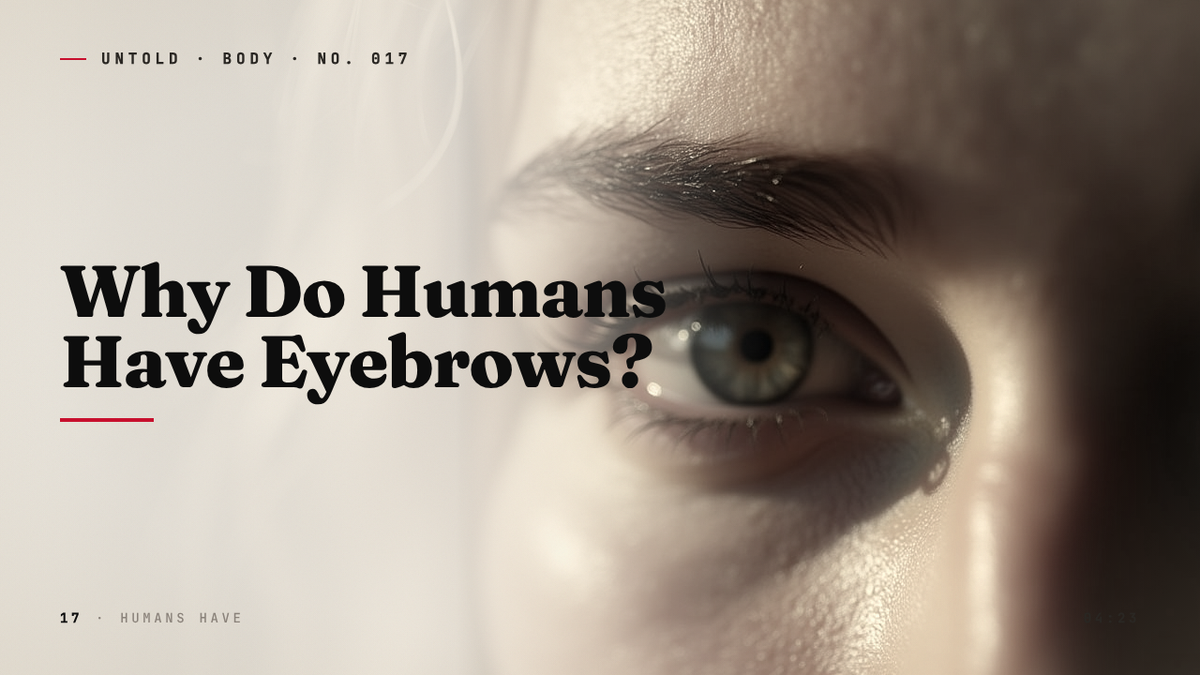
Consider what happened to human hair. Over the long arc of our evolution, the dense pelt that covered our primate ancestors thinned and retreated until what remained was almost incidental: a scalp, some patches that arrive at puberty, the fine vellus down that catches light on a forearm but does almost nothing. We became, among the great apes, conspicuously bare. And yet two features held their ground. Eyelashes, for obvious reasons of debris and dust. And above them, two thin arched strips that we rarely think about and could not easily explain if asked: the eyebrows.
They seem trivial. They are not. Remove them from a photograph of a well-known face and something strange happens. The face becomes difficult to place, sometimes impossible. In a frequently cited experiment from the early 2000s, researchers at MIT digitally erased either the eyes or the eyebrows from images of famous people and asked viewers to identify them. Faces missing their eyes were recognized about 60 percent of the time. Faces missing their eyebrows fared worse, identified correctly only around 46 percent of the time 1. The eyebrows, it turned out, carried more recognition weight than the eyes themselves.
That finding is the kind of thing that makes a biologist suspicious. A feature this small should not matter this much. Which raises the question that has occupied a small but stubborn group of anthropologists and psychologists: what are eyebrows actually for, and why did natural selection bother to keep them when it was discarding nearly everything else?
The tidy theory and its quiet failure
The textbook answer is plumbing. Eyebrows, the standard account goes, are tiny diversion channels. Sweat beads on the forehead, gravity pulls it down, and without some obstacle it would slide straight into the eyes, blurring vision and stinging with salt. The arch of the brow, this theory holds, catches the moisture and shunts it sideways, around the orbit, down the temples, away from the eye itself. The same mechanism would handle rain. For an animal running down prey across the savanna under a hard sun, clear vision is not a luxury. Salt in the eyes at the wrong moment could mean a lost meal, or in a more dangerous encounter, a lost life.
It is a clean story. It has the shape of good evolutionary reasoning: a structure, a function, a survival payoff. For a long time it was simply the explanation, repeated in physiology textbooks and casual conversation alike. The eyebrow as gutter.
The trouble is that the gutter theory has never quite earned its confidence. The protective benefit is real enough as far as it goes, but it is curiously thin when examined closely. Plenty of mammals sweat very little and still grow brows of one kind or another. Humans who shave their eyebrows entirely do not report a meaningful flood of sweat into their eyes, nor any catastrophe of vision in the rain. The feature is too prominent, too universal, and too socially loaded to be explained by a function that an umbrella or a wiped forearm handles just as well. When a trait survives the brutal accounting of evolution while almost all surrounding hair disappears, sweat management feels like an incomplete reason. It explains why eyebrows might be tolerated. It does not explain why they were kept.
To find a better answer, the question had to be turned around. Instead of asking what the soft hair does today, a team of researchers in England began asking about the bone underneath, and about what our ancestors carried there long before the hair we now recognize.
The puzzle of the heavy brow
Look at the skull of an archaic human and the first thing you notice is the shelf. Our extinct relatives, the species that branched off the human line before us, wore a heavy bony ridge across the brow, a thick protrusion of bone jutting over the eye sockets. Homo heidelbergensis, a species that lived across Africa and Europe several hundred thousand years ago, had an especially pronounced version: a continuous bar of bone crowning the eyes like a permanent visor 2. Neanderthals had it too. So did earlier hominins stretching back deep into our genus. The browridge was, for an enormous span of human prehistory, simply part of what a face was.
For most of the twentieth century, anthropologists assumed the ridge was a piece of structural engineering. The reasoning was mechanical. One long-standing idea proposed that the bony shelf braced the skull against the powerful forces of chewing. Archaic humans ate tough, fibrous, unprocessed food, and their jaws generated considerable strain. Perhaps the browridge was a buttress, reinforcing the upper face against the repeated stress of biting and grinding. A second idea was geometric. Early human skulls combined large eye sockets with relatively flat, low foreheads, and the browridge may simply have been the bone that filled the awkward gap between the orbits and the braincase, a structural consequence of the way the skull was shaped rather than a feature selected for any purpose of its own.
Both ideas had been around long enough to feel settled. Then, in 2018, a group of researchers decided to actually test them, and the explanations began to come apart.
When the models broke
The work came out of the University of York, led by the biological anthropologist Ricardo Miguel Godinho and his colleagues, including the archaeologist Penny Spikins. Their approach was computational. They took a digital reconstruction of a Homo heidelbergensis skull, a fossil known as Kabwe 1, and subjected it to a technique borrowed from engineering called finite element analysis. The method breaks a structure into thousands of tiny elements and simulates how forces travel through it. Engineers use it to test bridges and aircraft parts before building them. Godinho’s team used it to bite, virtually, with an ancient face 3.
They ran the simulation again and again, watching where the strain of chewing actually traveled through the skull. Then they did something the buttressing hypothesis demanded a test of: they digitally shrank the browridge and ran the bite again. If the ridge existed to absorb chewing stress, reducing it should have caused strain to spike, to concentrate dangerously in the now-unsupported upper face.
It did almost nothing. The smaller browridge changed the distribution of stress only marginally. The big bony shelf, it turned out, was sitting in a part of the skull that the forces of biting barely reached. It was structurally close to idle. As the team put it, the ridge was doing far less mechanical work than anyone had assumed. The geometric explanation fared no better, because the analysis showed the ridge projecting well beyond what the spacing of the eye sockets and forehead required. The bone was bigger than any structural job called for.
So the team was left with a heavy, metabolically expensive, conspicuous feature that served no clear mechanical purpose. In evolutionary terms, that is a flashing signal. When a structure is too large to be explained by function, the usual suspect is communication. The peacock’s tail is not for flight. It is for being seen.
A billboard made of bone
Spikins and her colleagues proposed that the browridge was social. A permanent, fixed shelf of bone over the eyes does something specific to a face: it shadows the eyes, lowers the visual line, and reads, across the entire animal kingdom and to us instinctively, as dominance and aggression. Think of the way a heavy brow lends a glowering, intimidating cast to a face. Now imagine that expression frozen into the skeleton, unchangeable, worn at all times. The archaic browridge, in this reading, was a constant broadcast of status and threat, a piece of social signaling built into the bone itself, much as large canine teeth or exaggerated body size signal dominance in other primates 4.
The problem with a billboard is that it never turns off. A face permanently fixed in something like a scowl is excellent at intimidation and useless at everything else. It cannot soften. It cannot signal openness, reassurance, the willingness to cooperate. And as human social life grew more complex, as survival came to depend less on individual dominance and more on the ability to form alliances, share information, and coordinate in groups, the value of a fixed threat display began to fall. What our ancestors increasingly needed was not a way to look perpetually fearsome but a way to manage subtle, shifting, cooperative relationships. They needed a face that could change its mind.
What happened next is one of the more remarkable transformations in the anatomy of the modern human, and it happened relatively recently. The browridge melted away. As Homo sapiens emerged, the forehead grew tall and rounded and vertical, the bony shelf receded, and the heavy visor of bone was replaced by something altogether different: a smooth surface across which thin, mobile strips of hair could be raised and lowered at will. The fixed bone became a flexible flag.
From bone to language
This is the heart of the argument, and it reframes the whole question. The smoothing of the human forehead was not merely the loss of an old feature. It was the enabling of a new one. A vertical forehead and a recessed brow gave the muscles of the upper face room to move. The frontalis muscle could lift the brows; the corrugator could draw them together; a small constellation of muscles around the eyes could produce, in combination, an astonishing range of fine, fast, readable changes. We had traded a permanent statement for a vocabulary 4.
And a vocabulary is exactly what eyebrows became. Raise both, quickly, and you signal surprise, recognition, greeting. Raise one and you express doubt, skepticism, a wry challenge. Draw them together and down and you convey concentration, concern, displeasure. Lift the inner corners while the outer corners stay down and you produce one of the most universally recognized expressions of human distress, the look of grief or sympathy that appears on faces across every culture. None of this requires a word. All of it is legible in a fraction of a second.
The universality matters. The Austrian ethologist Irenäus Eibl-Eibesfeldt, who spent decades filming human social behavior in cultures that had little or no contact with the industrialized world, documented a particular gesture that appeared everywhere he looked: a rapid up-and-down flick of both eyebrows, lasting about a sixth of a second, exchanged between people at the moment of greeting or to signal a desire to engage. He called it the Augengruss, the eyebrow flash. He found it among Europeans, among the Indigenous peoples of New Guinea and the Amazon, among groups separated by oceans and thousands of years of cultural divergence 5. It looked like something built into the species rather than learned, a piece of social hardware as deep as the smile.
A fossil of friendliness
So the eyebrow turns out to have a buried history, and it is not the one we tell ourselves. It was never really about sweat. The protective function is real but minor, a side benefit rather than a reason. The deeper story runs from bone to behavior. For hundreds of thousands of years, our ancestors wore a fixed signal of dominance carved into their skulls. Then, as cooperation became the engine of human success, that rigid broadcast gave way to something subtler and far more powerful: a mobile surface that could negotiate, reassure, question, and invite. We replaced a billboard with a language.
The evidence that this is what eyebrows are for is hiding in plain sight, in the way we use them now. Watch any conversation closely and you will see the brows working constantly, punctuating speech, granting permission to continue, registering surprise a beat before the mouth catches up. They lift in greeting before a single word is spoken. And they keep doing it in situations where the old protective function is entirely irrelevant. On a video call, with no sweat to channel and no rain to divert, people raise their eyebrows at one another with exactly the same reflexive frequency. The gesture has outlived its alibi. It persists because its real job was never the one written in the textbooks.
There is something quietly moving in this. The next time you greet a friend and feel your brows lift, very slightly, an instant before you say hello, you are performing a gesture older than any language you speak, a flicker of friendliness inherited from ancestors who learned that the face could do more than threaten. Two thin arches of hair, the last holdouts of a vanished pelt, carry a story about the moment our species decided that getting along mattered more than looking fierce. They are the moving borders of the human face, and they have been signaling trust since long before we had a word for it.

Sources
- Sadr, J., Jarudi, I., Sinha, P., ‘The role of eyebrows in face recognition,’ Perception, 2003. — https://journals.sagepub.com/doi/10.1068/p5027
- Stringer, C., ‘The origin and evolution of Homo sapiens,’ Philosophical Transactions of the Royal Society B, 2016. — https://royalsocietypublishing.org/doi/10.1098/rstb.2015.0237
- Godinho, R. M., Spikins, P., O’Higgins, P., ‘Supraorbital morphology and social dynamics in human evolution,’ Nature Ecology & Evolution, 2018. — https://www.nature.com/articles/s41559-018-0528-0
- Spikins, P., ‘The evolution of human eyebrows: why we lost the brow ridge,’ University of York Research, 2018. — https://www.york.ac.uk/news-and-events/news/2018/research/mobile-eyebrows/
- Eibl-Eibesfeldt, I., Human Ethology, Aldine de Gruyter, 1989. — https://www.routledge.com/Human-Ethology/Eibl-Eibesfeldt/p/book/9780202020372
- Ekman, P., Emotions Revealed, Times Books, 2003. — https://www.paulekman.com/books/emotions-revealed/
Related reading