The Upright Gamble
The ache in your lower back is a six-million-year-old compromise finally coming due.
Somewhere in the world, in the time it takes to read this sentence, a person will bend to pick something off the floor and feel it: that bright, unwelcome flash across the lower back. A pulled drawstring of pain. It arrives without warning and leaves a person moving like someone forty years older, one hand pressed to the small of the back as if holding the body together.
The scale of this small private misery is enormous. At any given moment, roughly 619 million people worldwide are living with lower back pain, which makes it the single leading cause of disability on Earth.1 Four out of five adults will feel it at some point in their lives. It is one of the most common reasons people miss work, visit a doctor, or reach quietly for a bottle of ibuprofen at the end of a long day.
We tend to treat back pain as a personal failing: bad posture, a weak core, an unlucky lift. But the deeper story is written into the bones themselves, stacked one on top of another from the base of the skull to the pelvis. To understand the modern epidemic of aching backs, it helps to look past the individual and toward something far older. The human spine is not a finished piece of engineering. It is a hand-me-down, retrofitted over millions of years for a job it was never originally built to do.
The Upright Gamble
Roughly six million years ago, somewhere in the woodlands of Africa, our ancestors did something radical. They stood up.
Bipedalism, walking habitually on two legs, is one of the defining features of the human lineage, and it came long before big brains or stone tools. Standing upright freed the hands. It allowed our ancestors to carry food, wield objects, and see over tall grass across an open savanna. It made walking astonishingly efficient over long distances. By almost any measure, it was a spectacular evolutionary success.
But success carried a hidden invoice. To rise onto two legs, the entire skeleton had to be rewired, and the spine bore the brunt of the redesign. In four-legged animals, the spine works like a suspension bridge. It hangs horizontally between the front and back limbs, and the weight of the internal organs is distributed evenly along its length, supported at both ends by sturdy pillars of leg. It is an elegant arrangement. The load spreads out; no single point takes the strain.
When our ancestors stood, that horizontal bridge was tipped roughly ninety degrees skyward. Suddenly the spine was not a beam slung between supports but a tower, balancing the entire weight of the head, arms, and torso on a narrow stack of bones and, ultimately, on the small platform of the pelvis. Gravity, which had once pressed the four-legged spine gently downward across its whole span, now bore straight down through the column, concentrating its force on the lowest vertebrae.
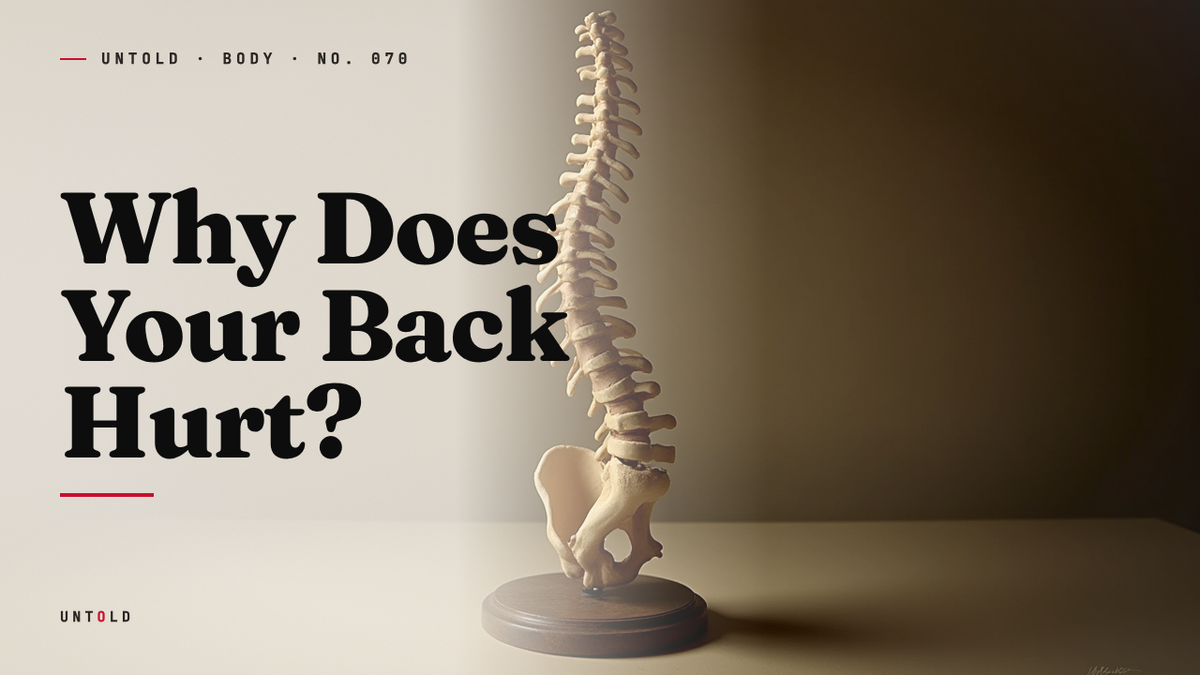
To cope with this new vertical arrangement, the lower spine developed a forward curve, a shape anatomists call lordosis. This inward sweep of the lumbar region pulls the body’s center of mass back over the hips, so that a standing human does not topple forward. It is a clever fix. Without it, walking upright would be nearly impossible. But the same curve that makes bipedalism work also concentrates stress precisely where the pain tends to strike.
Bruce Latimer, an anatomist at Case Western Reserve University who has spent much of his career studying the evolution of the human skeleton, has described the spine as a structure straining under demands it was never optimized for. Evolution, he and others have argued, does not sit down at a drafting table and design from first principles. It tinkers. It takes whatever already exists and modifies it, one small adjustment at a time, keeping whatever works well enough to survive and reproduce. The lumbar curve is exactly that kind of improvisation: a workable patch on an inherited design, and a weak point in the same breath.
The Borrowed Blueprint
The crucial point is that the human spine was never redesigned from scratch. It was inherited, more or less intact, from four-legged ancestors and then jury-rigged to stand tall. Every vertebra, every disc, every ligament carries the ghost of an earlier animal that walked on all fours.
Between each of the bony vertebrae sits an intervertebral disc, a small cushion with a tough fibrous ring on the outside and a soft, jelly-like core within. These discs act as shock absorbers and spacers, allowing the spine to bend and twist while keeping the bones from grinding against one another. In a horizontal spine, the load on any single disc is modest. In a vertical one, especially at the base of the lumbar region, the discs spend the entire day pressed down by the weight of everything above them. Hour after hour, year after year, gravity works on them like a slow vise.
Over time, this constant loading takes a toll. The discs lose water, flatten, and become less resilient. By around age fifty, the majority of people show signs of disc degeneration on medical scans, whether or not they feel any pain.2 Sometimes the outer ring of a disc weakens and the soft interior bulges outward, a condition known as a herniated or slipped disc. If that bulge presses against a nearby nerve root, it can send sharp, radiating pain down through the buttock and leg. This is sciatica, and it is one of the most vivid ways the body announces that its inherited plumbing has sprung a leak.
Jeremy DeSilva, a paleoanthropologist at Dartmouth College and the author of a book on the evolution of upright walking, has made the case that human locomotion is a compromise riddled with the leftover flaws of our ancestry. Our gait is efficient, but it is also, in a sense, a workaround. The pelvis, too, was reshaped by the shift to two legs. It narrowed and shortened, tilting to support the organs from below and to anchor the powerful muscles that swing the legs forward. That narrower pelvis is part of what makes upright walking possible, but it also provides a tighter, less forgiving foundation for the spine to balance upon. We are, in DeSilva’s memorable framing, apes wearing the posture of a completely different kind of animal.
What the Chimpanzee Reveals
If standing upright is the root of the problem, we would expect our closest living relatives, who do not habitually walk on two legs, to be spared the worst of it. Broadly speaking, that is what we find. Chimpanzees and other great apes rarely suffer the disc herniations and chronic lower back trouble that plague human beings. Their spines remain much closer to the ancient, more horizontal blueprint, and they simply do not load the lumbar region in the relentless vertical way that we do.
But the most intriguing evidence comes from a study that looked not at whole animals but at the subtle shape of individual bones. In 2015, a research team led by biological anthropologist Kimberly Plomp, then at Simon Fraser University, published a comparison of the vertebrae of humans, chimpanzees, and extinct human ancestors.3 Plomp and her colleagues examined the fine geometry of the lower vertebrae in modern people, some with healthy spines and some with a history of herniated discs.
What they found was striking. People who had suffered disc herniations tended to have vertebrae shaped subtly more like those of a chimpanzee. Certain features of the bone, the size and orientation of parts of the vertebra, fell closer to the ancestral, ape-like end of the spectrum. In other words, some human backs appear to be, quite literally, more ancestral than others. Their spines never fully caught up with the demands of upright life. The researchers proposed that these individuals may be less well adapted to bipedal loading, and the data linked these chimp-like vertebral shapes to higher rates of disc herniation.
The implication is almost poetic. It is as if evolution left some backs in an earlier draft, a version of the manuscript that was never fully revised for standing. This does not mean that everyone with a bad back is carrying a more primitive spine, and the picture is more complicated than any single feature can capture. But the finding underscores the central theme: the human back is not a clean, purpose-built machine. It is a lineage of compromises, and how much a given person suffers may depend in part on which compromises they happened to inherit.
The Cost of Living Long
Upright posture gave our ancestors a great deal. It gave them endurance, the ability to walk and jog for hours across open country, chasing game or covering vast distances between water sources. It freed the hands for carrying and making. It lifted the eyes above the grass. These were not trivial gifts; they helped shape the entire trajectory of the human story.
But the bill came due in the lowest vertebrae of the back. And here is a crucial wrinkle. For the overwhelming majority of human history, that bill was rarely paid in full. Disc degeneration and the aches of an aging spine tend to accumulate over decades. They are, in large part, problems of the second half of life. For most of the human past, average life expectancy was low, dragged down by high infant mortality and the constant threats of infection, injury, and famine. Many people simply did not live long enough to reach the years in which discs reliably begin to fail.
Natural selection works on traits that affect survival and reproduction, and it is far less concerned with what happens to a body long after its reproductive years are over. A design flaw that only bites at age sixty exerts almost no pressure on the genes passed to the next generation. So the vulnerabilities of the aging spine were never really weeded out. They were allowed to persist, invisible, because so few of our ancestors survived to feel them.
We, by contrast, live long enough to experience every one of those deferred compromises in full. Modern medicine, sanitation, and nutrition have stretched the human lifespan far beyond anything our evolutionary history prepared us for. In a sense, chronic lower back pain is a disease of success. It is the ache of a body that has outlived the timetable its own biology assumed.
The Chair Is New
And yet, to lay the entire blame at evolution’s feet would be to miss the most important modern culprit. Because if standing upright were simply and inevitably a recipe for a ruined back, we would expect people who live the most physically demanding, traditional lives to suffer the worst. The opposite appears to be true.
Studies of contemporary hunter-gatherer and subsistence-farming societies have repeatedly found remarkably low rates of chronic lower back pain, even among older adults who spend their days walking, digging, squatting, and carrying heavy loads. These are people whose spines are worked hard, and yet the debilitating, persistent back pain so familiar in wealthy nations seems far rarer among them. That contrast points to an uncomfortable conclusion. The problem may not be that we stand and move too much. It may be that we barely move at all.
The human spine did not evolve to be still. It evolved to walk long distances, to squat down and rise again, to climb, to bend, to carry. Movement is not incidental to its health; it is essential to it. The intervertebral discs have almost no direct blood supply of their own. Instead, they are nourished largely through a process of diffusion that depends on motion. When we move, the alternating pressure and release act like a pump, drawing nutrients into the disc and flushing waste out. Motion, in a very literal sense, feeds the spine.
The chair, on this timescale, is a brand-new invention. For millions of years, our ancestors had no reason to fold themselves into a seated position for eight or ten hours a day. Now vast numbers of people do exactly that, hunched over desks, slumped on sofas, curled around glowing screens. Prolonged sitting places sustained pressure on the lumbar discs while denying them the very movement they depend on for nourishment. Stillness, in effect, slowly starves them. A growing body of research links long hours of sitting and sedentary behavior with higher reported rates of lower back pain, though the relationship is complex and posture alone is rarely the whole story.
This reframing changes the diagnosis in a hopeful way. Your ancient spine is not fundamentally broken. For the most part, it is simply under-used. The same structure that aches after a day in an office chair is capable, when kept moving and well supported by strong surrounding muscles, of carrying you comfortably for decades. Regular movement, physical strength, and attention to how the body is loaded through the day can ease a great deal of what evolution left unfinished. None of this is a substitute for medical care; persistent or severe back pain, especially pain that radiates down the leg or comes with other worrying symptoms, always warrants a professional’s attention. But it does mean that the story is not one of helpless inheritance.
The pain in your lower back, then, is a message from deep time. It is the echo of a six-million-year-old gamble, the moment a walking ape rose onto two legs and traded the stability of four supports for the freedom of empty hands. That trade built the human world. It also left us balancing our entire upper bodies on a stack of borrowed bones, and living long enough, and sitting still enough, to feel the consequences our ancestors never did. The next time your back reminds you it is there, it is worth remembering what that ache is really made of: not simply a bad day or a careless lift, but the long, unfinished story of how we learned to stand.

Sources
- GBD 2021 Low Back Pain Collaborators, Global, regional, and national burden of low back pain, The Lancet Rheumatology, 2023 — https://www.thelancet.com/journals/lanrhe/article/PIIS2665-9913(23)00098-X/fulltext
- Brinjikji, W. et al., Systematic Literature Review of Imaging Features of Spinal Degeneration in Asymptomatic Populations, American Journal of Neuroradiology, 2015 — https://www.ajnr.org/content/36/4/811
- Plomp, K. A. et al., The ancestral shape hypothesis: an evolutionary explanation for the occurrence of intervertebral disc herniation in humans, BMC Evolutionary Biology, 2015 — https://bmcecolevol.biomedcentral.com/articles/10.1186/s12862-015-0322-4
- DeSilva, J., First Steps: How Upright Walking Made Us Human, Harper, 2021 — https://www.harpercollins.com/products/first-steps-jeremy-desilva
- Latimer, B., The Perils of Being Bipedal, Annals of Biomedical Engineering, 2005 — https://link.springer.com/article/10.1007/s10439-005-3688-4
- Fahad S. Algarni et al. / reviews on sedentary behaviour and low back pain, various, summarized in Journal of Physical Activity and Health, 2016-2020 — https://pubmed.ncbi.nlm.nih.gov/27019102/
- Bramble, D. M. & Lieberman, D. E., Endurance running and the evolution of Homo, Nature, 2004 — https://www.nature.com/articles/nature03052
Related reading