The Green Shoulder We Bred Away
A single switched-off gene explains why the winter tomato tastes of wet paper.
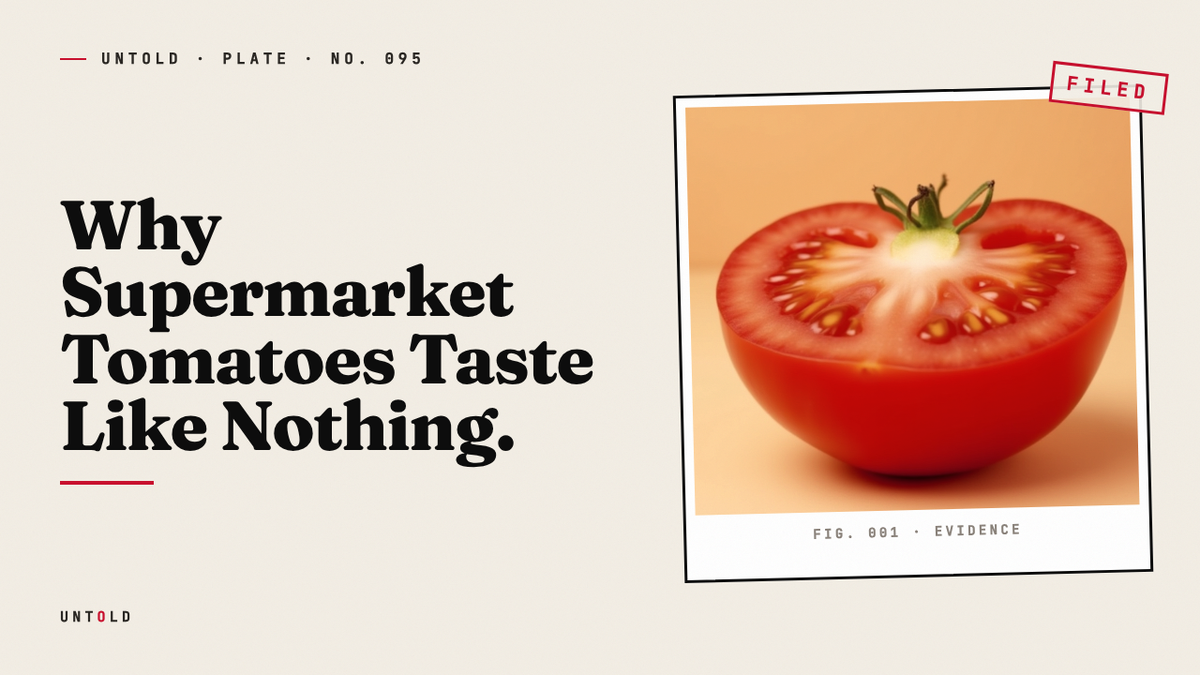
It is January, and the tomato in your hand looks like an advertisement for itself. Round, unblemished, evenly red from stem to base, it has the confident gloss of something engineered rather than grown. You bring it home, set it on the board, and draw the knife across it. There is almost no resistance. Inside, the flesh is pale toward the center, faintly mealy, weeping a thin watery juice onto the wood. You take a bite anyway, out of stubborn optimism. It tastes of nothing much. Cold water, a whisper of acid, the ghost of a flavor that used to be there.
This is such a common disappointment that it has become a kind of folk wisdom, and the folk wisdom comes with a ready explanation. The tomato was picked green and gassed to redness. It was refrigerated, and everyone knows the cold ruins tomatoes. It was trucked two thousand miles in a climate-controlled trailer, jostled and chilled and warmed and chilled again until whatever life it had was shaken out of it. All of this is repeated in cooking columns and farmers-market conversations with the certainty of settled fact.
And it is not wrong, exactly. It is only half true. Refrigeration does dull a tomato. Long-distance shipping does it no favors. But these are insults added to an injury that was inflicted decades earlier, long before any particular fruit was picked, before it was even a seed. The deeper reason the January tomato tastes of nothing is not sitting in the cold chain. It is written into the plant’s DNA, and it was put there on purpose. Somewhere in the middle of the twentieth century, working with the best intentions and no idea what they were doing, tomato breeders switched off a single gene. They were breeding for beauty. They got tastelessness for free.
A Problem of Shoulders
To understand what was lost, you have to go back to the era before the perfect red tomato existed, when tomatoes were, from a grower’s point of view, a nuisance. In the 1930s and 1940s, the ordinary commercial tomato ripened unevenly. The bottom and sides would flush to a ripe red while the top of the fruit, the region around the stem that breeders call the shoulder, stayed stubbornly green. A fully ripe tomato could still wear a hard green collar near its crown.
To a farmer this was a headache, and to a shopper it looked like a defect. A tomato with green shoulders read as unripe or spoiled, something you would pass over in the pile. Worse, the mechanization of agriculture was accelerating. Machines were beginning to harvest entire fields in a single pass, and a machine cannot judge ripeness fruit by fruit the way a human picker can. What growers needed was a tomato that ripened all at once, uniformly, every fruit the same marketable shade of red at the same moment, ready to be stripped from the vine in bulk.
Nature, as it happened, offered a solution. Among the natural variation in tomato populations, breeders found a mutation that erased the problem entirely. Cross it into a variety and the green shoulders simply vanished. Every fruit turned an even, identical red, from crown to base, with no unsightly collar. They gave the trait a plain and honest name: uniform ripening. It was a single recessive gene, easy to breed for, and it did exactly what it promised.
Growers were delighted, and the trait spread. Over the following decades it was crossed into variety after variety until it became nearly universal in the commercial tomato. If you buy a tomato from a supermarket today, it almost certainly carries this mutation. It is one of the quiet foundations of the modern produce aisle. And for all that time, through generation after generation of breeding, nobody understood what the mutation was actually doing inside the fruit. They could see what it removed. They could not see what it removed along with it. A trait that looked like a pure gift was hiding a cost, and the cost would not be measured for seventy years.
The Factories in the Green
The accounting finally came at the University of California, Davis, where a team of plant scientists including Ann Powell and Alan Bennett decided to find out what the uniform-ripening gene was really doing. Their curiosity began with the very thing the mutation had eliminated: those dark green shoulders that growers had spent decades trying to breed out.
When they looked closely at the unripe green patches on wild and heirloom tomatoes, they found the tissue was densely packed with chloroplasts. Chloroplasts are the small green organelles inside plant cells that carry out photosynthesis. They are, in effect, tiny factories. They capture sunlight and use it to build sugar. The green color itself is a byproduct of the chlorophyll they contain. A darker green shoulder meant a higher concentration of these factories, and a higher concentration of factories meant more photosynthesis happening in that part of the young fruit.
This is the crucial point, and it inverts the intuition entirely. A tomato is not merely a passive vessel that receives sugar shipped in from the leaves. While it is still green and growing, the fruit itself photosynthesizes. It makes a meaningful share of its own sugar in place, using the chloroplasts in its skin and outer flesh. The dark green shoulders, the very feature that looked like a flaw, were among the most productive photosynthetic regions of the whole fruit. They were where a good deal of the sweetness was being manufactured. 1
The uniform-ripening mutation erased the green. In doing so, it also erased the factories. A tomato bred to be evenly pale-green before ripening, with no dark shoulders, was a tomato with fewer chloroplasts distributed across its surface. Fewer chloroplasts meant less photosynthesis during the fruit’s development. Less photosynthesis meant less sugar produced and stored in the growing fruit, which in turn meant less sugar available to carry through into the ripe, red tomato you eventually eat. The green that breeders and shoppers hated was the green where the sweetness was made.
One Gene, Named Golden
Having traced the trail from color to chloroplasts to sugar, the Davis team went hunting for the specific gene the uniform mutation had broken. In 2012 they published their answer in the journal Science, and the whole seventy-year story came down to a single gene coding for a single regulatory protein, a transcription factor. 1
The gene is called GLK2, short for Golden 2-like. Transcription factors are master switches; rather than doing a job themselves, they turn other genes on and off. GLK2’s job is to tell developing cells to build chloroplasts. In a normal tomato with a functioning copy, GLK2 is especially active in the shoulder region, which is why the shoulders develop that dark green, chloroplast-rich tissue. It is, quite literally, the switch that installs the sugar factories where the fruit needs them.
The uniform-ripening mutation, the team found, is a mutation that disables GLK2. With the switch broken, the signal to build chloroplasts never arrives in force. No working GLK2 means no dark shoulders. No dark shoulders means fewer chloroplasts across the young fruit. Fewer chloroplasts means less photosynthesis, and less photosynthesis means less sugar. The pretty even color and the missing flavor were never two separate problems. They were the same gene, seen from two sides.
The magnitude was not trivial. Fruit carrying the uniform mutation showed sugar levels roughly ten to fifteen percent lower than fruit with a working gene. 1 In a food where the pleasure lies almost entirely in a delicate balance of sugar, acid, and aroma, a loss of that scale is the difference between a tomato that sings and one that mumbles.
To make certain the gene was truly the cause and not merely a companion of it, the researchers ran the experiment in reverse. They engineered tomatoes to switch GLK2 back on, restoring its activity in the fruit. The rescued tomatoes did exactly what the theory predicted. They developed darker green tissue while unripe, and when they ripened they carried measurably more sugar inside. 1 The proof ran both directions: break the gene and the sweetness falls, restore the gene and the sweetness returns.
More Than Sugar
Sugar, though, was only the most obvious casualty. Flavor in a tomato is not sweetness alone. It is a chord, and the other notes come from aroma, the volatile compounds that reach your nose as you chew and do most of the work your tongue gets credit for. Here too the chloroplasts mattered.
Chloroplasts are not only sugar factories. They are also the site where the plant builds carotenoids, the pigment compounds that give a ripe tomato and many other fruits their warm color. Carotenoids are more than decoration. Some of them are the raw material from which the fruit later constructs a suite of aroma volatiles, the very molecules that make a good tomato smell like a tomato. Fewer chloroplasts during development therefore meant a diminished carotenoid supply, which meant a thinner supply of the precursors to aroma. 2
So the single broken gene dimmed the fruit on two fronts at once. It lowered the sugar, taking away sweetness, and it lowered the carotenoid stock, taking away a share of the smell. The uniform mutation did not simply make tomatoes less sweet. It made them less like tomatoes, flattening both halves of the flavor chord in one stroke. What had looked to breeders like a cosmetic improvement was, in flavor terms, a double subtraction, and it went on being repeated across variety after variety for the better part of a century because no one could see the wiring underneath.
What the Cold Cannot Explain
None of this means the familiar villains are innocent. Refrigeration genuinely does harm a tomato. Below about fifty-five degrees Fahrenheit, chilling damages the membranes of the fruit’s cells and interferes with the enzymes that generate aroma compounds, which is why a tomato that has spent days in a cold trailer or a home refrigerator smells and tastes duller than one kept on the counter. 3 Long-distance shipping, with its bruising and its picking-while-green, adds its own toll. That part of the folk wisdom is real.
But chronology settles the argument. Cold dulls the aroma of a tomato after it has been picked. The sugar deficit was decided long before, in the seed itself, decades before any particular fruit reached the cold chain. You can keep a uniform-ripening tomato on a sunny windowsill from flower to full red, never let it near a refrigerator, treat it with perfect care, and it will still be short on sugar, because the factories that would have made that sugar were never built. The damage was upstream of everything the cold could do. Refrigeration finished a job the breeding had already started.
This is also why heirloom tomatoes taste the way they do. The lumpy, irregular, sometimes homely heirlooms sold at farm stands, the ones with green or dark collars around the stem, still carry a working copy of GLK2. They kept the green shoulders, and with the shoulders they kept the chloroplasts, the photosynthesis, the sugar, and the aroma. Their imperfect appearance and their vivid flavor are two expressions of the same intact gene. The green ring you might once have taken for a flaw is a sign that the fruit’s sugar factories were left switched on.
The encouraging part is that the trade need not be permanent. Now that the mechanism is understood down to the single gene, breeders and researchers can pursue what once seemed impossible: a tomato that ripens to an even, marketable red while retaining GLK2’s activity, so that the fruit keeps its sugar and aroma without the shoulders that shoppers were taught to reject. The goal is a tomato that is both beautiful and sweet, no longer forced to choose. 4
The Fingerprint of a Choice
The lesson of the tasteless tomato is not that technology ruined our food, or that nature always knows best. It is subtler and more humbling than that. For seventy years, thousands of skilled people made a rational decision over and over again. They chose the fruit that looked better, sold better, and harvested more cleanly. Each choice was sensible on its own terms. None of them could see that the color they were selecting for and the flavor they were selecting against were controlled by the same switch.
So the next time a January tomato tastes of wet paper, look at it a little differently. Its flawless, even red is not a sign of freshness or care. It is a fingerprint, the visible mark of exactly what was taken away. We did not lose the flavor of the tomato by accident, or to the refrigerator, or to the long roads it traveled. We selected it out, deliberately and unknowingly, one beautiful red fruit at a time.

Sources
- Powell, A. L. T. et al., “Uniform ripening Encodes a Golden 2-like Transcription Factor Regulating Tomato Fruit Chloroplast Development,” Science, 2012. — https://www.science.org/doi/10.1126/science.1222218
- Klee, H. J. and Tieman, D. M., “The genetics of fruit flavour preferences,” Nature Reviews Genetics, 2018. — https://www.nature.com/articles/s41576-018-0002-5
- Zhang, B. et al., “Chilling-induced tomato flavor loss is associated with altered volatile synthesis and transient changes in DNA methylation,” PNAS, 2016. — https://www.pnas.org/doi/10.1073/pnas.1613910113
- UC Davis News, “Tomato study finds gene that dictates fruit sweetness and color,” 2012. — https://www.ucdavis.edu/news/uniform-ripening-tomato-gene
- Tieman, D. et al., “A chemical genetic roadmap to improved tomato flavor,” Science, 2017. — https://www.science.org/doi/10.1126/science.aal1556
- Estabrook, Barry, “Tomatoland: How Modern Industrial Agriculture Destroyed Our Most Alluring Fruit,” Andrews McMeel Publishing, 2011. — https://www.barryestabrook.com/tomatoland
Related reading