The Carrot That Was Too Ugly to Sell
How a bean cutter, a stubborn packer, and a mountain of waste invented the snack in your fridge.
Somewhere in California’s Central Valley, a carrot rolls off a sorting belt and into a bin bound for cattle. It is not rotten. It is not diseased. It is perfectly sweet, perfectly edible, and utterly unsellable, because it is bent. Its shoulder is faintly green from a day too long in the sun. It forked around a stone as it grew, splitting into two blunt legs. To the grocery buyer who will never see it, this carrot has already failed. Nature made it wrong.
For most of the twentieth century, this was the ordinary fate of the majority of a carrot harvest. Not a minority. The majority. And the story of how one man looked at that bin of rejects and refused to accept the waste is, improbably, the origin of one of the best-selling produce items in the modern supermarket. The baby carrot is not a baby. It is not a variety. It is a redemption story told through a green bean cutter.
The tyranny of the cylinder
Carrots are a root vegetable, which means they grow blind, pushing down into soil that offers no guarantees. A pebble, a clod, a pocket of dense clay: any obstruction can force the root to bend, fork, or knob its way around it. Uneven moisture makes them split. Exposure at the crown, where the shoulder pokes above the surface, turns the top green and slightly bitter as chlorophyll develops. Left to its own devices, the carrot is a wildly variable object. Some emerge as textbook orange cylinders. Many do not.
This would matter very little if shoppers judged carrots by taste. They do not. For decades, the American produce shopper wanted a specific thing: a long, straight, smooth, uniformly orange carrot, unblemished and photogenic, the kind that stacks neatly in a crate and photographs well under fluorescent light. Anything that deviated was demoted. A carrot with a fork, a bend, a green top, or a healed-over crack was a cull, no matter how good it tasted.
The scale of the loss was staggering. In a typical operation, a very large share of the harvest could be rejected on appearance alone, with industry accounts of the era describing losses that ran well past half of what came out of the ground.1 These were not spoiled vegetables. They were cosmetic failures. And they went where cosmetic failures go: to livestock feed, to juice processors paying pennies, or simply to the dump. A farmer could spend a full season nurturing a crop and then watch most of it leave for a fraction of its potential value, all because it did not look the part.
This is the quiet inefficiency that sat underneath the produce aisle for generations. The abundance on display was purchased with an unseen mountain of edible waste. And it persisted because no one had figured out what else to do with an ugly carrot. You cannot un-bend it. You cannot un-fork it. The shape was the problem, and the shape seemed permanent.
Bakersfield, 1986
Mike Yurosek was a carrot farmer and packer in Bakersfield, California, and he had spent years watching his own crop leave on the wrong truck. By his own later account, the arithmetic offended him more than it cost him. He was throwing away roughly half of what he grew, day after day, season after season, and every truckload that hauled his rejects off for animal feed was a small daily insult to a man who did not like waste.2
“I hate to waste,” he told an interviewer years afterward, in what has become the founding quotation of an entire product category. “I was throwing away half my carrots.”2
The conventional response to this problem was resignation. The ugly carrots were ugly; that was that. But sometime in the mid-1980s, Yurosek stopped treating the shape as a fixed property of the carrot and started treating it as a problem of geometry. If the whole carrot could not be sold because of its outline, perhaps the outline could be discarded and the good flesh inside kept. The question was how to do it fast enough, and cheaply enough, to matter.
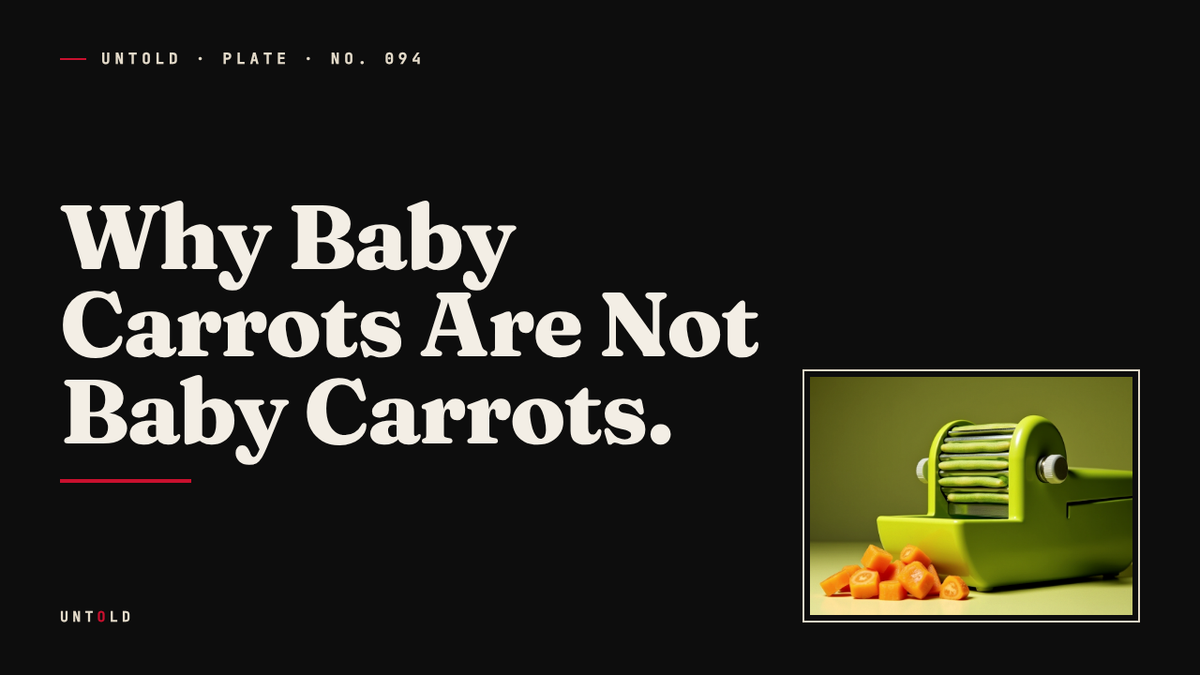
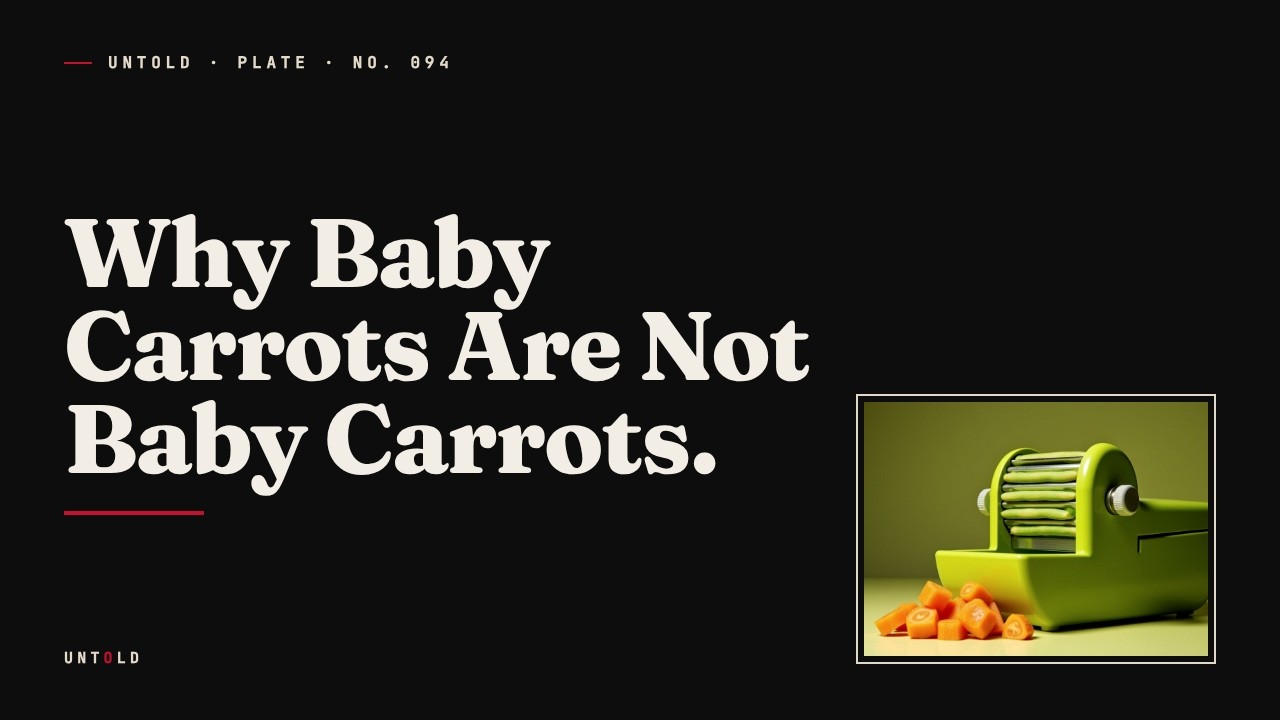
His answer came not from the produce industry but from the cannery. He had on hand an industrial green bean cutter, a machine designed to chop long green beans into short, uniform segments for canning. One night he fed his reject carrots through it instead. What tumbled out the other end were not carrots as anyone thought of them. They were short cylindrical chunks, roughly two inches long, cut clean and consistent regardless of how twisted the parent carrot had been. The bend, the fork, the knob: all of it fell away as offcuts. What remained was uniform.
The pieces were still rough, though, still skinned and unpeeled, still looking like what they were: cut sections of a field carrot. So Yurosek borrowed a second machine from a different corner of the food world. He ran the segments through an industrial potato peeler, an abrasive drum that tumbles produce against rough surfaces until the skin is worn away. The rough edges rounded off. The peel came away. The corners softened into that smooth, blunt, slightly tapered shape that would soon become instantly recognizable.1
What came out of the drum looked nothing like a reject. It looked like a product. Smooth, orange, bite-sized, clean enough to eat straight from the hand. Yurosek had taken the least valuable thing on his farm and, in two mechanical steps borrowed from two other industries, turned it into the most valuable.
“That’s all I want now”
A good idea in a packing shed is worth nothing until someone will buy it. Yurosek bagged a batch of his newly minted little carrots and sent them to a local grocer, more as a trial balloon than a business plan. The response was not measured. According to the story he told for the rest of his life, the buyer’s reaction was immediate and total: “I sent them a bag,” Yurosek recalled. “The buyer said, that’s all I want now.”2
That sentence contains the whole revolution. The grocer did not want to add the cut carrots to his existing order. He wanted to replace the full-size carrots with them. Because for the shopper, the appeal was not novelty. It was labor. A full carrot must be scrubbed, topped, peeled, and chopped before it becomes a snack or a side. The peeled two-inch carrot arrived at that finish line already crossed. It could be poured into a lunchbox, dumped onto a veggie tray, or eaten from the bag while standing at the counter. In an era when convenience was quietly becoming the most valuable attribute a food could have, Yurosek had made the carrot effortless.
He needed a name, and the name he chose was pure marketing genius and pure fiction at once. He called them baby carrots. They were not babies. They had not been harvested young or tender; they were mature field carrots, often the very ones deemed too large or misshapen to sell whole, sliced down to size. The honest industry term, the one used on invoices and in trade literature, is baby-cut carrots: full carrots, cut small.1 But baby-cut is a description. Baby carrot is a promise, and the promise sold.
The market response was extraordinary. Over the years following Yurosek’s innovation and its rapid imitation across the industry, carrot consumption in the United States climbed sharply, with sales roughly doubling within about a decade as the cut carrot moved from curiosity to staple.3 Farmers who had once paid to haul rejects away now had a premium item that commanded a higher price per pound than the whole carrots it was carved from. The waste stream had become the revenue stream.
When the shape started shaping the crop
There is a tidy irony in what happened next. The baby carrot was invented to make use of carrots that were badly shaped for the market. But once the process succeeded, growers began breeding carrots specifically to be well shaped for the process. The machine, in other words, started to redesign the plant.
The ideal carrot for baby-cutting is not the same as the ideal carrot for whole sale. For the bean cutter and the peeling drum, you want a root that is long and slender rather than fat and stubby, so that each carrot yields the maximum number of clean two-inch segments with minimal waste. You want a small, pale core, because the woody central column is less sweet and less appealing once exposed by cutting. You want even color all the way through and a sweetness that survives peeling. Above all you want length and uniformity, because a long, thin, consistent carrot cuts into more usable pieces than a short irregular one.1
Growers turned toward carrot types suited to exactly this, notably the Nantes family and purpose-bred hybrids descended from it. The Nantes-style carrot is long, slender, cylindrical, evenly colored, and comparatively sweet, with a small core, almost as if it had been designed for the assembly line it now feeds. Seed companies developed proprietary varieties optimized for baby-cut production, selecting for the traits that maximized yield through the machines rather than beauty on the shelf.4
This is a small but genuine reversal of how we usually imagine agriculture working. We tend to assume the plant comes first and the processing adapts to it. Here the processing came first, born of a bean cutter and a peeling drum, and the plant was bred to serve it. The shape of the product drove the science of the seed.
Meanwhile the process itself industrialized far beyond one man’s shed. Modern baby-carrot plants receive whole carrots by the truckload and run them through automated lines that wash, cut, peel, polish, size, and grade the pieces at enormous scale, sorting out fragments and misfits along the way. The offcuts and shavings, the parts trimmed away in creating the smooth shape, are themselves used, often going to juice or feed, so the waste of the waste is minimized too. From a single stubborn experiment grew an entire manufacturing category. Today, baby-cut carrots account for a substantial majority of fresh carrot sales in the United States, outselling the whole carrots from which they descend.3
An entire aisle, in other words, built on one farmer’s refusal to throw good food to the cows.
The white film, and other misunderstandings
If the baby carrot has a folk mythology, its darkest chapter concerns the whitish blush that sometimes appears on carrots that have sat too long in the bag. A persistent rumor holds that this pale film is chlorine, evidence that the carrots have been soaked in bleach and are somehow leaching it back out. The rumor is wrong, and understanding why reveals something about the carrot’s manufactured nature.
The white blush is not a chemical residue at all. It is dehydration. When a carrot is cut and peeled, its protective skin is removed, exposing the flesh directly to air. The outermost cells at that cut surface slowly lose moisture and roughen, scattering light in a way that reads to the eye as a pale, chalky film. It is the vegetable equivalent of dry, flaky skin. The proof is simple: drop a blushed carrot into water for a few minutes and the whiteness vanishes as the surface cells rehydrate. You cannot rinse away bleach that easily. You can rehydrate a dry surface that easily.
Where the rumor draws its half-truth is that baby carrots are, in fact, rinsed with a dilute chlorine solution during processing, the same kind of sanitizing wash used on bagged salad greens and much other ready-to-eat fresh produce.5 This is a standard food-safety step, meant to reduce bacteria on a product that will be eaten without cooking. The carrots are then rinsed again, and the residual levels are held well within the limits set by food-safety regulators. The chlorine wash is real; the notion that it seeps back out as a white powder is not. The blush is water leaving, not chemicals arriving.
A rescued harvest
Strip away the marketing and the mythology and what remains is stranger and better than the story on the bag. There is no such thing as a baby carrot. Every one of them is a fully grown carrot, carved down and smoothed over by machines borrowed from the bean cannery and the potato plant. Many began as the crooked, forked, sunburnt culls that an earlier generation of farmers would have shoveled onto a feed truck without a second thought.
That is the quiet triumph hidden in the plastic bag. A vegetable that was once discarded by the ton, judged too ugly for human eyes, now sits in millions of lunchboxes and on hospital trays and in the hands of children who would never touch a knobby field carrot. The reject became the staple. The waste became the product people actually prefer. It took one packer who could not stand the arithmetic of throwing half his crop away, one machine designed for a different vegetable entirely, and one refusal to accept that ugly meant useless. The next time a handful of them rattles out of the bag, it is worth remembering: this is not a baby. It is a harvest that was saved.
Sources
- Karp, Myrna Oliver, “Mike Yurosek, 84; Farmer Created First Baby-Cut Carrots,” Los Angeles Times, 2005. — https://www.latimes.com/archives/la-xpm-2005-nov-11-me-yurosek11-story.html
- Freeman, Andrea, “How Baby Carrots Were Invented,” NPR / The Salt, 2011. — https://www.npr.org/2016/03/28/470328891/how-a-farmer-turned-ugly-carrots-into-a-baby-carrot-empire
- United States Department of Agriculture, Vegetables and Pulses Yearbook / carrot consumption data, USDA Economic Research Service. — https://www.ers.usda.gov/data-products/vegetables-and-pulses-data/
- University of California Agriculture and Natural Resources, “Carrot Production in California,” UC ANR Publication 7226. — https://anrcatalog.ucanr.edu/Details.aspx?itemNo=7226
- U.S. Food and Drug Administration, “Guide to Minimize Microbial Food Safety Hazards of Fresh-cut Fruits and Vegetables,” FDA, 2008. — https://www.fda.gov/regulatory-information/search-fda-guidance-documents/guidance-industry-guide-minimize-microbial-food-safety-hazards-fresh-cut-fruits-and-vegetables
Related reading