The Iron Filings in Your Breakfast
The metallic dust a magnet pulls from your cereal is a wartime decision you eat every morning.
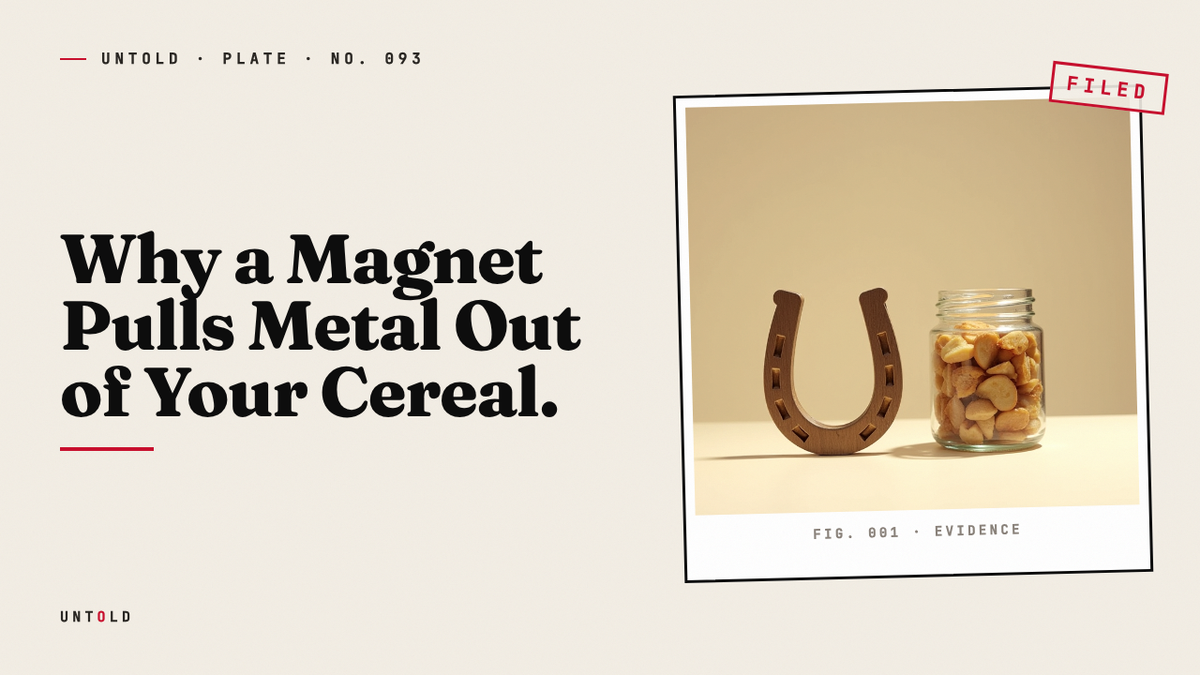
Crush a handful of cornflakes into a glass of water and stir until the flakes disintegrate into a grey, gritty slurry. Let it settle for a minute. Then take a strong magnet, a rare-earth disc from a hardware drawer works best, and drag it slowly along the outside of the glass, near the bottom.
Watch closely. Something dark begins to move. A faint metallic fuzz gathers along the inner wall and crawls upward, following the magnet’s path like iron filings answering a schoolroom demonstration. That is exactly what they are. Not dissolved iron, not a mineral salt, not a clever illusion of sedimentation. Actual particles of metal, the same element that makes up a nail or a paperclip, milled into powder and mixed into your breakfast on purpose.
The phrase on the box has been read a thousand times without a second thought: fortified with iron. Most people picture something clean and chemical, a dissolved compound bonded safely into the food, invisible and inert until the gut absorbs it. That picture is not wrong for every product, but it misses the strangest and most common truth. A great deal of the iron added to the world’s flour and cereal is not a compound at all. It is metal.
The belief worth abandoning
Ask almost anyone how a food gets fortified with iron and the assumption is nearly universal: some soluble salt, a ferrous sulfate or ferrous fumarate, dissolved into the mixture so thoroughly that it disappears. That does happen. Liquid infant formulas and some flours use exactly those compounds. But the cheapest, most widely deployed form of food-grade iron on the planet is something more literal.
It is called reduced elemental iron powder, and the name describes it precisely. Reduced means the iron has been chemically stripped back to its pure metallic state, no longer bound to oxygen or sulfur. Elemental means it is iron and nothing else. Powder means it has been ground into a fine grey dust, particles measured in microns, fine enough to sift into flour and vanish to the eye 1.
Because it is metal, it behaves like metal. It responds to a magnet for the same reason a compass needle does. It conducts. It rusts if left wet. Chemically, the flake of iron pulled from your cereal glass is indistinguishable from the shavings that come off a lathe. The only difference is scale and cleanliness. Food-grade iron powder is manufactured to tighter specifications and much finer sizes, but it is still, unambiguously, the element.
Which raises the obvious question. How did powdered metal come to be sprinkled into staple food by government mandate, and why does no one seem alarmed? The answer is not a story of contamination or corporate shortcuts. It is a story about hunger, war, and a public-health calculation made in the anxious months before the United States entered the Second World War.
A nation being weighed
In 1940 and 1941, as America edged toward war, the Selective Service began examining young men by the millions. What the draft boards found was sobering. A striking share of early registrants were rejected as physically unfit for service. The commonly cited figure at the time hovered around forty percent, a number that alarmed military planners and made headlines 2.
Some of the disqualifications were unsurprising: bad teeth, poor eyesight, old injuries. But a quieter problem ran through the rejection statistics, and it pointed at the dinner table. Many of these men were simply undernourished. They had come of age during the Great Depression, on diets thin in vitamins and minerals, and their bodies showed it. A generation raised on cheap, monotonous food had grown up short on the nutrients a healthy soldier needed. Malnutrition, it turned out, was a defense problem hiding in plain sight.
The culprit was partly the staple itself. White flour had become the dominant grain of the American diet, and modern industrial milling had made it whiter and cheaper than ever. The trouble was what milling removed. To produce fine white flour, mills stripped away the wheat’s bran and germ, the very parts richest in B vitamins and iron. What remained was mostly starch: pale, shelf-stable, and nutritionally hollow. The country was eating more bread than ever while getting less nourishment from each slice.
The response came from the top. In May 1941, President Franklin Roosevelt convened the National Nutrition Conference for Defense in Washington, gathering scientists, physicians, and food administrators. The framing was deliberate and blunt. Feeding the population well was no longer a matter of private welfare. It was a matter of national security 3. A country that could not field a healthy army could not win a war.
The scientists did not arrive empty-handed. A solution had been circulating in nutrition circles for years, and it was elegantly simple: if milling took the nutrients out, put them back in.
Putting the nutrients back
The work of turning that idea into policy fell largely to Russell Wilder, a physician from the Mayo Clinic who chaired the committee on flour enrichment. His approach was to restore, at least partially, the nutrients that milling had discarded. The plan settled on four: thiamine, niacin, and riboflavin, three of the B vitamins, plus iron 4.
The logic of enrichment was that it required no change in behavior. People would not have to eat differently, cook differently, or buy anything new. They would keep eating the same white bread they already ate, and the missing nutrients would ride along invisibly. It was a public-health intervention delivered through the existing food supply, cheap and nearly frictionless.
Momentum was swift. By 1942, enriched flour was required in United States military rations, ensuring that every soldier’s bread carried its quota of vitamins and iron. Many states soon followed with mandates covering civilian bread as well. Within a few years, enrichment had become the American default, a standard so quiet and so complete that most eaters never knew it existed.
Three of the four additives posed no real difficulty. The B vitamins mixed into flour without complaint. Iron was another matter entirely.
The problem with iron
Iron is chemically restless. Many of its compounds are reactive, and that reactivity caused trouble the moment food chemists tried to add them to flour. Certain iron salts turned bread an unappetizing grey. Others reacted with the fats naturally present in flour and cereal, accelerating rancidity and leaving a metallic, bitter taste. An iron-fortified loaf that no one wanted to eat solved nothing. A nutrient that drives customers away is worse than useless.
The engineering challenge was therefore narrow and specific. Chemists needed a form of iron that would sit quietly in the bag, contributing no color, no odor, and no off-flavor, surviving months on a shelf without spoiling the product around it, yet still delivering usable iron once eaten. Soluble salts were reactive precisely because they were available, and their availability made them unstable in food.
The answer was to use iron in its least reactive form: the metal itself. Reduced elemental iron powder barely interacts with anything at room temperature. Dispersed through flour, it adds no taste, no color, and no smell. It does not react with fats. It does not go rancid. It is cheap to produce, easy to blend, and remarkably stable 1. For a manufacturer trying to hit a legally mandated iron number without ruining the food, it was close to ideal. In the decades since, reduced iron powder has become one of the most widely used iron sources on Earth, folded into flours and cereals across dozens of countries.
The magnet trick, then, is not a defect or a scandal. It is a direct consequence of the design. The iron responds to a magnet because it is, quite deliberately, real metal. When the demonstration works and grey fuzz creeps up the glass, it is doing exactly what the chemistry promises. In a small and entirely legal way, you are eating iron filings.
Cereal manufacturers embraced the same ingredient, sometimes in generous quantities. Certain fortified cereals pack close to a full day’s recommended iron into a single serving, which is why the magnet effect is so easy to see with a bowl of the right brand. Crush enough flakes into a slurry and the metallic pull becomes unmistakable.
What the stomach actually does
Here is where the story turns on a detail that almost no one appreciates. Your body does not care, in the end, whether iron arrived as gleaming metal or dissolved salt. It cannot use either form directly.
Iron can only be absorbed across the wall of the small intestine as an ion, a charged particle in solution. Everything that reaches the gut, whether a soluble ferrous salt or a fleck of pure metal, must first be converted into that same dissolved form. The engine of that conversion is stomach acid. Hydrochloric acid in the stomach slowly attacks the surface of each tiny iron particle, dissolving it into ions the intestine can take up 5. The metal that responded to your magnet is, an hour later, chemically identical to the iron that would have come from a salt.
This is also where particle size becomes decisive. A soluble salt dissolves almost instantly, its iron immediately available. A speck of metal must be eaten away from the outside in, and the finer the powder, the more surface the acid can reach and the more iron the body can extract. Coarse iron powder passes through largely undissolved, its iron wasted. Fine powder is dissolved more completely. So the effectiveness of metallic fortification depends heavily on how finely the iron was milled, a quiet manufacturing variable with real nutritional consequences 1.
The honest complication is that elemental iron, even finely powdered, tends to be absorbed less efficiently than the soluble salts. Studies comparing iron sources have generally found that reduced iron delivers less usable iron per milligram than ferrous sulfate, precisely because it must dissolve slowly rather than instantly 5. Regulators have long known this and have accepted it as a trade-off. Elemental iron still counts toward the fortification target, and its stability and cheapness have kept it in wide use despite the absorption penalty. The calculation was pragmatic: a slightly less efficient iron that people would actually eat, in food that stayed palatable on the shelf, beat a more efficient iron that spoiled the product.
The quiet arithmetic of deficiency
Whether the trade-off was worth it depends on the scale of the problem it addressed, and that problem is enormous. Iron deficiency remains the most common nutritional shortfall in the world, affecting billions of people to varying degrees and causing the majority of anemia cases globally 6. It saps energy, impairs concentration, and, in pregnancy and early childhood, can leave lasting marks on development.
Against that backdrop, fortification is one of the least visible and most cost-effective public-health measures ever devised. It requires no clinics, no compliance, no behavior change. It works precisely because it is invisible, dosing an entire population through the food they already buy. The wartime enrichment order that put iron into American flour has been echoed by fortification programs around the world, and the cumulative effect has been to prevent anemia in vast numbers of people who never knew they were at risk and never gave the grey dust in their cereal a second thought.
That invisibility is the point, and also the reason the magnet trick feels so uncanny. A successful public-health intervention leaves no trace on the plate. It hides its work so completely that the only way to reveal it is to crush the food, suspend it in water, and coax the hidden metal to the surface with a magnet.
A wartime decree, still in the bowl
The order that shaped this began in a season of national anxiety, in draft-board statistics and a conference room in 1941, in the very ordinary fear that a country’s young men were too poorly fed to fight. The solution the scientists reached for was not glamorous. It was powdered metal, chosen because it was cheap and stable and would not turn bread bitter, sprinkled into flour to hit a number set by public-health policy.
Eighty years later, that decision is still in the bowl. Every fortified flake carries a small, deliberate dose of a wartime idea, dissolved each morning by the acid in millions of stomachs. The grey fuzz that climbs the side of a glass is not a glitch or a contaminant. It is real iron, put there on purpose, doing quietly what it was always meant to do. Your body has been dissolving metal at breakfast all along, and it turns out to be one of the better things ever hidden in food.

Sources
- Hurrell, R. F., “How to ensure adequate iron absorption from iron-fortified food,” Nutrition Reviews, 2002. — https://pubmed.ncbi.nlm.nih.gov/12227734/
- Foster, G. M., “Draft Rejections and Malnutrition in World War II,” historical accounts of Selective Service medical rejections. — https://www.ncbi.nlm.nih.gov/books/NBK234932/
- Bishai, D. & Nalubola, R., “The History of Food Fortification in the United States,” Economic Development and Cultural Change, 2002. — https://www.journals.uchicago.edu/doi/10.1086/340012
- Wilder, R. M., “Enrichment of flour and bread: a history of the movement,” National Research Council, 1956. — https://www.nap.edu/catalog/9199/enrichment-of-flour-and-bread
- Hurrell, R. et al., “Iron bioavailability and dietary reference values,” American Journal of Clinical Nutrition, 2010. — https://pubmed.ncbi.nlm.nih.gov/20200263/
- World Health Organization, “Micronutrient deficiencies: Iron deficiency anaemia,” WHO, 2023. — https://www.who.int/health-topics/anaemia
Related reading