The Mountain of Carrots That Fooled the World
Britain's wartime carrot myth had nothing to do with spies and everything to do with a surplus nobody could eat.
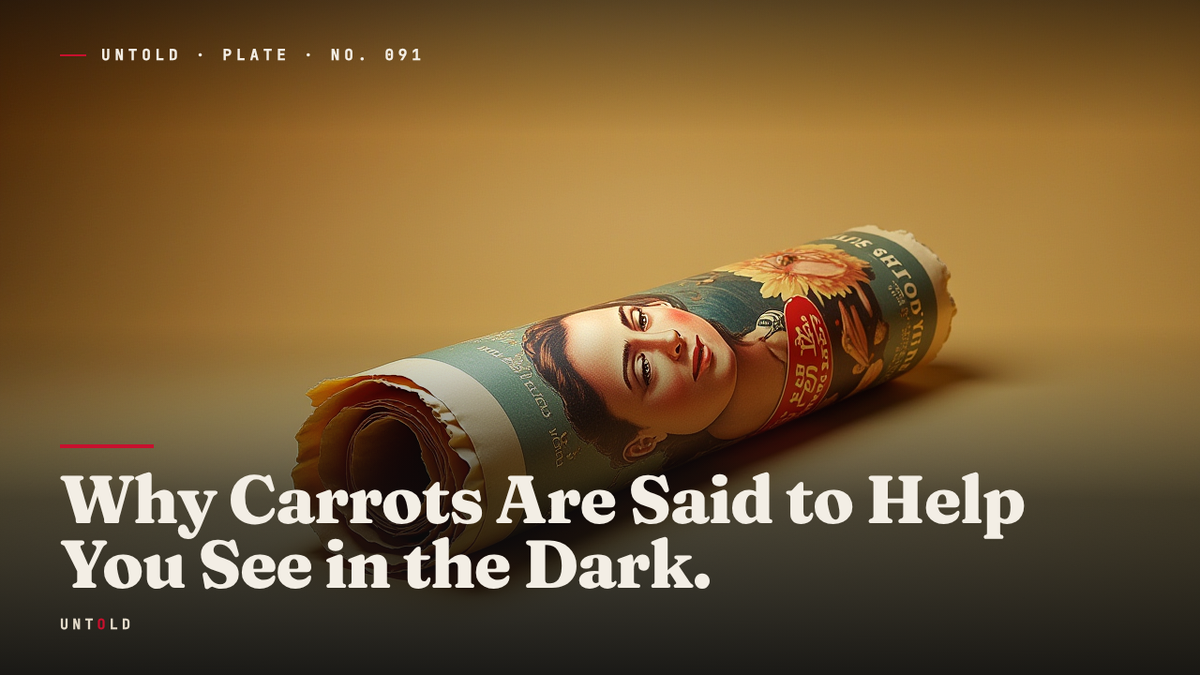
Sit in a dimly lit room for a few minutes and watch the colour drain away. The red of a book cover fades to grey. The blue of a mug becomes a shade indistinguishable from the shadow beside it. This is not a trick of mood or fatigue. It is a physiological handover. As the light fails, the cone cells that handle daytime colour vision fall silent, and your eyes surrender the work to a single class of pigment, one that reads brightness and brightness alone.
That pigment is called rhodopsin, and it is built, in part, from vitamin A. Which is why, for the better part of a century, one vegetable has carried an almost mythological reputation. Carrots, the story goes, help you see in the dark.
Most people who repeat this line know it is not quite true. And many of them will offer you a knowing correction, the kind of tidy fact that makes the teller sound clever at a dinner party. The carrot story, they will say, was wartime propaganda. A deliberate lie invented by the British to explain how their night-fighter pilots were shooting down German bombers in total darkness, a lie designed to hide a real secret weapon: airborne radar. Feed the Germans a story about carrots and superhuman eyesight, the theory runs, and they would never suspect the machine.
It is a wonderful story. It has a hero, a secret, and a satisfying twist. It is also wrong. The true reason Britain spent the Second World War urging its citizens to eat carrots is far less glamorous than espionage. It involved no spies, no misled enemy, and no cover-up. It involved a mountain of vegetables that nobody could eat fast enough, and a cheerful cartoon man sent out to solve the problem.
The pilot who could see in the dark
To understand how the myth took root, begin on the night of 19 November 1940, in the cold air above the Sussex coast. A young Royal Air Force pilot named John Cunningham, flying a twin-engine Bristol Beaufighter, brought down a German bomber in near-total darkness. It was one of the first confirmed night interceptions of its kind, and over the following months Cunningham would rack up an extraordinary record of kills in conditions where, by any ordinary reckoning, a pilot should have been able to see almost nothing.
The explanation sat in the back of his aircraft. Cunningham’s Beaufighter carried an early airborne interception radar set, operated by a second crewman who guided the pilot toward targets he could not yet see with his own eyes. Radar let the crew find an enemy in the black sky and close to firing range before the German gunners ever knew a fighter was there. It was one of the most valuable technical advantages Britain possessed, and the Air Ministry was determined to keep it secret.
But secrecy created a problem of its own. Cunningham’s success was too spectacular to ignore, and the press wanted a story. So the Air Ministry gave them one that carefully avoided the word radar. The papers credited Cunningham’s remarkable natural eyesight and handed him a nickname that would follow him for the rest of his life: “Cat’s Eyes Cunningham,” the man who could see in the dark.1
And what, everyone knew, helped a person see in the dark? Carrots. The connection was so culturally familiar that it needed no explaining. Cunningham ate his carrots, the story implied, and now he could pick a bomber out of a moonless sky.
This is the version most people carry today. The trouble is that it collapses the moment you examine it closely. The famous carrot campaign was not built to deceive Germany. It was built to feed Britain, and the reasons had almost nothing to do with the sky.
An island cut off from its food
While Cunningham was flying above the coast, Britain on the ground was facing a slower and far more grinding emergency. The country imported a vast share of its food, and German U-boats were systematically sinking the merchant ships that carried it across the Atlantic. Every tonne of butter, bacon, or sugar that failed to arrive was a tonne the nation had to do without.
Rationing began in January 1940. Bacon, butter, and sugar were the first to be controlled, and the list of restricted goods grew steadily through the war years.2 For a country accustomed to importing much of what it ate, the arithmetic was frightening. Every shipping route was a target. Every cargo was a gamble.
The government’s answer was to turn the nation into a garden. Under the slogan “Dig for Victory,” the Ministry of Agriculture urged citizens to grow their own vegetables wherever they could find soil.3 Suburban lawns were dug up and planted. Public parks, school grounds, railway embankments, and the moat of the Tower of London were pressed into cultivation. If the ships could not bring food, Britain would grow it at home.
And one vegetable took to the campaign with almost embarrassing enthusiasm. Carrots grew abundantly in British soil, required no imported seed of any consequence, and stored reasonably well through the winter. They needed no ships to bring them in and, crucially, no ration coupons to buy them. They were cheap, hardy, and dependable. They were, in short, everything a besieged island could want.
The difficulty was that they grew too well. By 1942, Britain was sitting on an estimated hundred thousand tons of surplus carrots, a stockpile so large that the ordinary appetite of the population could not keep pace with it.4 The country had inadvertently solved a shortage by manufacturing a glut. Something had to be done with the mountain, and the job of doing it fell to a single government department.
Enter Dr Carrot
The Ministry of Food had one overriding task: keep the nation fed and fighting on whatever supplies were available. When a food was scarce, the Ministry rationed it and taught people to stretch it. When a food was plentiful, the Ministry did the opposite. It launched a campaign to make people want it.
In November 1941, the Ministry introduced a cartoon character created to save the carrot crop. His name was Dr Carrot, and he appeared as a smiling orange figure, root vegetable for a body, carrying a doctor’s bag stamped with the words “Vit A.” He came with a companion, Potato Pete, and together the pair fronted a relentless push to get the British public eating homegrown vegetables in place of the scarce imported foods they could no longer buy.5
The campaign was inventive to the point of desperation. Recipes poured out of the Ministry’s kitchens: carrot fudge, carrot jam, carrot marmalade, curried carrot, a mock apricot flan made with carrots. There was even a carrot served on a stick and sold to children as a substitute for the sweets that rationing had made rare. The message was constant and unavoidable. Carrots were patriotic. Carrots were plentiful. Carrots were good for you.
And among all the claims the Ministry pressed, one stood out for its usefulness. Carrots, the posters insisted, would help you see in the dark. In a country enduring nightly blackouts, where streetlights were extinguished and windows blacked out to hide targets from German bombers, the promise of better night vision sounded almost like a gift. “Carrots keep you healthy and help you to see in the blackout,” ran one of the campaign’s lines, tying the vegetable directly to the daily hazard of stumbling through darkened streets.6
The campaign worked. The British public ate carrots by the ton, exactly as the Ministry had hoped. The surplus shrank, the population absorbed a cheap and nutritious food, and a piece of folklore was quietly cemented into the national imagination. But notice who this campaign was aimed at. Not the Luftwaffe. Not German intelligence. It was aimed squarely at British householders trying to get through the blackout without breaking an ankle, and at British gardeners with more carrots than they knew what to do with.
The historian who went looking for the spies
The idea that the carrot campaign was really a deception aimed at Germany is so appealing that it has been repeated in countless books, articles, and television segments. But at least one person decided to check.
John Stolarczyk ran, of all things, the World Carrot Museum, an online archive devoted to the history and folklore of the vegetable. Intrigued by the persistent claim that the carrot myth had been a wartime deception, he went searching through the archival record for the German half of the story. If Britain had truly manufactured the carrot legend to fool the enemy, there should be some trace of the machinery: propaganda designed for German consumption, intelligence intended to reach German ears, some deliberate leak aimed across the Channel.7
What he found instead was campaign after campaign directed at the British public. Posters about rationing. Posters about the blackout. Dr Carrot cheerfully urging homegrown eating. All of it domestic, all of it concerned with the mundane business of feeding a country under siege. The material aimed at deceiving the Germans, the supposed engine of the whole legend, was essentially absent. There was no evidence of a coordinated effort to plant the carrot story in enemy minds.
Stolarczyk’s conclusion was deflating in the best way. The carrot campaign was real, extensive, and effective. But it was a food campaign, not an intelligence operation. The night-vision claim was a selling point for a surplus vegetable, not a smokescreen for a radar set. The spies had been added later, by storytellers who found the truth too plain and improved it.
The secret that was never a secret
The deception theory has an even deeper flaw, one that undermines it before we ever consult the archives. The story assumes that the existence of airborne radar was a secret the Germans did not possess, a mystery so total that the British needed an elaborate cover to explain their pilots’ success. But the Germans knew perfectly well that radar existed. They had their own.
Germany’s Freya radar system had been guiding fighters toward RAF bombers since December 1939, nearly a year before Cunningham’s celebrated night kill.8 Radar was not some uniquely British marvel that the enemy had never imagined. It was a technology both sides were racing to develop and deploy. The specific details of any particular set (its range, its frequency, its precise capabilities) were closely guarded on all sides, and remained genuinely valuable secrets. But the basic fact that aircraft could be guided in darkness by radio-echo apparatus was no revelation to the German air command. There was no great secret of that shape for a carrot to hide.
This is the point at which the spy story fully collapses. It requires an enemy who did not understand radar, and no such enemy existed.
The half-truth that survived
And yet the carrot poster was not simply a lie. This is what makes the whole episode so durable. The Ministry’s claim sat on top of a real and well-understood piece of biology, which is precisely why it was so easy to sell and so hard to kill.
Vitamin A really is essential to night vision. The body uses it to manufacture rhodopsin, the light-sensitive pigment packed into the rod cells of the retina that allow you to see in dim conditions.9 When rhodopsin absorbs a photon it changes shape and fires a signal toward the brain, and to rebuild itself for the next photon it needs a steady supply of vitamin A. Starve the body of that vitamin and the system falters. Severe vitamin A deficiency causes night blindness, an inability to see in low light, and it remains a serious cause of visual impairment in parts of the world where diets are poor.10 In such a case, eating carrots, which are rich in beta-carotene that the body converts to vitamin A, can genuinely restore night vision.
But here the claim quietly overreaches. For a person who already gets enough vitamin A, and most people on an adequate diet do, eating more of it adds nothing to their eyesight. The rhodopsin system is not improved by a surplus. Extra carrots do not sharpen a well-fed person’s vision beyond its natural range, and they certainly cannot bestow the eyes of a cat. The vitamin corrects a deficiency; it does not grant a superpower.
This is the anatomy of a lasting half-truth. It was not built from nothing. It took a real biological fact, that vitamin A prevents night blindness, and stretched it just far enough to promise something extraordinary. Because the foundation was true, the exaggeration felt plausible. Because the exaggeration was flattering and useful, it stuck. And because it flattered a wartime population learning to eat a homely orange root, it became a permanent fixture of the culture.
What the mountain teaches
Strip away the spies, and what remains is a quieter and more human story. Britain had too many carrots and a clever way to persuade people to eat them. A cartoon doctor with a bag marked “Vit A” went to work on the surplus, leaning on a night-vision claim that was true enough at its root to survive the exaggeration built on top of it. There was no German audience. There was no radar cover story. There was only a country making the best of what its soil would grow, and a piece of folklore born from the marketing of a glut.
Dr Carrot did his job well. The surplus was eaten, the myth outlived the war, and the tidy “actually it was propaganda” correction that people offer today turns out to be its own kind of embellishment, one legend layered over another. The next time someone tells you carrots gave British pilots the power to see in the dark, you can offer the real explanation. It was never about the Luftwaffe, and it was never about a secret weapon. It was about a mountain of vegetables that somebody, somehow, had to convince a nation to eat.
Sources
- Smithsonian Magazine, “A WWII Propaganda Campaign Popularized the Myth That Carrots Help You See in the Dark”, 2013. — https://www.smithsonianmag.com/arts-culture/a-wwii-propaganda-campaign-popularized-the-myth-that-carrots-help-you-see-in-the-dark-28812484/
- Imperial War Museums, “How Britain Rationed Food During the Second World War”. — https://www.iwm.org.uk/history/how-britain-rationed-food-during-the-second-world-war
- Imperial War Museums, “The Dig for Victory Campaign in Photos”. — https://www.iwm.org.uk/history/the-dig-for-victory-campaign-in-photos
- BBC News Magazine, “Did carrots help win World War II?”, 2013. — https://www.bbc.com/news/magazine-31743110
- The National Archives (UK), Ministry of Food wartime food campaigns and Dr Carrot / Potato Pete records. — https://www.nationalarchives.gov.uk/education/resources/second-world-war/
- Stolarczyk, John, World Carrot Museum, “Carrots and the Second World War”. — http://www.carrotmuseum.co.uk/history4.html
- Zimmermann, R., “The German Freya and Wurzburg radar systems in WWII”, historical overview. — https://en.wikipedia.org/wiki/Freya_radar
- Wald, George, “Molecular Basis of Visual Excitation” (Nobel Lecture), 1967, on vitamin A and rhodopsin. — https://www.nobelprize.org/prizes/medicine/1967/wald/lecture/
- World Health Organization, “Vitamin A deficiency”, global prevalence and night blindness. — https://www.who.int/data/nutrition/nlis/info/vitamin-a-deficiency
Related reading