The Slide Nobody Wanted to See
A biochemist warned in 1957 that the heart-healthy spread was the real danger. It took the world fifty years to listen.
In 1957, a thin section of a human artery lay frozen under a microscope in an Illinois laboratory. The man peering at it, a biochemist named Fred Kummerow, was not looking for controversy. He was looking at plaque, the pale greasy sludge that narrows a coronary vessel until the heart starves. He had collected the tissue from people who had died of heart attacks, and he wanted to know exactly what kind of fat was lodged inside those failing walls.
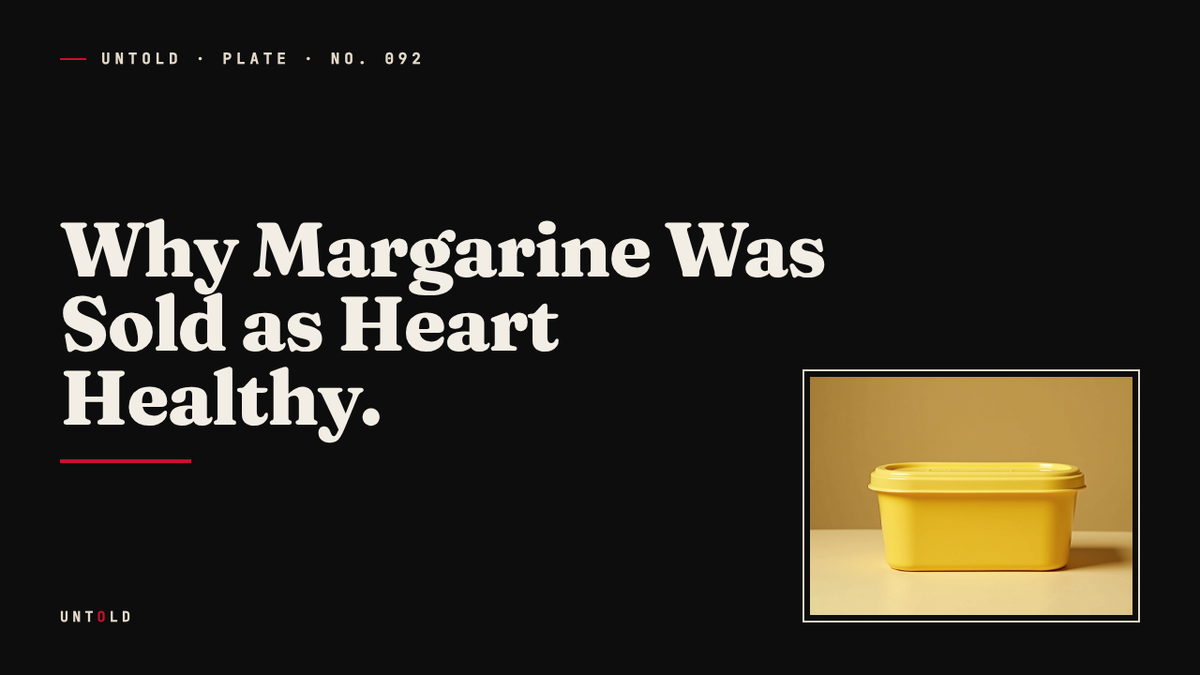
The answer did not match the story his country was about to tell itself. The fat clogging those arteries was not, for the most part, the animal fat everyone feared. A large share of it was something newer, something manufactured, something that until a few decades earlier had never existed on earth in any meaningful quantity. It was trans fat, the peculiar molecule created when food chemists forced hydrogen through liquid vegetable oil. And it was hiding, at that very moment, in the pale yellow tub sitting in millions of American refrigerators, the one doctors were beginning to recommend as the safe alternative to butter.
Kummerow published what he found. Then, for the better part of fifty years, almost no one paid attention. The tale of how margarine came to be sold as a guardian of the heart, while the thing that made it heart-hostile went uncorrected for two generations, is not really a story about fat at all. It is a story about how a scientific consensus, once formed, can become almost impossible to move, even by the tissue in front of your eyes.
A Pearl for an Emperor
The substance began, like a surprising number of nineteenth-century inventions, as a military supply problem. In 1869, Napoleon III of France wanted a cheap, durable fat to feed his army and his poorer subjects. Butter was expensive and spoiled quickly. The emperor offered a prize for a workable substitute, and a chemist named Hippolyte Mege-Mouries claimed it.
His method was crude by modern standards. He took beef tallow, separated out a softer fraction, and churned it with milk and water into a pale, spreadable paste. Under certain light the fat took on a faint pearly sheen, which is why he named it after the Greek word for pearl, margarites. Margarine was born as an act of economy: cheap, stable, and just close enough to butter to pass at a dim table.1
For a few decades it stayed a minor curiosity, a poor relation of the real thing. Then chemistry gave it a transformation that would carry it into nearly every kitchen on the planet. In 1902, a German chemist named Wilhelm Normann patented a process that sounds almost alchemical: bubble hydrogen gas through liquid vegetable oil in the presence of a metal catalyst, and the runny oil thickens into a solid, creamy, shelf-stable fat.2 The technique was called hydrogenation, and when it was carried only part of the way, partial hydrogenation, it did something no one fully understood at the time.
It rearranged the geometry of the fat molecules. Natural unsaturated fats bend at their double bonds into a shape chemists call cis. Partial hydrogenation flipped some of those bonds into a straightened configuration called trans, a form that barely occurs in nature outside the guts of ruminant animals. The straightened molecule packed together more tightly, which is precisely why the oil turned solid and spreadable. A brand new kind of fat had entered the human diet, and the food industry fell in love with it before anyone had asked what it did inside a body.
The Fat That Never Went Bad
The appeal was obvious and enormous. In 1911, Procter and Gamble launched Crisco, a snow-white cooking fat made from hydrogenated cottonseed oil. It was cheaper than lard, cleaner in appearance, and it possessed one almost magical property: it did not go rancid on the shelf. A tin of Crisco could sit in a pantry for a year and emerge unchanged.3
For food manufacturers, this was a gift. Partially hydrogenated oil was cheap, stable, and endlessly versatile. It made pie crusts flaky, cookies crisp, fried food long-lasting, and it gave margarine a texture that finally rivaled butter. By the middle of the twentieth century, hydrogenated fat had quietly infiltrated the industrial food supply. It was in bread, crackers, pastries, fried chicken, and above all in the margarine now marketed as a modern convenience.
The substance had every commercial virtue a food scientist could want. It also happened to be, molecule for molecule, one of the most harmful things a person could eat. But that recognition was still decades away, and in the meantime a different alarm was ringing across the United States, one that would push margarine from convenience to prescription.
Hunting the Wrong Villain
By the 1950s, American men were dying of heart attacks at rates that frightened public health officials. Middle-aged executives collapsed at their desks. The coronary epidemic seemed to appear out of nowhere, and medicine went hunting for a cause.
The most influential answer came from a physiologist named Ancel Keys. Keys was formidable, combative, and persuasive, and he became convinced that dietary saturated fat, the kind concentrated in butter, meat, and other animal products, raised blood cholesterol and clogged the arteries. His epidemiological work, which culminated in the famous Seven Countries Study, drew a line between saturated fat intake, cholesterol, and heart disease.4 The message that filtered out to the public was blunt and memorable: animal fat was killing you, and the way to save yourself was to swap it out.
The recommendation had a clean logic. If butter was dangerous, then a spread made from vegetable oil ought to be safer. The American Heart Association came to endorse exactly this substitution, urging Americans to replace butter and lard with polyunsaturated vegetable oils and the margarines made from them.5 Overnight, the tub became a virtue. It was the reasonable choice, the informed choice, the choice a caring doctor recommended to a patient with a family history of heart trouble.
There was only one problem with the advice, and it was buried inside the very product being prescribed. The margarine of that era was solid because it was partially hydrogenated, and partial hydrogenation was precisely the process that manufactured trans fat. In the rush to flee saturated fat, the nation was being steered toward something worse.
The Man at the Microscope
Fred Kummerow was not a headline scientist. He was a meticulous biochemist at the University of Illinois, more interested in what was physically inside diseased tissue than in the grand statistical theories being argued over in conference halls. Where Keys reasoned from populations and cholesterol numbers, Kummerow reasoned from the arteries themselves.
He obtained tissue from people who had died of coronary disease and analyzed the fat deposited in the plaque. His finding, published in the journal Circulation in 1957, cut directly against the emerging consensus. The artery walls were loaded with trans fatty acids, the artificial fat from hydrogenated oil, in concentrations far higher than one would expect if these fats were harmless passengers.6 Here was physical evidence that the manufactured fat, the fat in the heart-healthy tub, was accumulating in exactly the places where hearts failed.
He did not stop at autopsies. Kummerow fed hydrogenated fat to animals and watched their arteries stiffen and develop lesions. He built a case, patiently and repeatedly, that partially hydrogenated oil was doing damage the saturated-fat theory could not explain.
The response was close to silence. The saturated fat hypothesis had momentum, institutional backing, and a satisfying simplicity. Kummerow’s data complicated a story that everyone had already decided to believe. Funding for his line of research grew harder to secure. His warnings were noted politely and set aside. The problem was not that he was refuted; it was that he was inconvenient. A finding that undercut a national dietary campaign, one aligned with a powerful and profitable industry, had few natural allies. And so the tubs kept selling, many of them stamped with claims about protecting the heart, while the man who had looked directly at the disease was left talking to a wall.
The Evidence Catches Up
It took another generation, and a different kind of study, for the world to circle back to what Kummerow had seen in 1957. In the late 1980s and 1990s, researchers at the Harvard School of Public Health were running the Nurses’ Health Study, an enormous long-term project tracking the diets and health of tens of thousands of women over many years.
When the epidemiologist Walter Willett and his colleagues examined trans fat intake, the pattern was stark. Women who consumed more trans fat had a markedly higher risk of coronary heart disease. In their 1993 analysis published in The Lancet, higher trans fat consumption was associated with a substantially increased risk of heart attack.7 Controlled feeding studies filled in the mechanism. Trans fat did something almost uniquely bad to blood lipids: it raised LDL, the so-called bad cholesterol, while simultaneously lowering HDL, the protective kind.8 Saturated fat, the original villain, at least tended to raise both. Trans fat pushed the numbers in the worst possible direction on both counts.
Gram for gram, the manufactured fat appeared more dangerous to the heart than the animal fat it had been recruited to replace. By the mid-1990s, the metabolic and epidemiological evidence had converged on a conclusion that would have startled a 1957 dietitian and vindicated a lonely biochemist in Illinois: the safe swap had been carrying a poison.
The estimates that followed were sobering. Researchers calculated that trans fat in the American diet was responsible for tens of thousands of premature coronary deaths every year, a toll extracted quietly through decades of pie crusts, fried food, and heart-healthy spreads.9
The Ninety-Nine-Year-Old Plaintiff
Fred Kummerow did not mellow with age. Into his nineties he kept publishing, kept arguing, kept insisting that partially hydrogenated oil had no place in the food supply. In 2009 he petitioned the Food and Drug Administration to ban it. When years passed without meaningful action, he did something remarkable for a man approaching his hundredth birthday. In 2013, at the age of ninety-nine, he sued the FDA to force its hand.10
The move drew attention that his decades of quiet science never had. In 2015, the FDA finally determined that partially hydrogenated oils, the primary source of artificial trans fat, were no longer generally recognized as safe, effectively ordering their removal from the food supply.11 The ruling arrived fifty-eight years after Kummerow first looked at those streaked arteries and wrote down what he saw.
He lived to see it. Fred Kummerow died in 2017 at the age of one hundred and two, having outlasted not only most of his critics but the very product he had spent a lifetime warning against.
The modern tub is not the tub he studied. Today’s margarines have largely been reformulated to eliminate the old partially hydrogenated oils, and the artificial trans fat that once defined them has been engineered back out. Which means the honest answer to the question that opened this essay, margarine or butter, is genuinely: it depends on what you buy. The margarine of 1970 was a hazard dressed as a health food. The margarine of today, made without partial hydrogenation, is a different substance with a different verdict.
Coda
What lingers is not the chemistry but the delay. The information that should have stopped the trans fat epidemic existed in a published journal in 1957. It was not hidden in a locked drawer; it was in Circulation, findable by anyone who cared to look. The failure was not one of discovery but of listening. A consensus had formed around a simpler villain, an industry had built itself on a convenient molecule, and a warning that threatened both was allowed to sit unread for half a century while the arteries it described kept filling. The tub in the refrigerator was reformulated in the end. The lesson worth keeping is how long it took, and how loudly the evidence had to knock.

Sources
- Rupp, R., ‘The Butter Wars: When Margarine Was Pink,’ National Geographic, 2014. — https://www.nationalgeographic.com/culture/article/the-butter-wars-when-margarine-was-pink
- Normann, W., British Patent 1515: ‘Process for Converting Unsaturated Fatty Acids,’ 1903. — https://en.wikipedia.org/wiki/Wilhelm_Normann
- Procter & Gamble, ‘Crisco History,’ Company Archive / Smithsonian records, 1911. — https://www.si.edu/object/crisco
- Keys, A., et al., ‘Seven Countries: A Multivariate Analysis of Death and Coronary Heart Disease,’ Harvard University Press, 1980. — https://www.hup.harvard.edu/catalog.php?isbn=9780674802360
- American Heart Association, ‘Dietary Fat and Its Relation to Heart Attacks and Strokes,’ Circulation, 1961. — https://www.ahajournals.org/doi/10.1161/01.CIR.23.1.133
- Kummerow, F. A., ‘Fatty Acid Composition of the Human Aorta,’ Circulation, 1957. — https://www.ahajournals.org/journal/circ
- Willett, W. C., et al., ‘Intake of Trans Fatty Acids and Risk of Coronary Heart Disease Among Women,’ The Lancet, 1993. — https://www.thelancet.com/journals/lancet/article/PIIS0140-6736(93)90350-P/fulltext
- Mensink, R. P. & Katan, M. B., ‘Effect of Dietary Trans Fatty Acids on HDL and LDL Cholesterol,’ New England Journal of Medicine, 1990. — https://www.nejm.org/doi/full/10.1056/NEJM199008163230703
- Mozaffarian, D., et al., ‘Trans Fatty Acids and Cardiovascular Disease,’ New England Journal of Medicine, 2006. — https://www.nejm.org/doi/full/10.1056/NEJMra054035
- U.S. Food and Drug Administration, ‘Final Determination Regarding Partially Hydrogenated Oils,’ Federal Register, 2015. — https://www.federalregister.gov/documents/2015/06/17/2015-14883/final-determination-regarding-partially-hydrogenated-oils
Related reading