The Hand That Learned to Run
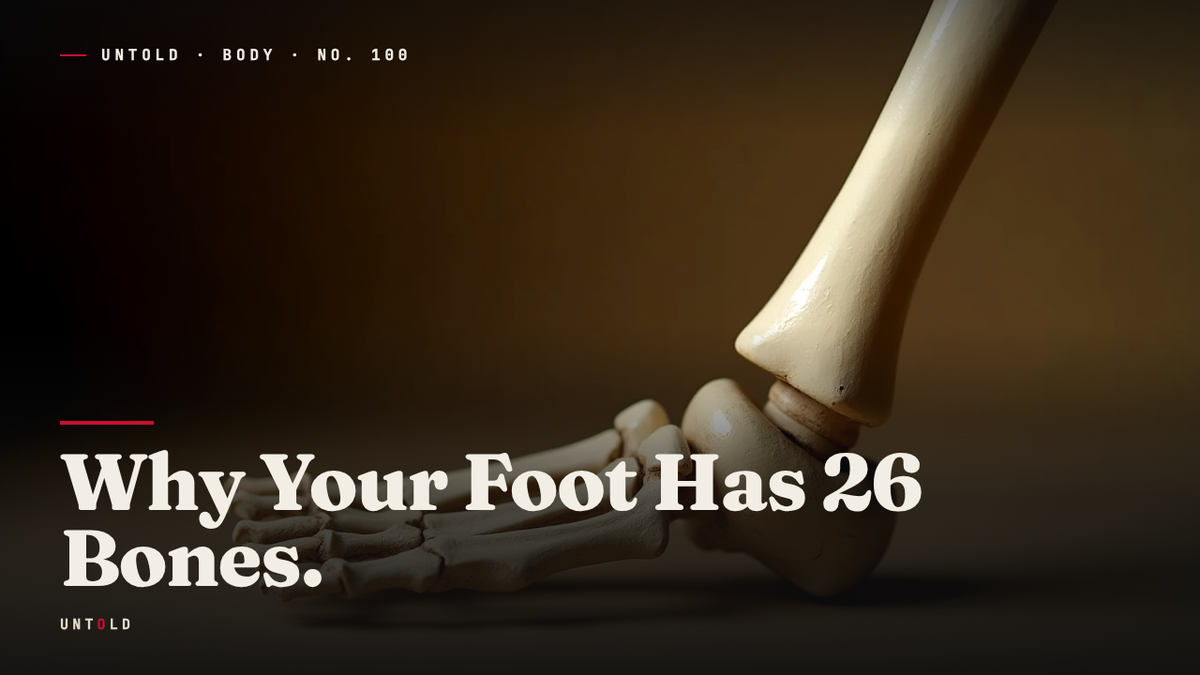
Your foot has 26 bones because it was never designed. It was repurposed from a climbing ape's grip.
Curl your toes against the inside of your shoe. Notice how little they grip, how weak and stubby they feel compared to the fingers on your hand. That weakness is a clue. It is the residue of a job your foot no longer does. Once, that same appendage could close around a branch and hold your entire weight above the forest floor. Your big toe did not point forward, tucked obediently in line with its neighbors. It jutted out to the side, opposable, a thumb for the treetops.
We tend to talk about the human foot as if it were engineered: a purpose-built platform, a marvel of biomechanical design, drawn up from scratch for the task of standing and walking upright. This is a comforting story, and it is wrong. The foot was never designed. Nothing in the body was. What we call the foot is a grasping ape hand that has been slowly, imperfectly, and incompletely rebuilt into a spring. Twenty-six bones, every one of them inherited from a climber. And that inheritance is the reason feet fail so predictably, why the podiatrist’s waiting room is never empty.
Same parts, opposite jobs
Set a chimpanzee’s foot beside your own and the first thing you notice is the sameness. The bone count is identical: 26 bones per foot, arranged in the same broad groups, the same tarsals in the ankle and midfoot, the same metatarsals fanning toward the toes, the same phalanges at the tips. If you handed the two skeletons to an anatomist without labels, they would recognize both as feet built from the same catalogue of parts.
The difference is not in the inventory. It is in the arrangement and the job. The chimpanzee’s big toe swings out to the side, set apart from the others so that it can press against them and hold objects. It grips a branch the way your thumb grips a pen 1. A chimp’s foot is, functionally, a second pair of hands, evolved for a life spent moving through a three-dimensional canopy where a secure grip is the difference between climbing and falling.
Human evolution took those exact parts and welded them into something rigid. The big toe was pulled inward until it lay parallel with the rest, sacrificing its grip for the ability to push off the ground in a straight line. The most striking product of that reworking is the arch, the feature schoolchildren are told to admire. But the arch is not a single bone, and it is not a solid structure. It is a curved bridge assembled from several bones and held in tension by ligaments and the thick band of connective tissue that runs beneath it. With every step you take, that bridge flattens under your weight and then springs back as you lift off, storing and returning energy like a bow.
The returns are real and measurable. Studies of the arch’s elastic behavior estimate that it can recycle a substantial fraction of the energy of each stride, roughly on the order of seventeen percent during walking, a saving that adds up over the tens of thousands of steps a body takes in a day 2. Here is the crucial point: this efficient machine is built from grasping parts, pressed into the service of a running job they were never shaped for. It works remarkably well. It also fails in ways that make perfect sense once you know its history.
The footprints in the ash
To watch this transformation caught in the act, we have to go to a plain in northern Tanzania called Laetoli, and to the year 1976. The site was being worked by a team led by Mary Leakey, one of the towering figures of twentieth-century paleoanthropology, a woman who had spent decades reading the deep past out of East African sediment.
The conditions that made Laetoli extraordinary were, in a sense, meteorological luck stretched across millions of years. A nearby volcano had dusted the surrounding plain with a fine layer of ash. Then rain fell, and the ash turned to something with the consistency of wet cement. Animals crossed it while it was still soft: birds, hares, extinct elephants, and, crucially, something walking upright on two legs. As the ash dried and hardened, it locked those footprints in place. More ash and sediment buried them, and there they stayed, sealed away for 3.6 million years 3.
What Leakey’s team eventually uncovered was a trail of prints left by at least two individuals walking side by side across the ancient plain. The prints were not the smudged, ambiguous marks you might expect. They were clear enough to read anatomy directly from the ground. There was a distinct arch pressed into the ash, exactly where a modern human foot would leave one. And the big toe pointed forward, aligned with the other toes, not splayed out to the side in a grip. This was not a climber’s foot that had happened to touch down. It was a walker’s foot, striding.
Leakey herself grasped the significance immediately. The prints, she wrote, were “as human as the imprint of our own” 3. The implication rearranged the expected order of events. The foot had become a walking foot before the brain had grown large. Uprightness came first. The great expansion of the human skull, the thing we usually treat as the headline of our evolution, arrived much later.
The prints almost certainly belonged to Australopithecus afarensis, the same species as the famous partial skeleton nicknamed Lucy, discovered in Ethiopia in 1974. Lucy and her kind were upright, arched, and striding across the African landscape more than a million years before anything resembling a modern human intellect appeared. The narrative order most of us carry in our heads, big brains leading to tool use leading to standing tall, runs almost exactly backward. The feet went first.
Ardi and the unfinished foot
If the Laetoli story were the whole picture, we could tell a clean tale: at some point the grasping foot was swapped for a walking one, and that was that. But paleoanthropology rarely offers clean tales, and a second fossil complicated the picture considerably.
The complication came from the work of Tim White and a large international team who spent years, decades really, excavating and analyzing a much older creature called Ardipithecus ramidus. Older than Lucy by roughly a million years, Ardipithecus lived around 4.4 million years ago. The full analysis, when it finally appeared in the journal Science in 2009 after an unusually long and careful reconstruction, was one of the most significant fossil publications of its generation 4.
The partial skeleton at the center of that work was nicknamed Ardi. And Ardi’s foot told a genuinely strange story, a story of an animal in the middle of changing. Ardipithecus could walk upright on the ground, at least some of the time. Its pelvis and other features showed real adaptations for bipedal movement. And yet the foot still carried a large, thumb-like, grasping big toe, offset from the others in the old climbing pattern 4. Here was a creature that could stride across the ground on two legs one moment and, the next, curl its foot securely around a branch.
Half climber, half walker, Ardi was not a missing link in the tidy sense of a single connecting rung. It was something more interesting: evidence that the transition was slow, messy, and incomplete, that for a very long stretch of our lineage’s history the foot did two contradictory jobs at once. The grasping toe did not vanish in a single evolutionary step. It was pulled inward over many generations, straightened, and pressed into a new kind of service. The old function shaded gradually into the new one, and for a long time both coexisted in the same foot.
This matters because it undermines the intuition of design more thoroughly than any single fossil could. A designer does not build a foot that grips and walks badly at the same time and then spend a million years slowly deciding which it will be. Only a process with no foresight, working by small modifications to whatever it inherits, produces a structure caught so visibly between two purposes.
A wheel improvised from a hand
Here, then, is the twist that turns a fossil story into a story about your own body. The human foot was never a fresh invention. It is a climbing hand that has been forced, over several million years, into the job of a wheel: something that rolls forward and pushes off, that must be rigid where the hand was flexible, straight where the hand was splayed.
Evolution does not start from a blank sheet. It cannot scrap a design and begin again. It can only tinker with the parts already present, bending existing structures toward new functions. The engineer’s dream, a platform built from first principles for the single task of upright walking, was never on the table. What was on the table was a fully formed grasping foot, and natural selection reworked it, ligament by ligament, bone by bone, into an adequate walker. Adequate, not perfect. The difference between those two words is where the trouble lives.
The price written in your bones
That ancient compromise is, quite literally, why so many people pay for orthotics and physical therapy. The aches in your feet after a long day are not evidence of a body that has broken. They are evidence of a body doing a job with tools reshaped from another purpose entirely.
Consider the arch again. It is held up by ligaments and connective tissue that, in an ancestral foot, served the demands of gripping and flexibility. Now those same tissues are asked to maintain a stable bridge under the full pounding weight of an upright animal, thousands of times a day, for decades. When they overstretch or weaken, the arch drops. Flat feet, fallen arches, the whole vocabulary of podiatry begins with a structure being asked to hold a shape it was only recently drafted into holding.
The plantar fascia, the thick band of tissue running along the sole from heel to toe, tells the same story. It becomes inflamed and painful, the condition called plantar fasciitis, precisely because it performs a demanding structural role in a foot that was reshaped for it rather than originally built for it. Plantar fasciitis is not rare. Estimates suggest that roughly one in ten adults will experience this kind of heel pain at some point in their lives 5. That is not the failure rate of a well-engineered part. It is the failure rate of a repurposed one.
Bunions belong to the same family of problems. The big toe, that once-opposable digit dragged inward over evolutionary time to line up with its neighbors, still sits at the end of a joint that bears enormous load with every push-off. Under sustained pressure, and often aggravated by footwear that squeezes the toe further inward, the joint drifts and deforms, and the characteristic bony bump appears 6. It is a distinctly human affliction, one that follows directly from the distinctly human decision, made by no one, to turn a thumb into a toe.
None of this is a flaw in the moralizing sense, a mistake to be embarrassed about. It is history made physical. Every twinge in the heel, every ache in the arch, every crooked joint at the base of the big toe is an echo of the same underlying fact: the foot you stand on is a hand that was drafted into a job it did not evolve to do, and has been getting away with it, more or less, ever since.
Coda
There is a particular kind of humility in understanding your own body as a museum of past lives rather than a finished product. The foot is not the triumph of design we were taught to see. It is a record of a slow, improvised, still-imperfect solution to a problem our ancestors never set out to solve. The next time your feet ache at the end of a long day, it is worth remembering what you are actually standing on. Not a platform built for the purpose, but a grasping ape hand that learned, over four million years and against the grain of its own history, how to run.
Sources
- Susman, R. L., “Comparative and functional morphology of hominoid fingers,” American Journal of Physical Anthropology, 1979. — https://onlinelibrary.wiley.com/doi/10.1002/ajpa.1330500207
- Ker, R. F. et al., “The spring in the arch of the human foot,” Nature, 1987. — https://www.nature.com/articles/325147a0
- Leakey, M. D. and Hay, R. L., “Pliocene footprints in the Laetolil Beds at Laetoli, northern Tanzania,” Nature, 1979. — https://www.nature.com/articles/278317a0
- Lovejoy, C. O., White, T. D. et al., “Combining Prehension and Propulsion: The Foot of Ardipithecus ramidus,” Science, 2009. — https://www.science.org/doi/10.1126/science.1175832
- Riddle, D. L. and Schappert, S. M., “Volume of ambulatory care visits and patterns of care for patients diagnosed with plantar fasciitis,” Foot & Ankle International, 2004. — https://journals.sagepub.com/doi/10.1177/107110070402500505
- Nix, S., Smith, M., Vicenzino, B., “Prevalence of hallux valgus in the general population: a systematic review and meta-analysis,” Journal of Foot and Ankle Research, 2010. — https://jfootankleres.biomedcentral.com/articles/10.1186/1757-1146-3-21
Related reading