The Winter a Flower Was Worth More Than a Mansion
How a diseased tulip bulb became the money of the age, and then became nothing at all.
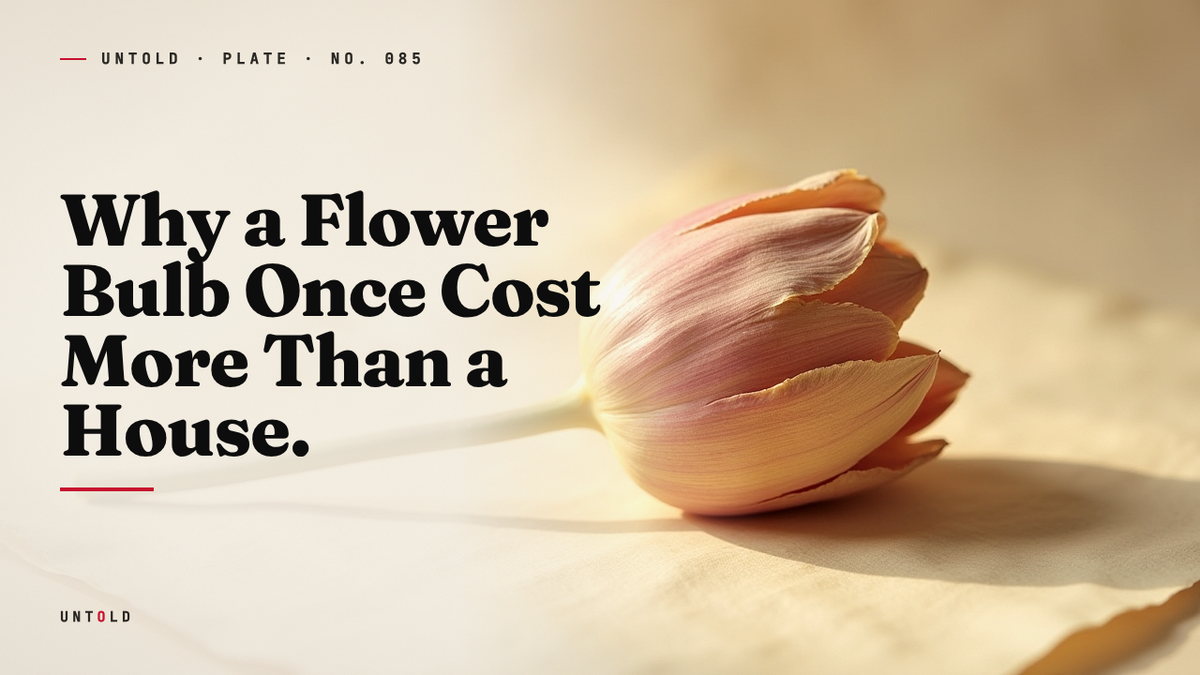
In the winter of 1637, in the trading towns of Holland, a person could hold a fortune in the palm of one hand. Not a coin, not a bar of silver, not a deed to land or a ship laden with spice. A tulip bulb. Dry, brown, unremarkable, roughly the size of a small onion. And yet the rarest of these bulbs changed hands for sums that could buy a canal-side house in Amsterdam, complete with garden and coach house, with money left over.
The figure that survives from the period is 5,200 guilders for a single bulb of the variety called Semper Augustus. To grasp what that meant, consider that a skilled craftsman in the Dutch Republic earned perhaps 300 guilders in a year 1. A bulb, then, could represent more than a decade and a half of honest labour, spent on something that would flower for a week, if at all, and then vanish back into the soil.
The episode has come down to us as Tulip Mania, and it holds a peculiar place in the history of money. It is routinely called the first speculative bubble, the original sin of the market, the ancestor of every crash from the South Sea Company to the dot-com collapse to the more recent frenzies over cryptocurrencies. It is also, on closer inspection, stranger and more slippery than the legend suggests. The flowers were real. The prices were, for a time, real. The ruin, however, may have been partly a story people told afterward, a moral fable that grew in the telling. What is certain is that for a few extraordinary months, an entire commercial society decided that a flowering plant was worth a fortune, and then, almost overnight, decided that it was not.
An exotic arrival in a wealthy republic
To understand how a flower could break the nerve of a nation, one has to understand how much money was sloshing through that particular nation at that particular moment. The Dutch Republic in the early seventeenth century was, by most measures, the richest society on earth. Amsterdam had become the pivot of global commerce. Its harbours received spices from the East Indies, silver from the Americas, timber and grain from the Baltic. The Dutch East India Company, founded in 1602, was among the first joint-stock corporations, and the Amsterdam exchange traded its shares with a sophistication that would not look wholly out of place today 2.
This was new money, and a great deal of it. A merchant class had risen that possessed both liquid wealth and a hunger for status. Into this world, sometime in the late sixteenth century, came the tulip.
The flower was not native to the Low Countries. It had travelled west along the trade and diplomatic routes from the Ottoman Empire, where it had long been cultivated and celebrated. The name itself is thought to derive from a Turkish word for turban, which the bloom was said to resemble. In 1593, the botanist Carolus Clusius, newly installed at the University of Leiden, planted tulip bulbs in the university’s physic garden and set about studying them with scholarly care 3.
Clusius was not a speculator. He was a scientist who wished to observe how the plants behaved in Dutch soil, and he guarded his specimens jealously. The story goes that thieves broke into his garden and stole bulbs, and whether or not that theft was the true origin of the trade, it captures something essential. From the very beginning the tulip provoked a covetousness out of all proportion to its size. The Dutch had never seen colours like these on any flower they grew. Deep reds, violent purples, whites of surprising clarity. In a landscape of grey skies and brown canals, the tulip was a small explosion of the exotic, and it could be owned.
Beauty that was, in fact, a disease
The most prized tulips of all were not the pure single colours. They were the ones with flame-like streaks, feathers of crimson dragged across a white ground, or violet marbled into cream, no two quite alike. These were the varieties that carried the grand names and the astronomical prices. Semper Augustus, the most coveted of them all, bore precisely this kind of streaking, red licking up petals of white 4.
What no one in the 1630s understood was that this beauty was a symptom of illness. The streaked patterning, which the Dutch called breaking, was caused by a virus. We now know it as the tulip breaking virus, spread by aphids, which disrupts the pigment in the petals and produces the very variegation the collectors prized 5. The virus also weakened the plant. Infected bulbs produced fewer offsets, the small daughter bulbs by which tulips reproduce, and they were more fragile and slower to multiply. The most beautiful flowers were, in the most literal sense, the sickest.
This is the quiet irony at the centre of the whole affair. The scarcity that drove the highest prices was manufactured not by human ingenuity or by a cartel of growers but by a plant disease that no one could see, name, or control. A grower could not reliably reproduce a broken tulip on demand, because he did not know what caused the breaking. The rarity was genuine, and it was accidental. Beauty, it turned out, was a symptom, and the market had fallen in love with a pathology.
From connoisseurs to bakers and weavers
At first, the tulip trade belonged to the wealthy and the knowledgeable. Collectors, gentleman gardeners, and serious horticulturists paid high prices for rare bulbs because they wanted, in the ordinary way of connoisseurs, to possess something beautiful and scarce. This phase could have continued indefinitely as a rich person’s hobby, an eccentric corner of a booming economy.
What changed, in the early 1630s, was the class of people involved and, crucially, their motive. Buyers began to appear who had no particular interest in flowers. Weavers, bakers, shopkeepers, and small tradesmen entered the market not to grow tulips but to trade them. They bought a bulb in the expectation that they could sell it, a week or a month later, to someone willing to pay more. The tulip had ceased to be a flower and had become an instrument, a thing valued not for what it was but for what it might fetch 6.
This is the moment a market for a good becomes a market for expectations, and it is the hinge on which every bubble turns. Prices, by the surviving accounts, could rise tenfold in the space of a month. Some people sold land, livestock, and even their homes to raise the capital for a single bulb, confident that the price would carry them upward. The whole edifice rested on a shared belief that there would always be a buyer further up the ladder, willing to pay yet more.
Among those who watched the fever spread was the chronicler Nicolaes van Wassenaer, whose periodical recorded the events of the day, including the strange spectacle of ordinary Hollanders abandoning their trades to chase riches in flowers 7. It is from such contemporary accounts, and from the moralising pamphlets that followed the crash, that much of the popular legend descends, a point worth keeping in mind, because the chroniclers had their own agendas.
The trading of wind
The most remarkable feature of the tulip trade, and the one that most clearly marks it as a modern financial phenomenon, was that the flowers themselves were largely absent from it. Tulips bloom in spring and can only be safely lifted from the ground in summer, when the bulb is dormant. Yet the trading roared on through the autumn and winter, when every bulb worth having was buried in cold soil, invisible, unbloomed, and immovable.
So the Dutch traded promises. A buyer and seller would agree, in a contract drawn up before witnesses, on the sale of a particular bulb to be delivered when the season allowed. These contracts could themselves be sold onward, changing hands many times before any bulb ever surfaced. The Dutch had a name for this, and it is one of the more poetic phrases in the history of finance: windhandel, the wind trade 8. They were trading wind. No bulbs moved. Only paper and expectation passed from hand to hand, in taverns lit by candles and lubricated by beer, where the deals were struck and toasted.
This was, in effect, a futures market, one of the earliest to operate at such a pitch of popular enthusiasm. It allowed people to buy and sell things that did not yet exist in any transferable form, using nothing but their confidence that the price would hold. And confidence, unlike a bulb, weighs nothing and can evaporate in an instant.
The silence in the Haarlem tavern
The end, when it came, arrived not with a catastrophe but with an absence. In February 1637, in a tavern in Haarlem, an auction of tulip contracts opened in the ordinary way. And then something ordinary failed to happen. No one bid. The buyers, for reasons no single account fully explains, simply declined to raise their hands. The offered lots went unsold 9.
Word of that silence travelled fast, and it did something that no shift in the supply of bulbs could have done. It broke the belief. Once it became clear that a buyer at the higher price might not appear, the entire logic of the trade collapsed, because the whole structure had been resting on the certainty that such a buyer always would. Within days, prices fell by more than ninety percent. The bulbs had not changed. The soil had not changed. The season had not changed. Only the faith had changed, and the faith was the only thing that had ever supported the price.
This is the twist that gives Tulip Mania its enduring power as a parable. The crash had almost nothing to do with the flowers. There was no blight, no glut, no sudden discovery that tulips were less beautiful than everyone had thought. The tulip was, throughout, entirely innocent. What collapsed was a state of mind, a collective agreement about value that held only so long as everyone kept agreeing. When the agreement broke, it broke completely.
What the courts did, and what historians dispute
In the aftermath, the wind trade left a legal mess. Thousands of contracts had been signed at prices that now looked absurd, obliging buyers to pay fortunes for bulbs that were suddenly worth a fraction of the agreed sum. Who owed what to whom? The provincial authorities, faced with an unworkable tangle, essentially declined to enforce the contracts as written. The disputes were handed to local arbitration, and many were eventually settled for a small percentage of the original price, if they were settled at all 10. The state, wisely, refused to compel a baker to hand over his house for a flower.
Here the modern historian must sound a note of caution. The lurid picture of a nation ruined, of merchants driven to suicide and an economy laid waste, comes largely from moralising pamphlets published soon after the crash, works that used the tulip as a warning against greed and godless speculation. The economic historian Anne Goldgar, who examined the surviving archival records in detail, has argued that the real damage was far more contained than legend holds. The trade was concentrated among a relatively small circle of merchants and skilled artisans who could afford to lose, few genuine fortunes were destroyed, and the Dutch economy as a whole barely registered the shock 1. The mania was real, and the prices were real, but the apocalypse was, to a significant degree, a story.
That revision does not diminish the episode so much as sharpen it. The most interesting thing about Tulip Mania may not be how much money was lost but how completely a rational, commercial, sophisticated society talked itself into believing that a diseased flower bulb was worth more than a year of a man’s life, and how quickly that belief unravelled once a single room fell quiet.
The pattern that keeps returning
For nearly four hundred years, economists and historians have kept coming back to the tulip. It appears in Charles Mackay’s 1841 catalogue of crowd delusions, which did much to fix the sensational version in the popular mind, and it is invoked to this day whenever a price seems to have detached itself from anything resembling underlying worth 11. Housing bubbles, internet stocks, meme shares, digital tokens: each time, someone reaches for the tulip.
They reach for it because the shape of the thing is so recognisable. An object, ordinary or exotic, becomes the focus of collective desire. Its price begins to rise. People start buying not because they want the object but because they expect the price to keep rising, and their buying makes it rise, which confirms the expectation, which draws in more buyers. For a while the loop feeds itself. Then, for some reason or no clear reason at all, the confidence cracks, and the loop runs in reverse just as fast. The object, all the while, sits there unchanged, as innocent as a bulb in frozen ground.
What the tulip really recorded was not a fact about flowers but a fact about people, about how value is not simply discovered in the world but assembled between us, held up by nothing sturdier than the shared conviction that it is real. That conviction can raise a flower above a house. It can also let go without warning, in the space of an afternoon, in a tavern in Haarlem, when a room full of confident men look at a bulb and, for the first time, decline to want it.
Sources
- Goldgar, Anne, Tulipmania: Money, Honor, and Knowledge in the Dutch Golden Age, University of Chicago Press, 2007. — https://press.uchicago.edu/ucp/books/book/chicago/T/bo5090353.html
- Petram, Lodewijk, The World’s First Stock Exchange, Columbia University Press, 2014. — https://cup.columbia.edu/book/the-worlds-first-stock-exchange/9780231163781
- Egmond, Florike, The World of Carolus Clusius: Natural History in the Making, 1550-1610, Pickering & Chatto, 2010. — https://en.wikipedia.org/wiki/Carolus_Clusius
- Pavord, Anna, The Tulip: The Story of a Flower That Has Made Men Mad, Bloomsbury, 1999. — https://www.bloomsbury.com/us/tulip-9781620401019/
- Dekker, R. J. and Gerlach, W. W. P., ‘Tulip breaking virus and the variegation of tulips,’ review of tulip breaking virus (Potyvirus), Wageningen / plant pathology literature. — https://en.wikipedia.org/wiki/Tulip_breaking_virus
- Garber, Peter M., ‘Tulipmania,’ Journal of Political Economy, 1989. — https://www.journals.uchicago.edu/doi/10.1086/261615
- Van Wassenaer, Nicolaes, Historisch Verhael (contemporary Dutch chronicle), 1620s-1630s. — https://en.wikipedia.org/wiki/Tulip_mania
- Goldgar, Anne, ‘Tulip mania: the classic story of a Dutch financial bubble is mostly wrong,’ The Conversation, 2018. — https://theconversation.com/tulip-mania-the-classic-story-of-a-dutch-financial-bubble-is-mostly-wrong-91413
- Thompson, Earl A., ‘The tulipmania: Fact or artifact?’ Public Choice, 2007. — https://link.springer.com/article/10.1007/s11127-006-9099-8
- Mackay, Charles, Extraordinary Popular Delusions and the Madness of Crowds, Richard Bentley, 1841. — https://en.wikipedia.org/wiki/Extraordinary_Popular_Delusions_and_the_Madness_of_Crowds
Related reading