The Manufactured Rarity on Your Plate
How a diamond cartel's oldest trick quietly decides what feels precious in your kitchen.
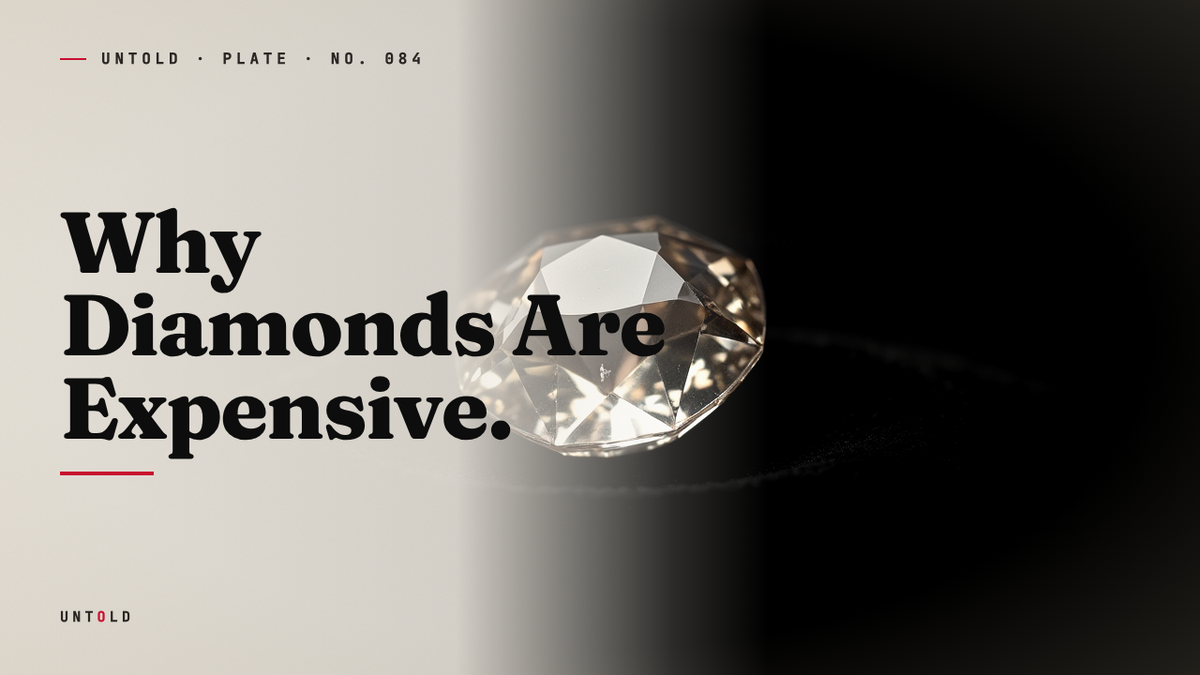
A diamond is carbon. So is the graphite core of a pencil, the soot on a chimney wall, the charcoal in a spent campfire. Arrange the atoms one way and you have something you would throw in the bin. Arrange them another and you have an object people will remortgage a portion of their lives to acquire. The difference in atomic structure is real. The difference in price is not a law of nature. It is a story, and a remarkably durable one.
The conventional explanation for the diamond’s cost is scarcity. Diamonds are rare, the reasoning goes, and rare things command high prices. It is a tidy account, and it happens to be mostly false. The overwhelming majority of diamonds sold in jewelry shops are not rare in any meaningful sense. They are common stones whose supply has been deliberately withheld for more than a century, priced not by geology but by strategy. And once you understand the mechanics of that strategy, you begin to see it everywhere. It is not confined to gemstones. It sits on your breakfast plate, chills in your fridge, and gets described on restaurant menus with the reverent adjective rare.
This is a story about scarcity, and more specifically about who gets to invent it.
The vault that changed everything
For most of recorded history, diamonds were genuinely scarce. They came from a handful of alluvial deposits in India, later from Brazil, sifted out of riverbeds in quantities small enough that a European monarch might own a famous stone the way a nation owns a landmark. Scarcity, in those centuries, was not manufactured. It was simply the situation.
Then, in 1871, prospectors struck an enormous deposit near the Orange River in South Africa, at a hill that would become the Kimberley mine.1 The diamonds did not trickle out. They poured. What had been counted by the handful was suddenly measured by the ton. By every principle a first-year economics student can recite, prices should have collapsed. A flooded market means cheap goods. The men who had invested in these mines watched a fortune threaten to turn into gravel before their eyes.
Into this panic stepped Cecil Rhodes, a British-born imperialist with an appetite for control that extended from mineral rights to entire territories. Rhodes understood something his rivals did not. If supply could no longer be kept scarce by nature, it could be kept scarce by ownership. His idea was audacious in its simplicity: buy every mine, consolidate every claim, and let a single hand decide how many diamonds the world would be permitted to see in any given year.
In 1888 he merged the competing operations into one company, De Beers Consolidated Mines.2 For the next century, that company would exert control over the global diamond trade that no ordinary business could dream of. At its height, De Beers and its distribution network handled the vast majority of the world’s rough diamonds. The genius of the operation was not extraction. It was restraint. De Beers dug diamonds out of the ground and then, quite deliberately, kept most of them out of sight. Stones went into vaults. Supply was released in careful, calibrated trickles designed to keep the market hungry.
Scarcity, in other words, was no longer a fact about the earth. It was a decision made in an office. The rarity you pay for at a jeweler’s counter is, to a significant degree, an accounting choice.
A copywriter and four words
Controlling supply solved half the problem. The other half was demand. A restricted supply keeps prices high only if people still want the thing. And in the early twentieth century, the diamond faced a threat that no vault could counter. During the Great Depression, prices sagged, and De Beers confronted the uncomfortable possibility that Americans simply did not consider a diamond ring necessary.
The solution came not from a geologist but from an advertising agency. In 1938 De Beers hired N. W. Ayer, a Philadelphia firm, to rehabilitate the diamond’s fortunes in the United States.3 The campaign that followed did not sell a stone. It sold an idea, and the idea was that a diamond was the only acceptable symbol of a marriage proposal.
The line that crystallized this idea was written in 1947 by Frances Gerety, a copywriter at the agency. Late one night, exhausted, she scribbled four words before going to bed: A diamond is forever.4 She reportedly thought little of it. It went on to be named the slogan of the twentieth century by Advertising Age, and it accomplished something subtler than a sales pitch. It fused two concepts that have no natural connection: the permanence of a mineral and the permanence of love. A diamond does not tarnish or decay, the logic ran, and neither should a marriage. The gem became a metaphor, and the metaphor became an obligation.
The results were staggering. Before the campaign, only a minority of American engagements involved a diamond ring. Within a few decades, the figure climbed toward the overwhelming majority.3 An entire tradition, one that now feels ancient and inevitable, was constructed inside a single human lifetime by people whose job was to make you want things. De Beers had not discovered a custom. It had authored one.
The playbook migrates to the kitchen
Here is where the story leaves the jewelry case and walks into the pantry, because the diamond’s trick, manufactured scarcity fused with invented tradition, was never unique to diamonds. It is a general-purpose tool for creating value out of perception, and the food industry has wielded it with enthusiasm.
Consider the lobster. Today it is a byword for luxury, priced at figures that would have baffled anyone in colonial New England. Back then, lobster was so abundant along the Atlantic coast that it washed ashore in windrows, sometimes piling up in drifts along the beach. It was fed to prisoners, to apprentices, to servants, and to livestock. In some Massachusetts households, contracts reportedly stipulated that servants could not be made to eat lobster more than a few times a week, a clause meant to protect them from a cheap and monotonous diet.5 Lobster was, in the plainest terms, poverty food.
What transformed it was not a change in the animal but a change in the story. As railroads pushed across the country in the nineteenth century, dining cars needed dishes that would impress passengers who had never seen the sea. Cooks began serving lobster to travelers as an exotic delicacy, and the passengers, ignorant of its lowly reputation on the coast, accepted the framing. Once the perception of luxury took hold, prices followed the perception rather than the supply. The lobster’s rise from prison ration to premium entree is one of the cleanest demonstrations in food history that value is a story before it is a number.
The father of the American breakfast
If Frances Gerety made the diamond a symbol of love, another figure did something comparable with the morning meal, and he did it with a cold-blooded precision that still unsettles when you read about it.
Edward Bernays was the nephew of Sigmund Freud and, by most accounts, the founding architect of modern public relations.6 He believed that the public could be guided, that desires could be engineered by appealing to the right authorities and the right anxieties. In the 1920s, a meatpacking client wanted to sell more bacon. Americans at the time tended to eat light breakfasts: coffee, perhaps a roll or some fruit. Bernays did not argue that bacon was delicious. He went after the framing.
He commissioned a physician to write to thousands of doctors asking whether a hearty breakfast was healthier than a light one. Enough agreed, and Bernays publicized their endorsements as though a medical consensus had spontaneously arisen: a substantial breakfast was good for you, and what could be more substantial than bacon and eggs?6 The campaign worked. The pairing of bacon and eggs, which now feels like an ancestral American institution, was in significant part a public relations construction attached to a client’s inventory. The tradition on the plate was, like the tradition on the ring finger, authored.
Bernays understood a principle that connects him directly to De Beers. “If you can influence the leaders,” the thinking went, you influence everyone who follows them. Doctors for breakfast, film stars for diamonds. Reshape the authority and the crowd reshapes itself.
Real scarcity, and the imitation of it
It would be dishonest to claim that every premium food is a con. Some scarcity is entirely real, and it is worth separating the genuine article from the manufactured version, because the difference is the whole point.
Take saffron, the most expensive spice in the world, which can command sums approaching ten thousand dollars per kilogram.7 That price is not primarily a marketing invention. Saffron is the dried stigma of a specific crocus, and each flower yields only three of them. Producing a single gram of the spice requires harvesting the stigmas from roughly one hundred and fifty flowers, every one picked by hand at dawn during a short blooming window.7 The labor is brutal and the yield is tiny. Here the price reflects a real physical constraint.
But alongside the real scarcity sits a vast architecture of engineered rarity. Champagne is the clearest case. Sparkling wine is made all over the world by essentially the same method, yet only wine from the Champagne region of France may legally carry the name, a protection enforced by regional appellation law.8 The boundary is not a fact of chemistry. It is a legal fence drawn around a word, and the fence keeps both the price and the mystique intact. An identical wine made a few hundred miles away must call itself something humbler and sell for less.
The purest illustration of all might be bottled water. Water from a tap is, in most developed countries, safe, tested, and nearly free. Yet bottled water sells for prices that can run to a thousand times the cost of the same volume from a faucet.9 There is no scarcity here whatsoever. What the consumer buys is the label, the imagery of a mountain spring, the sensation of consuming something purer and rarer than what comes out of the kitchen sink. It is manufactured scarcity in its most naked form: a story wrapped around a substance that is, by any measure, ordinary.
When the vault cracks
The final act of the diamond story is the one the industry least wanted to arrive, and it carries a lesson that reaches back onto the plate.
Diamonds, as it turns out, were never truly scarce even in the geological sense. Vaults have long held enormous stockpiles, released slowly to protect prices, a fact that undermines the entire premise of the diamond as a rare treasure. And in recent years the illusion has met a threat no cartel can hoard its way out of. Scientists can now grow diamonds in a laboratory that are chemically and physically identical to the ones pulled from the earth.10 These are not imitations or substitutes. They are diamonds, produced in weeks rather than dug from a mine, and they sell for a substantial discount, in many cases a large fraction below the price of a comparable mined stone.10
When a thing can be made cheaply and perfectly, the story of its rarity becomes difficult to sustain. The mystique that a century of advertising built is not collapsing overnight, but it is cracking, and the crack runs along the exact fault line that scarcity-based value always contains. Scarcity built on control rather than on genuine constraint is fragile. It survives only as long as no one floods the market.
That same reckoning is arriving in the kitchen. Vanilla, once ruinously expensive because of the labor of hand-pollinating orchids, is increasingly supplied by synthetic vanillin. Caviar, long a symbol of Russian aristocratic excess, is now farmed. Laboratories are growing meat from cultured cells, and the trajectory of the technology points toward abundance. Each of these developments takes a food whose value depended on a bottleneck and threatens to remove the bottleneck. When science can produce the once-scarce thing at will, the premium that rested on rarity has nowhere to stand.
None of this means the diamond will become worthless or that a farmed caviar will taste the same to a discerning palate. Some of what we pay for is genuinely difficult to replicate. But the century-long experiment of De Beers, and the parallel experiment on our plates, has revealed something we tend to resist admitting. A great deal of what we treat as intrinsic worth is nothing of the kind. It is a value we agreed to believe, sustained by whoever controlled the supply and told the most persuasive story.
The next time a menu whispers that a dish is rare, or a jeweler explains that a stone is precious, it is worth pausing to ask a single question: who decided that, and what did they stand to gain from your believing it? Scarcity, more often than we like to think, is not a fact discovered in the world. It is a choice made by someone, and the price on the tag may say far more about the marketing than about the thing itself.

Sources
- Epstein, Edward Jay, “Have You Ever Tried to Sell a Diamond?”, The Atlantic, 1982 — https://www.theatlantic.com/magazine/archive/1982/02/have-you-ever-tried-to-sell-a-diamond/304575/
- De Beers Group, Company History, De Beers Group — https://www.debeersgroup.com/about-us/our-history
- Sullivan, J. Courtney, “How Diamonds Became Forever”, The New York Times, 2013 — https://www.nytimes.com/2013/05/05/fashion/weddings/how-americans-learned-to-love-diamonds.html
- Friedman, Uri, “How an Ad Campaign Invented the Diamond Engagement Ring”, The Atlantic, 2015 — https://www.theatlantic.com/international/archive/2015/02/how-an-ad-campaign-invented-the-diamond-engagement-ring/385376/
- Luzer, Daniel, “How Lobster Got Fancy”, Pacific Standard, 2013 — https://psmag.com/economics/how-lobster-got-fancy-59440
- Tye, Larry, The Father of Spin: Edward L. Bernays and the Birth of Public Relations, Crown Publishers, 1998 — https://www.penguinrandomhouse.com/books/38596/the-father-of-spin-by-larry-tye/
- Fernandez-Sanchez, Jose Antonio et al., “Saffron: A Review of Cultivation, Quality and Economics”, Journal of Food Composition and Analysis, 2019 — https://www.sciencedirect.com/science/article/abs/pii/S0889157519300730
- Comite Champagne, The Champagne Appellation, Comite Interprofessionnel du Vin de Champagne — https://www.champagne.fr/en/from-vine-to-wine/appellation-and-terroir/the-champagne-appellation
- Gleick, Peter H., Bottled and Sold: The Story Behind Our Obsession with Bottled Water, Island Press, 2010 — https://islandpress.org/books/bottled-and-sold
- Paton, James, “Lab-Grown Diamonds Are Reshaping the Jewelry Industry”, Bloomberg, 2023 — https://www.bloomberg.com/news/articles/2023-05-30/lab-grown-diamonds-are-changing-the-jewelry-market
Related reading