The Recipe That Was Never the Point
Coca-Cola guards a formula in a vault, but the real secret was always the story around it.
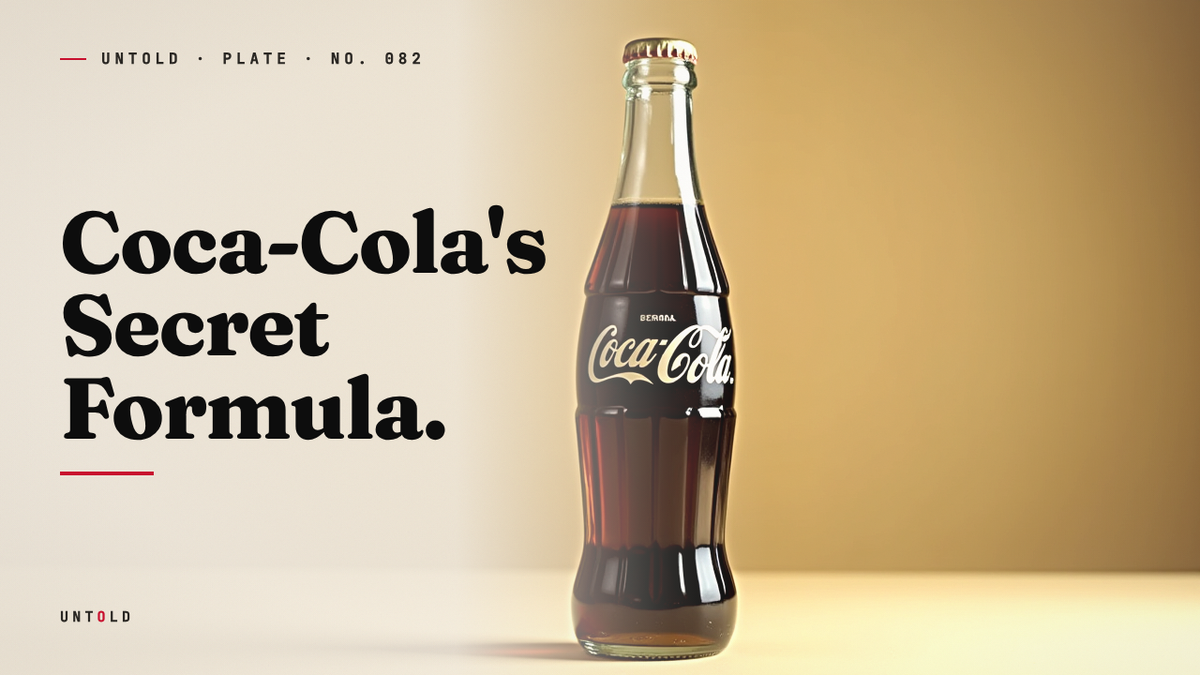
In a purpose-built vault at the World of Coca-Cola in downtown Atlanta, behind a steel door and a theatrical wall of red lighting, sits a single document. Tourists file past it every day. They are told, with reverent stagecraft, that this is one of the most valuable pieces of paper on earth: the original recipe for the world’s most recognizable soft drink, a secret so closely held that no more than a handful of people supposedly know it in full.
The formula has a name. Inside the company it is called Merchandise 7X, the cryptic blend of flavoring oils that gives Coca-Cola its distinct character. For more than 130 years the beverage giant has insisted the world does not officially know what is inside it. And for more than 130 years, that insistence has been the most brilliant thing the company ever produced.
Because here is the part the vault does not advertise. The formula was never really the point. The mystery was. And the man who mixed the first batch died broke, addicted, and largely unaware of what he had set in motion.
A Wounded Pharmacist Chasing a Cure
John Stith Pemberton was not an entrepreneur in any modern sense. He was a pharmacist and self-styled chemist in Georgia, a man who had gone to war and come home damaged. During the final months of the American Civil War, at the Battle of Columbus in April 1865, Pemberton took a saber slash across the chest. The wound left him in chronic pain, and like countless wounded veterans of that era, he was treated with morphine. He became dependent on it.1
That dependency shaped everything that followed. Pemberton spent the postwar years hunting for a painkiller he could bottle and sell, a tonic that might ease his own suffering and turn a profit at the same time. The nineteenth century was awash in such products. The patent medicine trade was booming, largely unregulated, and stuffed with compounds that promised to cure headaches, indigestion, exhaustion, nervous complaints, and vaguely defined “weakness of the blood.” Many of them contained alcohol, opiates, or both.
Pemberton’s inspiration came from across the Atlantic. In Europe, a Corsican chemist named Angelo Mariani had grown wealthy on a product called Vin Mariani, a Bordeaux wine steeped with coca leaves. The alcohol extracted the alkaloids from the leaf, producing a tonic that combined the lift of the coca plant with the warmth of the wine. It was adored across the continent. Popes reportedly endorsed it, and its admirers included heads of state and celebrated writers.2
In 1885, Pemberton produced his own answer to it, which he called Pemberton’s French Wine Coca. It married three active ingredients: alcohol from the wine base, extract of the South American coca leaf, and the caffeine-rich African kola nut. It was, in the language of the day, a nerve tonic and an “intellectual beverage,” marketed to the neurasthenic and the fatigued.
Then a law changed everything.
Prohibition, and a Fizzy Accident
In 1886, the city of Atlanta and Fulton County passed a two-year prohibition ordinance. Pemberton’s flagship product, built on a foundation of wine, was suddenly illegal to sell. He needed a version without alcohol, and he needed it quickly.
He reworked the recipe, pulling out the wine and replacing it with a sweet sugar syrup. What remained was a dark, bitter concentrate flavored with coca, kola, and a proprietary blend of oils. The syrup was designed to be mixed with plain still water at a soda fountain and served by the glass as a refreshing drink, no longer strictly a medicine, though Pemberton still pitched it as a remedy for headache and exhaustion.
The founding legend holds that the drink acquired its most famous quality by accident. The syrup was meant to be diluted with ordinary water. But at Jacobs’ Pharmacy in downtown Atlanta, where it was first sold at the soda fountain, someone is said to have reached for carbonated water instead of still. The mistake tasted better. The effervescence lifted the flavor and gave the drink its characteristic bite. Whether or not the story is literally true, carbonation quickly became standard, and the beverage we know as Coca-Cola, the soda rather than the tonic, took shape.3
The name itself came from Pemberton’s bookkeeper and business partner, Frank Mason Robinson. He suggested Coca-Cola, drawing on its two signature botanicals, the coca leaf and the kola nut, and altering the spelling of kola to a hard C for symmetry. Robinson had a further gift. He wrote the two words out in the flowing, looping Spencerian script that was fashionable for business penmanship at the time. That handwriting, essentially unchanged, remains one of the most recognized logos on the planet.3
Commercial success did not follow. Not at first. In its opening year, the drink sold roughly nine servings a day. It was, by any measure, a failure. And its inventor was running out of time.
The Druggist Who Bought a Legend for $2,300
Pemberton was sick and increasingly desperate. His morphine dependency had not eased, his health was failing, and he was short of money. So he began doing what desperate proprietors do. He sold off pieces of his creation to raise cash, dividing and reselling interests in the formula to various Atlanta businessmen, sometimes overlapping and contradicting himself in the process.
Into this confusion stepped Asa Griggs Candler, a shrewd and devout Atlanta druggist with a sharp instinct for opportunity. Candler moved methodically. He acquired interests in the formula piece by piece, consolidating the tangled ownership until, by 1891, he controlled the entire enterprise. The total he is generally reported to have paid to secure full rights was around 2,300 dollars.4
It is one of the great bargains in commercial history. For roughly the price of a modest house at the time, Candler took sole possession of what would become a brand valued, eventually, in the tens of billions of dollars.
Pemberton did not live to see any of it. He died in August 1888, poor and still in the grip of the addiction he had spent decades trying to cure. He had sold away his stake for a pittance, months before his death, never grasping the scale of what he had created. His son Charley held on to certain rights a while longer, but the family’s connection to the fortune effectively ended there. The inventor of Coca-Cola died broke.
Candler, by contrast, understood something Pemberton never did. He understood that the taste was not the asset.
Candler Sells the Mystery
What Candler grasped, with a clarity that still governs the company today, was that the real product was not the syrup. It was the story. And a story, unlike a syrup, could be protected, amplified, and repeated forever.
He began by locking the recipe away. He told almost no one the full ingredient list, cultivating an aura of secrecy around a formula that, chemically, was not especially remarkable. Then he spent, lavishly, on advertising. This was Candler’s genius. He treated marketing not as a supporting expense but as the core of the business.
He flooded the country with promotional material. Free drink coupons went out by the tens of thousands, enticing people to try the beverage for the first time. His name and logo appeared on calendars, clocks, serving trays, ornate soda fountain fixtures, and painted advertisements sprawled across the brick walls of towns from Georgia to the northern states. The strategy was saturation. Make the drink unavoidable, tie it to a sense of the modern and the refreshing, and let the mystique of the guarded recipe do the rest.
It worked at a staggering scale. By 1900, roughly a billion servings of Coca-Cola had been sold. The drink had gone, in little more than a decade, from a failing fountain tonic to a national habit. None of that growth came from the formula changing. It came from the advertising Candler poured over it.5
The Cocaine Problem
There was, however, a complication buried in the name. Coca-Cola promised coca, and the coca leaf is the raw material from which cocaine is derived. Early batches of the drink did contain trace amounts of cocaine, which was entirely unremarkable in the patent medicine landscape of the 1890s. Cocaine was a legal, common ingredient in tonics, and its presence in small quantities in a fountain drink raised no alarm at first.
That changed as the century turned. Public anxiety about cocaine grew sharply, entangled with the racial fears and moral panics of the era, and a product literally named for the coca plant became a liability. The company needed the flavor of coca to justify its name and its identity, but it could not afford the drug itself.
The solution was chemical. A process was developed to treat the coca leaves so that the active cocaine was stripped out while the flavoring compounds remained. By around 1903, the drink no longer contained active cocaine in any meaningful sense, though the coca flavor, and the name, stayed.6
The arrangement persists in a form that sounds almost too strange to be true. A single facility in New Jersey holds special federal permission to import coca leaves, from which the cocaine is extracted for legitimate pharmaceutical use, while the spent, decocainized leaf provides the flavoring extract that still contributes to the recipe. The coca in Coca-Cola never fully disappeared. It was simply defanged.6
The Vault Is a Marketing Prop
Candler and his family did not hold the company forever. In 1919, they sold Coca-Cola to a group of investors led by the Atlanta banker Ernest Woodruff for 25 million dollars. It was under this new ownership that the vault legend was born, and its origins are far more mundane than the mythology suggests.
To finance the purchase, Woodruff’s group took out a substantial loan, and the secret formula was pledged as collateral. To make that pledge concrete, the written recipe was placed in a bank vault, specifically the Trust Company of Georgia, which held it as security against the debt.7 There was nothing mystical about it. A lender wanted assurance, and a piece of paper representing the company’s most valuable intangible asset was locked away to provide it.
But a formula in a bank vault makes a wonderful story. Over the decades, the company leaned into it, transforming a piece of loan paperwork into a central pillar of the brand’s mythology. In 2011, marking its 125th anniversary, Coca-Cola moved the document from the bank to a purpose-built vault at the World of Coca-Cola museum, where visitors could stand before the sealed container and feel the weight of the secret it supposedly contains.7
The move was, fittingly, a marketing event. The secret had become a spectacle.
The Secret That Was Never Secret
Here is the twist that the vault’s theatrics work hard to obscure. The secret formula is not much of a secret.
In 2011, the American radio program This American Life devoted an episode to the recipe and dug up a 1979 article from The Atlanta Journal-Constitution that reproduced what appeared to be an early version of the formula, complete with ingredients and proportions, drawn from a copy of Pemberton’s own notes. The list included the expected suspects: sugar, water, caramel color, phosphoric acid, caffeine, extract of coca and kola, and a blend of essential oils, lime, lemon, orange, nutmeg, coriander, neroli, and cinnamon among them, that constituted the mysterious 7X flavoring.8
The company, predictably, insisted the published recipe was not the true one. And it may well be that the exact modern formulation differs in its particulars. But the broader truth is unavoidable. Chemists and flavor scientists have reverse-engineered cola for decades. Any competent laboratory can analyze the drink and reconstruct something functionally identical. Store-brand colas do it constantly. The beverage is, at its foundation, sweetened acidified caramel water with caffeine and a citrus-spice flavor blend. There is no unrepeatable chemistry locked in that vault.
What cannot be reverse-engineered is everything around the liquid.
What Is Actually in the Vault
So what is really behind that steel door in Atlanta? Not a formula that no one can crack. A story that no one can copy.
The genius of Coca-Cola was never the recipe. It was the layering of meaning on top of an ordinary syrup: the century of advertising, the handwritten script, the association with holidays and youth and American optimism, the deliberately cultivated sense that you are tasting something slightly forbidden, something with a hidden past involving coca leaves and locked vaults and a secret only a few living souls are trusted to know. That feeling is the product. The sugar water is just its delivery mechanism.
Pemberton mixed the syrup and died with nothing. Candler sold the legend and built an empire. The division of spoils tells you exactly where the value lay. The inventor captured the chemistry and starved. The marketer captured the myth and thrived. The legend outsold the syrup by an incalculable margin, and it has never stopped.
The numbers still stagger. Today, the company reports that its products are consumed at a rate of roughly 1.9 billion servings around the world every single day. No amount of that scale rests on a taste that a rival cannot reproduce. All of it rests on 130 years of accumulated meaning that a rival cannot buy.
The taste is easy to copy. The story is not.
Coda
There is a small honesty in standing before that vault and understanding what it actually holds. Not a mystery syrup guarded from a covetous world, but a monument to the oldest truth in commerce: that people rarely buy the thing itself. They buy what the thing has been made to mean.
John Pemberton spent his life searching for a cure and stumbled instead into an invention he could not comprehend and did not profit from. The men who followed him understood that the chemistry was the least valuable part of the whole enterprise. The next time a cold can hisses open, it is worth remembering that the sensation of tasting something special was engineered, deliberately and relentlessly, over more than a century. The recipe was never the secret. The feeling was.
Sources
- Pendergrast, Mark, For God, Country, and Coca-Cola, Basic Books, 2013. — https://www.basicbooks.com/titles/mark-pendergrast/for-god-country-and-coca-cola/9780465029174/
- Weinberg, Bennett Alan and Bealer, Bonnie K., The World of Caffeine, Routledge, 2001. — https://www.routledge.com/The-World-of-Caffeine-The-Science-and-Culture-of-the-Worlds-Most-Popular-Drug/Weinberg-Bealer/p/book/9780415927239
- The Coca-Cola Company, The Birth of a Refreshing Idea (company history). — https://www.coca-colacompany.com/about-us/history/the-birth-of-a-refreshing-idea
- Britannica, Asa Griggs Candler, Encyclopaedia Britannica. — https://www.britannica.com/biography/Asa-Griggs-Candler
- Britannica, Coca-Cola Company, Encyclopaedia Britannica. — https://www.britannica.com/topic/Coca-Cola-Company
- Benson, Drake, The Cocaine Trade and Coca-Cola, and DEA import records on Stepan Company, various. — https://en.wikipedia.org/wiki/Coca-Cola_formula
- The Coca-Cola Company, The Vault of the Secret Formula. — https://www.worldofcoca-cola.com/explore/explore-inside/explore-vault-secret-formula/
- Glass, Ira, Original Recipe (Episode 427), This American Life, 2011. — https://www.thisamericanlife.org/427/original-recipe
Related reading