The Fast Food That Became a Ceremony
Before the white tablecloths and hushed counters, sushi was a snack eaten standing up.
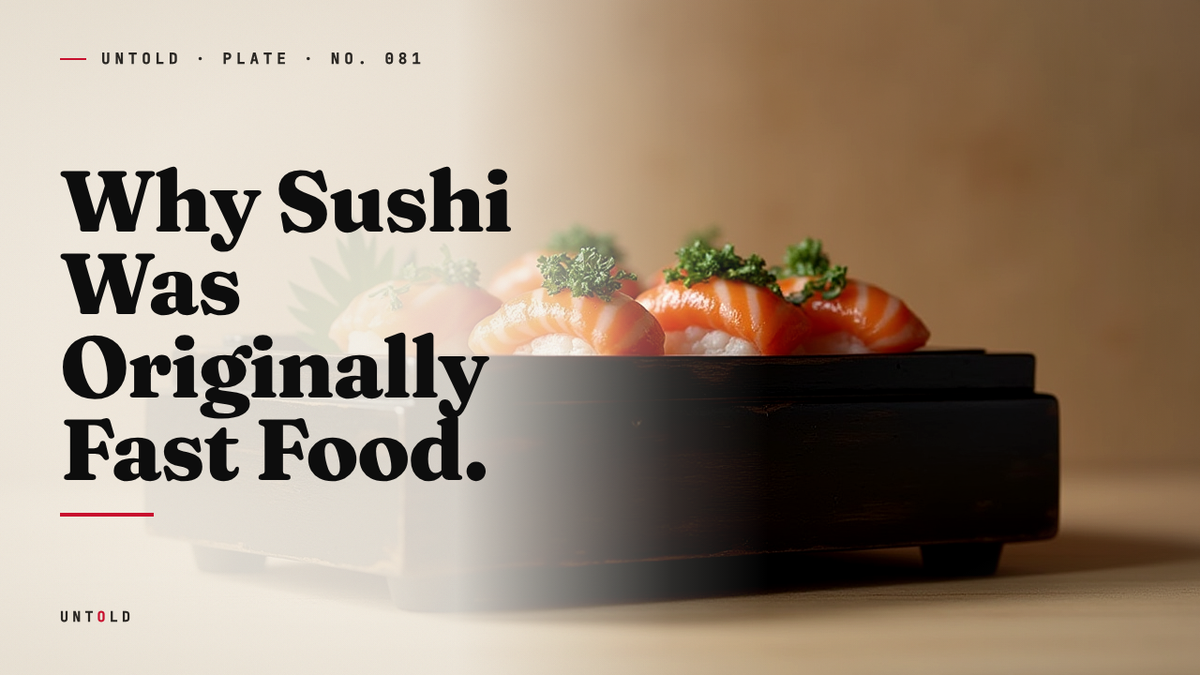
Picture a canal in the city then called Edo, sometime in the 1820s. The water carries the smell of fish and tidal mud. Along the bank, wooden stalls lean into the traffic of porters, day laborers, and merchants hurrying between errands. At one of them, a man in an apron works quickly, pressing a lump of seasoned rice in his palm, laying a sliver of fish across it, and handing it over. The customer eats it where he stands, licks his fingers, and moves on. No plate. No chopsticks. No ceremony. The whole exchange takes less time than it takes to read this sentence.
That snack was sushi. And for most of its history, that is exactly what it was: fuel for a body in a hurry, sold from a stall, eaten on foot, forgotten by the next block. The reverent image we now hold of sushi, the quiet counter and the meditative master, the omakase progression and the four-figure bill, is a recent invention. It sits on top of a far older and far humbler story, one that begins not with freshness but with its opposite. It begins with rot.
The problem before the pleasure
To understand sushi, it helps to forget the fish entirely and start with a logistical crisis. In the warm river deltas of mainland Southeast Asia, fresh fish was a gift that arrived with an expiration measured in hours. In tropical heat, a good catch turned foul before it could be carried inland or saved for a lean week. For communities that depended on protein from rivers and floodplains, spoilage was not a nuisance. It was the difference between a stored surplus and nothing at all.
Somewhere along the Mekong and its tributaries, people worked out an ingenious answer. They cleaned the fish, packed it in salt, and buried it in cooked rice, then left it to sit. What happened next was invisible but decisive. Bacteria in the rice fermented its starches into lactic acid, and that acid, together with the salt, created an environment hostile to the microbes that cause decay. The fish, submerged in this sour bath, could keep for months, sometimes for the better part of a year. The technique had a name that would eventually travel: narezushi 1.
This was not a dish designed for delight. It was designed to survive. And crucially, the rice was not the point. The rice was a preservative, a chemical sponge that generated the acid and then, when the fish was finally ready, got scraped away and discarded. What people actually ate was the fermented fish itself: soft, intensely sour, and pungent in a way that would clear most modern dining rooms. The closest living relative is funazushi, a fermented carp dish still made around Lake Biwa in Japan, whose aroma has been compared, generously, to a very assertive cheese 2.
The method spread north over centuries, carried alongside wet-rice farming as it moved through China and toward the Japanese archipelago. By roughly the eighth century, fermented fish preserved in rice had established itself in Japan, appearing in early tax records and administrative documents as a tribute food 3. The word that would become sushi traces back to an old adjective meaning sour. That etymology is worth holding onto, because it tells you what the word originally promised. Not raw fish. Not fresh anything. Sourness. Preservation. The tang of controlled decay.
This was slow food in the most literal sense. A batch of narezushi might take a year to reach the point of edibility. It was the antithesis of everything the word sushi now conjures. And it stayed that way, more or less, for a very long time.
Impatience as innovation
History rarely changes because someone has a vision. More often it changes because someone gets tired of waiting. Somewhere in the transition through medieval Japan, cooks began asking a reasonable question about narezushi: if the rice was going to be thrown away anyway, why let it ferment for so long that it became mush? Why not eat it too, before it collapsed?
This shift, which took hold over the sixteenth and seventeenth centuries, produced what is sometimes called namanare, a partially fermented sushi in which the rice was still sour but firm enough to eat as part of the meal 1. The fermentation window shrank from a year to weeks. The dish was no longer a way of storing fish for the hungry season. It was becoming a food you made on a shorter horizon and enjoyed as a whole. The fish and the rice, once adversaries in a chemical process, had become companions on a plate.
Then came the discovery that severed sushi from its own past. Cooks realized that the sourness they had spent centuries coaxing out of slow bacterial fermentation could simply be added. Rice vinegar, increasingly available as sake brewing produced it as a byproduct, delivered the tang instantly. Season the rice with vinegar, and it tasted fermented without ever having fermented at all. The acid that had once taken months to develop could now be poured from a jar.
It is hard to overstate what this did. Preparation time collapsed from months to minutes. The whole logic of sushi inverted. What had been a preservation technique, a way of defeating time, became a way of saving it. You no longer waited for sushi. You made it on demand and ate it at once. This was the technological breakthrough that made everything else possible, and it arrived just as Japan was building the perfect city for fast food to conquer.
The boomtown appetite
By the early nineteenth century, Edo had swollen into one of the largest cities on earth. Estimates put its population above a million, rivaling or exceeding London and Paris at the time 4. It was a city of movement: samurai retainers, itinerant merchants, construction crews rebuilding after frequent fires, and a vast underclass of laborers who lived in cramped tenements with little room and less time to cook. This was a population that needed to eat cheaply, quickly, and on the move.
The city obliged with a culture of yatai, mobile food stalls that clustered along canals, roadsides, and temple approaches. They sold tempura, soba noodles, grilled eel, and other quick meals to a public perpetually in transit. The yatai were the food trucks of their day, and the food they served answered the same demand that fast food answers now: hot, portable, immediate, and priced for a working wallet. Into this landscape, sometime around the 1820s, stepped a chef whose name has survived where thousands of his peers vanished.
Hanaya Yohei is traditionally credited with popularizing the form of sushi we would recognize instantly today. His innovation, refined at his Edo stall, was almost aggressively simple. Rather than press fish and vinegared rice together and let them sit, he made each piece to order: a hand-pressed oblong of seasoned rice with a slice of fresh fish laid over the top, formed and served in seconds 5. This was nigiri, and it was purpose-built for speed. Grab it, eat it, keep moving.
The fish came almost literally from the front door. Edo sat on a bay teeming with seafood, and the catch could travel from the water to the stall in hours. There was, however, a stubborn limitation. Refrigeration did not exist. The romantic modern notion of sushi as pristine raw fish would have been reckless in a city where a warm afternoon could turn a fillet dangerous. So the fish was rarely served truly raw. It was marinated in soy sauce, cured with salt, pickled in vinegar, or lightly cooked. Tuna might be soaked in soy. White fish might be salted. Shrimp was boiled. These were not aesthetic choices but safety measures, the same chemical logic that had governed sushi from the beginning, now working on a timescale of minutes rather than months.
There was another difference that would surprise a modern diner. Early nigiri was large, perhaps two or three times the size of a contemporary piece, closer to an onigiri rice ball than the delicate morsel served today 5. It was not a bite. It was a snack substantial enough to blunt a laborer’s hunger. Contemporaries and later historians have reached for the obvious comparison: the sushi stalls of Edo were the hamburger stands of their age. Cheap, filling, fast, and eaten with the fingers, standing in the street, without a hint of the reverence we now attach to the ritual.
How disaster spread a recipe
For about a century, nigiri remained a distinctly Edo phenomenon, a regional specialty tied to the city and its bay. What turned a local street food into a national dish was not a marketing campaign or a shift in taste. It was a catastrophe.
On the first of September in 1923, the Great Kanto earthquake struck the region around Tokyo and Yokohama. The tremor and the firestorms that followed killed well over a hundred thousand people and flattened enormous stretches of the capital 6. In the aftermath, with the city in ruins and work gone, sushi chefs who had trained in the Edo style scattered across the country in search of livelihoods. They carried their craft with them into towns and cities that had never seen it.
The result was a strange inversion of tragedy. A disaster that destroyed the birthplace of nigiri became the vehicle that carried it everywhere else. Chefs displaced from Tokyo set up shop in distant prefectures, teaching apprentices and feeding customers the fast, vinegar-seasoned, hand-pressed sushi of the capital. Within a generation, what had been a specialty of one city’s canals had become a dish understood across Japan. The rubble spread the recipe.
The polishing of a hurry
Here the story takes its final and most ironic turn. The very qualities that made sushi humble, its speed, its street-corner informality, its function as cheap fuel, were slowly refined into their opposite. And the pivot point was, of all things, cold.
Mechanical refrigeration and reliable cold-chain logistics arrived in force in Japan through the twentieth century, and they changed what was possible. For the first time, fish could be kept genuinely fresh and transported over distance without spoiling. The curing and marinating that had always been necessary suddenly became optional. Raw fish, the thing sushi had almost never actually been, became not only safe but reliable. And in becoming reliable, it became desirable. The freshness that refrigeration guaranteed was reframed as luxury.
Postwar Japan took the humble stall and elevated it. The yatai gave way to the counter. The rushed exchange became a performance. The chef, once an anonymous vendor pressing rice as fast as his hands could move, became a itamae, a master whose years of training, precision, and restraint were themselves the product being sold. Sushi acquired a grammar of etiquette, an aesthetics of minimalism, and a price to match. The hurry had been polished into ritual. What was once eaten standing up with greasy fingers was now approached with something close to reverence.
And then, almost as if the dish were trying to remember itself, speed came back. In 1958, an Osaka restaurateur named Yoshiaki Shiraishi opened the first kaiten-zushi, a conveyor-belt sushi restaurant, reportedly inspired by watching bottles move along a brewery’s assembly line 7. He had struggled to staff his shop and needed a way to serve customers quickly and cheaply. The rotating belt did exactly that. It stripped away the ceremony, lowered the price, and turned sushi back into something fast, affordable, and casual: a snack you grabbed as it passed, without waiting on a master’s pace.
In its way, the conveyor belt was sushi returning to its origins. The same democratic impulse that had once filled the yatai of Edo was now spinning around a loop of plastic plates. The two-thousand-year arc had bent back on itself.
What the belt carries
The next time a plate drifts toward you on a conveyor, or a chef sets a single piece of nigiri on the counter with the gravity of a surgeon, it is worth remembering how much history is compressed into that mouthful. The dish began as a defense against decay, a way for river communities to cheat the heat by burying fish in souring rice and eating the rot rather than starving. It became a snack for the working poor of the world’s largest city, seasoned with vinegar to fake the fermentation nobody had time for anymore, sold from stalls and eaten with the fingers. It spread across a nation on the back of an earthquake. And only at the very end, once machines could keep fish cold, did it acquire the freshness, the calm, and the prestige we now mistake for its essence.
The elegance is real, but it is also the youngest part of the story. Underneath the ritual sits something older and more stubborn: food born from rot, hunger, and a hurry, still solving a very old problem one bite at a time.

Sources
- Ishige, Naomichi, The History and Culture of Japanese Food, Kegan Paul, 2001. — https://www.routledge.com/The-History-and-Culture-of-Japanese-Food/Ishige/p/book/9780710306579
- Lyon, Barbara, Funazushi and the Fermented Fish of Lake Biwa, Smithsonian Magazine, 2015. — https://www.smithsonianmag.com/travel/heres-the-fishy-origins-of-sushi-180955372/
- Rath, Eric C., Japan’s Cuisines: Food, Place and Identity, Reaktion Books, 2016. — https://press.uchicago.edu/ucp/books/book/distributed/J/bo24949762.html
- Sorensen, Andre, The Making of Urban Japan: Cities and Planning from Edo to the Twenty-First Century, Routledge, 2002. — https://www.routledge.com/The-Making-of-Urban-Japan-Cities-and-Planning-from-Edo-to-the-Twenty-First/Sorensen/p/book/9780415226516
- Corson, Trevor, The Story of Sushi: An Unlikely Saga of Raw Fish and Rice, Harper Perennial, 2008. — https://www.harpercollins.com/products/the-story-of-sushi-trevor-corson
- Hammer, Joshua, The Great Japan Earthquake of 1923, Smithsonian Magazine, 2011. — https://www.smithsonianmag.com/history/the-great-japan-earthquake-of-1923-1764539/
- Barrett, Dean, The History of Kaiten-zushi and Yoshiaki Shiraishi, BBC Travel, 2019. — https://www.bbc.com/travel/article/20190917-the-japanese-invention-that-changed-how-we-eat
Related reading