The Fruit That Cannot Save Itself
The banana is the world's favorite fruit and one of its most fragile, and history is repeating itself underground.
Peel a banana. The gesture is so ordinary that it barely registers as an act. You do it without looking, mid-sentence, walking to a train. The fruit gives way with a soft tear, the flesh is pale and faintly sweet, and within a minute the whole thing is gone. It is the most eaten fruit on Earth. Humans consume more than 100 billion of them every year, more than apples and oranges combined.1
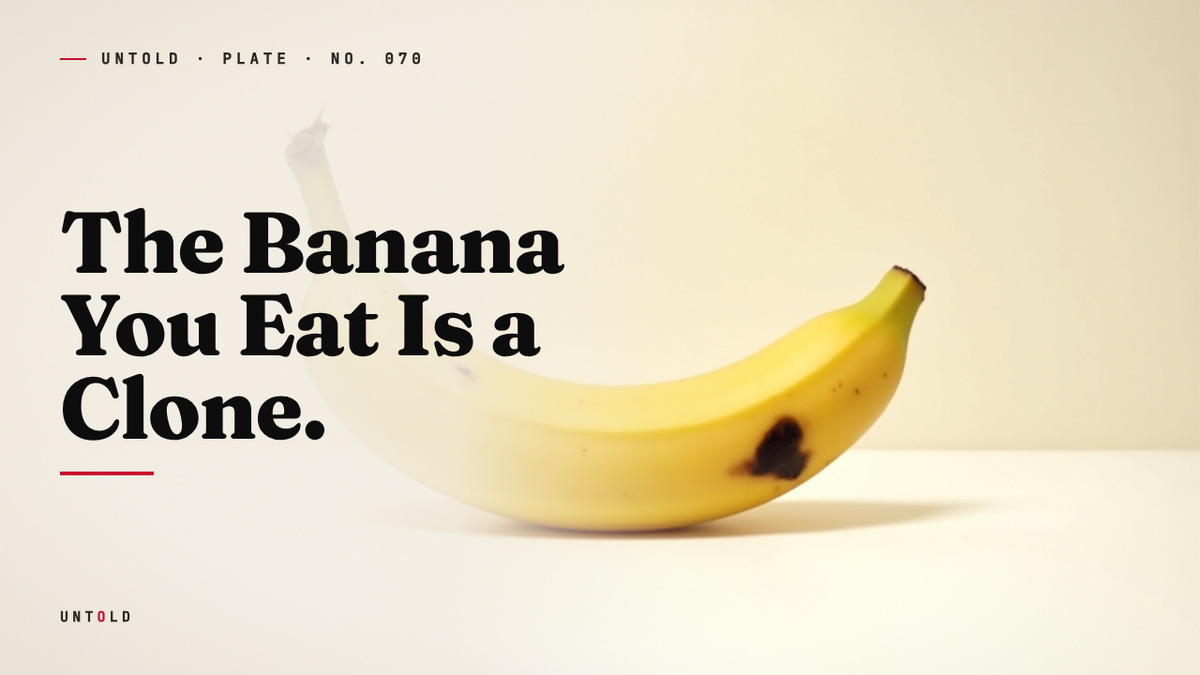
And here is the strange part. The banana in your hand is almost certainly a genetic clone of the last one you ate, and of the next one you will eat, and of nearly every banana sold in every supermarket from Oslo to Nairobi. They are not merely the same variety. They are, in a real biological sense, the same individual, propagated over and over across the planet, a single organism spread thin over millions of acres.
That sameness is the reason the banana is cheap, uniform, and reliably ripe on a Tuesday in February. It is also the reason the banana is one of the most precarious crops in the world. A version of this story has already played out once, within living memory, and it ended with the quiet extinction of the banana most of the twentieth century actually ate. It is now playing out again, and this time there is no obvious understudy waiting in the wings.
A fruit with no future of its own
To understand the banana’s fragility, you have to understand what it lost on the way to your kitchen. Wild bananas are not the seedless, creamy things we know. They are stubby, starchy, and packed with hard black seeds, more like a pod than a dessert. The plump yellow fruit we eat is a botanical accident: a sterile hybrid that produces flesh without needing to be fertilized, and therefore without needing to make seeds.
The trouble with sterility is that a plant which cannot make seeds cannot reproduce through sex, and sex is how species shuffle their genes into new combinations. Every generation of a sexually reproducing plant is a fresh roll of the dice, a slightly different hand dealt against whatever pests and diseases happen to be circulating. The banana forfeits that entirely. To make a new banana plant, growers do not plant a seed. They take a cutting, a piece of the underground stem, and grow a genetically identical copy. No seeds. No sex. No variety.
This means an entire plantation, and in effect an entire global industry, is built from copies of one original plant. It is the agricultural equivalent of writing your civilization’s most important document once and never making a backup that differs in any way. For efficiency, it is a marvel. Every fruit ripens the same, ships the same, tastes the same, fits the same box. For resilience, it is a catastrophe waiting for a trigger. A field of clones is not a population. It is a single target, repeated a billion times.
The banana your grandparents ate
For most of the first half of the twentieth century, the clone that fed the world was not the banana you know. It was a variety called the Gros Michel, and by many accounts it was a better fruit than what replaced it: sweeter, creamier, with a fragrance that people who remember it describe with something close to grief. Its skin was thick, which mattered enormously in an age before refrigerated logistics, because a thick skin meant the fruit could survive weeks at sea without bruising into mush.
Growers loved it. Shippers loved it. And in the early decades of the century, a handful of American companies turned that single fruit into an empire. The most famous was the United Fruit Company, whose reach across Central America was so total that it did not merely trade in bananas. It built railroads, ports, and telegraph lines, and it shaped the politics of whole nations to keep the fruit flowing.2
One of its architects was Minor Cooper Keith, an American entrepreneur who had gone to Costa Rica to build a railway, watched thousands of workers die in the effort, and ended up planting bananas along the tracks to make the line pay. The bananas turned out to be worth far more than the railway. Keith’s ventures merged into United Fruit in 1899, and from there the company grew into one of the most powerful commercial forces in the hemisphere.3
The phrase banana republic was coined for the countries that bent around this trade, where a foreign fruit company held more sway than the elected government. The term began as satire, in an O. Henry story set in a thinly disguised Honduras, but the reality behind it was not funny.4 Land was seized, labor was brutal, and in at least one notorious case, a strike by banana workers in Colombia in 1928 ended in a massacre. The banana was never just a snack. It was infrastructure, capital, and, too often, blood.
And all of it rested on a plant that could not defend itself, because every Gros Michel on Earth was the same Gros Michel.
The soil turns
The reckoning came from below. In the 1890s, in various banana-growing regions, plants began to sicken in a way no one could stop. The leaves yellowed and drooped. The inside of the stem turned brown and rotten. Within months, entire plantations could collapse into a graveyard of wilted stalks. The disease seemed to rise out of the ground itself, and no spray, no fence, no quarantine reliably held it back.
Scientists eventually named it Panama disease, after the region where it drew early attention, and traced the cause to a soil-borne fungus called Fusarium oxysporum. The fungus enters through the roots and colonizes the vascular tissue, the plumbing the plant uses to move water and nutrients. It effectively strangles the banana from within, choking off its own circulation.5 Worse, once the fungus was in the soil, it could survive there for decades, dormant and patient, waiting for the next susceptible plant.
Because every Gros Michel was genetically identical, the fungus faced no resistance and no exceptions. If it could kill one plant, it could kill all of them. The companies responded the only way the economics allowed. When land became infected, they abandoned it and cleared fresh jungle for new plantations, burning through vast tracts of Central American forest in a running retreat from a pathogen they could not see. It bought time, but the fungus always caught up. You cannot outrun something that lives in the ground you are trying to plant in.
By the 1950s, the Gros Michel was commercially finished across the major export regions. The most valuable single crop in the tropical Americas was dying of an infection that could not be cured, only fled, and there was nowhere left to flee.
The understudy from a duke’s greenhouse
The industry needed a banana that could resist Panama disease and still survive the long journey to Northern markets. It found one in an unlikely place: the collections of English botanical gardens, where a resistant variety had been grown decorative and obscure for over a century.
The fruit took its name from William Cavendish, the sixth Duke of Devonshire, whose head gardener cultivated the plant in the great glasshouses of Chatsworth House in the 1830s.6 The Cavendish had been a horticultural curiosity, a rich man’s tropical trophy. Now it became the salvation of a global commodity. Crucially, it shrugged off the strain of Fusarium that had annihilated the Gros Michel.
It was not a perfect replacement. It bruised more easily, so the entire supply chain had to be rebuilt around it: new packing methods, boxes instead of stems, refrigerated ships, temperature-controlled ripening rooms where ethylene gas coaxes the green fruit to yellow on a schedule. And by most accounts the Cavendish simply tasted less interesting, milder and less aromatic than the fruit it replaced. But it worked, and within roughly a decade it had conquered the world. Today it accounts for the overwhelming majority of the bananas in international trade.1
The crisis had been solved. The banana was saved. And here is the part of the story that should make anyone uneasy, because the industry solved the problem by making exactly the same bet again. The Cavendish, like the Gros Michel before it, is a sterile clone, propagated by cuttings, planted as genetically identical copies across millions of acres. The lesson of the first catastrophe was that uniformity is fatal. The response to the catastrophe was to rebuild uniformity from scratch, this time on an even larger scale.
The fungus learns a new key
A disease that once wiped out a global crop does not simply forget how to do it. Fungi evolve. Given enough time and enough identical hosts, Fusarium found its way back.
Sometime in the 1960s or 1970s, a new strain emerged, and it could do what the old one could not: kill the Cavendish. Researchers call it Tropical Race 4, or TR4. It was first identified causing damage in Taiwan and spread outward across Southeast Asia, then to Australia, the Middle East, and Africa.7 For decades, the banana-growing regions of Latin America, the ones that supply most of the fruit consumed in Europe and North America, remained free of it. Then, in 2019, TR4 was confirmed in Colombia, and later in Peru. It had crossed the ocean the fungus was never supposed to cross.8
TR4 is, if anything, harder to fight than its predecessor. It lives in the soil and can persist there for decades. It spreads on the smallest scraps of contaminated dirt: a single boot, a truck tire, a shovel, a plant cutting can carry it into a clean field. There is still no cure and no reliable chemical that stops it. The primary defense is quarantine, an attempt to keep infected soil physically separated from healthy plantations, which is a fragile line to hold across a globalized trade in a fruit that moves by the shipload.
The symptoms would have been eerily familiar to a plantation manager from 1910: yellowing leaves, browning stems, plants strangled from the inside, whole fields lost. The same disaster, a new lock picked by an old enemy. The banana industry is watching, in slow motion, a rerun of the exact event it thought it had escaped seventy years ago.
Buying back the diversity we gave away
The scientific response is, in essence, an attempt to reintroduce the variety the banana surrendered when it stopped making seeds. Several strategies are underway at once. One is conventional breeding, the painstaking work of coaxing sterile bananas to produce the occasional viable seed, then crossing them with wild or resistant relatives in the hope of combining edible flesh with disease resistance. It is slow, uncertain work; the plant is not cooperative.
Researchers such as the banana geneticist Rony Swennen have spent careers on this problem, maintaining vast collections of banana varieties and working to breed and, increasingly, gene-edit plants that can withstand TR4 without losing the qualities that make a banana marketable.9 Others comb the wild banana forests of Southeast Asia, the fruit’s evolutionary homeland, searching for genetic traits that the commercial monoculture threw away. The wild banana, seedy and inedible as it is, holds the raw diversity that the cultivated one lacks: resistance genes, tolerance to drought and disease, the accumulated defenses of millions of years of ordinary sexual reproduction.
All of it circles a single principle, one that ecologists have understood for a long time and that agriculture keeps relearning at great cost. A crop’s real insurance is not a chemical or a quarantine line. It is diversity. A field of genetically varied plants is a field where some individuals may survive what kills their neighbors, where a pathogen cannot assume that unlocking one plant unlocks them all. Uniformity buys efficiency at the price of resilience, and eventually the bill comes due.
A ghost in the candy aisle
There is a small, strange afterlife to this story that most people encounter without knowing it. If you have ever eaten artificial banana flavoring, the kind in cheap candy, in some medicines, in banana-flavored anything, you may have noticed that it does not taste much like the banana you buy. It tastes brighter, sweeter, more intensely banana than the real fruit, and people often assume the flavoring is simply a bad imitation.
But the flavoring may be closer to the truth than the fruit is. The compound at the heart of that candy taste is isoamyl acetate, and the flavor profile was developed in an era when the reference banana was the Gros Michel. What tastes artificial to us is, plausibly, a chemical memory of the banana our grandparents actually ate, preserved in candy long after the fruit itself vanished from the shelves.10 The real Gros Michel still exists in small quantities in parts of the world, but for most people its flavor survives only as a synthetic ghost, a taste from a fruit that history removed.
That is a fitting emblem for the whole enterprise. We built a global food out of a plant that cannot reproduce, cannot vary, and cannot defend itself, and we did it twice, and we are now watching the second attempt run into the same wall as the first. The banana is not a story about a fruit. It is a story about the hidden cost of sameness, about the way efficiency and fragility are often the same thing seen from different angles.
So the next time you peel a banana without looking, it is worth a second of attention. The fruit in your hand is uniform, cheap, and abundant, and it is also, in a quiet and literal sense, one disease away from becoming history. It has happened before. The evidence is in your candy drawer.

Sources
- Food and Agriculture Organization of the United Nations, Banana Market Review and Statistics, FAO, 2022. — https://www.fao.org/markets-and-trade/commodities/bananas/en/
- Chapman, Peter, Bananas: How the United Fruit Company Shaped the World, Canongate, 2007. — https://www.canongate.co.uk/books/1084-bananas/
- Bucheli, Marcelo, Bananas and Business: The United Fruit Company in Colombia, NYU Press, 2005. — https://nyupress.org/9780814799345/bananas-and-business/
- O. Henry, Cabbages and Kings, McClure, Phillips & Co., 1904. — https://en.wikipedia.org/wiki/Banana_republic
- Ploetz, Randy C., Fusarium Wilt of Banana, Phytopathology, 2015. — https://apsjournals.apsnet.org/doi/10.1094/PHYTO-04-15-0101-RVW
- Koeppel, Dan, Banana: The Fate of the Fruit That Changed the World, Hudson Street Press, 2008. — https://www.penguinrandomhouse.com/books/295362/banana-by-dan-koeppel/
- Ordonez, N. et al., Worse Comes to Worst: Bananas and Panama Disease, PLoS Pathogens, 2015. — https://journals.plos.org/plospathogens/article?id=10.1371/journal.ppat.1005197
- Garcia-Bastidas, F. et al., First Report of Fusarium Wilt Tropical Race 4 in Cavendish Bananas in Colombia, Plant Disease, 2020. — https://apsjournals.apsnet.org/doi/10.1094/PDIS-09-19-1922-PDN
- Swennen, Rony, KU Leuven and the Bioversity International Banana Genetic Resources Collection. — https://www.bioversityinternational.org/banana-genetic-resources/
- McGee, Harold, On Food and Cooking: The Science and Lore of the Kitchen, Scribner, 2004. — https://www.simonandschuster.com/books/On-Food-and-Cooking/Harold-McGee/9780684800011
Related reading