The Orchid That Refuses to Be Rushed
The world's second-priciest spice owes its fortune to a single-day flower and the hands of an enslaved boy.
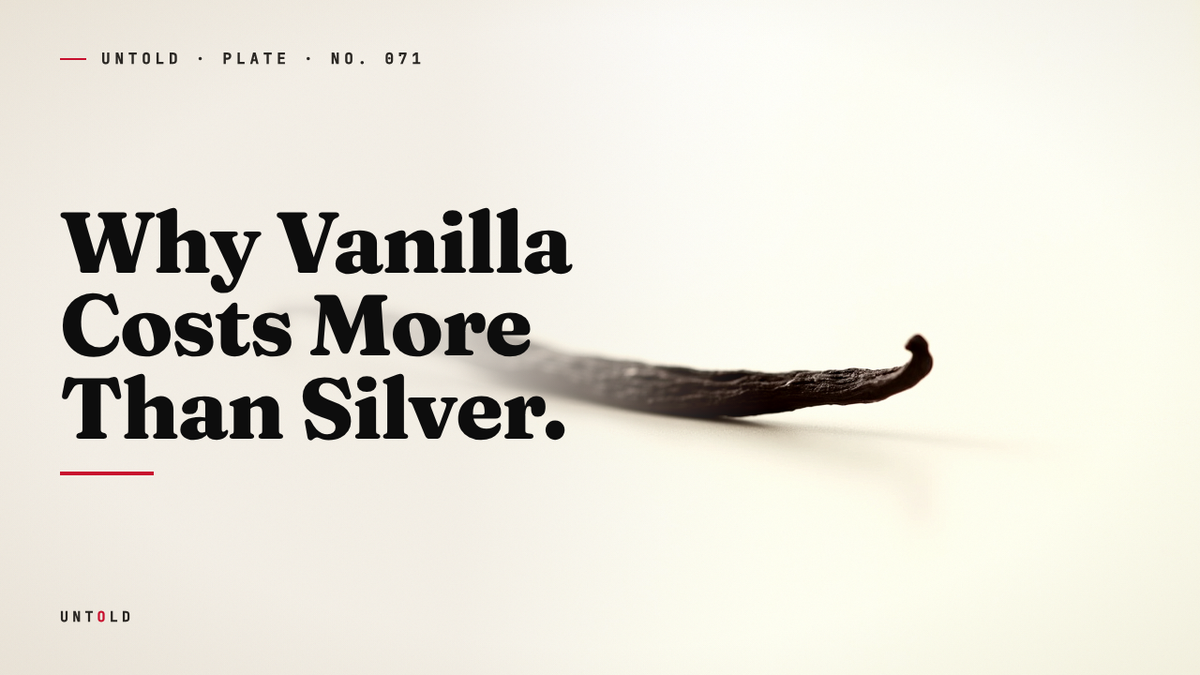
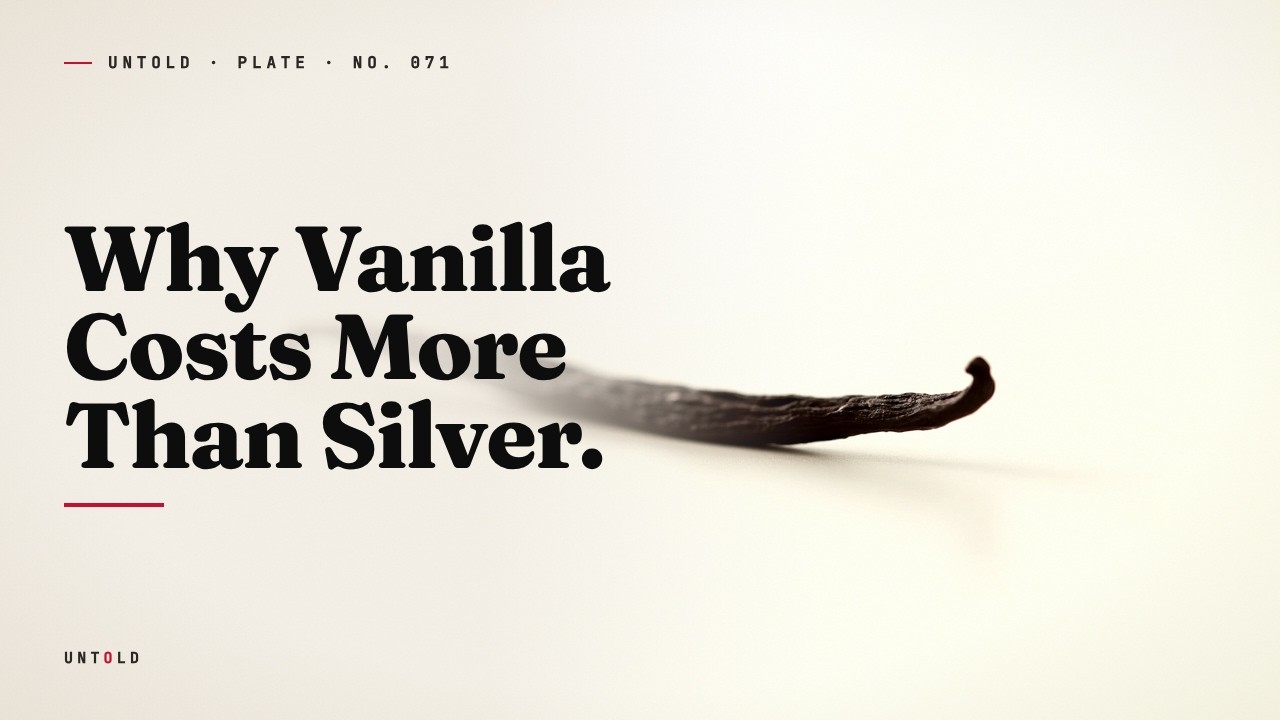
Say the word “vanilla” and most people picture the opposite of luxury. It is the flavor we reach for when we cannot decide, the default scoop, the beige of the dessert world. To call an idea “vanilla” is to call it dull. And yet the substance behind the word has, in living memory, traded for more money per kilogram than silver. At the height of a recent shortage, cured vanilla beans changed hands for roughly six hundred dollars a kilo 1. Only saffron, harvested from the threadlike stigmas of a crocus, outranks it among the spices of the world.
The gap between the word and the thing is one of the stranger stories in food. How did a flavor synonymous with blandness become a commodity that farmers guard with machetes and that manufacturers hedge against like a metal? The answer does not lie in scarcity of land or in some cartel keeping supply artificially tight. It lies inside the biology of a single, stubborn flower: an orchid that will not, under almost any circumstance, reproduce without a human being standing over it.
A Flower With a Lock Built In
Vanilla is the only orchid on Earth cultivated for food. There are more than twenty-five thousand species of orchid, prized across centuries for their strange and extravagant blooms, but only the genus Vanilla yields something we eat. The commercially dominant species, Vanilla planifolia, is a climbing vine native to the humid lowland forests of southeastern Mexico. It sends aerial roots up the trunks of trees and, once a year, produces pale greenish-yellow flowers along its length.
Each of those flowers opens for a single day. If it is not pollinated within that window, usually a matter of hours in the morning, it withers and drops, and with it any chance of a bean. This alone would make vanilla difficult. But the flower compounds the problem with its architecture. Inside the bloom sits a thin flap of tissue called the rostellum, a membrane that separates the male pollen from the female stigma. In most flowering plants, wind or an insect brushing past is enough to bridge that gap. In the vanilla orchid, the rostellum functions almost like a wall, a physical barrier that prevents the flower from fertilizing itself and blocks all but a very specific visitor from doing the job either.
In its Mexican homeland, that visitor was thought to be a native bee of the genus Melipona, a small stingless bee whose body and behavior happened to match the geometry of the flower. Where the orchid and its pollinators had evolved alongside one another, the system worked. Beans set, ripened, and fell. The plant had its partner and the partner had its plant. Move the vine anywhere outside that ancient arrangement, though, and the whole apparatus fell silent.
The Totonac, the Aztec, and the Long Silence
Long before Europeans arrived, the Totonac people of what is now the Mexican state of Veracruz cultivated vanilla in their forests. They understood the plant intimately, harvested its pods, and prized the dark, aromatic beans that emerged after careful drying. In their telling, the vine carried a near-sacred significance, and they used it to perfume and flavor their food and drink.
The Aztec empire, expanding across Mesoamerica, came to demand vanilla as tribute from the Totonac. The Aztecs blended it into xocolatl, the bitter, frothy chocolate drink that so astonished the Spanish when they first encountered it. When Hernan Cortes and his men reached the court of Moctezuma in the early sixteenth century, they tasted chocolate laced with vanilla and, like so many before and after, were seduced by it. By around 1520, Spanish ships were carrying cured beans back across the Atlantic 2.
Europe fell for vanilla quickly. It scented the courts of France and Spain, flavored the confections of the wealthy, and acquired a reputation as an exotic and expensive indulgence. But the continent faced a maddening obstacle. Botanists and gardeners could grow the vine easily enough in hothouses and, eventually, in the tropical colonies of the European powers. The plants climbed and flowered and looked, in every visible respect, healthy. And then, year after year, they produced nothing. No pods. No beans. Just flowers that opened, waited, and died.
For roughly three centuries, this was the state of affairs. Vanilla could be transplanted anywhere warm and wet, but it remained barren everywhere outside Mexico. The reason lay in the same partnership that had made the plant productive at home. The specialized pollinators had stayed behind. Without them, no natural agent existed to lift the rostellum and press the pollen against the stigma. The lock was still there. The key had never left the forest.
The Boy Who Solved It
The first crack in the mystery came from Belgium. In 1837, the botanist Charles Francois Antoine Morren, working with vines in the botanical garden at Liege, managed to hand-pollinate vanilla flowers and produce fruit 3. His achievement proved that human intervention could substitute for the missing bee. But his method was cumbersome and inconsistent. It required time, delicacy, and a botanist’s understanding, and it never scaled into anything that could turn a plantation into a producer. As a laboratory curiosity it succeeded. As an industry it did not.
The breakthrough that mattered came instead from a twelve-year-old boy on a small island in the Indian Ocean. Edmond Albius was born into slavery around 1829 on Bourbon, the French colony now called Reunion. Orphaned young, he was raised in the household of a plantation owner named Ferreol Bellier-Beaumont, who took an interest in the boy and taught him about the plants on the estate, including horticultural tricks such as the hand-pollination of watermelons.
In 1841, working with the vanilla vines that had, like all the others outside Mexico, stubbornly refused to fruit, Albius devised a technique that was as elegant as it was simple. Using a thin sliver of wood or a blade of grass, he lifted the rostellum, the very membrane that had defeated three centuries of European effort, and then, with a deft press of his thumb, folded the pollen-bearing anther against the stigma. The gesture took a second. A flower that would otherwise have died sterile now set a bean 4.
What Albius accomplished was not merely a party trick. It was a repeatable, teachable, astonishingly fast method that any worker could learn and perform hundreds of times a day. Bellier-Beaumont recognized its significance immediately and championed the boy’s discovery. The technique spread across Reunion and then leapt to the neighboring islands, and within a few years the geography of vanilla began to shift dramatically.
Albius himself received almost nothing. Slavery on Reunion was abolished in 1848, and he lived out a difficult life, at one point imprisoned on a theft charge and later released partly through Bellier-Beaumont’s intervention. He died in poverty in 1880. The method he invented as a child remains, essentially unchanged, the basis of the entire global vanilla trade. Nearly every bean grown today is fertilized by a variation of the pinch a twelve-year-old worked out on a plantation he did not choose to be on.
Why the Trick Never Made It Cheap
It would be reasonable to assume that once pollination was solved, vanilla would become abundant and cheap, like so many other crops that shed their mystery. The opposite happened. Albius’s method removed the impossibility, but it replaced it with an enormous, unending demand for human labor.
Consider what a vanilla harvest actually requires. Each flower still opens for only one day, once a year. To catch it, workers move through the vines every single morning during the flowering season, inspecting plant after plant, and hand-pollinating the blooms that have opened that day using the Albius pinch. Miss the window and that flower is gone. On a working plantation this means pollinating thousands of individual flowers by hand, over a season measured in weeks, with no machine able to help.
That is only the beginning. Once fertilized, the green pods must remain on the vine and ripen for several months. Then comes the harvest, and after the harvest, the part of the process that consumes more time than anything else: the curing.
Here lies one of the strangest facts about vanilla. A freshly picked bean smells of almost nothing. The rich, dark aroma we associate with the spice does not exist in the raw pod. It has to be created, coaxed out through a long and labor-intensive transformation. The beans are first “killed,” typically by scalding them in hot water, which halts their vegetative growth and triggers the enzymatic reactions that will generate flavor. Then begins a cycle that traditional producers repeat for weeks. The beans are laid out in the sun by day, then wrapped tightly in cloth and boxes to sweat by night, sun and sweat, sun and sweat, over and over. Over this period, chemical compounds inside the bean break down and recombine, and vanillin, the single molecule most responsible for what we call vanilla, gradually accumulates, alongside hundreds of other aromatic compounds.
The full curing can stretch across several months. By the end, the beans have darkened, softened, and shrunk dramatically. It takes roughly five kilograms of green pods to yield a single kilogram of cured, market-ready vanilla. From the day a flower opens to the day a finished bean is ready to sell, the process can consume the better part of a year. Every stage demands attention, judgment, and human hands. There is no shortcut, and there is no season in which the work stops.
The Ninety-Nine Percent That Was Never a Bean
Given all of this, the market did what markets do: it found a substitute. Most of the vanilla flavor consumed in the world today never came near an orchid. By many estimates, around ninety-nine percent of vanilla flavoring is synthetic vanillin, the isolated molecule manufactured at industrial scale rather than extracted from a cured bean 5.
Synthetic vanillin has an interesting lineage of its own. Chemists first synthesized it in the late nineteenth century, and over the decades manufacturers learned to produce it cheaply from a range of raw materials, including wood pulp byproducts of the paper industry, petrochemical feedstocks, and, more recently, compounds generated by fermenting microorganisms. The result is a molecule chemically identical to the vanillin inside a real bean, produced for a tiny fraction of the cost. It is why a bottle of imitation vanilla extract sits on the supermarket shelf for a few dollars while the real thing commands a premium many times higher.
So why does natural vanilla survive at all, let alone command a fortune? The answer is that a bean is not a molecule. Vanillin is the dominant note, but a cured vanilla pod contains hundreds of distinct aroma compounds interacting in ways that synthetic vanillin, on its own, cannot reproduce. If vanillin is a single note, the real bean is a chord. Chefs, perfumers, and premium food producers pay for that complexity, for the rounded, layered warmth that laboratory vanillin only gestures at.
Patience as a Commodity
The price of real vanilla is also hostage to a narrow and vulnerable geography. Today, Madagascar produces something on the order of eighty percent of the world’s natural vanilla, most of it grown by smallholder farmers on modest plots. This concentration makes the entire global supply acutely sensitive to local shocks. When a cyclone tears through the growing regions, as one did in 2017, a substantial share of the world’s crop can be damaged in a matter of hours, and prices lurch upward across the planet 1.
Theft compounds the problem. Because cured beans are so valuable and so portable, they are stolen from the vine before they are ripe, which drives some farmers to harvest early and pushes others to guard their plants through the night. The volatility feeds on itself. A crop that already takes a year to produce, requires hand-pollination and months of curing, and grows overwhelmingly in one storm-prone corner of the world is almost designed to swing between shortage and glut.
What all of this reveals is that vanilla is expensive for a reason that resists every ordinary economic fix. You cannot mechanize the single-day flower. You cannot speed up the months of sweating and drying. You cannot summon back the pollinator that stayed behind in Mexico. Behind every real bean stands a farmer walking the vines at dawn, a flower that will open only once, and a curing shed where nothing can be hurried.
The word “vanilla” came to mean plain because the flavor became so common, so reliably present in our ice cream and cakes, that we stopped noticing it. But the thing itself is the opposite of plain. It is the only orchid we eat, rescued from three centuries of sterility by a child’s discovery, and it remains costly for the most human of reasons: patience cannot be manufactured. Next time the flavor turns up, quiet and familiar, it is worth remembering the twelve-year-old, the membrane, and the single day the flower gives us to get everything right.
Sources
- Neimark, J., “The Bitter Truth About Vanilla,” Sapiens / reporting on Madagascar vanilla prices, 2018. — https://www.nationalgeographic.com/environment/article/how-vanilla-became-so-expensive
- Rain, P., The Vanilla Cookbook: A History of the World’s Favorite Flavor and Fragrance, Tarcher/Penguin, 2004. — https://en.wikipedia.org/wiki/Vanilla
- Morren, C. F. A., work on hand-pollination of vanilla at Liege, 1837 (historical account). — https://en.wikipedia.org/wiki/Vanilla#History
- Ecott, T., Vanilla: Travels in Search of the Ice Cream Orchid, Grove Press, 2004. — https://en.wikipedia.org/wiki/Edmond_Albius
- Gallage, N. J. and Moller, B. L., “Vanillin: A Review on the Biosynthetic Machinery,” Molecular Plant, 2015. — https://www.cell.com/molecular-plant/fulltext/S1674-2052(14)00040-6
- Havkin-Frenkel, D. and Belanger, F. C., Handbook of Vanilla Science and Technology, Wiley-Blackwell, 2011. — https://onlinelibrary.wiley.com/doi/book/10.1002/9781444329353
- Encyclopaedia Britannica, “Vanilla (plant and flavouring).” — https://www.britannica.com/plant/vanilla
Related reading