The Nut That Cost Manhattan
How a shriveled seed from ten volcanic islands rewrote the map of the modern world.
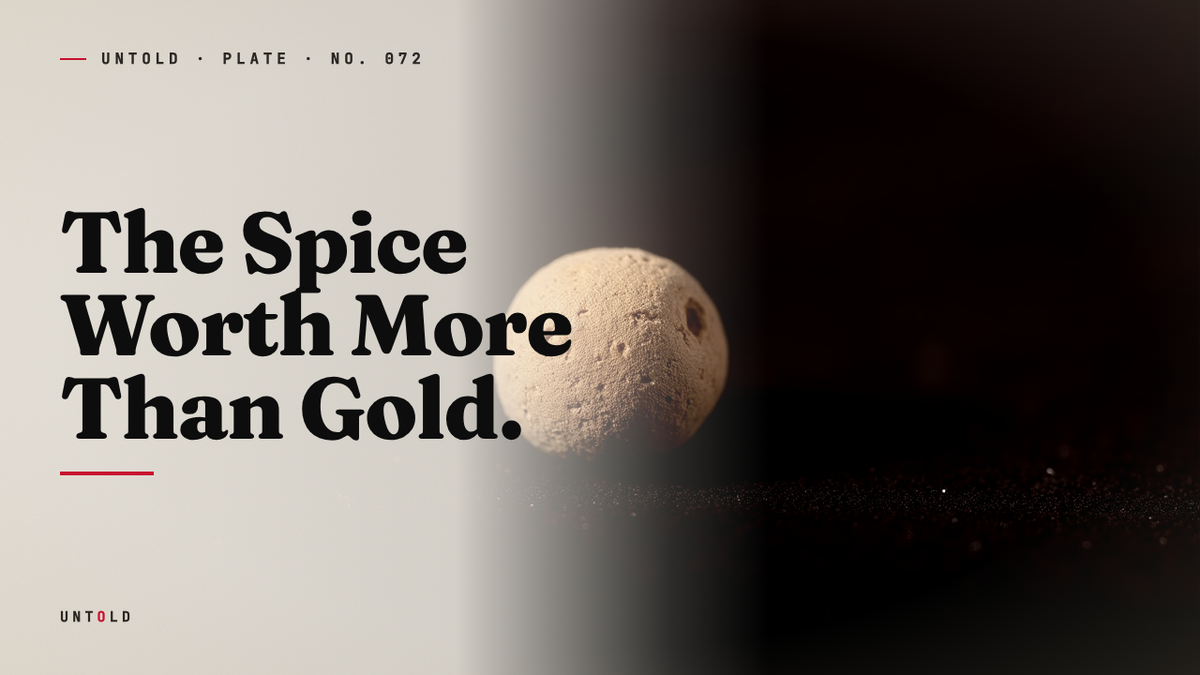
In the markets of early sixteenth-century Europe, a small brown seed the size of an acorn could change a family’s fortune. A single sack of it, carried through the alleys of Amsterdam or unloaded on the docks of London, might buy a merchant a townhouse, a coach, and the servants to fill both. It was not gold, though it was priced against gold. It was not medicine, though physicians swore by it. It was nutmeg, the shrivelled kernel of a tropical fruit, and for roughly two hundred years it was among the most valuable substances on the planet.
What makes the story remarkable is not the price, extraordinary as it was. It is the distance between that price and the thing itself. Today a small tin of grated nutmeg costs a few coins and sits, half-forgotten, on a shelf beside the cinnamon. It is a background flavor, a whisper in eggnog and pumpkin pie, a seasonal garnish grated over warm milk. Nobody has died for it in a very long time. But the modern geography of the world, the borders of Indonesia, the ownership of Manhattan, the plantations of Zanzibar and Grenada, all bear the fingerprints of this one seed. To trace nutmeg’s history is to watch a spice bend empires and erase a people.
Ten specks of volcanic rock
The entire drama begins with an accident of botany. Myristica fragrans, the nutmeg tree, is a tall tropical evergreen that produces a golden apricot-like fruit. When the fruit splits open it reveals a glossy brown seed wrapped in a lacy scarlet web. That seed, dried and ground, is nutmeg. The scarlet web, peeled away and dried separately, is mace, a second and subtler spice. Two prized commodities from a single fruit.
For most of recorded history this tree grew in exactly one place on Earth: the Banda Islands, a cluster of ten small volcanic outcrops in the Maluku archipelago of eastern Indonesia, deep in what Europeans would come to call the Spice Islands. 1 The islands are tiny, a scatter of green rising from the Banda Sea, dominated by a single restless volcano. Yet for centuries these few square miles produced the world’s only supply of nutmeg and mace, and the fruit would not grow anywhere else that anyone had tried.
That geographic monopoly gave the Bandanese a curious kind of power. They were skilled traders long before any European arrived, exchanging nutmeg and mace for cloth, rice, and metal goods brought by Javanese, Malay, Chinese, and Arab merchants. The spice moved along a chain of middlemen that stretched thousands of miles west, each link adding secrecy and markup. Arab traders in particular guarded the source of nutmeg jealously, spinning tales of the perilous lands where it grew, ensuring that the men who bought it in the Mediterranean had no idea where to find it themselves. By the time a nutmeg reached a European kitchen it had traveled something on the order of eight thousand miles and passed through a dozen hands. 2
The medicine that everyone wanted
Why did Europe want it so badly? Taste was part of the answer. Medieval and Renaissance cooking prized strong, warming spices, and nutmeg carried an air of exotic luxury that made it a status object at any wealthy table. But the deeper driver was fear.
When plague swept through European cities, physicians reached for whatever they had, and nutmeg developed a reputation as a defense against it. Doctors prescribed it, pomander-makers folded it into scented balls worn against the nose, and the belief spread that carrying or consuming the spice could ward off the pestilence that was killing families street by street. 3 Whether it worked scarcely mattered. What mattered was that a terrified continent came to believe it did, and belief translated directly into demand. When people think a small brown seed might save them from a horrifying death, they will pay almost anything for it.
The markup reflected that desperation. By some estimates, nutmeg leaving the Banda Islands sold in Europe for many hundreds of times its cost at the source, a spread so vast it made the men who controlled the trade among the richest in the world. 1 A commodity that valuable, grown in exactly one findable place, was an irresistible prize. The only question was who would seize it, and how much blood they would spill to do so.
The race for the source
For generations the Republic of Venice sat at the western end of the spice route, buying from Arab intermediaries and reselling to Europe at enormous profit. That comfortable arrangement collapsed when the Portuguese did something audacious: they went around it. In 1498 Vasco da Gama rounded the southern tip of Africa and reached India by sea, opening a direct maritime route to the East that bypassed the Venetian and Arab middlemen entirely. 4
The strategic logic was blunt and well understood at the time. The Portuguese apothecary and writer Tome Pires, surveying the trade in the early 1500s, captured it in a line that has echoed ever since: whoever was lord of Malacca had his hand on the throat of Venice. Malacca, on the Malay peninsula, was the great funnel through which the spices of the East flowed westward. In 1511 the Portuguese took it by force, and from that gateway their ships pressed on toward the source itself, hunting the Banda Islands and the nearby clove-producing islands of the Moluccas.
But Portugal never fully mastered the nutmeg trade, and it did not hold the field alone for long. At the turn of the seventeenth century a new and colder kind of power arrived from the north. In 1602 a group of Dutch merchants merged their competing ventures into a single chartered company: the Vereenigde Oostindische Compagnie, the Dutch East India Company, universally known by its initials, the VOC. 5
The VOC was something the world had not quite seen before. It is often called history’s first true multinational corporation, and it was more than that. Its charter granted it powers normally reserved for governments. It could raise armies, wage war, build forts, mint coins, and sign treaties in the name of the Dutch state. It was a business with the sovereign teeth of a nation, and it aimed those teeth at a single objective in the Bandas: a total, unbroken monopoly on nutmeg. Not a favorable trading position. Not a dominant share. Everything.
The man who emptied the islands
The monopoly had a human author, and his name was Jan Pieterszoon Coen. Coen was a young, austere, and ferociously capable administrator who rose quickly through the VOC ranks. He believed, with the certainty of a zealot, that Dutch commercial supremacy in the East could be built only on force, and he was not troubled by what that force required. His philosophy survives in a sentence he wrote to his superiors, a line that reads today like a confession: there could be no trade without war, and no war without trade. 6
The Bandanese had proved an inconvenient obstacle to the VOC’s plans. They were independent traders who saw no reason to sell exclusively to the Dutch when Portuguese, English, and Asian buyers all competed for their crop. Earlier agreements the Dutch claimed to have signed were, in Bandanese eyes, either misunderstood or unenforceable. To Coen, this was intolerable defiance. In 1621 he sailed to the islands with a fleet, soldiers, and hired Japanese mercenaries, and set about solving the problem permanently.
What followed is remembered, accurately, as one of the clearest colonial genocides in recorded history. The Bandanese population, estimated at around fifteen thousand before Coen’s arrival, was reduced to perhaps a thousand within a matter of months. 1 The people were killed outright, driven into the mountains where they starved, or captured and shipped away into slavery. Village leaders were executed. Whole communities that had traded these waters for centuries simply ceased to exist. In their place the VOC installed a plantation system, parceling out the islands to Dutch colonists called perkeniers and working the nutmeg groves with enslaved laborers brought from elsewhere in the archipelago.
The result was exactly what Coen wanted. The VOC now owned the only nutmeg-producing islands on Earth, and it managed them with the cold discipline of a monopolist protecting its margins. To keep prices high, the company deliberately restricted supply, burning nutmeg trees by the thousands when harvests grew too large. Every seed exported for consumption was dipped in lime, a treatment intended to kill the kernel so that no buyer could plant it and grow a rival tree. 1 The plan was elegantly total. Control the only source, and destroy the ability of anyone else to become a source.
Nutmeg for New York
There was, however, one loose thread. Among the Banda Islands sat a slender sliver of land called Run, barely two miles long, and for a time it lay under English rather than Dutch control. English traders had established themselves there in the early 1600s, and the little island became a symbol of everything the VOC could not quite finish. So long as anyone but the Dutch held nutmeg-bearing land, the monopoly was imperfect.
The two nations fought over these waters, and over Run in particular, for decades, in a rivalry that fed into the wider Anglo-Dutch wars of the seventeenth century. The dispute was finally settled not in the tropics but in Europe, on paper. Under the Treaty of Breda in 1667, England formally surrendered its claim to Run. 7 In exchange, England kept a possession the Dutch were happy enough to give up: a distant, swampy North American trading post the Dutch had called New Amsterdam, sitting on an island the local peoples knew as Manhattan.
History has rarely offered a cleaner irony. The Dutch, still convinced that control of nutmeg was worth almost any price, believed they had struck a brilliant bargain, trading a marshy colonial afterthought for the last piece of the world’s nutmeg supply. The English took the swamp. That swamp became New York. The single most consequential real estate exchange in the making of the modern world was, at its heart, a trade for a spice.
The monopoly that could not last
A monopoly built on lime-soaked seeds and burned groves was always more fragile than it looked. It depended on a single, unlikely condition: that no fertile nutmeg tree ever escaped the islands. For decades the VOC’s brutal vigilance held. Then it failed, undone by patience and a few living seedlings.
The man usually credited with breaking it was Pierre Poivre, a French administrator and botanist whose very surname, fittingly, meant pepper. In the middle of the eighteenth century Poivre and other French agents managed to obtain live nutmeg plants and smuggle them out of the Dutch-controlled islands. 8 Around 1770 these seedlings were carried to French-held territory, including the island of Mauritius, and from there nutmeg cultivation spread. Trees took root in Zanzibar, in the West Indies, and eventually in Grenada, a Caribbean island that would one day put the nutmeg on its national flag.
Once the tree grew in more than one place, the arithmetic that had justified a genocide collapsed. Supply rose, competition arrived, and the astronomical prices that had made men cross deadly oceans began their long slide toward the ordinary. Within a few decades the monopoly that had cost thousands of lives was simply gone, worth nothing, a piece of history rather than a source of power. The VOC itself, bloated and corrupt, went bankrupt at the end of the eighteenth century and was dissolved, its territories absorbed by the Dutch state.
The seed on the shelf
There is a strange coda to nutmeg’s fall from empire to eggnog, and it lives in the seed’s own chemistry. Nutmeg is not entirely the harmless kitchen ingredient it appears to be. In the small amounts a recipe calls for, it is perfectly safe. But the spice contains a compound called myristicin, and in large quantities the effects turn unpleasant and even dangerous. Consuming a tablespoon or more can bring on nausea, a racing heart, disorientation, and hallucinations lasting many hours, a form of poisoning documented in medical case reports. 9 The seed that Europe once trusted to fend off the plague can, in excess, make a person genuinely ill.
It is a fitting last note for a substance whose entire history was a matter of proportion and belief. A pinch was a luxury worth killing for. A spoonful is a toxin. The gap between those two facts is roughly the gap between the spice as fantasy and the spice as it actually is.
Sit with it for a moment the next time it appears in your kitchen. The little brown seed you grate over warm milk in December grew, for most of human history, on ten remote volcanic islands and nowhere else. Ships were built and crews sacrificed to reach it. A corporation with the powers of a state emptied an archipelago of its people to own it. England and the Dutch traded Manhattan over it. Whole colonial economies, from Mauritius to Grenada, exist in their modern form because a Frenchman named Pepper carried a few seedlings out in secret. The map we live on was quietly redrawn by a nut. It is one of the oldest and least comforting truths of history that the smallest things, wanted badly enough, can move the largest ones.

Sources
- Milton, Giles, Nathaniel’s Nutmeg, Farrar, Straus and Giroux, 1999. — https://en.wikipedia.org/wiki/Nathaniel%27s_Nutmeg
- Turner, Jack, Spice: The History of a Temptation, Knopf, 2004. — https://en.wikipedia.org/wiki/Spice:_The_History_of_a_Temptation
- Freedman, Paul, Out of the East: Spices and the Medieval Imagination, Yale University Press, 2008. — https://yalebooks.yale.edu/book/9780300151350/out-of-the-east/
- Encyclopaedia Britannica, Vasco da Gama, biography and voyage of 1498. — https://www.britannica.com/biography/Vasco-da-Gama
- Encyclopaedia Britannica, Dutch East India Company (VOC). — https://www.britannica.com/topic/Dutch-East-India-Company
- Encyclopaedia Britannica, Jan Pieterszoon Coen. — https://www.britannica.com/biography/Jan-Pieterszoon-Coen
- Encyclopaedia Britannica, Treaty of Breda, 1667. — https://www.britannica.com/event/Treaty-of-Breda-1667
- Encyclopaedia Britannica, Pierre Poivre. — https://www.britannica.com/biography/Pierre-Poivre
- Demetriades, A. K. et al., ‘Low cost, high risk: accidental nutmeg intoxication,’ Emergency Medicine Journal, 2005. — https://emj.bmj.com/content/22/3/223
Related reading