The Vegetable That Held Up a Nation
How a Peruvian tuber fed eight million people, then became the fuse for the worst famine of the nineteenth century.
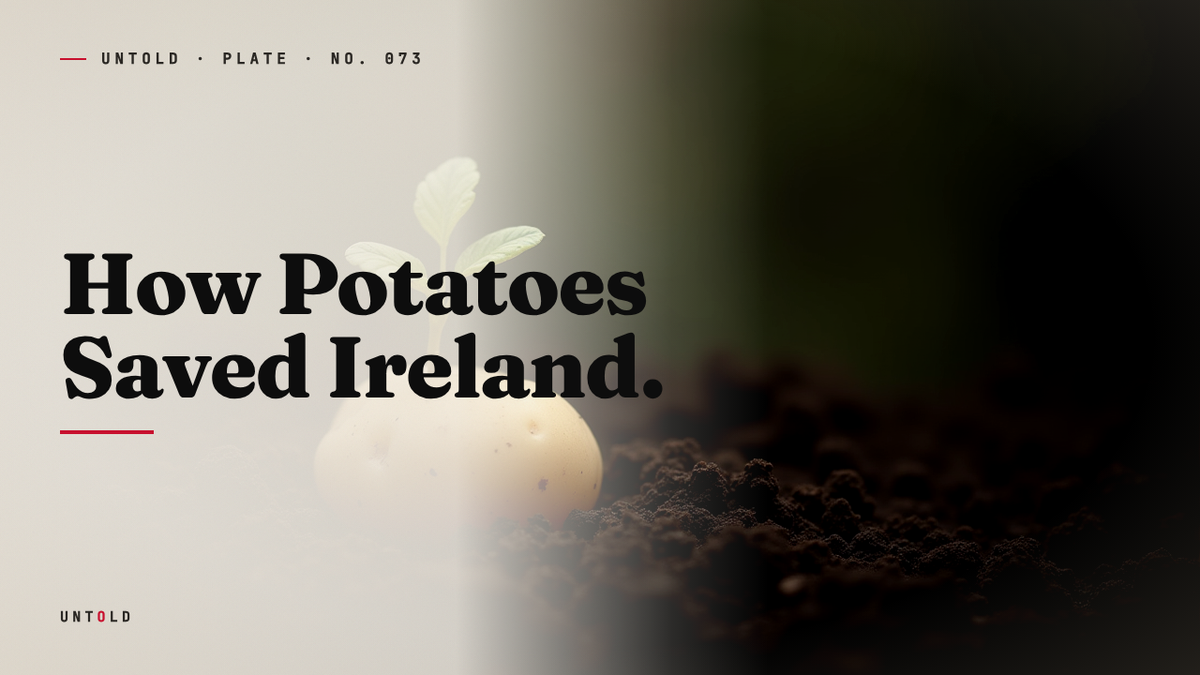
In the autumn of 1845, farmers across Ireland walked out to their fields and found something that did not make sense. The plants had been green and healthy days earlier. Now the leaves were curling into black lesions, and when a man pulled a tuber from the ground it came apart in his hand, soft and stinking, dissolving into a grey slime that smelled of rot. Whole ridges collapsed within a week. Nobody understood what they were looking at. Nobody knew how to stop it. And for a third of the country, this failing crop was very nearly the only thing that stood between a family and starvation.
The story that follows is usually told as a tragedy of nature, a plague that fell from the sky onto an unlucky island. It is more accurate, and more disturbing, to say that the potato had done exactly what it was supposed to do for two centuries. It had fed the hungry, filled the fields, and let a poor population grow larger than the land had ever supported before. The catastrophe was not that the potato failed. It was that a whole society had been arranged so that when it failed, there was nothing underneath.
A Tuber From the Andes
The potato is not native to Europe. It was domesticated thousands of years ago in the high Andes of South America, in what is now Peru and Bolivia, where indigenous farmers bred hundreds of varieties adapted to thin soil and cold altitude 1. Spanish ships carried it back across the Atlantic in the sixteenth century, and by around 1590 it had reached Ireland, most likely through the same trade routes that moved silver and spice.
At first it was a curiosity. Then it turned out to be something close to a miracle crop for the particular conditions of Ireland. Wheat and barley struggled in the cold, wet, rocky ground of the west. The potato thrived in exactly that soil. It could be grown with a spade in ground too poor for grain, and it yielded an extraordinary amount of food per acre. Historians estimate that a single acre of potatoes, combined with the milk of a cow, could feed a family of six for most of a year 2. That same acre produced roughly twice the calories of any grain a farmer might plant instead.
The effect on the population was dramatic. Cheap, abundant calories meant that people could marry younger, raise more children, and survive on smaller and smaller plots of rented land. Over the eighteenth and early nineteenth centuries, Ireland’s population climbed from around three million to more than eight million 3. It became one of the most densely populated rural regions in Europe, and it did so on the back of a single vegetable.
There is a temptation to read this as pure abundance. It was not. The land itself was owned overwhelmingly by a small class of landlords, many of them British and absentee, who had acquired vast estates through centuries of conquest and confiscation. The Irish who actually worked the soil rented it, often in plots so small that only the potato could produce enough food to survive on. A tenant might grow grain and livestock as well, but those were cash crops, sold to pay the rent. The potato was what the family actually ate. This arrangement meant that the potato was not merely popular. For millions of people it was the entire diet, and the only crop they could afford to depend on.
The Fragility Nobody Named
Dependence on one food is dangerous enough. Ireland compounded the danger by depending on one kind of that food. Most farmers planted a variety called the Irish Lumper, a watery, high-yielding potato that grew reliably in poor ground and fed a great many people from a small space. It was not prized for flavour. It was prized because it worked, and because seed was cheap and easily shared from one season’s crop to the next.
The problem with planting the same variety everywhere is that every plant carries the same weaknesses. A field of Lumpers is not a collection of individuals. It is, genetically, close to a single organism spread across the countryside. Whatever can kill one plant can kill them all, in the same way, at the same speed. Modern agronomists have a word for this: monoculture. In the 1840s no one used the term, but the reality was already in place across the whole of rural Ireland. One crop, one variety, one shared vulnerability, planted in millions of small plots from Donegal to Cork.
This is the part of the story that is easy to miss. Nothing about the potato itself was the flaw. The flaw was the structure built on top of it: a landholding system that pushed the poor onto ever smaller plots, a diet with almost no margin, and a genetic uniformity that turned the whole country into a single field waiting for a single disease. A monoculture like that behaves like a fuse. It needs only a spark.
Phytophthora Infestans
The spark had a name, though it would take science decades to prove it. Phytophthora infestans is a microscopic organism often called a fungus but in fact a water mold, an oomycete, more closely related to algae than to mushrooms. It reproduces by releasing spores that spread through moisture, and in cool, damp air it multiplies with terrifying speed. A single infected plant can seed the spores that destroy an entire field within days.
The mold appears to have travelled from the Americas to Europe on ships, arriving in 1845 and spreading rapidly across the continent 4. It reached Ireland in the late summer of that year and found something close to ideal conditions: mild, wet weather, and endless acres of a single susceptible variety planted close together. What might have been a manageable problem in a diverse agricultural system became a nationwide collapse.
The numbers are stark. In 1845, the first year of the blight, roughly half of Ireland’s potato harvest was lost. In 1846 the disease returned and destroyed almost the entire crop. Then came a bitterly cold winter, and a partial recovery in 1847 that was too small to matter, followed by further failures. For a population that ate potatoes and little else, this was not a hardship. It was the removal of the ground beneath their feet.
At the time, no one knew what they were fighting. Most scientists and clergymen blamed the weather, or the damp air, or some vague miasma rising from the soil. One English clergyman and botanist, the Reverend Miles Berkeley, looked closely at the rotting plants and proposed something radical: that the blight was caused by a living fungus growing on the plants, not by the atmosphere around them 5. He was largely ridiculed. The dominant view held that the mold was a symptom of decay, not its cause.
Berkeley was right, but the proof came too late to help anyone. In 1861, the German botanist Anton de Bary carried out careful experiments demonstrating that the organism itself was the agent of the disease, that it infected healthy plants and caused them to rot 6. This was a landmark moment in the history of plant pathology, one of the first times a microorganism was shown to cause a specific disease. It arrived sixteen years after the fields first turned black.
A Famine of Policy
Here is where the story stops being about a vegetable and becomes about the people in charge of a starving country. As the potatoes rotted, roughly a million people died over the following years, not only from outright starvation but from the diseases that stalk the malnourished 7. Typhus, dysentery, and relapsing fever tore through communities. Much of the killing happened in the crowded workhouses where the desperate went for shelter and instead found infection.
And throughout all of it, Ireland was still exporting food. This is the fact that turns tragedy into indictment. Boatloads of grain, butter, cattle, and pork left Irish ports for England during the worst years of the famine 8. The country as a whole produced enough to feed its population several times over. But those harvests did not belong to the people who grew them. They belonged to the landlords, and they were sold to pay rents and debts. A family could starve on a plot of land while the wheat they had raised sailed out of a harbour a few miles away.
The British government’s response was shaped by the economic dogma of the age and by a particular contempt for the Irish poor. The official most responsible for administering relief was Charles Trevelyan, an assistant secretary to the Treasury. Trevelyan regarded the famine less as a disaster to be relieved than as a corrective to be endured. He wrote that the calamity was a judgement of God sent to teach the Irish a lesson, and worried more about the moral hazard of feeding people than about the fact that they were dying 9.
The result was relief that was limited, delayed, and deliberately made unpleasant. The government feared that giving away free food would distort private grain markets and encourage dependence, so much of the aid was tied to public works schemes. The starving were set to building roads that led nowhere and walls that served no purpose, exchanging brutal labour for wages barely sufficient to buy food. Soup kitchens were eventually opened and did save lives, but the overall machinery of relief was governed by a belief that the market should be disturbed as little as possible, even as a population collapsed.
Those who could escape did. Over the famine years and immediately after, more than a million people emigrated, most of them across the Atlantic to North America 10. Many crossed on vessels so overcrowded and disease-ridden that they earned the name coffin ships. Fever and dysentery killed thousands before they ever saw land. The Irish diaspora that would shape the cities of America and beyond was, in large part, born from these desperate crossings.
What the Potato Did Not Do
Step back from the individual horrors and a single conclusion becomes hard to avoid. The famine was not, at its root, a shortage of food. Ireland grew enough grain and raised enough livestock to have carried its people through the loss of the potato crop. The blight destroyed one food source. It was human decision, the structure of land ownership, the priorities of the government, the ideology that valued markets over lives, that turned a crop failure into the death of a million people and the exile of a million more.
This distinction matters, because the comfortable version of the story blames the fungus and stops there. Nature dealt the first blow. But Phytophthora infestans did not decide that food should keep leaving Irish ports while children died in ditches. It did not tie relief to pointless labour or worry about spoiling the market for grain. Those were choices, made by people who had the power to choose otherwise.
After the Fields Turned Black
The demographic wound never fully closed. Within roughly a decade Ireland lost about a quarter of its population, falling from more than eight million to around six 3. But the fall did not stop there. Emigration became a permanent feature of Irish life, and the population continued to decline for the better part of a century, something almost unheard of for a European nation in an age of general growth. A whole society had been reshaped, and it stayed reshaped for generations.
The scientific legacy was more constructive. The blight helped launch the field of plant pathology, and the eventual understanding of Phytophthora infestans changed how farmers and scientists think about crop disease. Today, agriculture guards against a repeat through blight-resistant potato varieties, chemical treatments, and the simple wisdom of not staking a nation’s survival on a single crop of a single kind. Researchers still track the mold as it evolves and spreads across the world’s farms, because it never disappeared. It only stopped being allowed to decide the fate of millions.
The deeper lesson was never really about a vegetable at all. It was about the danger of building a life, or an economy, or a food supply, on a single point of failure. A potato is a remarkable thing. It crossed an ocean, thrived where nothing else would grow, and fed more people on less land than any crop before it. But it was asked to carry a burden that no single crop should ever have to bear, propped up by a system that gave the poor no second option and the powerful no reason to provide one.
So the next time a potato sits on a plate, ordinary and unremarked, it is worth remembering what this particular vegetable once carried. For a while it held up an entire nation. And when it could hold no longer, the people who might have caught the fall decided, for reasons of doctrine and contempt, to let it happen.

Sources
- Reader, John, Potato: A History of the Propitious Esculent, Yale University Press, 2009. — https://yalebooks.yale.edu/book/9780300171457/potato/
- Salaman, Redcliffe N., The History and Social Influence of the Potato, Cambridge University Press, 1949. — https://www.cambridge.org/core/books/history-and-social-influence-of-the-potato/
- O Grada, Cormac, Ireland Before and After the Famine, Manchester University Press, 1993. — https://www.jstor.org/stable/j.ctt155j94w
- Bourke, Austin, The Visitation of God? The Potato and the Great Irish Famine, Lilliput Press, 1993. — https://www.lilliputpress.ie/
- Berkeley, M. J., Observations, Botanical and Physiological, on the Potato Murrain, Journal of the Horticultural Society of London, 1846. — https://www.biodiversitylibrary.org/bibliography/9012
- de Bary, Anton, Die gegenwartig herrschende Kartoffelkrankheit (research on Phytophthora infestans), 1861. — https://en.wikipedia.org/wiki/Anton_de_Bary
- Kinealy, Christine, This Great Calamity: The Irish Famine 1845-52, Gill and Macmillan, 1994. — https://www.gillbooks.ie/
- Woodham-Smith, Cecil, The Great Hunger: Ireland 1845-1849, Harper and Row, 1962. — https://archive.org/details/greathungerirela0000wood
- Gray, Peter, Famine, Land and Politics: British Government and Irish Society 1843-1850, Irish Academic Press, 1999. — https://www.jstor.org/stable/j.ctt1x76g0p
- Miller, Kerby A., Emigrants and Exiles: Ireland and the Irish Exodus to North America, Oxford University Press, 1985. — https://global.oup.com/academic/product/emigrants-and-exiles-9780195051872
Related reading