The Bony Shrug at the Bottom of Your Face
Every human has a chin, no other animal does, and science still cannot agree on why.
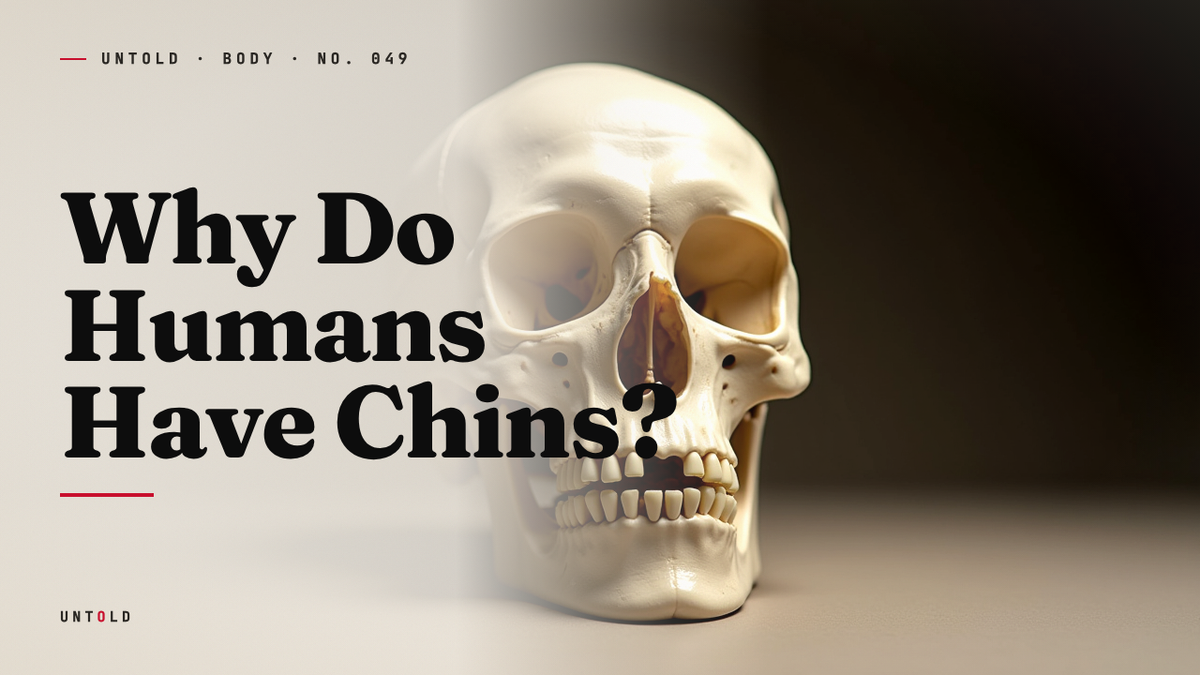
Run a finger along the front of your lower jaw. There is a small forward-projecting shelf of bone there, a point that juts out below your lips. It is so ordinary that you have probably never thought about it. And yet that unremarkable bump is one of the strangest features in the entire animal kingdom, because as far as anyone can tell, no other creature on Earth has one.
Not chimpanzees. Not gorillas. Not orangutans or any of the great apes who share so much of our anatomy. Not even the Neanderthals, our closest extinct relatives, who walked out of the same evolutionary neighborhood and vanished only forty thousand years ago. A gorilla’s jaw slopes gently backward from the teeth toward the throat. A Neanderthal’s powerful mandible fades into the neck without ceremony. Yours alone terminates in a defiant, projecting point. Across every living primate species, and across the entire fossil record of our own genus, anatomically modern humans stand completely alone in possessing a true chin 1.
This should be a solved problem. It is a visible, measurable, universal trait of a species that has spent centuries studying itself in obsessive detail. But scientists have argued about why we have chins for well over a hundred years, and they still cannot agree. The chin is one of those small facts that, once you notice it, refuses to sit quietly. It raises a question that turns out to be far deeper than it looks: does every part of the body have a reason, or do some shapes simply happen?
What a chin actually is
Before chasing explanations, it helps to be precise about what we are trying to explain. Anatomists call the chin the mental protuberance, from the Latin mentum for jaw, and it refers to a specific forward-projecting triangular shelf of bone at the very front of the mandible, the lower jaw. It is not simply the flesh under your mouth, and it is not the same thing as a strong or heavy jaw. A person can have a large, robust jaw with no true chin, or a delicate face with a pronounced one.
The crucial detail, the one that makes the chin a genuine puzzle rather than an anatomical footnote, is this: the chin projects outward even in people who have lost all their teeth. Pull the teeth from a human skull and the bony point remains, still jutting forward beneath where the incisors used to sit 2. That single observation rules out the most boring possible explanation. The chin is not merely leftover bone from anchoring your front teeth, because it persists when the teeth are gone. It is a structure in its own right, and structures in biology usually demand an account of how they got there. Either something built the chin on purpose, sculpted by natural selection, or something produced it by accident as a side effect of building something else.
Charles Darwin himself puzzled over exactly this kind of feature in the 1870s. In The Descent of Man he wrestled repeatedly with traits that seemed to lack any obvious survival value, because for a theory built on the slow accumulation of useful variations, a useless feature is an itch that will not go away 3. If a trait does nothing, why would selection maintain it? Darwin did not settle the chin. But he framed the discomfort that has driven the search ever since. Every generation of anthropologists since has felt obliged to ask what, exactly, the human chin is for.
The chewing hypothesis and why it broke
The oldest and most intuitive answer involves chewing. When you bite down on something tough, the muscles of mastication generate enormous force, and that force loads the jaw with stress. A single hard bite can transmit hundreds of newtons through the bone. The front of the mandible, where the two halves of the jaw fuse together at a joint called the symphysis, is a natural point of weakness, a seam that must resist bending and twisting every time you chew.
So the logic went: perhaps the chin is a buttress. A reinforcement, thickened bone added to a stress point the way an engineer might add a strut to a bridge or a bracket to a shelf. It is an appealing idea precisely because it sounds like the sort of thing evolution ought to do. Natural selection is often described as a tinkering engineer, patching weaknesses and strengthening whatever bears load. If the front of the jaw takes a beating during a lifetime of chewing tough food, a bony reinforcement there would make perfect sense.
The trouble is that when researchers actually tested this idea, it fell apart. Nathan Holton, a biological anthropologist then at the University of Iowa, led a team that examined how the human mandible develops and how it handles the mechanical stresses of chewing. Their work found that the chin does almost nothing to resist those forces. If the goal were to strengthen the symphysis against bending, the chin is in the wrong place and the wrong shape to help 4. As Holton and his colleagues pointed out, if the jaw genuinely needed reinforcement against chewing stress, the most effective solution would be a vertical column of bone, a buttress running up and down the midline, not a horizontal shelf projecting forward at the bottom.
Worse for the theory, the comparative picture makes no sense under a chewing account. Many other primates chew tougher, more fibrous diets than humans do, and put far greater strain on their jaws, yet none of them evolved a chin. Neanderthals ate a demanding diet of meat and hard-won calories with jaws more powerful than ours, and they had no chin at all. If anything, the trend in human evolution runs the wrong way: our diets became softer over time as cooking and food processing spread, reducing the load on our jaws. Softer food, smaller chewing forces, and yet a new bony projection appears. The chewing hypothesis, the front-runner for the better part of a century, quietly collapsed.
Speech, sex, and the crowded field of failed theories
With chewing eliminated, attention turned to the one thing humans do with their jaws that no other animal does: talk. Speech recruits the tongue and the muscles of the floor of the mouth in fast, precise, endlessly repeated movements. Perhaps, the argument ran, the chin evolved to brace the jaw against the constant tug of the muscles involved in producing language. It is a seductive story, in part because it flatters us. Language is often held up as the defining human trait, and it would be tidy if the defining human bump turned out to serve the defining human ability.
But the speech hypothesis has cracks of its own, and most of them are about timing. The chin appears in the fossil record of early anatomically modern humans that predate the clearest evidence for fully complex, syntactic language. The correlation between having a chin and needing one for speech is far weaker than the theory requires, and no clear mechanism shows that the specific stresses of talking would sculpt a forward-projecting shelf rather than some other reinforcement 5. Like the chewing idea before it, the speech account explained the chin only in the loose, after-the-fact way that a good story explains anything. It did not survive contact with the details.
And these were only two entries in a surprisingly crowded field. James Pampush, an anthropologist who has studied the chin’s evolution more carefully than almost anyone, spent years cataloguing every serious explanation that had been proposed. He identified at least seven competing hypotheses in the scientific literature 5. There was the chewing buttress. There was speech. There was sexual selection, the idea that a prominent chin advertised something desirable to potential mates and was chosen for over generations, much as a peacock’s tail is. There were hormonal explanations tying the chin to testosterone and facial development, and explanations rooted in the general shrinking of the human face. Pampush examined them one by one, and one by one, under scrutiny, most of them failed to account for the chin convincingly. The sexual-selection idea, for instance, struggles to explain why women have chins too, and why the trait is so nearly universal rather than exaggerated in one sex the way most sexually selected ornaments are.
After more than a century of hypotheses, the striking pattern was not that one theory had won. It was that nearly all of them had lost. The chin had defeated every attempt to give it a job.
The shrinking face
The most promising modern explanation is also the most humbling, because it suggests the chin may not have a job at all. To understand it, you have to look not at the chin itself but at the face around it.
Over roughly the last thirty thousand years, and with particular speed in the last ten thousand, human faces have grown dramatically smaller. Compared with our Ice Age ancestors, modern people have more delicate skulls, smaller brow ridges, shorter jaws, and faces that sit flatter and more tucked-in beneath the braincase. This is not a subtle trend visible only to specialists. Lay a Cro-Magnon skull beside a modern one and the reduction is obvious. Something pulled the human face inward and shrank it.
Researchers have connected this to a process sometimes called self-domestication. Domesticated animals, from dogs to cattle to laboratory foxes bred for tameness, tend to develop smaller faces, shorter snouts, and more juvenile features than their wild ancestors, a cluster of changes known as domestication syndrome. Some scientists argue that humans, as we became more cooperative, more social, and less physically aggressive across the arc of our evolution, effectively domesticated ourselves, and that our shrinking faces are part of the same package 6. As cooking softened our food and complex tool use reduced the demands on our teeth and jaws, the whole facial architecture retreated.
And here is where the chin re-enters the story, not as a hero but as a survivor. As the face pulled backward and the region above the front of the jaw receded, the lower edge of the mandible may simply have been left behind. Picture the front of the face retreating inward while one small point at the base of the jaw stays put. The result is exactly what we see: a bony shelf projecting forward, not because it was pushed out but because everything around it moved back. The chin, on this account, is less a structure that grew than a landmark that failed to retreat. It is the high-water mark of a face that flowed away from it.
Evolution’s shrug
Here is the twist that unsettles the whole century-long search. If the shrinking-face account is right, the chin may serve no purpose whatsoever. It would not be an adaptation at all, sculpted by survival pressure to do some useful thing. It would be a byproduct, a spandrel in the language the biologist Stephen Jay Gould made famous, an incidental shape thrown off by other changes and never selected for in its own right. The chin might exist simply because our faces shrank around it, and for no other reason at all 5.
That idea is harder to accept than it sounds, because we are trained, by Darwin and by a hundred nature documentaries, to read the body as a catalogue of solutions. Every bone a lever, every curve a tool, every feature the answer to some ancient problem. It is a powerful and mostly correct way to see ourselves. But it can curdle into an assumption that everything must be for something, that no part of the body would exist without a job to justify it. The chin is a standing rebuke to that assumption. Sometimes biology builds a shape with no reason behind it, a form that is simply the leftover geometry of other forces, and no amount of clever storytelling will conjure a purpose that was never there.
This matters beyond the chin. It is a lesson in how to read our own anatomy honestly. Not every feature is a message from natural selection. Some are accidents, quirks, side effects, the structural equivalent of a shadow cast by something else. Recognizing that requires a kind of scientific humility, a willingness to say that the answer to “what is this for” might genuinely be “nothing.” The chin may be evolution’s shrug.
And yet there is a final irony worth sitting with. For a feature that may mean nothing, the chin means an enormous amount to us. It defines the human profile utterly. It anchors portraits and sculptures and caricatures; it is one of the first things we register when we recognize a face; it carries, across cultures, freighted associations with strength, weakness, resolve, and beauty. We rest it in our hands when we think. We raise it in defiance and drop it in defeat. A shape that may have arrived by pure accident has become, for our species, one of the most expressive and recognizable things about us.
Next time you prop your chin in your palm and settle in to think, consider what you may be holding. Not a tool. Not a solution. Perhaps only a mystery that science, after more than a century of trying, still cannot solve.

Sources
- Pampush, J. D. and Daegling, D. J., “The enduring puzzle of the human chin,” Evolutionary Anthropology, 2016. — https://onlinelibrary.wiley.com/doi/10.1002/evan.21471
- Holton, N. E. et al., “Ontogenetic scaling of the human nose in a longitudinal sample: implications for genus Homo facial evolution,” American Journal of Physical Anthropology, 2015. — https://pubmed.ncbi.nlm.nih.gov/25921629/
- Darwin, C., The Descent of Man, and Selection in Relation to Sex, John Murray, 1871. — https://www.gutenberg.org/ebooks/2300
- Holton, N. E., Bonner, L. L., Scott, J. E. et al., “The ontogeny of the chin: an analysis of allometric and biomechanical scaling,” Journal of Anatomy, 2015. — https://pubmed.ncbi.nlm.nih.gov/25581469/
- Pampush, J. D., “Selection played a role in the evolution of the human chin,” Journal of Human Evolution, 2015. — https://pubmed.ncbi.nlm.nih.gov/25488355/
- Cieri, R. L., Churchill, S. E., Franciscus, R. G. et al., “Craniofacial Feminization, Social Tolerance, and the Origins of Behavioral Modernity,” Current Anthropology, 2014. — https://www.journals.uchicago.edu/doi/10.1086/677209
Related reading