The Fingertip's Betrayal
A wound too small to bleed properly still hijacks one of the most sensitive instruments the body owns.
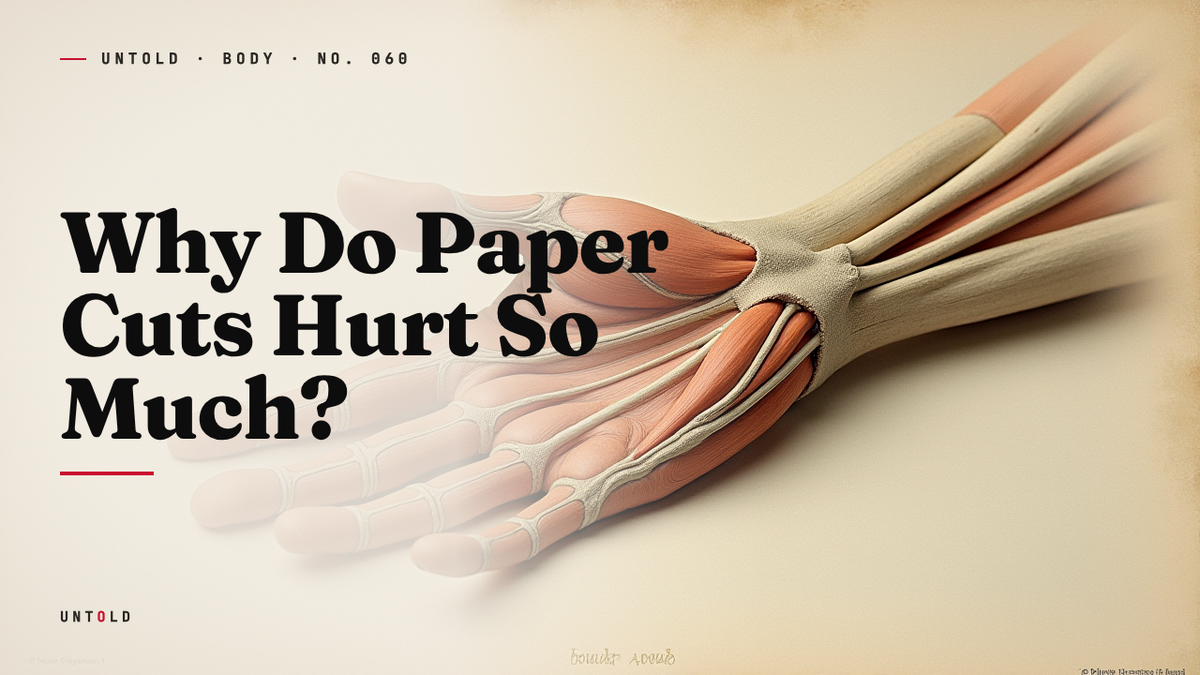
It is a small humiliation, universally understood. You are shuffling a stack of documents, or turning the page of a paperback, or reaching into an envelope, and then there is a bright line of sensation that seems out of all proportion to its cause. You look down expecting damage. There is almost nothing to see. A pale seam, maybe a bead of blood no larger than a pinhead, sometimes not even that. And yet the fingertip is announcing an emergency, throbbing with an intensity that a bruise the size of a plum could not match.
The absurdity is the point. A paper cut is smaller than a mosquito bite and shallower than a shaving nick, but it can dominate an afternoon. It reasserts itself every time you type, wash your hands, or reach into a pocket. The mismatch between the injury and the agony feels almost personal, as if the paper were mocking you. But there is nothing mysterious about it once you understand what the fingertip actually is. The pain is not a glitch. It is the correct output of a system doing exactly what it evolved to do.
A body that pays attention to its hands
The skin is not a passive wrapper. It is an organ dense with sensors, and among the most important of these are the nociceptors: specialized nerve endings whose entire job is to detect damage and report it as pain. When tissue is torn, compressed, burned, or chemically irritated, nociceptors fire, sending signals up through the spinal cord to the brain, which converts the electrical traffic into the conscious experience of hurting. This is the alarm system, and like any alarm system its usefulness depends on where the sensors are placed.
The crucial fact about nociceptors, and about touch receptors more broadly, is that they are not distributed evenly across the body. Some regions are wired for exquisite discrimination, others for little more than a general sense of contact. The classic way to measure this is the two-point discrimination test, in which a researcher touches the skin with two points and gradually narrows the gap until the subject can no longer tell whether they are being touched in one place or two. On the back, the two points can be separated by several centimeters and still feel like a single touch. On the fingertip, the threshold collapses to a couple of millimeters 1. The finger can resolve fine detail because it is packed with receptors at a density the back simply does not possess.
This is why a scratch between the shoulder blades feels vague and hard to locate, while a fingertip can register a single grain of sand, read a line of Braille, or detect a surface irregularity smaller than the width of a human hair. Studies of tactile acuity have found that people can perceive textural features on the order of tens of nanometers when their fingertip is dragged across a surface, a sensitivity that borders on the microscopic 2. The hand is not merely a tool for gripping. It is the body’s principal instrument of exploration, and it is built to notice everything.
That sensitivity carries a cost. A region wired to detect the faintest texture is also wired to detect damage with the same precision and the same urgency. The nociceptors are part of the package. You cannot have a fingertip that reads Braille and shrugs off a laceration. The same crowding of nerve endings that makes the finger brilliant makes it, when injured, unbearable.
The map that draws the hand as a giant
The density of sensors in the skin is only half the story. The other half is what the brain does with the incoming signal. In the 1930s and 1940s the neurosurgeon Wilder Penfield, working at the Montreal Neurological Institute, developed a way to peer into that arrangement. Operating on patients with epilepsy, often while they were awake under local anesthesia, Penfield stimulated points along the surface of the brain with a mild electrical current and asked what they felt 3. A touch here produced a tingle in the thumb. A touch there, a sensation in the lip or the foot.
By mapping these responses across the somatosensory cortex, the strip of tissue that processes bodily sensation, Penfield built a picture of how the body is represented inside the brain. The result was strange and unforgettable. When artists rendered the map as a human figure, scaling each body part to the amount of cortex devoted to it, they produced a creature that has been called the sensory homunculus: a grotesque little man with enormous lips, a vast tongue, and hands so large they dwarf the torso and legs 3. The trunk and the back, despite their physical size, were shrunk almost to nothing.
The homunculus is not a map of the body as it looks. It is a map of the body as the brain cares about it. The hands and lips claim a disproportionate share of neural real estate because those are the regions through which we manipulate objects, feel our way through the world, and, in evolutionary terms, distinguish nourishment from poison and safety from threat. More cortex means more processing, and more processing means more resolution and more amplification. A signal arriving from the fingertip does not fade into a general background hum. It lands in one of the most heavily represented districts of the entire brain, and it is treated accordingly.
This is the first reason a paper cut is so loud. The wound may be trivial, but the fingertip has a direct line to a region of cortex that treats its reports as high priority. The same injury inflicted on the small of the back would barely register. On the finger, it is broadcast at full volume.
The weapon is worse than it looks
So far this explains why the fingertip is a bad place to be injured. It does not yet explain why paper, of all things, is such an effective instrument of injury. A single sheet seems almost designed to be harmless. It bends, it folds, it tears without effort. And yet under magnification its edge is a different object entirely.
A clean blade, a scalpel or a fresh razor, cuts by concentrating force along a smooth continuous line. The wound it leaves is tidy: the tissue is parted rather than destroyed, and the edges can knit back together cleanly. Paper does nothing of the kind. Seen through a microscope, the edge of a sheet is not a line at all but a ragged frontier of protruding wood fibers, jagged and irregular, more like the teeth of a dull saw than the edge of a knife 4. When this edge meets skin under pressure, it does not slice. It saws, snags, and tears, leaving a wound whose walls are frayed rather than smooth.
A ragged wound is a worse wound in a specific sense. Torn tissue exposes and irritates far more nerve endings than a clean incision of the same length, because the damage is spread messily across a wider zone of cells. The paper does not so much divide the skin as chew through it, and every fiber that catches and drags leaves more nociceptors triggered and more debris in its path.
There is also the question of what paper is made of. It is not pure cellulose. To make it smooth, opaque, and printable, manufacturers add mineral fillers and coatings: clay, calcium carbonate, titanium dioxide, and similar particles that stiffen the sheet and lend its edge a hardness the soft fibers alone would lack 4. These additives help explain why something so flimsy can breach skin at all. The edge is rigid enough, at the microscopic scale, to overcome the resistance of the softer tissue it meets. Paper is soft until it encounters something softer, and skin, under the right angle and pressure, qualifies.
Then there is the matter of aim. Paper cuts land, overwhelmingly, on the hands, the fingers, the lips, and occasionally the tongue. These are precisely the regions the homunculus draws as giants, the parts of the body with the highest concentration of sensors and the largest share of cortical attention. It is a kind of perfect storm. The most jagged everyday edge tends to strike the most densely innervated tissue we have.
Shallow enough to stay in the danger zone
The depth of the wound completes the picture, and it is here that the paradox sharpens. Intuition says a deeper cut should hurt more. With paper cuts, the opposite tends to hold, and the reason lies in the layered architecture of the skin.
The outermost layer, the epidermis, is thin, on the order of a fraction of a millimeter across much of the body, though thicker on the palms and soles. Just beneath it sits the dermis, and it is in the upper dermis and the boundary zone between the two layers that the sensory nerve endings are most densely packed. This is the alarm floor of the skin. A paper cut, being shallow, tends to open the tissue precisely here, in the crowded nerve layer, and then stop. It does not plunge past the sensors into the quieter tissue below. It parks itself at the exact depth where the nociceptors live and leaves the wound gaping open right along that seam.
A deeper cut, paradoxically, can be less tormenting in the moment because it passes through the nerve-rich surface and into deeper structures, and because it triggers a more dramatic response that helps shut the pain down. That response is bleeding. When a deep wound bleeds freely, the blood clots, and the clot dries into a scab, a crust that seals the wound and, critically, covers the exposed nerve endings, shielding them from the air and from every passing touch. The scab is nature’s dressing, and it quiets the alarm.
A paper cut denies you this mercy. Because it is so shallow and so narrow, it barely bleeds. Little or no clot forms, no scab develops, and the torn nerve endings are left open to the world. Every subsequent contact reaches them directly. Air moving across the finger, water and soap during hand washing, the salt of sweat, the edge of a keyboard, the fabric of a pocket: each one re-triggers the raw nociceptors, and each use of the hand can pull the wound open again before it has begun to close. The injury is not a single event but a repeating one, refreshed dozens of times a day, which is why a paper cut can feel as if it lasts far longer than its size should allow.
Stack these factors and the mystery dissolves. A ragged tear, in the most heavily innervated tissue in the body, at exactly the depth where the nerves crowd, left unsealed by any protective clot, reporting to a district of the brain that treats fingertip signals as urgent. The pain is not disproportionate to the situation the nervous system perceives. It is a faithful account of a small disaster in a very important place.
An alarm that is not a mistake
It is tempting to file the paper cut under the body’s design flaws, alongside the appendix and the blind spot. But that misreads what is happening. The oversized alarm is not a malfunction. It is the visible edge of a system that has been keeping animals alive for a very long time.
Hands, and the sensitive surfaces around the mouth, are the interfaces through which we meet the physical world. Every tool our ancestors made passed through their fingers. Every unfamiliar object was probed by hand before it was trusted. Every piece of food was tested by lip and tongue. The stakes of these encounters were high, because the world is full of things that can cut, burn, sting, and poison, and the hand was usually the first to make contact. Natural selection did not build the fingertip to be stoic. It built it to be an early warning system, tuned to notice the smallest deviation and to react before minor damage became major.
Seen this way, the paper cut is that finely tuned system caught doing its job on a target it was never meant to fear. The same sensitivity that lets a surgeon feel the faint change in tissue beneath a scalpel, that lets a blind reader glide across a page of raised dots, that lets a mechanic detect a loose fitting by touch alone, is the sensitivity that turns a torn envelope into an event. You cannot have the gift without the liability. They are the same wiring.
The practical advice, such as it is, follows from the mechanism. Keep the cut clean, and cover it. A simple adhesive bandage does what the missing scab cannot: it shields the exposed nerve endings from air and contact, and it gives the tissue a chance to close without being reopened every time the hand is used. The relief a bandage brings is not psychological. It is the physical restoration of the seal the wound was too shallow to make on its own.
So the next time a sheet of paper draws its thin bright line across a fingertip, the target of your irritation is misplaced. The paper is only paper, ragged and stiffened and unlucky in its aim. The real reason it hurts so much is standing at the end of your arm: a machine of astonishing sensitivity, wired to notice everything, doing precisely what it was built to do.

Sources
- Weinstein, S., “Intensive and extensive aspects of tactile sensitivity as a function of body part, sex, and laterality,” in The Skin Senses (ed. Kenshalo), 1968. — https://psycnet.apa.org/record/1969-11090-001
- Skedung, L. et al., “Feeling small: exploring the tactile perception limits,” Scientific Reports, 2013. — https://www.nature.com/articles/srep02617
- Penfield, W. & Boldrey, E., “Somatic motor and sensory representation in the cerebral cortex of man as studied by electrical stimulation,” Brain, 1937. — https://doi.org/10.1093/brain/60.4.389
- Gordon, W. J. (Encyclopaedia of Papermaking) and analyses of paper fiber and mineral filler composition, various. — https://en.wikipedia.org/wiki/Paper
- Purves, D. et al., Neuroscience (chapter on cutaneous mechanoreceptors and nociceptors), Sinauer Associates, 2018. — https://www.ncbi.nlm.nih.gov/books/NBK10895/
- Dubin, A. E. & Patapoutian, A., “Nociceptors: the sensors of the pain pathway,” Journal of Clinical Investigation, 2010. — https://www.jci.org/articles/view/42843
- Corniani, G. & Saal, H. P., “Tactile innervation densities across the whole body,” Journal of Neurophysiology, 2020. — https://journals.physiology.org/doi/full/10.1152/jn.00313.2020
Related reading