The Dial We Did Not Know We Had
Aging was long treated as destiny. A handful of experiments suggest it behaves more like a setting.
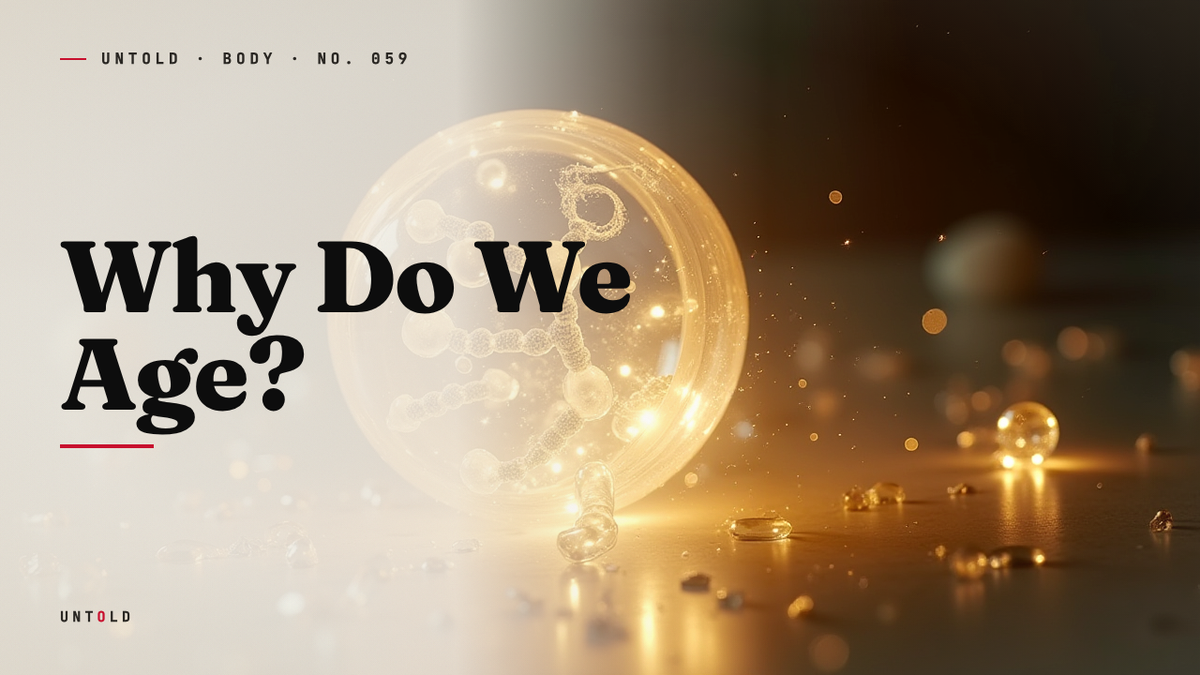
Every second, in trillions of cells at once, your body is copying and recopying the instructions that keep it running. Most of the time the transcription is faithful. Occasionally it is not. A base gets misread, a protein folds wrong, a strand of DNA takes a hit from a stray molecule and the repair crew arrives a fraction too late. Individually these events are trivial. There are simply so many of them, over so many years, that they never stop arriving. This is the quiet truth that modern biology has arrived at: aging is not one great machine wearing out. It is the sum of thousands of small failures that accumulate faster than the body can erase them.
The scale of the consequence is easy to miss because it is so ordinary. Roughly 100,000 people die each day of causes tied to age.1 Cancer, heart disease, stroke, dementia, the slow stiffening of arteries and the slow loss of muscle: nearly all of it traces, at some level, to the same underlying process. And because the process is so universal, it was long treated as a fixed feature of the universe, like gravity. Something to be endured, not investigated. That assumption is now breaking down. A growing number of researchers are asking a question that would once have sounded like hubris. Is aging a law of nature we must obey, or a biological condition we might one day treat?
The reason they dare to ask is partly that the natural world refuses to cooperate with the old assumption. Some animals barely age at all. And what those creatures hide in their cells has reshaped how we think about the whole question.
Forget the Word Old
For almost all of human history, the phenomenon we now call aging was rare. People did not grow old. They died young. In 1900, average life expectancy across much of the world hovered around 32 years.2 Infection carried off children and adults alike. Childbirth killed mothers. Minor injuries turned septic. Famine and violence took their share. The problem was never that human bodies fell apart at 70; it was that most bodies never got the chance.
Then, over the span of a few generations, the timeline was rewritten. Clean water and sewage systems removed the bacterial load that had killed infants for millennia. Vaccines closed off entire categories of death. Antibiotics turned a scratch that once meant amputation into an inconvenience. The effect was not that humans suddenly became biologically sturdier. It was that a far larger fraction of them lived long enough to encounter the slow diseases that had always been waiting at the end of a long life. Mass longevity, in a sense, revealed aging. We built a society in which enough people survived to grow old that growing old became a public problem.
So the first thing to abandon is the intuition that aging is a program running to completion, like a fruit ripening and then rotting on schedule. That intuition has a distinguished history. In the 1880s the German biologist August Weismann proposed that aging existed for the good of the species.3 Old individuals, he reasoned, must die to clear space and resources for the young, and natural selection had therefore built in a mechanism to remove them. It was an elegant idea, and it was influential for decades. It was also wrong, and understanding why it is wrong is the key to understanding what aging actually is.
A Side Effect, Not a Plan
The flaw in Weismann’s reasoning is that natural selection does not plan for the good of the species. It rewards whatever helps an individual pass on its genes, and it is essentially blind to anything that happens after reproduction is done. This is the heart of the modern evolutionary theory of aging, developed in the mid-twentieth century by thinkers including Peter Medawar and George Williams.
Consider a gene that causes some harm late in life but confers an advantage early on. Because most organisms in the wild are killed by predators, accident, or disease long before old age, the early advantage is felt by almost everyone who carries the gene, while the late-life cost is paid by only the few who survive long enough. Selection sees the benefit and ignores the cost. Williams called this idea antagonistic pleiotropy, and it produces a startling conclusion. Aging is not something evolution built. It is something evolution failed to weed out, because by the time the damage shows up, the genes have already been passed along and selection has stopped paying attention.
This reframing matters enormously. If aging were a purpose-built program, stopping it might require dismantling something the body actively wants to do. But if aging is a side effect, a slow drift of damage in the shadow of selection’s indifference, then it becomes, at least in principle, the kind of problem biology solves all the time: a matter of maintenance and repair. Evolution never designed us to last. It designed us to reproduce, and then it looked away. The question that follows is simply mechanical. What, specifically, breaks?
The Clock at the Tips of the Chromosomes
The first concrete answer arrived in 1961, from a young cell biologist named Leonard Hayflick. The reigning dogma at the time held that normal human cells, given the right nutrients, would divide indefinitely in a dish. Hayflick found that they would not.4 Human cells copied themselves roughly 40 to 60 times and then stopped, entering a stable state in which they remained alive but refused to divide. This ceiling became known as the Hayflick limit, and it demolished the idea that cells were naturally immortal.
The question of why cells count their divisions was answered later, and it turns out the clock sits at the very tips of the chromosomes. Each chromosome ends in a stretch of repetitive DNA called a telomere, a kind of protective cap. Because of the way DNA is copied, a little of that cap is lost with every division. The telomere functions like the plastic tip of a shoelace. As long as it is intact, the genetic material is protected. Once it wears too thin, the cell can no longer safely replicate, and it withdraws.
In the 1970s and 1980s, Elizabeth Blackburn, working first on the strange DNA of a pond organism, discovered that cells possess an enzyme capable of rebuilding these caps. She and her colleague Carol Greider named it telomerase, and for the discovery Blackburn shared the 2009 Nobel Prize in Physiology or Medicine.5 For a moment it looked as though the answer to aging might be simple: turn telomerase back on, keep the caps long, and cells could divide forever.
The catch is that some cells already do this, and we have a name for them. Cancer cells reactivate telomerase to escape the Hayflick limit and become effectively immortal, which is precisely what makes them so dangerous. The telomere clock, it turns out, is not a flaw so much as a safeguard, a brake on runaway division. Any intervention that lengthens telomeres has to reckon with the fact that unlimited cellular division is the definition of a tumor. Telomeres, in other words, are only one thread in a much larger tangle.
Power Plants and Zombie Cells
Inside every cell sit hundreds to thousands of mitochondria, the compartments that convert food and oxygen into usable energy. They are astonishingly productive, and productivity has a cost. The same chemistry that generates energy also throws off reactive byproducts, corrosive molecules that damage proteins, membranes, and DNA, including the mitochondria’s own small genome. Cells have elaborate defenses against this wear, but the defenses are imperfect, and over decades the damage outpaces the repair. Mitochondria become less efficient, tissues that depend heavily on energy such as muscle and brain feel the shortfall first, and the general decline of old age acquires one of its physical bases.
Then there are the cells that will not leave. When a cell reaches its Hayflick limit or suffers damage it cannot fix, it can enter a state called senescence: it stops dividing, but it does not die and it does not get cleared. Instead it lingers, and it changes its behavior. Senescent cells pump out a steady cocktail of inflammatory signals, a phenomenon researchers call the senescence-associated secretory phenotype. In small numbers these cells may serve useful functions in wound healing and tumor suppression. In large numbers, accumulating over the years, they become a problem. Because they poison the tissue around them with chronic low-grade inflammation, they have earned a nickname: zombie cells.
That slow inflammation is now understood as a driver of much of what we recognize as aging. Stiffened arteries, arthritic joints, the gradual failure of tissue to regenerate: a meaningful share of it can be traced to senescent cells whispering distress signals to their neighbors, year after year. The picture that emerges from all of this is not a single failing part but a web of interacting processes, telomere attrition, mitochondrial decay, cellular senescence, and several more, each feeding the others. What turned this web from a list of miseries into a research program was a discovery about worms.
The Worm That Lived Twice as Long
In 1993, Cynthia Kenyon and her team at the University of California, San Francisco, were studying a tiny roundworm called Caenorhabditis elegans, a favorite of biologists because its short life and simple body make it easy to track. Kenyon altered a single gene, called daf-2, and watched something that should not have been possible. The mutant worms lived roughly twice as long as their unaltered siblings.6 And they were not merely surviving in a decrepit state. They stayed vigorous, active, and youthful well into what would normally have been advanced old age.
The significance of this was hard to overstate. If aging were simply the accumulation of random, unavoidable damage, no single genetic change should be able to slow the whole process so dramatically. Instead the experiment suggested that aging is governed, at least in part, by regulatory pathways, networks of genes that set the pace at which an organism ages and repairs itself. The daf-2 gene turned out to sit in a signaling pathway related to insulin and growth, one that is conserved across an enormous range of species, from worms to mice to humans. Aging suddenly looked less like an inexorable slide and more like a dial: something the body could, in principle, be persuaded to turn.
The hunt for ways to turn that dial began in earnest. One line of attack targets the zombie cells directly. Researchers have identified compounds called senolytics that selectively kill senescent cells while sparing healthy ones. In mice, clearing these cells has restored physical strength, improved organ function, and extended the healthy portion of life.7 Another line focuses on the growth pathways Kenyon’s work implicated. A drug called rapamycin, originally isolated from soil bacteria on Easter Island and used to prevent transplant rejection, calms an overactive nutrient-sensing pathway known as mTOR. In carefully controlled mouse studies, rapamycin extended lifespan by figures on the order of 25 percent, one of the most robust life-extension results ever produced in a mammal.8 None of this is a fountain of youth. But taken together, it established that aging is malleable, that its speed can be changed by molecules we understand.
The Experiment That Ran the Clock Backward
Slowing aging is one thing. Reversing it is another, and for a long time reversal was considered the boundary that biology could not cross. That boundary was tested in 2020 by a team led by David Sinclair at Harvard Medical School.
The experiment rested on a distinction that has become central to modern aging research. There is the damage to the genetic sequence itself, the mutations, which are hard to undo. And there is the epigenome, the layer of chemical markers sitting on top of the DNA that tells each cell which genes to switch on and off. Over a lifetime, the epigenome drifts, losing the crisp patterns of youth and taking on a noisier, more disordered configuration. Sinclair’s hypothesis was that this epigenetic drift, rather than sequence damage alone, is a major cause of aging, and that if the original youthful pattern could be restored, the cell would behave young again.
His lab used a subset of the so-called Yamanaka factors, a set of genes capable of resetting a cell’s identity, and applied them to the retinal nerve cells of aged, visually impaired mice. The treatment appeared to roll back the epigenetic clock in those cells. Nerve fibers regenerated, and the aged mice recovered lost vision.9 The cells had, in a meaningful sense, been made young again, without erasing their identity or turning them cancerous. It was a proof of principle, in one tissue, in a laboratory animal. But it demonstrated something that had been an article of near-faith to deny. Aging, at the cellular level, is not necessarily a one-way street.
From Lifespan to Healthspan
So, can we stop aging? The honest answer is no, not yet, and it is worth being blunt about how much distance separates a mouse eye from a human life. There is no proven pill, no cream, no supplement that reverses aging in people. Many of the interventions that work in mice have failed, produced serious side effects, or remain entirely untested in humans, and the field has a long and cautionary history of promising compounds that dissolved under scrutiny.
But the goal has quietly shifted, and the shift is more than semantic. Researchers increasingly talk not about lifespan, the raw number of years, but about healthspan, the number of years lived free of serious disease and disability. The distinction matters because extending life without extending health is a hollow prize; nobody wishes for more years of frailty. The aim of the most serious work in the field is to compress the period of decline, to keep people vigorous for as long as possible and then let the end come quickly, rather than to simply postpone death while stretching out the misery before it.
And here the research arrives at an ending that is almost anticlimactic. The most reliable ways to extend healthspan available today are not exotic. They are sleep, movement, and unprocessed food, the advice so familiar it has become easy to ignore. What has changed is our understanding of why it works. Regular exercise, it turns out, helps clear senescent cells and stimulates the repair and renewal of mitochondria, doing for free some of what the experimental drugs attempt to do in a lab.10 The boring counsel and the cutting-edge science point in the same direction, which is itself a kind of evidence.
Aging may be the deepest problem biology has ever set itself, a puzzle that touches every disease and every death from natural causes. It is also, we now understand, not a curse or a punishment or a moral failing. So the next time you find a gray hair, it is worth remembering what it actually records. Not decay, exactly, but persistence: the visible trace of countless cells that copied themselves, took their damage, and carried you this far.

Sources
- López-Otín, C. et al., The Hallmarks of Aging, Cell, 2013. — https://www.cell.com/fulltext/S0092-8674(13)00645-4
- Roser, M., Ortiz-Ospina, E. & Ritchie, H., Life Expectancy, Our World in Data, 2019. — https://ourworldindata.org/life-expectancy
- Weismann, A., Essays Upon Heredity and Kindred Biological Problems, Clarendon Press, 1889. — https://archive.org/details/essaysuponheredi01weis
- Hayflick, L. & Moorhead, P. S., The serial cultivation of human diploid cell strains, Experimental Cell Research, 1961. — https://doi.org/10.1016/0014-4827(61)90192-6
- The Nobel Prize in Physiology or Medicine 2009 (Blackburn, Greider, Szostak), Nobel Foundation. — https://www.nobelprize.org/prizes/medicine/2009/summary/
- Kenyon, C. et al., A C. elegans mutant that lives twice as long as wild type, Nature, 1993. — https://www.nature.com/articles/366461a0
- Baker, D. J. et al., Naturally occurring p16Ink4a-positive cells shorten healthy lifespan, Nature, 2016. — https://www.nature.com/articles/nature16932
- Harrison, D. E. et al., Rapamycin fed late in life extends lifespan in genetically heterogeneous mice, Nature, 2009. — https://www.nature.com/articles/nature08221
- Lu, Y. et al., Reprogramming to recover youthful epigenetic information and restore vision, Nature, 2020. — https://www.nature.com/articles/s41586-020-2975-4
- Chakravarty, E. F. et al., Exercise and senescent cells / mitochondrial biogenesis review, Ageing Research Reviews, 2021. — https://doi.org/10.1016/j.arr.2021.101425
Related reading