The Toe That Forgot Its Purpose
Your smallest toe is a half-finished draft, caught between a life in the trees and one spent walking upright.
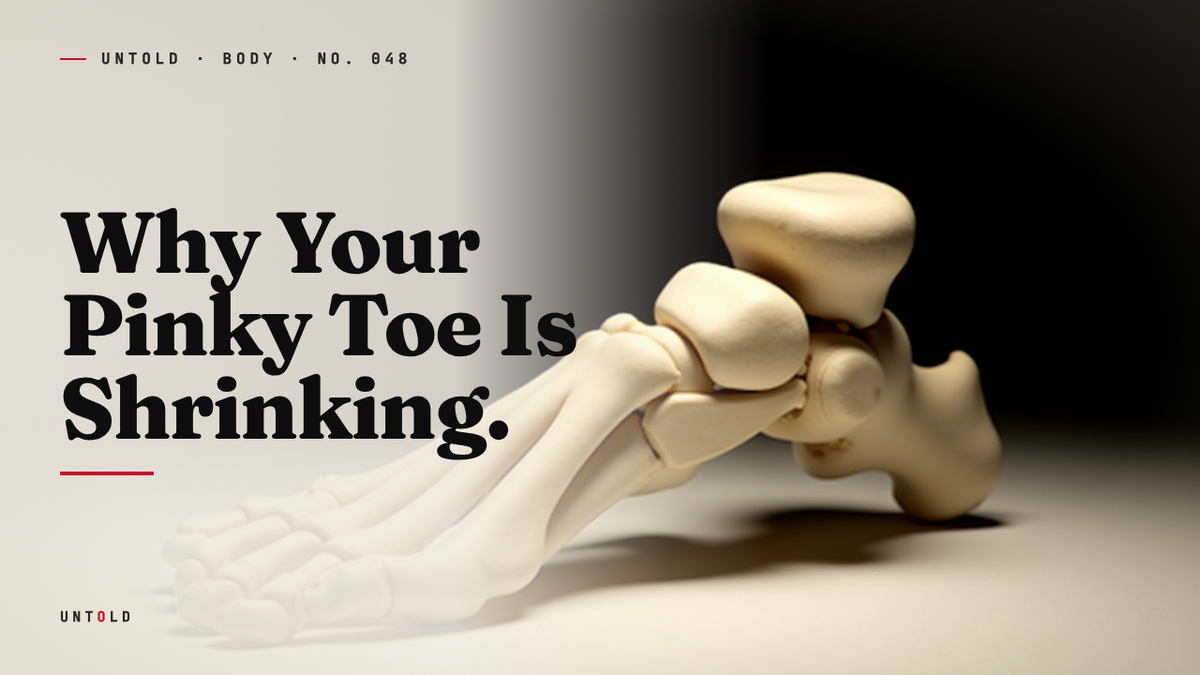
Look down at the smallest toe on your foot. Really look at it. In most people it barely resembles a toe at all: squashed against its neighbor, curled slightly inward, the nail often reduced to a stubborn fleck of keratin that seems reluctant to grow. Try to wiggle it on its own, without dragging the other toes along. You almost certainly cannot. The muscle wiring simply is not there to move it in isolation. It comes along for the ride, a passenger rather than a driver.
This is not a defect. It is not a sign that your foot was assembled carelessly. The fifth toe is one of the most quietly interesting structures in the human body precisely because it is unfinished. It is a fossil you carry with you, a small souvenir of a body that once lived a very different life. Anatomists have been staring at it for well over a century, and what they have found is a toe caught mid-edit, halfway between a purpose it no longer serves and an obsolescence it has not quite reached.
To understand why it looks the way it does, we have to go back to a time before our ancestors ever set foot on solid ground.
A foot built for the canopy
For most of the deep history of the primate lineage, the foot was not a platform for walking. It was a hand. Our tree-dwelling ancestors used their feet the way we use our hands today: to grasp, to grip, to wrap around branches and anchor a heavy body high above the forest floor. The toes spread wide and curled around wood. The big toe, in particular, was opposable, splaying out to the side like a thumb so that the whole foot could close around a limb.
In that world, every toe earned its keep. Each one contributed to the grip that kept an animal from falling. The fifth toe was not the shriveled afterthought it is now. It was a working digit, long and muscular, part of a five-fingered clamp that made arboreal life possible. You can still see this arrangement clearly in a chimpanzee. Place a chimp’s foot beside a human’s and the difference is almost comical. Their fifth toe is long, strong, and mobile, and their big toe juts out sideways, ready to hook around a branch. Their feet look, unmistakably, like hands.
Our feet do not. And the reason is that around four million years ago, our ancestors climbed down from the trees and began to walk.
The day the arch collapsed
Walking on two legs demanded a completely different kind of foot. A grasping foot is flexible, splayed, and soft, everything a good gripper should be. A walking foot needs to be almost the opposite: stiff, arched, and springy, capable of converting the downward slam of body weight into forward motion. The anthropologist Owen Lovejoy, who spent decades studying the biomechanics of early hominin locomotion, described this transition as one of the most consequential redesigns in our evolutionary history.1 The grasping arch that once wrapped around branches collapsed and reformed into something new: a rigid lever, a springboard for striding upright.
The most dramatic casualty of this change was the big toe. It swung inward from its sideways, thumblike position to sit parallel with the others, forming the powerful push-off point that drives every step you take. But the redesign rippled outward across the whole foot, and the toes on the outer edge paid a particular price. Once we started walking rather than climbing, the outer toes had almost nothing left to do. The grip they had provided in the trees was no longer needed on the ground. Their old job simply vanished.
What happens to a body part when its job disappears? The answer is written into the fifth toe itself.
The joint that quietly fused
Here is one of those anatomical facts that sounds invented but is not. A normal toe has three small bones, called phalanges: a base, a middle, and a tip, with joints between them that let the toe bend. The big toe is the exception, with only two. But in an enormous fraction of the human population, the fifth toe also has only two working bones, because two of its three phalanges have fused into a single stiff segment. The middle and end bones simply merge, erasing the joint between them.
This is not rare. Studies of foot anatomy across different populations have found the fusion in anywhere from a third to more than two-thirds of people examined, depending on the group and the method of measurement.2 For a large share of humanity, the smallest toe has already lost a joint that it is supposed to have. It has begun to simplify, to smooth itself down toward something less articulated, less complicated, less like a toe at all.
Why this toe, and not the others? The answer comes from mechanics, and it was mapped out in careful detail by an orthopedic surgeon named Dudley Morton in the early twentieth century. Morton studied how weight travels through the foot during a stride, and his work, published in books like The Human Foot in 1935, laid the foundation for how we understand the distribution of force across the sole today.3 When you push off from the ground, the vast majority of that propulsive load runs through the big toe and the ball of the foot on the inner side. The outer edge, where the fifth toe sits, carries almost nothing. The little toe is barely loaded at all. It comes along, quietly, and does very little.
And bone, it turns out, cares a great deal about how much it is used.
Bone follows function
In the 1890s, a German anatomist named Julius Wolff described a principle so fundamental that it now carries his name. Wolff’s Law states that bone remodels itself in response to the forces placed upon it.4 Load a bone heavily and repeatedly, and it responds by growing denser, stronger, and more sharply defined. Leave a bone idle, spare it from stress, and the opposite happens. It softens. It loses density. Over time, and over generations, it simplifies.
This is not a metaphor. It is a measurable, physical process, visible in the thickened arm bones of tennis players and the weakened bones of astronauts returning from long stretches of weightlessness. Bone is not inert scaffolding. It is living tissue that listens constantly to the mechanical demands placed on it and adjusts accordingly.
Apply Wolff’s Law to the fifth toe and the story clicks into place. Since the day we stopped climbing, this toe has felt almost no force. Step after step, mile after mile, generation after generation, it has been carrying nearly nothing. And a structure that carries nothing has no reason to maintain its full complexity. The joint that once let it bend and grip became, functionally, dead weight. So it began to fuse away. The toe is not shrinking because something went wrong. It is shrinking because nothing is asking it to stay the same.
Charles Darwin had a word for structures like this. He called them vestiges: organs and features that persist in a body long after the function that shaped them has disappeared, like echoes of a former life. In The Descent of Man, published in 1871, he catalogued a whole gallery of them in the human body.5 The appendix, a shrunken remnant of a longer digestive tract. The coccyx, the fused tailbone at the base of the spine, all that remains of a tail our ancestors once had. The wisdom teeth, crammed into jaws that have grown too small for them. The tiny, mostly useless muscles around the ear that once let our ancestors swivel their ears toward sound. To this list of slowly fading parts, the pinky toe fits neatly. It is a vestige in progress, an echo still audible but growing fainter.
Four million years is a long time for an unused toe to keep simplifying. And yet the story does not end with a clean verdict of uselessness. There is a twist.
Not quite useless after all
It would be tidy to declare the fifth toe a piece of evolutionary junk, a relic on its way to nowhere. But the body rarely works so neatly, and the pinky toe turns out to still be doing a quiet, unglamorous job. Surgeons who have had to amputate the smallest toe in patients report real consequences for balance and stability.6 The little toe, it emerges, is not there to push you forward. It is there to keep you from tipping over.
When you stand, the fifth toe widens the base of your foot on its outer edge, extending the platform you balance on. That extra width, small as it is, helps steady you against the constant sideways sway that every upright body fights. Standing on two legs is, mechanically, a perpetual near-fall. The body corrects for it thousands of times a day with subtle adjustments most of us never notice. The pinky toe, sitting out at the edge, is part of that correction. It broadens your footing and dampens the tendency to topple laterally. It may carry almost no load when you walk, but it earns its place when you simply stand.
So the toe occupies a strange middle ground. It has lost its old grip-oriented purpose, its joint has begun to disappear, its muscles have withered to the point that you cannot move it independently. And yet it has not been abandoned entirely, because it stumbled into a new, smaller role: a stabilizer, a widener of the base, a quiet contributor to the extraordinary balancing act of walking upright.
A structure between two lives
Evolution, it is worth remembering, does not tidy up after itself. It does not delete a structure the moment that structure stops being useful, and it does not redesign a body from a clean sheet. It works by modification, by accumulation, by leaving half-finished drafts scattered through the anatomy of every living thing. The pinky toe is one of those drafts, caught partway through an edit that began four million years ago and shows no sign of concluding.
Will it vanish completely one day? Perhaps, over hundreds of thousands of years, the fusion will spread, the toe will shrink further, and our distant descendants will look down at four toes and a smooth outer ridge where a fifth once sat. Or perhaps the small balancing job it still performs will be enough to keep it around indefinitely, frozen in this unfinished state, neither useful enough to strengthen nor useless enough to disappear. Evolution offers no guarantee either way. It is not steering toward a destination.
What the toe does offer is a record. It is not broken. It is a structure suspended between two lives: a tree-climbing past in which it gripped and anchored and mattered, and an upright present that no longer needs it for much of anything at all. So the next time you crack it against the leg of a chair, an event that produces pain absurdly out of proportion to the size of the offending digit, you might pause before cursing it. That flash of agony is radiating up from a tiny relic of the canopy, a leftover from the hands we once had for feet, still hanging on, still quietly steadying you, still carrying its history in the smallest part of you.
Sources
- Lovejoy, C. O., “The Natural History of Human Gait and Posture, Part 2: Hip and Thigh,” Gait & Posture, 2005. — https://pubmed.ncbi.nlm.nih.gov/15621364/
- Le Minor, J. M., “Comparative anatomy and significance of the sesamoid bone of the peroneus longus muscle,” Journal of Anatomy, and population studies on fifth-toe phalangeal fusion (symphalangism), 1987. — https://pubmed.ncbi.nlm.nih.gov/3654351/
- Morton, Dudley J., The Human Foot: Its Evolution, Physiology and Functional Disorders, Columbia University Press, 1935. — https://archive.org/details/humanfootitsevol0000mort
- Wolff, Julius, Das Gesetz der Transformation der Knochen (The Law of Bone Remodelling), 1892. — https://en.wikipedia.org/wiki/Wolff%27s_law
- Darwin, Charles, The Descent of Man, and Selection in Relation to Sex, John Murray, 1871. — https://www.gutenberg.org/ebooks/2300
- Hollinshead, W. H., Anatomy for Surgeons, and clinical reports on lateral toe amputation and balance, Harper & Row. — https://www.ncbi.nlm.nih.gov/pmc/articles/PMC3126973/
Related reading