The Arithmetic of Cancer
Cancer is less a moral verdict than a statistic written into the act of staying alive.
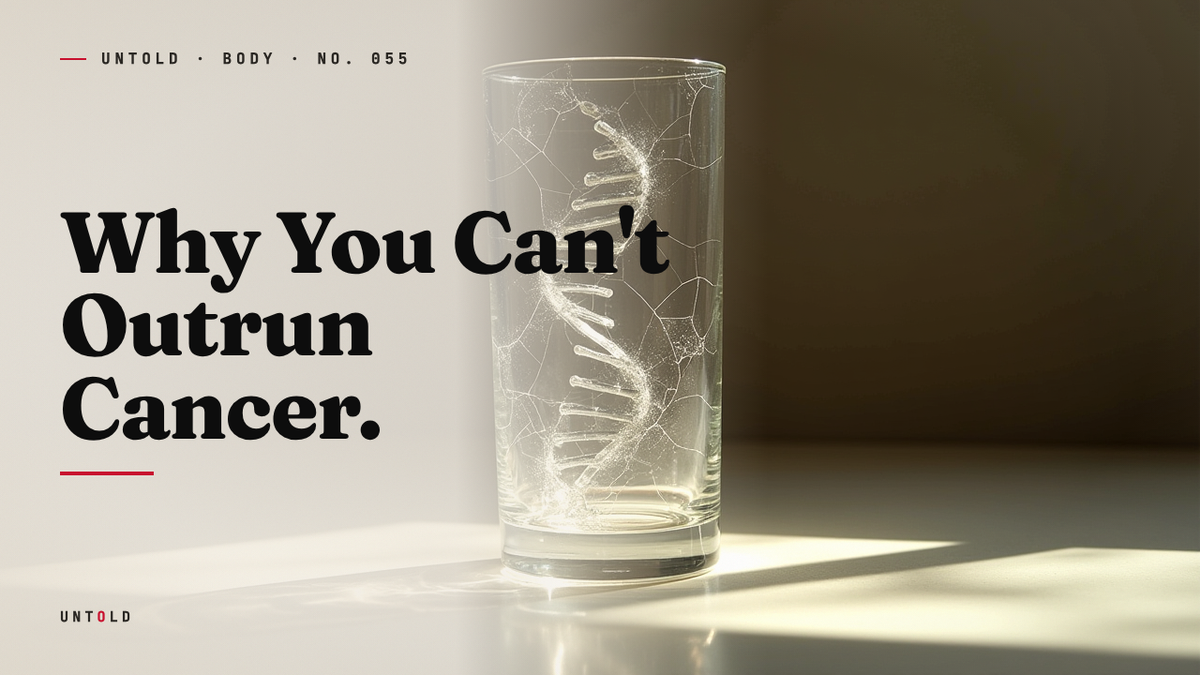
There is a particular kind of person who believes cancer is a problem that can be solved through discipline. He runs at dawn. He weighs his portions. He treats his body like a machine that will reward maintenance with immunity. And he is not wrong to try. The trouble is that the story he has been told, that health is a contract and cancer a breach of it, misreads the biology almost entirely.
Roughly one in two men and slightly fewer than one in two women will receive a cancer diagnosis in their lifetime. The figure is not a verdict on the modern diet or the sedentary office or any of the usual suspects. It is closer to a mathematical inevitability, the shadow cast by a body that must constantly rebuild itself in order to remain alive. To understand why you cannot outrun cancer, you have to stop thinking about willpower and start thinking about numbers.
A Body Built From Copies
Consider what your body does while you sleep. Every day it manufactures somewhere in the region of 330 billion new cells, replacing the ones worn out by the ordinary friction of living. The lining of your gut sheds and renews itself every few days. Your skin turns over relentlessly. Red blood cells live about four months before they are recycled. This is not a background hum. It is the main event, the ceaseless labor that keeps a human being from dissolving.
Each of those new cells begins with a task of almost absurd delicacy. Before a cell divides, it must copy its entire genome: three billion letters of DNA, transcribed faithfully so that each daughter cell inherits a complete instruction manual. The machinery that performs this feat is extraordinary, equipped with proofreading enzymes that catch and correct the great majority of errors. But it is not perfect, and perfection is not on offer. Every division introduces a handful of random typos, tiny substitutions where one chemical letter is swapped for another.
Most of these mistakes land in stretches of DNA that do nothing, or change nothing that matters. The cell carries on. But mutation is a lottery played billions of times a day across a lifetime of decades, and in a lottery of that scale, rare outcomes become certainties. Some errors, by pure chance, will fall in exactly the wrong place: in a gene that governs how fast a cell grows, or when it should stop, or when it should die.
External forces make matters worse. Ultraviolet light from the sun fractures the DNA in skin cells. Tobacco smoke coats lung tissue in dozens of chemicals that scramble the genetic code. Certain industrial compounds do the same. These are the risks we talk about, because they are the risks we can, in principle, avoid. But they sit on top of a deeper and more inescapable driver, one that hid for a long time in plain sight. The largest force scrambling your genome is not the sun or the cigarette. It is time itself, and the sheer number of times your cells have had to copy themselves to keep you here.
The Man Who Mapped the Steps
For most of medical history, cancer was understood as a single catastrophe, a cell that suddenly went mad. The work that dismantled this picture belongs largely to Bert Vogelstein, a physician-scientist at Johns Hopkins who spent decades tracing, mutation by mutation, how a normal cell becomes a malignant one. Studying colorectal tumors, Vogelstein and his colleagues showed that cancer is not an event but a process, a slow accumulation of genetic damage unfolding over years 1.
The model that emerged is now foundational. A single cell does not turn cancerous from one broken gene. It needs a sequence of hits, each one disabling a different safeguard. One mutation might switch on a growth signal that should stay quiet. Another might disable a brake that normally halts runaway division. A third might silence the cellular suicide program that is supposed to eliminate damaged cells before they multiply. A fourth might let the cell evade the immune system, and a fifth might allow it to invade neighboring tissue.
A cell carrying one such mutation is almost always harmless; its neighbors and its own internal controls keep it in check. Two or three, and the odds shift. But by the time five or six of these safeguards have failed in the same cellular lineage, the result can be catastrophe: a colony of cells that grows without restraint, ignores every signal to stop, and eventually spreads. The insight is deceptively simple and its consequence is stark. If cancer requires several independent errors to accumulate in a single lineage of cells, then the more times those cells divide, the more chances there are for the errors to land. Every division is another roll of the dice. And some tissues roll far more often than others.
Bad Luck, Quantified
That observation set up one of the most contentious papers in recent cancer research. In 2015, Cristian Tomasetti, a mathematician and biostatistician, published a study with Vogelstein in the journal Science that tried to put a number on the role of chance 2. Their reasoning followed directly from the stepwise model. If mutations accumulate with cell division, then tissues that divide frequently should, all else being equal, develop cancer more frequently than tissues that divide rarely.
The two researchers gathered data on how often the stem cells in various human tissues renew themselves over a lifetime. The range is enormous. The cells lining the small intestine divide constantly. The stem cells of the colon divide often too. At the other extreme, the neurons of the adult brain barely divide at all, and mature muscle cells are similarly quiet. Tomasetti and Vogelstein then plotted this lifetime division rate against the lifetime cancer risk for each tissue.
The result was striking. Across the tissues they examined, the number of stem cell divisions correlated with cancer risk closely enough to account for roughly two-thirds of the variation between tissue types. Tissues that copied their DNA more often simply developed cancer more often, in rough proportion to how much copying they did. The headline, distilled by the press into a single blunt phrase, was that much of cancer comes down to bad luck: to the random errors that accumulate during ordinary cell division, rather than to inherited genes or unhealthy living.
The paper landed like a provocation. Critics worried, reasonably, that the message would be heard as a shrug, an invitation to abandon prevention on the grounds that fate had already decided. Some argued the analysis conflated the risk between different tissue types with the risk within any single type, and that the two-thirds figure had been widely misinterpreted. A later 2017 follow-up broadened the analysis across countries and tried to separate three sources of mutation: inherited, environmental, and the random errors of replication 3.
But the misreading was in the framing, not the finding. Bad luck sets the floor, not the ceiling. The random errors of replication establish a baseline risk that no lifestyle can eliminate, because no living person can stop their cells from dividing. What environment and behavior do is push risk above that baseline, sometimes dramatically. A smoker does not merely accept the ambient bad luck of lung tissue; he multiplies it many times over by flooding those cells with mutagens. The floor is fixed by biology. The distance you rise above it is, to a meaningful degree, yours to influence.
The Whale That Should Have Died
If the arithmetic of cell division truly governed cancer, then a strange prediction follows, one that troubled the epidemiologist Richard Peto in the 1970s. Cancer risk, on this logic, should scale with the number of cells in a body and the length of time those cells spend dividing. A creature with more cells has more lottery tickets. A creature that lives longer buys tickets for more years.
By that reasoning, large, long-lived animals should be consumed by tumors. A blue whale carries something on the order of a thousand times more cells than a human being, and lives for decades. An elephant is vast and long-lived too. If each cell carries the same per-division risk that ours do, these animals should develop cancer at rates that would make survival impossible. They should be extinct several times over.
They are not. Peto observed that across species, cancer incidence bears essentially no relationship to body size 4. Whales and elephants do not get cancer at higher rates than mice, and in some respects get it less. This contradiction, that bigger and longer-lived animals should be riddled with cancer but are not, became known as Peto’s Paradox, and it points to something profound. If body size does not raise cancer risk across species, then evolution must have engineered defenses that grow more effective as bodies grow larger. Natural selection could hardly have allowed elephants to exist otherwise; a lineage that could not solve cancer at scale would never have reached elephant size in the first place.
The defenses turn out to be tangible. The clearest example is a gene called TP53, often described as the guardian of the genome. Its job is precisely the quality control that cancer must overcome: when a cell’s DNA is badly damaged, the protein made from TP53 can halt division while repairs are attempted, or, if the damage is beyond fixing, order the cell to destroy itself before it can pass its errors on. Humans carry a single copy of TP53. Elephants, researchers discovered, carry around twenty copies 5. With so many guardians standing watch, an elephant’s cells are far quicker to commit suicide at the first sign of trouble, snuffing out potential tumors long before they can accumulate the full sequence of mutations that malignancy requires.
This is the sense in which, as the cancer biologist has put it, every large and long-lived animal is an evolved solution to the cancer problem. Biology can push back against the mathematics. It can layer on redundant safeguards, tune its repair machinery, and set its cellular suicide triggers to a hair. But the pushback is never total. Even the elephant is not immune. It has raised the floor, not abolished it.
A Disease As Old As Bone
There is a persistent belief that cancer is a modern affliction, a product of processed food and industrial chemicals and the general artificiality of contemporary life. It is a comforting idea, because it implies that if we could only return to some purer way of living, the disease would recede. The fossil and archaeological record dismantles it.
Paleopathologists have found tumors preserved in the bones of dinosaurs that lived tens of millions of years before any human walked the earth. They have identified cancers in the remains of ancient humans and in Egyptian mummies, whose diseased bones still bear the unmistakable signatures of malignant growth 6. Cancer is not a stranger that industrial civilization introduced. It is a companion that has traveled with multicellular life for as long as cells have had to copy themselves, which is to say for hundreds of millions of years. Any creature built from dividing cells carries the possibility within it.
Why, then, does cancer feel so much more prevalent now? The answer is not that the disease has become more common in any deep biological sense. It is that we have stopped dying of everything else first. For nearly the whole of human history, infection was the great killer. Pneumonia, tuberculosis, dysentery, childbirth fever, smallpox: these carried off enormous numbers of people long before their cells had accumulated enough mutations for cancer to declare itself. Death arrived early, and it arrived from outside.
The conquest of infectious disease changed the arithmetic entirely. Sanitation, vaccines, and antibiotics handed humanity decades of extra life that our ancestors almost never saw. And those additional decades are precisely the years in which the mutations of ordinary cell division pile up. Cancer is, in significant part, a disease of the time we were not previously granted. It is revealed, paradoxically, by our own success. As one framing has it, cancer is partly the price of a long life, a bill that comes due only because we now live long enough to receive it.
The Odds Are Still Yours to Shift
None of this counsels resignation, and it would be a serious misreading to conclude that choices are meaningless. The floor set by chance and time is real, but the space above it is wide, and behavior occupies a great deal of it. Cancer Research UK and other bodies estimate that around four in ten cancer cases are linked to preventable factors 7. Not smoking remains the single most powerful intervention available to any individual, cutting the risk of lung and several other cancers dramatically. Regular physical activity, a moderate weight, limited alcohol, sun protection, and vaccination against cancer-causing viruses all measurably lower the odds.
What these measures do is not defeat the mathematics but bend it. They keep you off the accelerated tracks, the ones where mutagens flood your tissues and push you far above the baseline that biology alone would set. The runner at dawn was never wrong to run. He was only wrong about what running could promise. It cannot buy immunity. It can, genuinely and worthwhile, improve his hand.
The deepest shift the science offers is not medical but moral. A cancer diagnosis is so often received as a judgment, a sign that the patient must have done something wrong, eaten the wrong thing, harbored the wrong stress, failed some invisible test of clean living. The arithmetic says otherwise. Cancer is not a verdict on how you lived. It is the statistical residue of the fact that you lived at all, the quiet cost of the trillions of cell divisions that rebuilt you, day after day, and kept you here long enough to fear it.

Sources
- Fearon, E. R. and Vogelstein, B., A Genetic Model for Colorectal Tumorigenesis, Cell, 1990. — https://www.cell.com/cell/fulltext/0092-8674(90)90186-I
- Tomasetti, C. and Vogelstein, B., Variation in cancer risk among tissues can be explained by the number of stem cell divisions, Science, 2015. — https://www.science.org/doi/10.1126/science.1260825
- Tomasetti, C., Li, L. and Vogelstein, B., Stem cell divisions, somatic mutations, cancer etiology, and cancer prevention, Science, 2017. — https://www.science.org/doi/10.1126/science.aaf9011
- Peto, R. et al., Cancer and ageing in mice and men, British Journal of Cancer, 1975. — https://www.nature.com/articles/bjc1975179
- Abegglen, L. M. et al., Potential Mechanisms for Cancer Resistance in Elephants and Comparative Cellular Response to DNA Damage in Humans, JAMA, 2015. — https://jamanetwork.com/journals/jama/fullarticle/2456041
- David, A. R. and Zimmerman, M. R., Cancer: an old disease, a new disease or something in between?, Nature Reviews Cancer, 2010. — https://www.nature.com/articles/nrc2914
- Brown, K. F. et al., The fraction of cancer attributable to modifiable risk factors in England, Wales, Scotland, Northern Ireland, and the United Kingdom in 2015, British Journal of Cancer, 2018. — https://www.nature.com/articles/s41416-018-0029-6
Related reading