The Children Who Cannot Feel a Burn
A rare genetic condition erases all pain, and in doing so reveals why the rest of us need it.
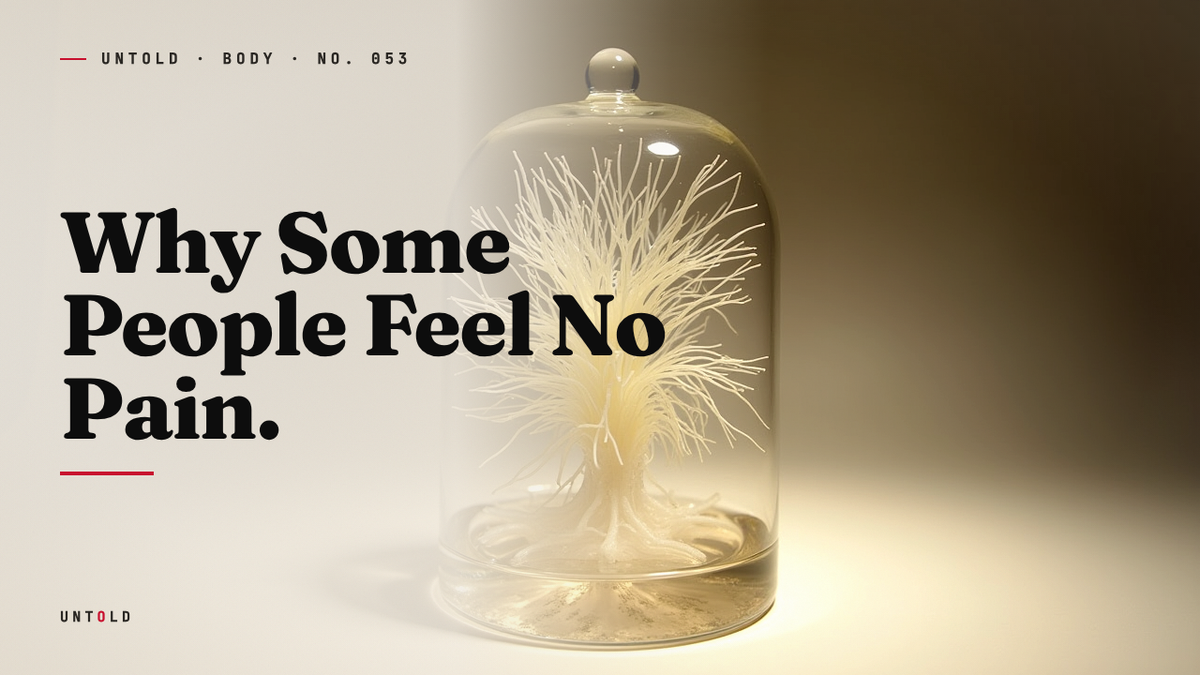
At a family dinner, a little girl chews steadily on her own tongue. She does not stop. She does not cry. Blood pools at the corner of her mouth, and she keeps eating as though nothing is wrong, because from the inside, nothing is. She has broken bones without knowing it. She has burned her hands on a stove and watched the skin blister with the detached curiosity of someone examining a stranger’s wound. She has bitten clean through her lip more than once. For her, the entire category of experience the rest of us call pain simply does not exist.
There is a temptation to read this as a gift. Most of us spend our lives in quiet negotiation with pain, dulling it, avoiding it, fearing its return. To be freed from it entirely sounds like the premise of a comic book. But the children born this way are not superheroes. They are among the most fragile people alive, and their condition, when you follow it to its conclusions, turns out to be less a liberation than a slow and dangerous exposure. Pain, it emerges, is not the enemy. It is one of the most sophisticated protective systems the body has ever evolved, and the people who lack it show us exactly what it was doing all along.
A Signal, Not a Sensation
The condition has a clinical name that reads like a warning label: congenital insensitivity to pain with anhidrosis, usually shortened to CIPA. Anhidrosis refers to the inability to sweat, which frequently accompanies the pain blindness, so these children also struggle to regulate body temperature and can overheat with alarming speed. It is written into the genes, present from birth, and it is vanishingly rare. Estimates place it at roughly one case per million people, though because it is so easily misdiagnosed in infancy, the true figure is uncertain 1.
Physicians began documenting cases like these in medical journals in the early twentieth century, and the early reports carry an unmistakable tone of bafflement. Here was a patient who could watch a needle pierce the skin with the calm of someone watching rain fall. Doctors described children who felt no discomfort during procedures that would have made any other patient scream. It seemed to violate something fundamental about being human.
To understand why this happens, it helps to abandon a common assumption: that pain is a thing that lives in the injured part of the body. It is not. Pain is a signal your brain constructs, an interpretation, an output rather than an input. Scattered across your skin, your muscles, your organs, and the linings of your joints are specialized nerve endings called nociceptors. Their job is to detect potential damage: extreme heat, crushing pressure, the chemical signature of torn tissue. When they fire, they send electrical pulses racing up the peripheral nerves, into the spinal cord, and onward to the brain. Only there, after the brain weighs the incoming traffic against context and memory and attention, does the sensation of hurting arise. Pain is the brain’s verdict, delivered back to the body as an urgent instruction: something is wrong here, stop, withdraw, protect.
Now imagine that the message never arrives. The alarm sounds at the site of the injury, the nociceptor detects the damage exactly as it should, but the wire carrying that alarm to the brain has been cut. The girl chewing her tongue is not brave. Her nervous system is not delivering the news.
The Boy Who Walked on Knives
The genetic root of this silence was traced through a piece of detective work that reads more like an expedition than an experiment. In the mid-2000s, a clinical geneticist named C. Geoffrey Woods, based at the University of Cambridge, was working in northern Pakistan when he heard about a remarkable street performer, a boy who earned money by placing knives through his arms and walking barefoot across burning coals. The boy, it was said, felt nothing at all.
Woods never met him. The child died before the research team could reach him, killed after jumping from the roof of a house on his fourteenth birthday, apparently as a stunt, apparently without any fear of the fall’s consequences 2. It was a grim illustration of the condition’s central danger. Without pain to teach caution, the ordinary lessons of childhood never take hold.
Woods turned instead to the boy’s extended family, and there he found six children across several related households who shared the same trait. Crucially, these children were not numb. They could feel a hand on the shoulder, the warmth of a fire, the pressure of a grip. Their sense of touch and temperature and proprioception worked normally. They had simply never, not once, experienced pain. They knew the word. They understood, intellectually, that other people avoided injury for a reason. But the feeling itself was a blank space where everyone else had a vivid, insistent presence.
When Woods and his colleagues sequenced the children’s DNA, the answer collapsed to a single point of failure. The problem lay in a gene called SCN9A. This gene carries the instructions for building a component of the nervous system called a sodium channel, specifically one designated Nav1.7. These channels sit in the membranes of pain-sensing nerve cells and act as tiny gates. When a nociceptor detects damage, sodium ions rush through these gates, and that flow is what amplifies the electrical signal enough to send it climbing toward the brain. In the affected children, mutations had rendered the channel nonfunctional. The gate would not open. The signal fired at the injury site but could not propagate. The team published its findings in the journal Nature in 2006, identifying SCN9A as essential for the perception of pain in humans 3.
One Gene, Two Extremes
What makes SCN9A so extraordinary is that the same gene, mutated in the opposite direction, produces a condition that is its mirror image. Instead of a channel that never opens, some families inherit a version of Nav1.7 that never fully closes. In these people, the pain-sensing nerves fire relentlessly, without any injury to justify the alarm. The result is a disorder called inherited erythromelalgia, sometimes described as one of the most painful conditions known to medicine. Sufferers report the sensation of their hands and feet being permanently submerged in molten lava or scalding water. The burning can be triggered by mild warmth or gentle exertion, and for some it never truly relents 4.
So here was a single gene sitting behind both extremes of human suffering: total absence at one end, ceaseless torment at the other. To researchers, this symmetry was not merely elegant. It was a signpost. If one channel governed the passage of pain so completely, then that channel was not just a component of the system. It was something closer to a master switch.
The implications for medicine were enormous. At Yale, the neurologist Stephen Waxman had spent much of his career studying sodium channels and their role in the nervous system, and Nav1.7 became a central focus of his work. If pain could be silenced by a natural mutation in this one channel, then perhaps a drug could achieve the same effect on demand 5. A medicine that blocked Nav1.7 might switch off pain at its source, in the peripheral nerves, without ever touching the brain. That distinction matters. Opioids, the most powerful painkillers we have, work by flooding the brain and body with signals that dull pain but also produce sedation, mental fog, dependence, and the slow lethal creep of tolerance. A Nav1.7 blocker promised something cleaner: relief without the high, without the addiction, without the fog. Just silence where pain used to be.
The stakes could hardly be higher. Chronic pain is one of the largest unaddressed burdens in global health, affecting well over a billion people at any given time and shaping the daily lives of many more. The opioid epidemic has made painfully clear how badly the world needs alternatives. And so pharmaceutical laboratories raced to build a Nav1.7 blocker, confident that nature had already proven the concept. The children with CIPA were living evidence that shutting down this channel abolished pain without dismantling the rest of the body’s sensory life.
What the Channel Alone Could Not Explain
And then the trials began to stumble. Drug after drug was designed to block Nav1.7 with high precision, and drug after drug failed to deliver the sweeping relief the biology seemed to promise. Some produced modest effects. Some produced almost none. The channel that nature had used to erase pain entirely seemed stubbornly resistant to being switched off by a pill. Something was missing from the picture.
The answer, when it came, complicated the story in a way that was both humbling and illuminating. Researchers returned to the people with CIPA and looked more closely at what was happening inside their bodies. They discovered that the loss of Nav1.7 did not act alone. In the absence of a working channel, the affected individuals also showed a dramatic increase in the activity of their own natural opioid system. Their bodies were producing an abundance of endogenous opioids, the internal molecules that quiet pain signals from within. The painlessness, it turned out, was not the work of a single broken wire. It was the product of two systems reinforcing each other: the silenced channel and a flood of the body’s own pain-suppressing chemistry 6.
The test of this idea was direct and startling. When researchers gave a woman with CIPA naloxone, the drug that blocks opioid receptors and is best known for reversing overdoses, something unprecedented happened. For the first time in her life, she reported feeling pain. The internal opioid flood had been holding part of the door shut, and closing off that pathway allowed sensation to break through 6. It confirmed that the missing channel and the amplified opioids worked in concert.
Far from being a dead end, this revelation opened a more promising path. If natural painlessness required both a quieted channel and boosted opioid signaling, then perhaps the most effective therapies would combine a Nav1.7 blocker with a way to enhance the body’s own opioids: a strategy that could deliver deep relief while using far lower, far safer doses than conventional opioids demand. Nature, in effect, had already run the experiment that pharmacology was still struggling to design. The task now was to read its results correctly rather than assume they said something simpler than they did.
The Price of a Fragile Body
It is worth returning, at the end, to the children themselves, because the science can make it easy to forget what their lives actually involve. A child who cannot feel pain must be watched every waking hour. In infancy they gnaw their own fingers and tongues raw because nothing tells them to stop. As toddlers they scratch at their eyes, and corneal damage is a common and serious complication. They run and fall and fracture bones and keep walking on them, because a broken leg registers as nothing at all until it swells or bends. Joints wear out prematurely under the strain of injuries that were never protected by the flinch that guards the rest of us. Wounds go unnoticed and become infected. The inability to sweat compounds everything, leaving them vulnerable to dangerous overheating. Many people with CIPA do not survive past early adulthood, and those who do live with the accumulated damage of a lifetime spent without warnings 1.
That is the quiet truth their existence reveals. Pain is not a design flaw or a cruelty imposed on us by an indifferent biology. It is a form of care the body performs on its own behalf, an alarm system so effective that we notice it only when it fails to fire. Every time you jerk your hand back from a hot pan before you can even name what you felt, every time you shift your weight off an aching foot without deciding to, every time a stubbed toe forces you to slow down and look at what you did, your nervous system is running a calculation that keeps you intact. The flinch is not weakness. It is the body voting, again and again across a lifetime, to keep you here. The children who cannot feel it are not spared that burden. They are simply left without the thing that was protecting them all along.
Sources
- Indo, Y., “Nerve growth factor and the physiology of pain: lessons from congenital insensitivity to pain with anhidrosis,” Clinical Genetics, 2012. — https://onlinelibrary.wiley.com/doi/10.1111/j.1399-0004.2012.01943.x
- Heckert, J., “The Hazards of Growing Up Painlessly,” The New York Times Magazine, 2012. — https://www.nytimes.com/2012/11/18/magazine/ashlyn-blocker-feels-no-pain.html
- Cox, J. J. et al., “An SCN9A channelopathy causes congenital inability to experience pain,” Nature, 2006. — https://www.nature.com/articles/nature05413
- Waxman, S. G. and Dib-Hajj, S. D., “Erythromelalgia: a hereditary pain syndrome enters the molecular era,” Annals of Neurology, 2005. — https://onlinelibrary.wiley.com/doi/10.1002/ana.20653
- Dib-Hajj, S. D., Yang, Y., Black, J. A. and Waxman, S. G., “The Nav1.7 sodium channel: from molecule to man,” Nature Reviews Neuroscience, 2013. — https://www.nature.com/articles/nrn3404
- Minett, M. S. et al., “Endogenous opioids contribute to insensitivity to pain in humans and mice lacking sodium channel Nav1.7,” Nature Communications, 2015. — https://www.nature.com/articles/ncomms9967
- Rice, F. L. and Albrecht, P. J., “Cutaneous mechanisms of tactile perception,” in The Senses: A Comprehensive Reference, 2008. — https://www.sciencedirect.com/science/article/pii/B9780123708809000345
Related reading