The Ancient Circuit That Whispers You Are Being Watched
A 125-year-old psychological puzzle keeps yielding stranger answers about how the brain reads other minds.
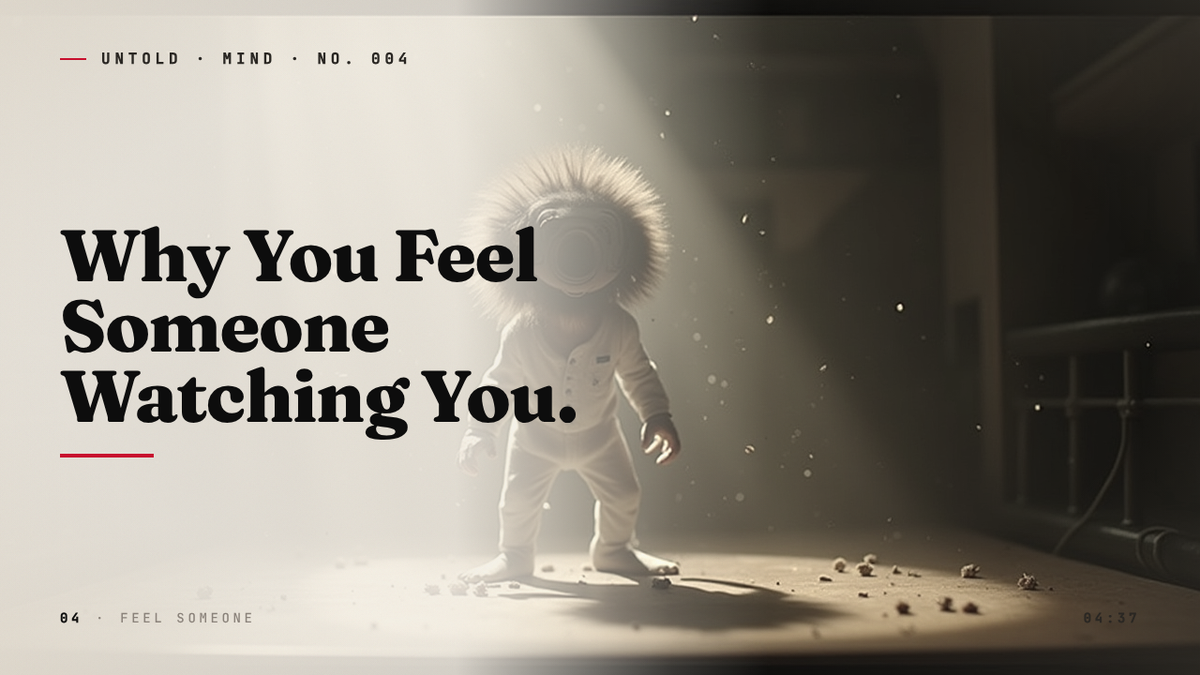
The sensation arrives without warning. You are reading on a train, or waiting at a crosswalk, or facing a shop window, and somewhere along the back of your neck a small pressure builds. The skin tightens. The shoulders square without instruction. You turn, expecting to meet a pair of eyes, and find only a wall, or a stranger absorbed in a phone, or nothing at all. The feeling does not embarrass itself. It simply recedes, leaving the suspicion that it knew something you did not.
This sensation has a name, awkward and Victorian: scopaesthesia, the perception of being stared at. It has been studied, debunked, revived, and reframed for more than a century. Almost everyone reports having felt it. Almost no one can reliably prove it under laboratory conditions. And yet the phenomenon refuses to dissolve, because the puzzle it presents is not really about psychic powers or sixth senses. It is about how the human brain, in its silent and unceasing work, treats the gaze of another person as one of the most important signals in the world.
A Cornell Laboratory and a Persistent Hunch
The first scientist to take scopaesthesia seriously was Edward Bradford Titchener, a transplanted Englishman who ran the psychology laboratory at Cornell University in the 1890s. Titchener was a structuralist, a believer that the mind could be dismantled into elementary sensations the way a chemist dismantles a compound. He had little patience for mysticism. But his students kept telling him that they could feel when someone was staring at them from behind, and he found that he could not simply dismiss the claim.1
In 1898 he published a short, exasperated paper in the journal Science. He had run a series of informal experiments, asking observers to sit with their backs turned while a confederate either stared at them or looked away. The results were unambiguous: his subjects performed at chance. They could not detect a gaze any better than they could guess a coin flip. “I have tested this ‘feeling,’” he wrote, “in the only way which seemed to be logically possible, and have always found it illusory.”1
Titchener nevertheless thought the experience deserved an explanation. He suggested that the sensation was a product of attention itself. If you happen to think that someone might be watching, you become self-conscious. You feel the muscles of your neck, the warmth of your scalp, the slight prickle of attention turned inward. You then turn, and your motion draws the gaze of anyone who happens to be in your vicinity. By the time you look, someone is looking back, and the loop closes. Cause and effect are confused.
It was a sensible theory. It explained the experience without invoking magic. And, for nearly a hundred years, it was largely where the matter rested.
The Eyes Have a Special Place in the Brain
What changed scopaesthesia from a curiosity into a real neuroscientific subject was not parapsychology but the slow unspooling of how the brain processes faces. Beginning in the 1970s, neurophysiologists recording from single cells in the monkey temporal lobe began to find neurons that responded only to faces, and within that population, neurons that responded specifically to the direction of another animal’s gaze.2 The Oxford physiologist David Perrett, working with colleagues at the University of St Andrews, identified clusters of cells in a region called the superior temporal sulcus that fired most strongly when a face was looking directly at the observer and less so when the eyes were averted by even a few degrees.2
This was not a minor finding. It implied that the brain has built dedicated hardware for the question of whether another creature is paying attention to it. The signal is not a downstream inference. It is computed early, fast, and automatically, in a region that sits at the intersection of vision and social cognition.
Later work in humans, using functional MRI, confirmed the same architecture. The fusiform face area handles identity. The superior temporal sulcus handles gaze, expression, and the moving parts of a face that signal intention. When eyes lock onto you, even at the edge of your visual field, this region activates within roughly 200 milliseconds, well before any conscious recognition that you have been seen.3
Why should the brain devote so much real estate to such a narrow question? The answer is evolutionary. For a social primate, knowing who is watching is the difference between a quiet meal and an ambush, between a peaceful resting place and a contested one, between sexual opportunity and embarrassment. Gaze direction is a public broadcast of private intent. The capacity to read it quickly, even before you understand you are reading it, is one of the foundational tools of being a person among other people.
Blindsight and the Unconscious Eye
The most startling demonstration of how deep this circuitry runs came from patients who, in the strictest sense, could not see at all. In the 1970s the Oxford neuropsychologist Larry Weiskrantz introduced a phenomenon he called blindsight: the ability of people with damage to the primary visual cortex to respond accurately to visual stimuli they consciously reported not seeing.4 A patient might insist that a screen in front of him was blank, then, when forced to guess, point with surprising accuracy at the location of a light.
Weiskrantz’s colleague Alan Cowey, also at Oxford, spent decades refining this work, and one of its most famous subjects, known in the literature as TN, became the focus of a series of experiments that touched directly on scopaesthesia. TN had suffered two strokes that destroyed his primary visual cortex on both sides. He was, by any conventional measure, cortically blind. He used a cane. He could not read. And yet, in a 2008 study, he was able to navigate a corridor strewn with obstacles without bumping into any of them.5
More strikingly, a 2009 paper led by Alan Pegna at the University of Geneva, in collaboration with Cowey, showed that TN’s amygdala, the small almond-shaped structure deep in the temporal lobe, lit up reliably when he was shown faces with direct gaze, but not when shown faces looking away.6 He could not tell anyone whose face he was looking at. He could not tell anyone whether there was a face at all. But the part of his brain that registers being seen registered it. The eyes detected the eyes. The conscious mind never received the memo.
This is the literal anatomy of scopaesthesia. There is a route from the retina through the superior colliculus, the pulvinar, and the amygdala that bypasses the visual cortex entirely.7 It is older, evolutionarily, than the high-resolution conscious vision we associate with seeing. It is the route that frogs use to catch flies and that lizards use to spot hawks. In humans it persists, quieter and overshadowed by the cortical visual system, but still operating, still feeding signals into the regions of the brain that handle threat and social attention.
When you feel watched, this older system is often the source. It has noticed something at the edge of your visual field, a face oriented toward you, eyes locked onto your body, and it has alerted the amygdala before the cortex has had time to construct a conscious picture of what is there.
Why the Brain Prefers a False Alarm
None of this, however, fully explains the experience that Titchener described. His students felt watched when no one was watching. Subsequent studies have replicated his results: under controlled conditions, with all visual access to the starer cut off, human beings cannot detect being looked at at rates better than chance.8 The parapsychologist Rupert Sheldrake has spent decades arguing the contrary, but mainstream replications have failed to find any effect not attributable to feedback or experimental design.8
So if the feeling is real, and the perception is unreliable, where does the false signal come from?
The answer most psychologists now favor is that the brain is biased, on purpose, toward overdetecting attention. It is the same logic that makes you flinch at a stick on the trail that might be a snake. The cost of a false positive, turning around to find nothing, is trivial. The cost of a false negative, failing to notice a predator or a rival, can be catastrophic. Over deep evolutionary time, a nervous system that occasionally hallucinates a gaze costs nothing. A nervous system that occasionally misses one may not get to pass on its genes.
The psychologist Colin Clifford and his collaborators at the University of Sydney demonstrated this bias directly in a 2013 study. When subjects were shown faces with eyes whose gaze direction was ambiguous, hidden by noise or shadow, they tended overwhelmingly to judge the eyes as looking at them.9 The brain, when uncertain, defaults to the assumption that it is the object of attention. Clifford and his coauthors called this the “prior” of direct gaze: a built-in expectation that, all else being equal, you are being looked at.
This is not a flaw. It is, the researchers argued, an adaptive feature of a social species. Direct gaze is consequential. If there is any chance it is happening, you want to know. The brain therefore tips the scale toward yes.
The Body Joins In
The sensation of being watched is not purely visual. People who report it describe physical experiences: a prickle on the neck, a coolness on the scalp, a tightening of the shoulders. These are not imaginary. They are the autonomic nervous system responding to a perceived increase in social or physical threat. The same response shows up in laboratory measurements when subjects are shown faces with direct gaze. Their pupils dilate. Their skin conductance rises. Their heart rate shifts. The body is being prepared for evaluation, for confrontation, or for some unspecified social transaction whose outcome is not yet clear.10
The sociologist Erving Goffman observed in the 1960s that in public, human beings perform what he called “civil inattention,” the careful art of acknowledging another person’s presence with a brief glance and then looking away. To stare is to violate the protocol. It signals that something is wrong, or interesting, or dangerous, or desirable. To be stared at is to be marked. The autonomic system seems to know this. It treats sustained attention from another person not as neutral information but as a stimulus requiring response.
This explains why the sensation of being watched feels so visceral, so embodied, so different from the abstract knowledge that someone is looking at you. The knowledge passes through the cortex. The feeling routes through the brainstem and the autonomic ganglia, lighting up muscle and skin before any deliberate thought catches up.
The Modern Surveillance and the Ancient Watcher
There is something to be said about what this old machinery does in a world it was not built for. Human ancestors evolved in groups of perhaps 150, in landscapes where the eyes upon you were always eyes you knew. The modern city presents the same nervous system with thousands of strangers per day, with security cameras at every corner, with the disembodied attention of phones and screens and algorithms tracking patterns of behavior the watchers themselves may never see.
Researchers have studied what chronic exposure to surveillance does to the gaze-detection system, and the findings are sobering. People who feel observed perform differently on tasks. They make different moral choices. Even a poster of a pair of eyes hung above an honesty box, in a much-replicated experiment by Melissa Bateson and colleagues at Newcastle University, makes people more likely to pay for their coffee.11 The mere image of attention shifts behavior. The system does not check whether the watcher is real.
In this sense, scopaesthesia is not a quirk to be diagnosed. It is the ordinary operation of a vigilance circuit that runs continuously in the background of consciousness, sampling the environment for indications that another mind has turned its focus toward you, and signaling, with whatever fidelity it can muster, that something important may be about to happen. The signal is often wrong. The mechanism is essential.
What the Sensation Actually Is
If you assemble the pieces, scopaesthesia turns out to be neither a paranormal sense nor a simple confusion. It is a composite. A subcortical pathway that registers gaze before consciousness does. A cortical face system biased toward seeing direct attention even in noise. An autonomic response that prepares the body for social evaluation. A statistical prior, baked in by evolution, that tilts the brain toward assuming it is the object of regard. And, threaded through all of this, the ordinary social reality that being looked at matters, and that the cost of missing it has, for most of human history, been higher than the cost of imagining it.
What Titchener could not have known, working from his armchair with rotating chairs and stopwatches, is that the feeling his students described was not nothing. It was the muffled output of a system designed to be a little paranoid for a reason. He was right that conscious perception failed the test. He was wrong, perhaps, to assume that conscious perception was the only thing being tested. Beneath it, the older brain was doing its quieter and more honest work, sampling the world for eyes, and refusing, when uncertain, to assume it was alone.
The next time the sensation arrives, on a quiet street or in a crowded room, it is worth pausing before turning. The feeling is not evidence that someone is there. It is evidence that you are equipped to find out. The circuit that produces it has been refined across hundreds of thousands of years by ancestors for whom unnoticed attention often meant the end of the line. Their inheritance is a nervous system that overestimates the gaze of others, and a body that quietly prepares, dozens of times each day, for an encounter that, most of the time, never comes. The rest of the time, of course, it does. That is why the system is still here.

Sources
- Edward B. Titchener, ‘The Feeling of Being Stared At’, Science, 1898. — https://www.science.org/doi/10.1126/science.8.208.895
- David I. Perrett et al., ‘Visual cells in the temporal cortex sensitive to face view and gaze direction’, Proceedings of the Royal Society B, 1985. — https://royalsocietypublishing.org/doi/10.1098/rspb.1985.0003
- Truett Allison, Aina Puce & Gregory McCarthy, ‘Social perception from visual cues: role of the STS region’, Trends in Cognitive Sciences, 2000. — https://www.sciencedirect.com/science/article/abs/pii/S1364661300015018
- Lawrence Weiskrantz, ‘Blindsight: A Case Study and Implications’, Oxford University Press, 1986. — https://global.oup.com/academic/product/blindsight-9780198521921
- Beatrice de Gelder et al., ‘Intact navigation skills after bilateral loss of striate cortex’ (Patient TN), Current Biology, 2008. — https://www.cell.com/current-biology/fulltext/S0960-9822(08)01433-1
- Alan J. Pegna, Alan Cowey et al., ‘Discriminating emotional faces without primary visual cortices involves the right amygdala’, Nature Neuroscience, 2005. — https://www.nature.com/articles/nn1364
- Marco Tamietto & Beatrice de Gelder, ‘Neural bases of the non-conscious perception of emotional signals’, Nature Reviews Neuroscience, 2010. — https://www.nature.com/articles/nrn2889
- David F. Marks & John Colwell, ‘The Psychic Staring Effect: An Artifact of Pseudo Randomization’, Skeptical Inquirer, 2000. — https://skepticalinquirer.org/2000/09/the-psychic-staring-effect-an-artifact-of-pseudo-randomization/
- Harriet Mareschal, Colin W. G. Clifford & Isabelle Mareschal, ‘Humans have an expectation that gaze is directed toward them’, Current Biology, 2013. — https://www.cell.com/current-biology/fulltext/S0960-9822(13)00181-4
- Bruno Laeng et al., ‘Pupillary Responses to Direct and Averted Gaze’, PLOS ONE, 2013. — https://journals.plos.org/plosone/article?id=10.1371/journal.pone.0060549
- Melissa Bateson, Daniel Nettle & Gilbert Roberts, ‘Cues of being watched enhance cooperation in a real-world setting’, Biology Letters, 2006. — https://royalsocietypublishing.org/doi/10.1098/rsbl.2006.0509
Related reading