The Monocle That Was Never There
Millions remember the same details that never existed, and the reason reveals what memory actually is.
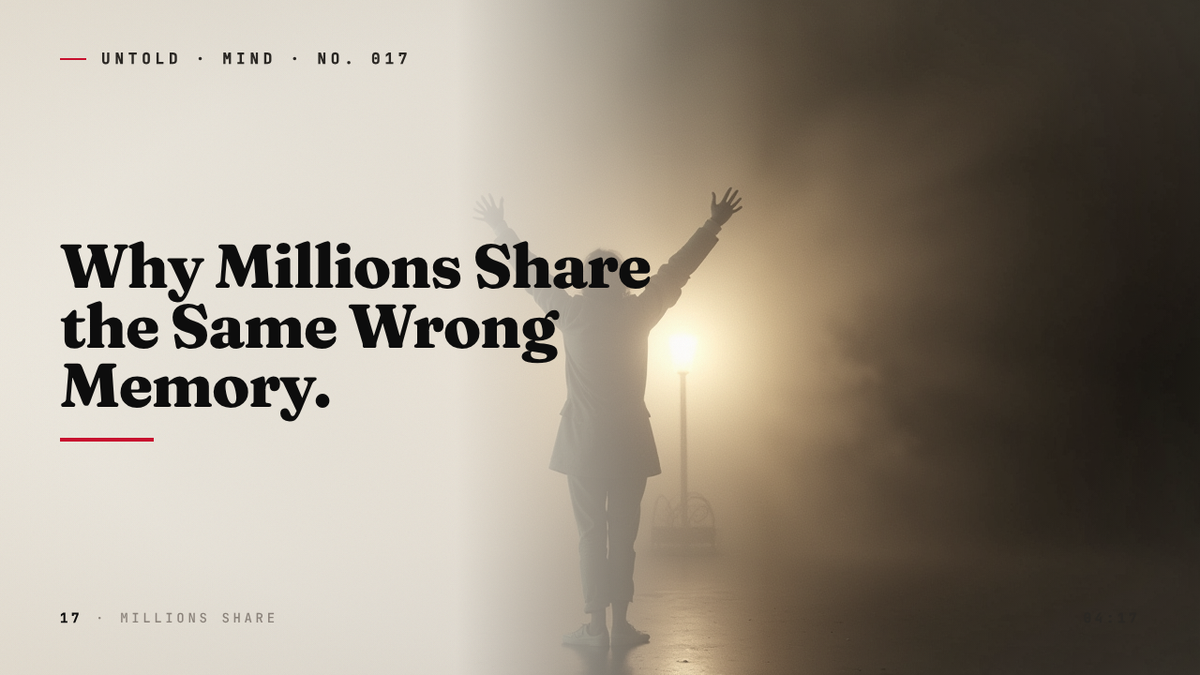
Picture the mascot of Monopoly. The dapper gentleman with the white moustache, the top hat, the cane. And the monocle, gleaming in one eye like a tiny window. Most people can summon him without effort. The detail feels worn smooth by use, the kind of image so familiar it seems beneath suspicion.
He has never worn a monocle. Search every board printed since 1936, every Chance card, every box lid and instruction sheet. Rich Uncle Pennybags, later christened Mr. Monopoly, has a bare face. The monocle belongs to the Planters peanut, to the Penguin from Batman, to a hundred drawings of Edwardian wealth. It does not belong to him. And yet a sizeable fraction of people who have played the game for decades will describe it in confident detail, then feel a small vertigo when shown they are wrong.
The same vertigo waits in the children’s section of any library. The bears who taught a generation about honesty and bedtime and not talking to strangers were written by Stan and Jan Berenstain. Their name ends in ain. Most readers remember it ending in ein: Berenstein, with the soft Germanic vowel, the way the name simply ought to sound. The covers say otherwise. They always have.
These are not the ordinary slips of an unreliable narrator. A private misremembering is forgettable; you correct it and move on. What makes these errors strange is that they are shared. Strangers who have never met, separated by geography and age and language, converge on the same wrong detail with the same unshakeable certainty. They remember a thing that did not happen, and they remember it together.
This is the phenomenon now called the Mandela Effect, and the explanation is both less magical and more unsettling than the theories that swirl around it.
A death that never happened
The name was coined in 2009 by a paranormal researcher named Fiona Broome, who found herself at a conference describing a memory she held with total conviction. She remembered Nelson Mandela dying in prison in the 1980s. Not vaguely. She could see the television coverage of his funeral, the grieving crowds, a speech delivered by his widow.1
None of it occurred. Mandela walked out of Victor Verster Prison a free man in February 1990. He became the first democratically elected president of South Africa in 1994. He died in December 2013, at the age of ninety-five, decades after the funeral Broome believed she had witnessed.
What unsettled her was not the error itself but its company. When she mentioned her false memory aloud, others in the room said they remembered it too. They had also believed Mandela died behind bars years earlier. They could describe details. A shared mistake, oddly specific, held by people who had no reason to coordinate. Broome started a website to collect such cases and gave the pattern a name.1
The internet did the rest. Within a few years, the catalogue had grown enormous, and it followed a consistent shape. The errors clustered around famous, repeated, slightly mutable cultural artifacts: film lines, brand logos, fairy-tale phrasings, spellings of household names.
Consider the film quotations. In The Empire Strikes Back, Darth Vader is widely believed to say, “Luke, I am your father.” The actual line is “No, I am your father.” In Disney’s Snow White, the Evil Queen is remembered intoning “Mirror, mirror on the wall.” She says “Magic mirror on the wall.” The cereal mascot is recalled by many as Froot Loops with an extra letter, “Fruit Loops” or “Frooot Loops,” though the box has always read Froot Loops, no spare vowel.
Each case has the same texture. The remembered version is more regular, more expected, more grammatically tidy than the real one. “Luke, I am your father” makes narrative sense as a standalone line in a way the dialogue-bound “No” does not. “Mirror, mirror” has the satisfying rhythm of repetition. These are not random errors. They are improvements, the kind a careful editor might make, and they are made by millions of minds independently arriving at the same edit.
Memory is not a recording
To understand why, it helps to abandon a metaphor most of us carry without examining it: the idea that memory is a kind of recording, a video file stored in the brain and replayed on demand. It is among the most durable folk beliefs about the mind, and among the most wrong.
The person who did the most to demolish it is the psychologist Elizabeth Loftus, who spent her career demonstrating how readily memory can be reshaped after the fact. In a now-classic 1974 experiment with John Palmer, she showed participants film of a car accident, then asked them how fast the cars were going when they collided. The crucial variable was a single verb. Some were asked how fast the cars were going when they “smashed” into each other; others heard “hit,” “bumped,” or “contacted.” The verb alone shifted the speed estimates. People who heard “smashed” reported the cars moving substantially faster than those who heard “contacted.”2
The more striking result came a week later. When participants returned and were asked whether they had seen any broken glass, those who had earlier heard the word “smashed” were more than twice as likely to report glass that had never appeared in the film. A single suggestive word, introduced after the event, had rewritten what they believed they witnessed.2
Loftus went on to show that whole episodes could be implanted. In later work, she and colleagues convinced a meaningful proportion of adults that they had been lost in a shopping mall as children, an event that never happened, simply by having a trusted relative describe it plausibly. The participants did not merely accept the claim. Many elaborated it, adding sensory detail, emotion, dialogue.3
The lesson that emerged across decades is that memory is reconstructive. Each act of recall is not a playback but a rebuild, assembled fresh from fragments, expectation, and context. And because it is rebuilt rather than retrieved, it can quietly incorporate material that was never part of the original. The brain does not flag the additions. The reconstructed memory feels exactly as vivid, exactly as certain, as one that happens to be accurate.
This explains why a false memory can feel true. It does not explain why so many people produce the same false memory. For that we need a second piece of machinery.
The templates the brain reaches for
The mind does not store the world in full detail. The bandwidth required would be ruinous, and most of the detail is redundant anyway. Instead it relies on what psychologists call schemas: generalized mental templates for how categories of things tend to look and behave. You have a schema for “kitchen,” “job interview,” “birthday party,” and you use it constantly to fill gaps that perception and memory leave open.
Schemas are why you can walk into a stranger’s kitchen and know where to look for a glass. They are also why, asked to recall an office you visited once, you may confidently remember books on the shelves that were not there. A famous early study by William Brewer and James Treyens found exactly this: people who waited briefly in an academic office later “remembered” books in a room that had none, because books belong to the schema of a scholar’s office.4
Now return to the Monopoly man. He is a schema-perfect figure of old-money wealth: the top hat, the tails, the cane. The monocle is the canonical accessory of that archetype, the thing such a man should wear. When memory reconstructs his face from the schema rather than the actual image, it reaches for the monocle and inserts it, because the template says it belongs. The error is not random. It is the predictable output of a brain that completes patterns according to expectation.
The same logic governs the spellings. “Berenstein” is the more common surname pattern in English-speaking countries; the -stein ending is familiar, the -stain ending is not. The brain, reconstructing a name it has seen a thousand times but never closely studied, defaults to the more probable template. “Froot” gets corrected toward “Fruit” because the real spelling is a deliberate violation of the rule the brain holds. In every case, the false memory is the schema asserting itself over the awkward, irregular truth.
Because schemas are broadly shared within a culture, the errors they produce are shared too. Different people drawing on the same templates make the same substitutions. That is the engine of collective false memory: not coordination, but convergence. Many minds running similar software arrive at the same bug.
How the brain mistakes a link for a memory
There is a cleaner laboratory demonstration of false memory forming collectively, and it has become one of the most replicated findings in cognitive psychology. In 1995, Henry Roediger and Kathleen McDermott revived and refined an old procedure now known by their initials, the DRM paradigm. They gave participants lists of words to study, each list built around a theme. A list might contain bed, rest, awake, tired, dream, snooze, blanket, doze, slumber, nap.5
Notice the word that does not appear: sleep. Every item points toward it, but it is never on the list. When participants were later asked to recall the words or to recognize them from a larger set, a large share confidently reported having seen sleep. In the recognition tests, false recognition of the critical lure often matched or exceeded recognition of words that had actually been presented, and participants rated their false memories with high confidence, frequently insisting they specifically remembered the word appearing.5
The mechanism is illuminating. As the brain processes the related words, it activates the concept that ties them together. That activation leaves a trace. Later, the trace of the idea of sleep is mistaken for the experience of having read the word. The brain has confused a link it generated with a memory it stored. It cannot reliably tell its own inference from external fact.
Scale that up. The DRM effect is robust precisely because it does not depend on any individual quirk; nearly everyone shows it, which is why roughly a large fraction of participants commit the same error on the same list. Collective false memory is this tendency operating across a population on the shared material of culture. The cultural “list” is everything we half-remember about a logo or a film, and the false detail is the lure the whole population converges on.
Then comes the modern accelerant. The internet allows these private reconstructions to meet and reinforce one another. One person writes “Berenstein” in a forum, and a hundred others reply that they remember it that way too. The agreement feels like corroboration, like evidence external to any single faulty mind. It is not. It is the same schema, expressed in parallel, mistaken for proof. Worse, encountering the false version repeatedly increases its fluency, the ease with which it comes to mind, and the brain routinely reads fluency as truth. Repetition does not verify a memory. It makes it feel familiar, and familiarity is easily mistaken for accuracy.
The part that resists the tidy explanation
If the story ended there, the Mandela Effect would be a satisfying footnote: schemas plus reconstruction plus social reinforcement, mystery solved. But a careful study published in 2022 complicates the picture in a way worth taking seriously.
Wilma Bainbridge and Deepasri Prasad, then at the University of Chicago, ran the first systematic experimental investigation of what they called the Visual Mandela Effect. They tested whether certain widely shared false memories of icons and logos held up under controlled conditions, and they found something that pure social-contagion accounts struggle to explain. For a specific set of images, including the Monopoly man, the Fruit of the Loom logo, and the Pikachu and Curious George characters, people made the same errors, with high confidence, even when they reported never having seen the manipulated versions and even on first exposure.6
In other words, the shared mistake did not require prior contact with the wrong version circulating online. The errors were consistent, specific, and predictable across strangers. People did not simply default to a vaguer or more generic image, as a loose schema account might predict. They converged on a particular false detail. When asked to draw or pick the Monopoly man, many reliably added the monocle. When shown the correct Fruit of the Loom logo and a false version with a cornucopia behind the fruit, many picked the cornucopia as the real one, despite the cornucopia having never existed.6
Bainbridge and Prasad were careful not to claim a single cause. They noted the effect could not be fully explained by exposure to the false images, by visual similarity, or by simple guessing, and they suggested the answer likely involves several mechanisms acting together: how visual attention is distributed, what features are most memorable in a given image, and the schema-driven expectations the brain brings to canonical figures.6 The honest summary is that the Visual Mandela Effect is real, measurable, and not yet fully understood. The reconstructive account explains most of it. A residue remains under study.
What the finding does not support is the explanation that launched a thousand forum threads: that these memories are accurate records of a different reality, evidence of timeline shifts or parallel universes bleeding into our own. The experimental evidence points firmly in the opposite direction. The errors are systematic in exactly the way human cognition is systematic. They are signatures of a particular kind of mind, not echoes of a particular kind of cosmos. A universe-hopping explanation would predict random, idiosyncratic discrepancies. What we observe instead are the same predictable shortcuts, made by the same kind of brain, on the same kind of material.
A storyteller, not a librarian
So the monocle is not proof that you slipped sideways out of a world where Mr. Monopoly wore one. It is proof of something more intimate and more strange: that your memory was never the faithful archive you assumed it to be.
The brain you carry did not evolve to store accurate footage. It evolved to predict, to simplify, to extract the gist of a situation and discard the rest, and to stitch the surviving fragments into a smooth, coherent, usable story. That talent is not a flaw to be ashamed of. It is the foundation of fluent thought. It lets you walk into an unfamiliar room and function, recognize a face in changing light, understand a sentence before it finishes. The same machinery that fills the gaps usefully a thousand times a day will, on rare occasion, fill one with a detail that was never there. It places a monocle on a man who never wore one and hands you the result with full confidence, no warning label attached.
The deepest lesson sits in that confidence. The unsettling thing about a Mandela Effect memory is not that it is wrong. Everyone is wrong about small things constantly. It is that it feels so completely right, indistinguishable from the memories that happen to be true. There is no internal alarm that sounds for false recall, no flicker of static at the edge of the fabricated image. Certainty, it turns out, is a feeling the brain generates. It is not a measurement of accuracy.
Memory is less a library than a storyteller, and a storyteller’s first loyalty is to the coherence of the tale, not the fidelity of the record. Most of the time the story it tells is true enough to live by. But the next time a memory arrives wearing the full armor of certainty, daring you to doubt it, it is worth pausing for a moment. The feeling of being sure is real. What it is sure about may not be.

Sources
- Broome, Fiona, “The Mandela Effect,” mandelaeffect.com, 2009. — https://mandelaeffect.com/
- Loftus, E. F., & Palmer, J. C., “Reconstruction of automobile destruction,” Journal of Verbal Learning and Verbal Behavior, 1974. — https://www.demenzemedicinagenerale.net/images/mens-sana/AutomobileDestruction.pdf
- Loftus, E. F., & Pickrell, J. E., “The formation of false memories,” Psychiatric Annals, 1995. — https://webfiles.uci.edu/eloftus/LoftusPickrell_PA_95.pdf
- Brewer, W. F., & Treyens, J. C., “Role of schemata in memory for places,” Cognitive Psychology, 1981. — https://doi.org/10.1016/0010-0285(81)90008-6
- Roediger, H. L., & McDermott, K. B., “Creating false memories,” Journal of Experimental Psychology: Learning, Memory, and Cognition, 1995. — https://psychnet.wustl.edu/memory/wp-content/uploads/2018/04/Roediger-McDermott-1995_JEPLMC.pdf
- Prasad, D., & Bainbridge, W. A., “The Visual Mandela Effect as Evidence for Shared and Specific False Memories Across People,” Psychological Science, 2022. — https://doi.org/10.1177/09567976221108944
- Nelson Mandela biography, Nelson Mandela Foundation. — https://www.nelsonmandela.org/biography
Related reading