The Vanishing Years
Everyone forgets the first chapter of their life, and the reason is stranger than Freud believed.
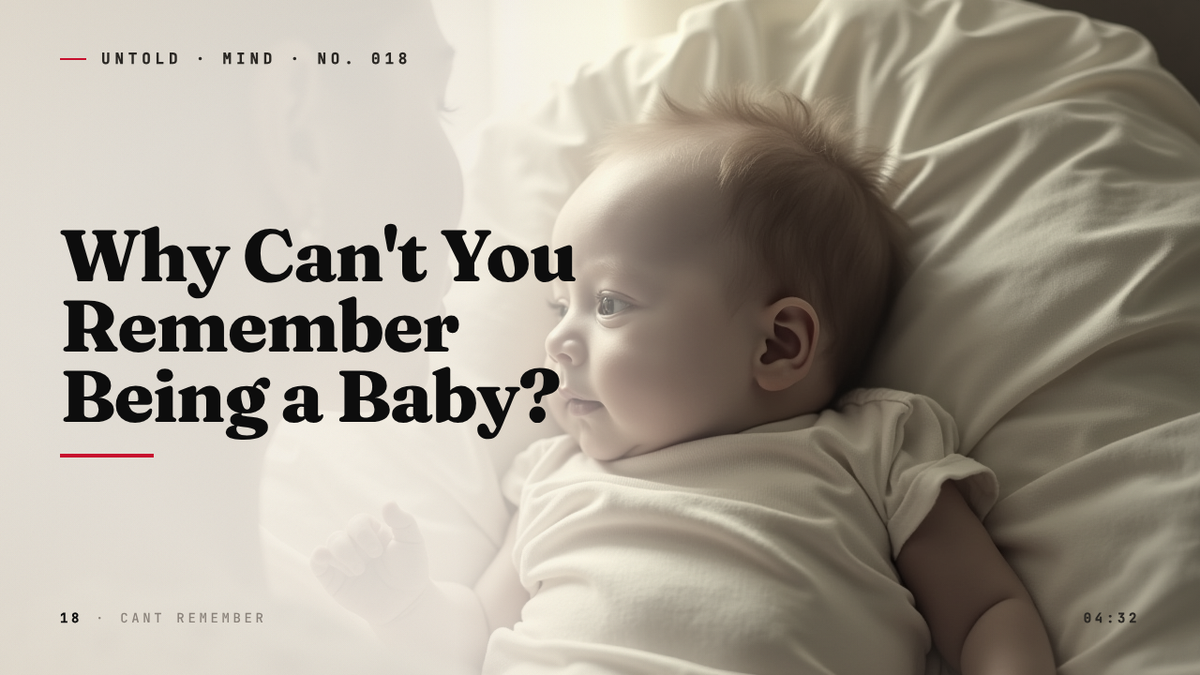
You learned to walk before you could form a sentence. You acquired a language from scratch, decoded thousands of faces, mastered the physics of grasping a spoon, and survived the most cognitively demanding stretch of your entire life. And you remember almost none of it.
For most adults, the first three years are a near-total blackout. The first steps, the first words, the first birthday cake with its single candle: gone. Press hard against the edge of your earliest recollection and you will likely arrive at a fragment from around age three and a half, often blurry, possibly borrowed from a photograph or a story told so many times it calcified into something that feels like memory. Before that line, the personal past dissolves into fog.
This is one of the strangest features of the human mind, and one of the most universal. It happens to nearly everyone, across cultures and continents. Psychologists call it infantile amnesia, and despite more than a century of investigation, it remains only partly solved. The mystery is sharpened by a single uncomfortable fact: the infant brain is not a passive sponge waiting to switch on. It is learning faster than it ever will again, forging connections at a rate that would dwarf any later year of life. So where do those years go? And why would a healthy, ferociously active brain erase its own first chapters?
The man who named the puzzle
The phenomenon got its name from Sigmund Freud, who noticed around 1899 that his patients could rarely recall anything from their earliest years.1 To Freud, this was not an accident of biology but an act of psychological defense. He proposed that the mind actively buries early memories, particularly those tangled up with the forbidden desires and conflicts he believed dominated infancy. The memories were repressed, he argued, sealed away to protect the developing self from material too charged to confront.
Freud was wrong about the mechanism. There is no warehouse of forbidden infant memories locked behind a wall of repression. But he was right about the question, and right that the pattern was real and worth explaining. The cutoff he identified turns out to be remarkably consistent. Studies across decades and populations place the average earliest memory at roughly three to three and a half years of age.2 A few people insist they remember earlier, even being born. Researchers treat these claims with deep skepticism, and for good reason: the human memory system is exquisitely vulnerable to suggestion. Many supposed early memories are not retrievals at all but reconstructions, assembled after the fact from family photographs, home videos, and the stories relatives repeat at dinner tables. The brain is a confident editor. It does not always flag what it has invented.
So the real question is not whether early memories were ever pleasant or painful, as Freud framed it. The real question is what happens to them. Because here is the twist that modern science had to confront: babies clearly do form memories. The trouble comes later.
The memories exist, then they fade
The psychologist Patricia Bauer spent much of her career studying how memory works in very young children, and her findings dismantled the old assumption that infants simply fail to record anything. They do record. Bauer’s experiments showed that even preverbal toddlers can remember sequences of events for surprisingly long stretches, reproducing actions they had seen weeks or months earlier.3 A two-year-old plainly remembers familiar people, the layout of a home, the shape of a daily routine. The hardware for memory is online far earlier than anyone once thought.
Which raises an even more curious problem. If the memories are formed, why do they not last?
The most revealing answer came from a long, patient study by Carole Peterson at Memorial University of Newfoundland. Peterson did something deceptively simple but methodologically powerful: she interviewed young children about their earliest memories, then returned years later to interview the same children again. What she found was that childhood amnesia is not a failure to record experience. It is a fading.4 Young children could readily describe early memories. But when Peterson came back after several years, many of those same memories had quietly disappeared. The children, now older, no longer recalled events they had described in vivid detail before. The memories had not been blocked at the moment of formation. They had been written, held for a while, and then lost.
This reframed the entire problem. Infantile amnesia is not a recording failure. It is something closer to erasure, or to a file the brain can no longer locate. And to understand why a brain would do that to its own early life, researchers had to go down into the tissue itself.
A structure still under construction
Deep in the brain, curled into each temporal lobe, sits a small structure named for its resemblance to a seahorse: the hippocampus. It is the brain’s archivist, the structure most responsible for binding the scattered elements of an experience (the sights, the sounds, the sequence, the place) into a single retrievable long-term memory. In an adult, this filing system runs smoothly, if imperfectly.
In an infant, the hippocampus is still being built. It is one of the slower-maturing regions of the brain, and in the first years of life its circuitry is incomplete. A newborn’s hippocampus simply cannot file experiences the way an adult’s can. Memories may form in a fragmentary, short-lived fashion, but the long-term consolidation machinery is not yet fully wired. For a long time this immaturity was treated as the whole explanation: the recorder was too primitive, so nothing stuck.
But that account left something unexplained. Bauer and Peterson had shown that early memories can be remarkably detailed and can persist for months or years before vanishing. An immature filing cabinet might explain why infant memories are fragile. It struggles to explain why memories that were clearly stored, sometimes for years, later disappear. There had to be an active process at work, something doing the erasing. And the prime suspect turned out to be the very thing that makes the infant brain so extraordinary.
The growth that overwrites
The infant brain is a construction site of almost incomprehensible intensity. In the early years it generates new neural connections at a rate of more than a million per second, sculpting the vast web of circuitry that will support every later thought.5 Among this activity is a process called neurogenesis: the birth of new neurons. And the hippocampus, the very seat of memory, is one of the few brain regions where neurogenesis continues robustly after birth, peaking in infancy.
The neuroscientist Paul Frankland proposed a startling idea about what all this growth might do. What if the flood of new neurons pouring into the infant hippocampus does not simply add capacity, but actively disrupts the memories already stored there? New neurons have to integrate into existing circuits, rewiring connections as they go. That rewiring could overwrite the delicate patterns that encode an early memory. In other words, the same explosive growth that builds the brain might be erasing its first records as a side effect.
In 2014, Frankland and his colleague Sheena Josselyn put the hypothesis to the test in mice.6 They trained young mice to fear a specific environment, then tracked how long the fear memory survived. The results were elegant and unsettling. When neurogenesis in the hippocampus was running high, as it naturally does in infant mice, the animals forgot the fear quickly. The memory dissolved. But when the researchers slowed neurogenesis down, the same memories survived far longer. And in the reverse experiment, when they boosted neurogenesis in adult mice, whose memories normally persist, the adults began to forget faster, as if they had been pushed back toward an infant-like state of rapid loss.
The implication was difficult to absorb. The brain’s relentless early growth, the engine that makes infants such prodigious learners, may be precisely what scrubs away the memories of being an infant. Building the structure costs the contents. The first chapters are sacrificed to construct the book that will hold all the later ones.
The story we cannot yet tell
Neurogenesis is not the only force at work. There is another, gentler one, and it has to do with the strange condition of living before language.
Adult memory is profoundly verbal. We do not merely store experiences; we narrate them. We turn a chaotic afternoon into a sentence, a sequence, a story with a beginning and an end. That narrative scaffolding is part of what makes a memory retrievable later. We file events partly by the words we wrap around them.
Infants have no such scaffolding. A baby experiences the world in a torrent of sensation that has not yet been organized into language. There are no words to mark where one event ends and another begins, no narrative thread to pull on years later. Without language, experiences are harder to encode in a durable, retrievable form, and harder still to summon back. This is why the boundary of infantile amnesia roughly tracks the development of language and a sense of self. As children acquire the ability to say I did this, then that happened to me, their memories begin to stick.
The evidence for this is more than theoretical. Studies of how parents talk to their children have found that the style of conversation shapes how much a child later remembers. Children whose parents narrate daily events richly, asking elaborative questions and weaving experiences into stories, tend to have earlier and more detailed first memories than children whose parents speak in sparse, factual terms.7 Memory, in this light, is partly a social skill, taught at the dinner table and in the back of the car. We learn to remember by being told how.
Dormant, not deleted
For most of this history, the working assumption was that early memories, once faded, were simply gone. Erased. Beyond recovery. Then came a finding that complicated even that grim conclusion.
In work published in 2023, researchers studying infantile amnesia in mice found evidence that the lost memories were not necessarily destroyed at all.8 Using techniques that tag the specific clusters of neurons that hold a given memory, they showed that the traces of early experiences could remain physically present in the adult brain, dormant rather than deleted. When the scientists artificially reactivated those neuron clusters, the animals behaved as though the buried memory had returned. The file had not been wiped. It had been hidden, stored somewhere the normal machinery of recall could no longer reach.
This does not mean your first birthday is sitting in your head waiting for the right trigger, nor that any technology exists to retrieve a human infant memory. The work was done in mice, and the leap to human experience is enormous and unproven. But it shifts the conceptual picture in an important way. Infantile amnesia may be less a problem of storage than a problem of access. The earliest chapters of a life might be written in an ink the adult brain has simply lost the ability to read.
What the blackout built
It is tempting to mourn those vanished years, to feel cheated of the footage. But the forgetting is not a flaw, and the years were not wasted. They were the most formative of your life precisely because the brain was prioritizing construction over preservation. In the period you cannot recall, you learned to trust the people who fed you, to recognize the cadence of a language, to feel safe or unsafe in the world. You absorbed the deep grammar of being human.
Those lessons did not disappear when the episodic memories faded. They simply migrated. The attachment patterns formed in infancy, the linguistic intuitions, the bodily sense of how the world responds to you: these persist not as scenes you can replay but as instinct, as temperament, as the unexamined architecture of the self. Your earliest self lives on, just not in a form you can narrate. You carry it the way you carry your native accent, without remembering the moment you acquired it.
The grip of childhood amnesia tightens with age. By around seven, the rapid loss that defines the earliest years gives way to the more durable autobiographical memory of later childhood. The memories a young child forms today, vivid and real in the moment, may well be gone by their teenage years, faded by the same growth that is making them so quick to learn. Watching a toddler narrate their day, you are watching memories that are, in all likelihood, temporary.
So the next time you look at a photograph of yourself as a baby, held by people some of whom may no longer be here, resist the instinct to treat the child as a stranger. You were truly there. You felt the warmth of that room and the weight of those arms. The experience was real and it mattered, more than almost anything that came after. You simply cannot find the file. Your own brain, in the act of becoming itself, quietly wrote over it.

Sources
- Freud, S., “Screen Memories,” in The Standard Edition of the Complete Psychological Works, 1899. — https://www.sas.upenn.edu/~cavitch/pdf-library/Freud_Screen.pdf
- Rubin, D. C., “The distribution of early childhood memories,” Memory, 2000. — https://pubmed.ncbi.nlm.nih.gov/11045240/
- Bauer, P. J., Remembering the Times of Our Lives: Memory in Infancy and Beyond, Lawrence Erlbaum Associates, 2007. — https://psycnet.apa.org/record/2006-22389-000
- Peterson, C., Warren, K. L., & Short, M. M., “Infantile amnesia across the years: A 2-year follow-up of children’s earliest memories,” Child Development, 2011. — https://pubmed.ncbi.nlm.nih.gov/21679171/
- Center on the Developing Child, Harvard University, “Brain Architecture,” Harvard University. — https://developingchild.harvard.edu/science/key-concepts/brain-architecture/
- Akers, K. G., Frankland, P. W., Josselyn, S. A., et al., “Hippocampal neurogenesis regulates forgetting during adulthood and infancy,” Science, 2014. — https://www.science.org/doi/10.1126/science.1248903
- Reese, E., Haden, C. A., & Fivush, R., “Mother-child conversations about the past,” Cognitive Development, 1993. — https://www.sciencedirect.com/science/article/abs/pii/S0885201405800067
- Power, A. R., et al., “Reactivating forgotten infant memories in mice,” reported in Science Advances / Current Biology coverage, 2023. — https://www.science.org/content/article/can-you-recover-lost-childhood-memories
Related reading