The Feeling You Are Avoiding
Procrastination was never a failure of willpower. It is a strategy for managing emotion.
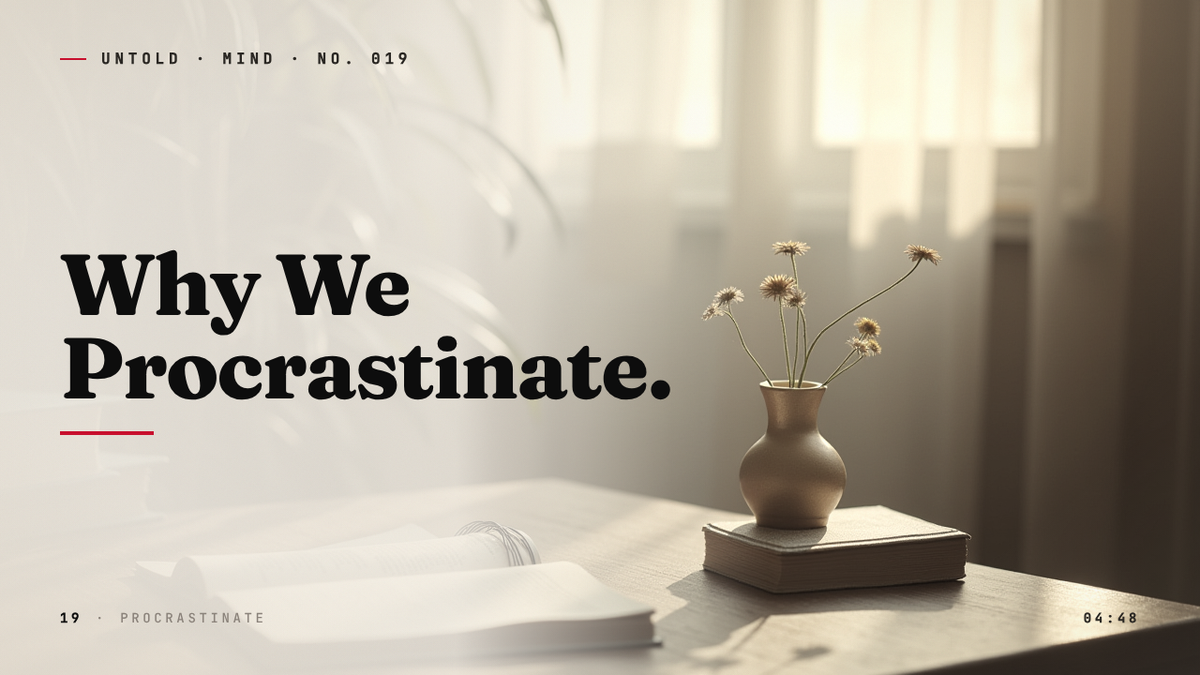
It is eleven at night. The deadline is tomorrow morning. The document is open on the screen, cursor blinking at the top of an empty page, and for a moment there is the possibility that work might actually begin. Then the document closes. The desk gets tidied instead. The photo library gets reorganized by date. A snack is assembled with the care of a Michelin plating. By midnight, the only thing that has not happened is the one thing that needed to.
Anyone who has lived this scene knows that the standard explanation does not fit. The person at the desk is not lazy. They want to do the task. They understand its importance, sometimes with painful clarity. They can feel the consequences gathering like weather on the horizon. And still they do not start. This is the strange paradox at the center of procrastination, and it is far more common than most people assume. Surveys across cultures suggest that around twenty percent of adults are chronic procrastinators, meaning the pattern is not an occasional lapse but a stable feature of how they live 1. That is a larger share of the population than those who experience clinical depression or diagnosed phobias.
For most of the twentieth century, the assumed culprits were obvious: weak willpower, poor time management, a deficit of discipline. Buy a planner, build a system, white-knuckle your way through. The trouble is that none of it works very well, and the reason it fails is that it misdiagnoses the problem. The research of the past three decades points somewhere stranger and more human. Procrastination is not really a problem of managing time. It is a problem of managing emotion.
A very old human failing
The word itself carries a quiet confession. Procrastination comes from the Latin pro, meaning forward, and cras, meaning tomorrow. To procrastinate is, etymologically, to push a thing toward a tomorrow that conveniently never arrives. The behavior is at least as old as the written record of complaint about it. The Greek poet Hesiod, writing nearly three thousand years ago, warned his brother not to put off work until tomorrow or the day after, because the man who delays is forever wrestling with ruin. Cicero, the Roman consul and orator, condemned slowness and procrastination in public affairs as hateful. The Bhagavad Gita and the analects of various traditions circle the same anxiety. Humans have been dreading their duties, and feeling ashamed about the dread, for as long as they have had duties.
What changed is that someone finally decided to study the behavior rather than simply moralize about it. Joseph Ferrari, a psychologist at DePaul University, spent decades doing exactly that, and his work reframed procrastination as a measurable, stable trait rather than a passing mood. Ferrari drew a distinction that matters enormously. Everyone procrastinates occasionally, he observed, but not everyone is a procrastinator 2. The occasional delay is ordinary. What interested him was the roughly one in five people for whom delay is a way of life, a default setting that surfaces across cultures, across age groups, and across every kind of profession from surgeons to students to executives. These chronic procrastinators do not lack intelligence or ambition. Many of them are talented and accomplished. Their problem is not capability. It is something happening underneath capability, in the place where feeling meets action.
The war inside the skull
To understand that underneath, it helps to look at the brain as a system of competing interests. Two regions, in particular, are locked in a quiet argument whenever an unpleasant task appears on the horizon.
The first is the limbic system, an ancient cluster of structures buried deep in the brain that governs emotion and the pursuit of immediate reward. It is fast, automatic, and powerful. Its job, evolutionarily speaking, is to steer the organism toward comfort and away from pain, and it does not particularly care about your quarterly report. The second is the prefrontal cortex, the newest and most distinctly human part of the brain, sitting just behind the forehead. This is the region that plans, weighs consequences, imagines the future, and steers behavior toward long-term goals. When the two disagree, as they constantly do, the outcome of the argument determines whether you start the task or clean the desk.
The problem is that the fight is not fair. The limbic system is older, faster, and tied directly into the brain’s reward machinery. The prefrontal cortex is slower, more effortful, and, crucially, the last part of the brain to fully mature. Neuroscientists now place full prefrontal development somewhere around the age of twenty-five, which goes a long way toward explaining why adolescents and young adults struggle so intensely with putting things off 3. The very hardware responsible for resisting the pull of immediate relief is, in the years when most academic deadlines pile up, still under construction. When a task feels threatening, the limbic system tends to win by default, and the conscious mind is left to invent a justification after the fact.
Which raises the obvious question. Why should a perfectly ordinary essay, or expense report, or email feel threatening in the first place?
Repairing a bad mood
The most illuminating answer came from Timothy Pychyl, a psychologist at Carleton University who spent his career studying precisely that moment of avoidance. Pychyl’s central insight was to stop treating procrastination as a failure of self-control and to start treating it as a strategy for mood repair 4. We do not avoid the task because the task is objectively difficult. We avoid it because the task makes us feel something we would rather not feel.
The list of those feelings is long and familiar. Boredom. Anxiety about whether the work will be good enough. Self-doubt that whispers we are not equal to it. Frustration at its complexity. Resentment at having to do it at all. A vague, formless insecurity that the task seems to confirm. None of these are pleasant, and the brain treats them, sensibly enough, as forms of pain to be escaped. The moment you turn away from the document and toward something easier, the unpleasant feeling lifts. That relief is immediate, real, and rewarding.
This is the engine of the whole cycle. Pychyl described it as giving in to feel good, and the phrase captures the mechanism exactly 4. Avoidance is not aimless. It is a deliberate, if unconscious, exchange: trade a small amount of future trouble for a large amount of present relief. And because the brain is a learning machine that repeats whatever gets rewarded, the relief teaches itself. Each act of avoidance makes the next one slightly more likely. The behavior is reinforced not by laziness but by the most ordinary feature of how mammals learn.
The cruelty of the arrangement is that the relief is temporary while the consequences compound. The deadline does not move. As it approaches, the anxiety that was briefly soothed comes back larger, now carrying interest. The procrastinator ends up experiencing more total distress than someone who simply started, not less, because the dread is paid in installments across days rather than discharged at once. The strategy that promises to reduce suffering quietly multiplies it.
The tyranny of now
There is a second force compounding the emotional one, and it has to do with how human beings value time. We are, all of us, systematically biased toward the present. A reward available now feels far more vivid and compelling than an equivalent reward available next month, and a cost we can defer feels much smaller than a cost we must pay today. Psychologists call this present bias, and it warps nearly every decision involving the future.
Piers Steel, a researcher at the University of Calgary, turned this into something close to a law. After reviewing the scattered findings of the field, he proposed a formula he called temporal motivation theory, which holds that our motivation to do a task rises with our expectancy of success and the value of the reward, and falls as the reward becomes more distant and as our own impulsiveness rises 5. The equation is elegant in its implications. Hold everything else constant and simply push the payoff further into the future, and motivation collapses. A deadline three weeks away exerts almost no pull at all, which is why the work so often begins only when the deadline is close enough to generate real fear.
Steel’s 2007 paper, which synthesized findings from nearly seven hundred studies, did more than describe the mechanism 5. It argued that procrastination has been rising sharply in the modern world, and the reason is not hard to locate. The limbic system’s appetite for immediate reward has become an industry. Every notification, every autoplaying video, every infinite scroll is engineered by teams of talented people whose explicit goal is to win the battle against your prefrontal cortex. The phone in your pocket is a procrastination machine of unprecedented sophistication, offering an endless supply of frictionless relief precisely at the moments when you most need to tolerate discomfort. The deck was always stacked toward the present. Now it is stacked by professionals.
The self behind the delay
Beneath the emotional and temporal layers lies a third, darker one, and it concerns how we judge ourselves. For a certain kind of person, procrastination is not merely about escaping an unpleasant feeling. It is about protecting an identity.
Consider the perfectionist. The perfectionist’s sense of worth is bound tightly to the quality of their output, which means that a finished piece of work is also a verdict. If the essay is completed and judged mediocre, the mediocrity attaches to the self. But an unfinished task can never be a failed task. As long as the work remains undone, its potential quality remains theoretically perfect, and the fragile sense of competence stays intact. Delay becomes a shield. Researchers studying this pattern have linked it to what is sometimes called self-handicapping, the unconscious construction of an excuse in advance 6. The logic, never spoken aloud, runs something like this: if I procrastinate, then any failure can be blamed on the delay rather than on me. I could have done brilliantly, the story goes, if only I had started sooner. The performance is sacrificed to preserve the self-image.
This is why procrastination so often travels with shame. The behavior is, at bottom, a defense of a vulnerable sense of worth, and the more vulnerable that worth feels, the more powerful the urge to delay becomes. It also explains why the standard advice fails so reliably. Telling a frightened perfectionist to simply try harder addresses none of the machinery actually driving the avoidance.
The unlikely cure
If procrastination is an emotional problem rather than a scheduling one, then the conventional remedies were always aimed at the wrong target. The cure was never a better calendar app or a sterner internal taskmaster. The evidence points, counterintuitively, in the opposite direction. The most effective antidote to procrastination appears to be self-compassion, not self-discipline.
The finding feels almost paradoxical, because it suggests that being harder on yourself makes the problem worse while being gentler makes it better. Yet that is precisely what the research shows. In a 2010 study, Pychyl and his colleague Michael Wohl followed first-year university students through their exam periods and found that those who forgave themselves for procrastinating on a first exam were significantly less likely to procrastinate before the next one 7. Forgiveness, not guilt, predicted improvement. The mechanism makes sense once you remember what the cycle runs on. Guilt and self-recrimination are themselves negative emotions, and negative emotions are exactly what the procrastinator is trying to escape. Beating yourself up adds fuel to the very fire you are trying to put out. Kindness, by contrast, quietly removes it.
This reframing changes what a practical fix looks like. The first move is not to schedule the task but to name the feeling it triggers. Is it boredom, fear of judgment, resentment, the suspicion of inadequacy? Naming the emotion is more than introspective housekeeping. It loosens the emotion’s grip, because a feeling that has been identified is no longer operating in the dark, dictating behavior from below awareness. Studies of affect labeling suggest that simply putting an emotion into words reduces its intensity 8.
The second move is to shrink the task until the first step feels almost weightless. The limbic system resists the entire mountain. It rarely objects to a single small stone. The instruction is not to write the report but to open the file. Not to finish the chapter but to write one ungraceful sentence. The goal is to lower the activation energy of beginning to the point where avoidance loses its purpose, because there is no longer anything large enough to dread. Once the first sentence exists, momentum tends to take over, and the task that loomed as a threat reveals itself as merely a series of ordinary, survivable actions.
A different question
What all of this finally dismantles is the oldest and most corrosive belief about procrastination: that it is a character flaw, a sign of some weakness in the self. It is not. It is the predictable output of a brain doing what brains do, choosing relief over discomfort, the near over the far, the felt over the imagined. The person frozen at the desk at eleven at night is not failing at being disciplined. They are succeeding, all too well, at managing a feeling they would rather not have.
Which means the useful question is not the accusatory one. When the document closes and the desk suddenly needs cleaning, the thing to ask is not what is wrong with me. The more honest and more practical question, the one that actually opens a door, is quieter than that. What feeling am I trying to avoid right now? Answer that, even partway, and the task stops being an enemy and becomes what it always was: something difficult, and entirely possible to begin.

Sources
- Ferrari, J. R., Still Procrastinating? The No-Regrets Guide to Getting It Done, Wiley, 2010. — https://www.wiley.com/en-us/Still+Procrastinating%3F%3A+The+No+Regrets+Guide+to+Getting+It+Done-p-9780470611586
- Steel, P., The Nature of Procrastination: A Meta-Analytic and Theoretical Review, Psychological Bulletin, 2007. — https://pubmed.ncbi.nlm.nih.gov/17201571/
- Pychyl, T. A., Solving the Procrastination Puzzle, TarcherPerigee, 2013. — https://www.penguinrandomhouse.com/books/315008/solving-the-procrastination-puzzle-by-timothy-a-pychyl/
- Sirois, F. M. and Pychyl, T. A., Procrastination and the Priority of Short-Term Mood Regulation, Social and Personality Psychology Compass, 2013. — https://onlinelibrary.wiley.com/doi/10.1111/spc3.12011
- Wohl, M. J. A., Pychyl, T. A., and Bennett, S. H., I forgive myself, now I can study: How self-forgiveness for procrastinating can reduce future procrastination, Personality and Individual Differences, 2010. — https://www.sciencedirect.com/science/article/abs/pii/S0191886910000474
- Lieberman, M. D. et al., Putting Feelings Into Words: Affect Labeling Disrupts Amygdala Activity, Psychological Science, 2007. — https://pubmed.ncbi.nlm.nih.gov/17576282/
- Casey, B. J., Jones, R. M., and Hare, T. A., The Adolescent Brain, Annals of the New York Academy of Sciences, 2008. — https://www.ncbi.nlm.nih.gov/pmc/articles/PMC2475802/
- Ferrari, J. R. and Tice, D. M., Procrastination as a Self-Handicap for Men and Women, Journal of Research in Personality, 2000. — https://www.sciencedirect.com/science/article/abs/pii/S0092656699922820
Related reading