The Pepper's Beautiful Lie
Chili heat is a chemical hoax your nervous system can't ignore, and somehow you keep asking for more.
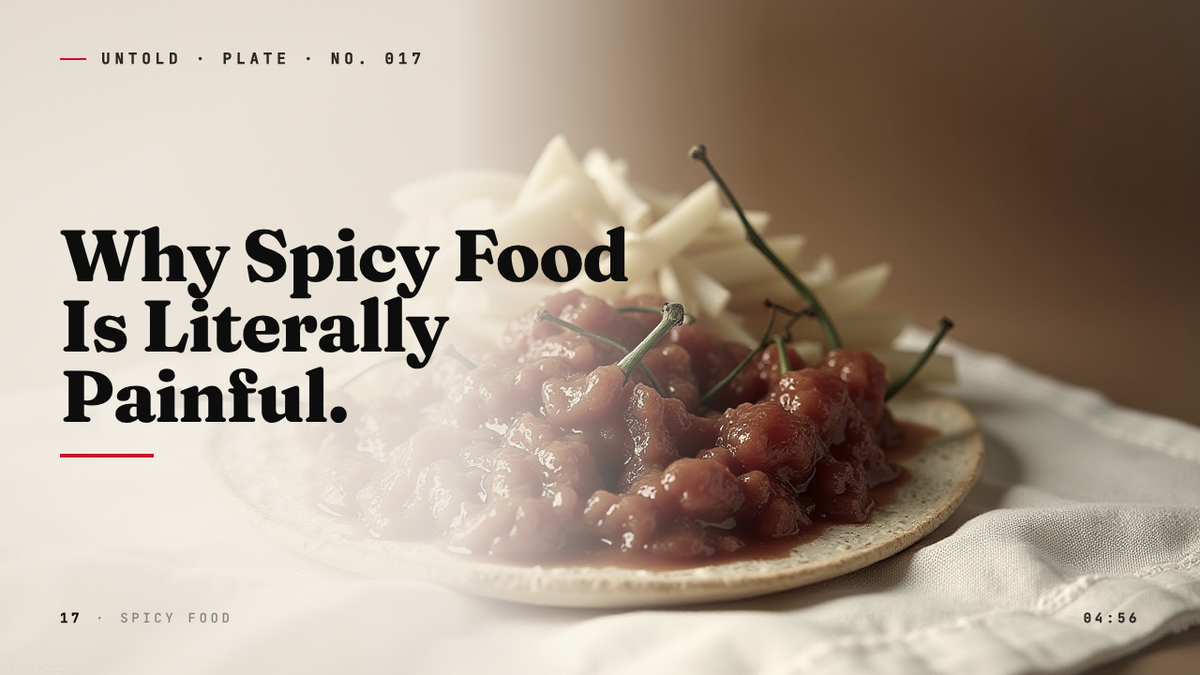
Bite into a fresh habanero and the sensation arrives with the unmistakable authority of an emergency. The mouth floods. The lips throb. The back of the throat tightens as though something has caught fire just behind the tongue. Sweat beads along the hairline. The eyes water. Every instinct that evolution spent hundreds of millions of years installing announces, in unambiguous terms, that tissue is being destroyed and the body should do something about it immediately.
And yet nothing is burning. The pepper is room temperature. No cell in the mouth has been damaged. The temperature of the tongue has not risen by a single degree. The entire catastrophe is a fabrication, an elaborate and convincing lie told by a plant molecule to a nervous system that cannot tell the difference between a real flame and a chemical impersonation of one.
Stranger still: roughly a quarter of the world’s adult population eats chili peppers every single day, and many of them, far from enduring this deception, actively pursue it. They cultivate tolerance the way athletes train muscle. They graduate from jalapeños to ghost peppers to the cultivar named, with grim honesty, the Carolina Reaper. We appear to be the only species on Earth that deliberately seeks out a sensation engineered specifically to repel us. The question is not merely why spicy food hurts. It is why a body would willingly court its own torment, again and again, and call the experience pleasure.
The answer lives inside a single molecule, a protein receptor it deceives, and an evolutionary argument between a plant and a tooth that is older than our species by a wide margin.
The receptor that cannot tell heat from chemistry
The human tongue, like the rest of the skin, is studded with sensors whose job is to warn of damage before it becomes permanent. Among the most important is a protein called TRPV1, a channel embedded in the membranes of pain-sensing neurons. Under ordinary circumstances it has a single, sensible task. When the surrounding temperature climbs past roughly 43 degrees Celsius, around 109 degrees Fahrenheit, the threshold where heat begins to scald living tissue, TRPV1 opens. Charged particles rush into the neuron. The neuron fires. The signal travels up the nerve and into the brain, where it is interpreted, correctly, as a warning: you are being burned, move.
This is a good system. It is the reason you yank your hand off a stove before conscious thought catches up. The problem is that TRPV1 does not actually detect heat in any direct sense. It detects a change in its own shape, a conformational shift that high temperature happens to cause. And it turns out that heat is not the only thing capable of forcing that shift.
Capsaicin, the active compound in chili peppers, is a long, fatty molecule that slips through the neuron’s membrane and binds to TRPV1 from the inside. When it docks, it pries the channel open exactly as a scalding temperature would 1. The neuron fires the identical signal. The brain receives an identical message. As far as the nervous system is concerned, the mouth is genuinely on fire, because the only evidence the brain ever receives is the firing of that nerve, and the nerve cannot distinguish a real burn from a chemical counterfeit.
This is the crucial and counterintuitive fact about spicy food. The pain is entirely real. It is processed by the same machinery, in the same brain regions, with the same emotional weight as a literal burn. But the fire is pure fiction. There is no heat, no injury, no scalded cell. Capsaicin has simply found the password to a security system and used it to trigger a false alarm.
David Julius and the gene that senses fire
For most of the twentieth century, scientists knew that capsaicin produced a burning sensation and that it somehow acted on pain neurons, but the actual mechanism remained obscure. The breakthrough came from the laboratory of David Julius at the University of California, San Francisco, in the late 1990s.
Julius reasoned that if capsaicin produced its effect by binding to a specific receptor, then the gene encoding that receptor could be hunted down directly. His team assembled a vast library of complementary DNA derived from sensory neurons, then inserted fragments of it into cultured cells that ordinarily felt nothing when exposed to capsaicin. The logic was elegant in its brute simplicity. If a given fragment contained the gene for the capsaicin receptor, the cells carrying it would suddenly respond to the chemical. The researchers could watch for the telltale rush of calcium that signals an activated neuron.
After screening pools of thousands of genes, in 1997 they isolated a single one that made ordinary cells abruptly sensitive to the burn 1. They had found the receptor, which they initially called VR1 and which is now known as TRPV1. And when they tested it further, they discovered its second life: the same channel that capsaicin opened was also opened by noxious heat. The molecule had, in effect, handed them a key to one of the body’s fundamental pain pathways.
The discovery proved foundational to the entire field of sensory neuroscience, illuminating how the body translates temperature and chemical insult into the conscious experience of pain. In 2021, Julius shared the Nobel Prize in Physiology or Medicine, together with Ardem Patapoutian, who identified the receptors that sense pressure and touch 2. The chili pepper, it turned out, had never been the point. It was merely the most convenient tool anyone had ever found for prying open a question about how living things feel.
Wilbur Scoville and the arithmetic of heat
Long before anyone understood the molecular machinery, people wanted to quantify the burn, and the first serious attempt belongs to an American pharmacist named Wilbur Scoville. In 1912, working for a pharmaceutical company that used capsaicin in muscle salves, Scoville devised a method that was crude, subjective, and surprisingly durable 3.
He took an extract of a given pepper and dissolved it in sweetened water, then asked a panel of tasters to sip progressively diluted solutions until the burning sensation could no longer be detected. The more dilution required to extinguish the heat, the more capsaicin the pepper contained, and the higher its score. A measurement that needed the extract diluted a thousandfold scored 1,000. One that needed dilution by a factor of a million scored a million.
The resulting Scoville scale remains in use more than a century later, even though it began as a panel of human tongues guessing in a laboratory. A bell pepper, containing essentially no capsaicin, scores zero. A jalapeño lands somewhere around 5,000 Scoville heat units. The Carolina Reaper, bred deliberately for ferocity, exceeds 1.6 million. Pure crystalline capsaicin sits at roughly 16 million, a figure that describes a substance no human would willingly place on the tongue. Modern laboratories now measure capsaicin concentration directly with chromatography and convert it back into Scoville units, but the scale still bears the name of the pharmacist who first thought to dilute fire until it disappeared.
What the numbers conceal is a question Scoville never asked. The pepper went to considerable metabolic expense to manufacture this molecule. Capsaicin is not a byproduct or an accident. The plant builds it on purpose. And a plant does not invest in a chemical weapon without a reason.
A message meant for birds, not for us
The reason, it turns out, is reproduction, and it is here that the story of spice reveals its hidden architecture. A chili pepper, from the plant’s point of view, is a delivery vehicle. The fruit exists to carry seeds away from the parent so that new plants can sprout at a useful distance. To accomplish this, the plant needs an animal to eat the fruit, transport the seeds inside its gut, and deposit them elsewhere, conveniently packaged in fertilizer.
But not every animal makes a good courier. Mammals are a problem. A rodent’s molars grind seeds to powder, destroying the very thing the plant is trying to disperse. From the chili’s perspective, a mouse is not a partner but a thief, an animal that eats the fruit and annihilates the next generation in the process. The plant needed a way to repel the destroyers while still attracting useful carriers.
The solution was capsaicin, a molecule that targets TRPV1, the heat-and-pain receptor that mammals carry. To a mouse, the pepper is agony, and the mouse learns to leave it alone. Birds, however, have a version of the TRPV1 receptor that capsaicin barely activates 4. A bird can swallow the hottest chili in the world and feel nothing at all. And birds happen to be the ideal dispersal agent: they swallow fruit whole, fly considerable distances, and pass the seeds undamaged through their digestive tracts. The chili, in effect, speaks two languages at once. To mammals it says stay away. To birds it says nothing, and they eat freely.
This was not merely a tidy hypothesis. In 2001, the ecologist Joshua Tewksbury and his colleague Gary Nabhan published fieldwork on wild chiltepin peppers in the American Southwest, demonstrating directly that birds consumed the fruit and dispersed viable seeds while rodents avoided the pungent fruit entirely 4. Later work extended the picture: Tewksbury’s team found that within wild pepper populations, spiciness rose precisely in environments where seed-destroying insects and fungal infection threatened the fruit, suggesting capsaicin doubles as a defense against microbial attack as well 5. The heat was never arbitrary. It was a finely tuned chemical signal, calibrated by natural selection to repel exactly the enemies that mattered.
Which leaves the strangest character in the whole story unexplained. Humans are mammals. We carry the very TRPV1 receptor the pepper evolved to punish. The molecule is, in the most literal evolutionary sense, a message that means keep away. And we have responded by cultivating the plant across the globe, breeding it for ever-greater ferocity, and building entire cuisines around the deliberate triggering of an alarm meant to drive us off.
The pleasure in a false emergency
Why humans override the warning is partly a matter of chemistry and partly a matter of mind. When TRPV1 fires in response to capsaicin, the brain does what it does in the face of any pain it judges manageable: it releases endorphins, the body’s own opioid painkillers, the same molecules that produce the glow after hard exercise 6. Alongside them comes dopamine, the neurotransmitter of reward and relief. The burn, in other words, is followed by a genuine pharmacological reward, a small flood of pleasure chemistry that the brain learns to anticipate.
But chemistry alone does not explain the appetite. The deeper account belongs to the psychologist Paul Rozin, who spent decades studying the peculiar human capacity to enjoy experiences the body interprets as threatening. Rozin coined the phrase “benign masochism” to describe it: the pleasure that arises when the body sounds an alarm and the mind, observing from a position of safety, recognizes that no real harm is occurring 7. A roller coaster triggers the physiology of falling while the rider knows the harness will hold. A sad film summons grief at no genuine cost. And a chili pepper screams burn while the brain calmly registers that the tongue is intact.
Rozin’s insight was that the gap itself is the pleasure. The body insists on danger; the mind knows better; and the dissonance between alarm and safety becomes a kind of thrill, a way of playing with the machinery of fear without paying its price. Children, his work suggested, often have to learn to like spice, acquiring the taste only once they have enough experience to trust that the burn will not actually hurt them. The enjoyment is not innate. It is a triumph of the higher brain over the reflexes of the body, a learned delight in mastering a false emergency.
When the alarm grows quiet
There is a final turn, and it points toward medicine rather than dinner. Because capsaicin causes pain without causing injury, repeated exposure does not damage the tissue. Instead it gradually wears down the alarm itself. Over time, persistent stimulation desensitizes the TRPV1 receptors, depleting the neurons of the chemical signals they need to fire and leaving them less responsive 8. This is the physiological reason chili enthusiasts can tolerate doses that would fell a novice, and why they tend to chase ever-hotter peppers to feel anything at all. The alarm has been turned down at the source.
That same property has made capsaicin an object of serious clinical interest. High-concentration capsaicin patches are now used to treat certain forms of chronic nerve pain. By flooding the affected nerves with capsaicin, clinicians can effectively exhaust and silence the pain fibers in a localized area, producing relief that can last for weeks 8. The molecule that exists to scream fire, it turns out, can be used to switch a different fire off.
The larger health picture remains more tentative. Several large population studies have found associations between regular chili consumption and lower mortality, including a major Chinese cohort study published in The BMJ in 2015 9. But these are correlations, tangled up with diet, geography, and lifestyle, and they fall well short of proving that spice itself extends life. What is certain is narrower and stranger: a plant toxin evolved to repel us has become a tool we use to study pain, treat pain, and quietly seek out for pleasure.
So the next time the mouth ignites and the eyes begin to water, it is worth remembering that the fire was never there. What you are tasting is a deception roughly twenty million years in the making, a chemical argument between a plant trying to protect its seeds and a mammal whose teeth would destroy them. The pepper meant the message for a mouse. You intercepted it, decoded it, and decided that the alarm was a kind of music. And with every bite, knowing exactly what it is, you choose the burn again.

Sources
- Caterina, M. J., et al., “The capsaicin receptor: a heat-activated ion channel in the pain pathway,” Nature, 1997. — https://www.nature.com/articles/39807
- The Nobel Assembly at Karolinska Institutet, “The Nobel Prize in Physiology or Medicine 2021,” Nobel Prize Press Release, 2021. — https://www.nobelprize.org/prizes/medicine/2021/press-release/
- Scoville, W. L., “Note on Capsicums,” Journal of the American Pharmaceutical Association, 1912. — https://doi.org/10.1002/jps.3080010520
- Tewksbury, J. J. & Nabhan, G. P., “Directed deterrence by capsaicin in chillies,” Nature, 2001. — https://www.nature.com/articles/35088074
- Tewksbury, J. J., et al., “Evolutionary ecology of pungency in wild chilies,” PNAS, 2008. — https://www.pnas.org/doi/10.1073/pnas.0802691105
- Sharma, S. K., et al., “Mechanisms and clinical uses of capsaicin,” European Journal of Pharmacology, 2013. — https://doi.org/10.1016/j.ejphar.2013.07.018
- Rozin, P., et al., “Glad to be sad, and other examples of benign masochism,” Judgment and Decision Making, 2013. — https://journal.sjdm.org/12/12502a/jdm12502a.pdf
- Anand, P. & Bley, K., “Topical capsaicin for pain management,” British Journal of Anaesthesia, 2011. — https://doi.org/10.1093/bja/aer260
- Lv, J., et al., “Consumption of spicy foods and total and cause specific mortality,” The BMJ, 2015. — https://www.bmj.com/content/351/bmj.h3942
Related reading