The Drug That Learned to Be Dessert
Before it was candy, chocolate spent three thousand years as a bitter, frothy medicine.
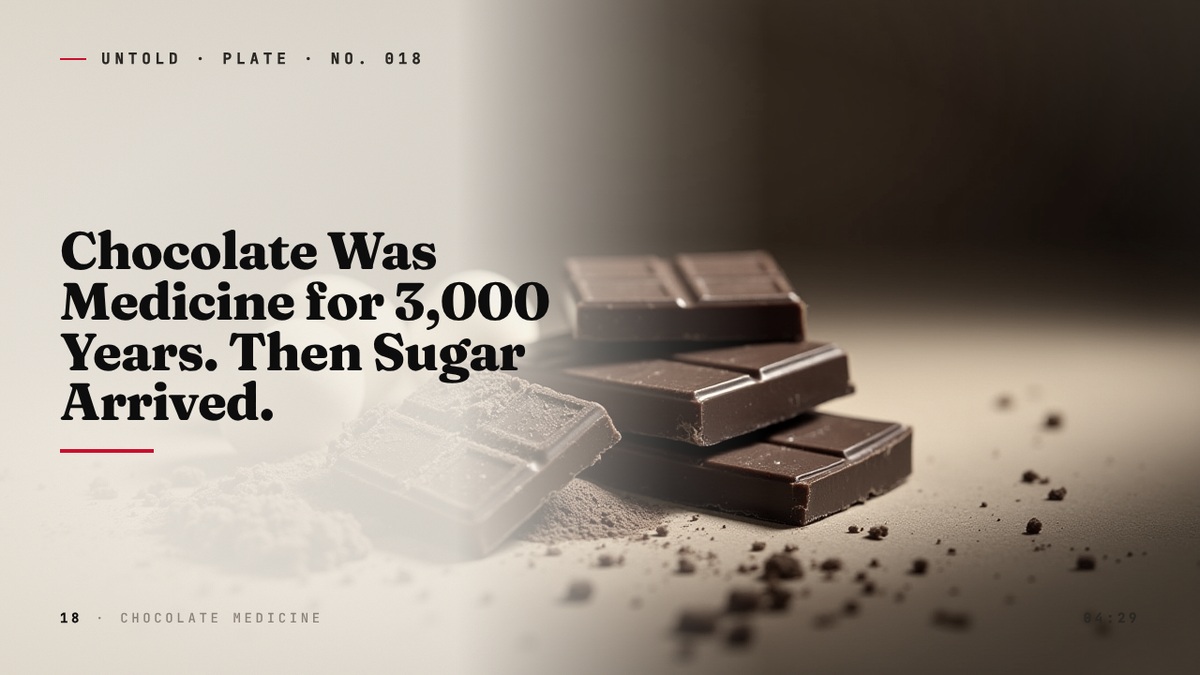
For most of its long life, chocolate was not sweet. It was bitter, often spiced with chili, thickened into a froth, and consumed with the seriousness of a tonic. The Aztecs drank it to fight fatigue. Spanish apothecaries sold it in tins beside their pills. European physicians argued over whether it warmed or cooled the body, the way they argued over rhubarb and opium. For roughly three millennia, sugar appears nowhere in the original recipe. The candy bar that now sits at every supermarket checkout is, historically speaking, a recent and slightly improbable mutation: a drug that learned to be dessert.
The transformation took place across continents and centuries, and it involved priests, conquerors, chemists, and a handful of obsessive Swiss confectioners. But the strangest part of the story is not that a medicine became a treat. It is that the medicine was, in a modest way, working all along. The people who first ground cacao into a foaming drink were tasting compounds that modern laboratories are still measuring today. To follow chocolate from the pharmacy to the candy aisle is to watch a culture slowly forget why it once took the stuff seriously.
Food of the gods
The cacao tree, Theobroma cacao, grows in the humid lowlands of Mesoamerica, and humans have been coaxing something useful out of its seeds for a very long time. Residue analysis of pottery vessels suggests the Olmec were processing cacao more than three thousand years ago, making it one of the oldest cultivated stimulants in the Americas.1 By the time the Maya inherited the practice, cacao had acquired a sacred dimension. They drank it at births, at weddings, at burials, pouring it from one vessel to another to raise a thick foam that was prized above the liquid itself.
The name Theobroma, assigned much later by the Swedish botanist Linnaeus, means “food of the gods,” and it preserves something true about how Mesoamerican cultures regarded the bean. Cacao was not an everyday indulgence. It was ritual matter, a substance dense enough with meaning that it doubled as currency. Aztec tribute records and early colonial documents describe prices reckoned in beans. One sixteenth-century source notes that around 1545, roughly ten cacao beans could buy a rabbit, and a hundred could purchase a turkey hen.2 A food you could spend was a food worth guarding, and counterfeiters were known to hollow out beans and fill the husks with mud.
The Aztec drink itself would be nearly unrecognizable to a modern palate. The beans were fermented, dried, roasted, and ground into a paste, then whisked with water and flavored with maize, chili, vanilla, and various aromatic flowers. The result was bitter, peppery, and cold. Crucially, it was believed to do something. Bernal Diaz del Castillo, a soldier in Cortes’s expedition, recorded that the emperor Montezuma drank cacao before entering his harem, and the chroniclers attached to the Spanish court repeated the conviction that the drink built strength and stamina. One physician’s phrase, often quoted, captures the register precisely: a divine drink that builds up resistance and fights fatigue. This was not a dessert. It was a performance enhancer with a priesthood.
Crossing an ocean in a white coat
When Hernan Cortes arrived on the Mexican coast in 1519, he encountered cacao as a marker of royal power, served to him in golden cups at Montezuma’s court. The Spanish reaction to the taste was, by most accounts, unenthusiastic. The Jesuit naturalist Jose de Acosta wrote that the drink was loathsome to those unaccustomed to it, with a foam or scum that was very unpleasant. Bitterness and chili did not suit the European mouth.
The solution was sugar. Spanish settlers, and especially the convents where nuns refined recipes for wealthy patrons, began warming the drink and sweetening it with cane sugar, cinnamon, and anise. Sweetened and heated, chocolate became something Europeans could enjoy, and over the seventeenth century it spread from Spain to Italy, France, and eventually England. But it did not arrive as a frivolity. It arrived wearing the white coat of medicine.
The European medical establishment of the day still operated within humoral theory, the ancient framework that explained health as a balance of four bodily fluids, each associated with combinations of hot, cold, wet, and dry. Any new substance had to be classified within this scheme before it could be safely prescribed, and cacao provoked genuine debate. Was it heating or cooling? Did it dry the body or moisten it? Physicians disagreed, sometimes vehemently, and the disagreement itself signals how seriously they took the question.
A Spanish physician named Santiago de Valverde Turices produced a treatise on chocolate as treatment in 1624, arguing that in large quantities it was good for the chest, and in smaller amounts good for the stomach.3 A few years later, in 1631, Antonio Colmenero de Ledesma published one of the most influential medical chocolate manuals of the century, a careful account of cacao’s properties and its healing recipes that combined ground beans with sugar, vanilla, and chili.4 Colmenero’s work was translated into several languages and helped fix chocolate’s reputation as a serious pharmaceutical preparation. Doctors prescribed it for poor digestion, for weight gain in the frail, for weak lungs, for melancholy. It comforts the stomach and refreshes the spirits, ran one seventeenth-century endorsement, a sentiment that could have come straight from Montezuma’s physician a century earlier and an ocean away.
By 1650, chocolate had reached London, where the first chocolate houses opened and quickly became fashionable gathering places, rivals to the new coffeehouses. There, men drank thick cups of it to cure hangovers and lift low spirits, blending the medical and the social in a way that would have been familiar to anyone who has ever justified a glass of wine on health grounds. Chocolate had crossed an ocean, but it remained what it had always been: a drink, taken for its effects, never chewed.
The problem of fat
The obstacle standing between chocolate the beverage and chocolate the bar was not flavor. It was fat. A cacao bean is extraordinarily rich in cocoa butter, the natural fat that makes up nearly half its weight. In the traditional drink, this fat floated and pooled, giving early European chocolate a greasy, heavy quality that drinkers tried to mask with thickeners and spices. The richness that we now prize in a smooth bar was, in liquid form, mostly a nuisance.
The man who cracked the problem was a Dutch chemist named Coenraad van Houten. In 1828 he patented a hydraulic press capable of squeezing a large fraction of the cocoa butter out of roasted, ground beans.5 What remained was a hard cake that could be pulverized into a fine, dry powder: cocoa, in something close to the modern sense. The powder dissolved far more easily in water and made a lighter, less oily drink. Van Houten also developed a process of treating the cocoa with alkaline salts, which darkened the color and softened the harsh, acidic taste. This step became known as Dutch processing, or Dutching, and it remains in use today.
Van Houten’s innovation is usually remembered as a way of improving the drink, but its more consequential legacy ran in the opposite direction. By separating the bean into two products, cocoa solids and cocoa butter, the press created a new possibility. The extracted fat, once a liability, could now be measured, stored, and added back deliberately. A confectioner could take cocoa powder, sugar, and an extra dose of cocoa butter and produce something the old drinkers had never imagined: a paste smooth and stable enough to pour into a mold and set solid.
That is precisely what the British firm J. S. Fry and Sons did in 1847, combining cocoa powder, sugar, and melted cocoa butter into a moldable paste and producing what is generally credited as the first solid eating chocolate bar.6 It was a modest, bittersweet thing by modern standards, far from the creamy product to come. But the conceptual leap was enormous. For the first time in roughly three thousand years, chocolate was something a person could eat rather than drink. The medicine had taken solid form.
Milk, smoothness, and the final luxury
Two further inventions, both arriving from the Swiss-speaking world within a few decades, completed the transformation. The first solved a chemistry problem. Adding ordinary milk to chocolate introduced water, which caused the mixture to spoil and seize. The breakthrough came from a collaboration between a chocolatier named Daniel Peter and his neighbor Henri Nestle, who had perfected a process for making shelf-stable condensed and powdered milk. Around 1875, Peter combined Nestle’s milk powder with chocolate, sidestepping the water problem and producing the first successful milk chocolate.7 The result was paler, sweeter, and gentler than anything that had come before, and it would eventually become the dominant form of chocolate worldwide.
The second invention addressed texture. Even the best chocolate of the 1870s had a slightly gritty, granular feel, the sugar and cocoa particles never fully smoothed. In 1879 a Swiss confectioner named Rodolphe Lindt developed a process he called conching, in which the chocolate was ground and agitated by rollers in a heated trough for many hours, sometimes for days.8 The prolonged kneading coated every particle in fat, drove off volatile acids, and produced a chocolate that melted on the tongue rather than crumbling against it. Lindt’s chocolate was silky in a way that bordered on the sensual, and it set the standard for fine chocolate that endures to this day.
With milk and conching, the journey was complete. The bitter, spiced, medicinal drink of the Aztecs had been pressed, sweetened, lightened, and smoothed into a melting luxury. The transformation was not merely technical. It was a wholesale change in what chocolate was for. Where Montezuma’s court drank cacao to summon strength and the London chocolate houses drank it to chase away melancholy, the Victorian consumer now ate a bar simply because it tasted wonderful. Pleasure had displaced purpose. Sugar, the foreign addition that made chocolate palatable to Europeans in the first place, had over four centuries quietly become the point.
The medicine was never entirely wrong
Here the story takes a turn that the candy industry rarely advertises. The healers who prescribed cacao were not, in their crude way, mistaken. Cacao genuinely contains pharmacologically active compounds, and the Aztecs were responding to real effects in their own bodies. The bean is rich in theobromine, a mild stimulant chemically related to caffeine, and it contains caffeine itself in smaller amounts. These are the substances behind the lift that ancient drinkers felt and attributed to the gods.
More intriguing are the flavanols, a class of plant compounds abundant in raw cacao. Over the past two decades, researchers have studied cocoa flavanols with some care, and the evidence suggests they have measurable effects on the cardiovascular system, chiefly by improving the flexibility and function of blood vessels. A 2012 Cochrane systematic review pooling many controlled trials concluded that flavanol-rich cocoa products produced a small but statistically significant reduction in blood pressure over the short term.9 The effect was modest, on the order of a couple of millimeters of mercury, but it was real and consistent, and it pointed to a mechanism the old physicians could never have named but seem to have sensed.
This vindication comes with a heavy asterisk. The cocoa flavanols responsible for these benefits are bitter, and they are largely destroyed by the very processes that make modern chocolate delicious. Roasting reduces them; Dutch alkaline processing, the same innovation that made cocoa smooth and dark, destroys a large share of them. And the finished candy bar carries far more sugar and fat than flavanol. The sweetness that won chocolate its place in the human diet is also what buried its medicine. A square of heavily processed milk chocolate is, from a flavanol standpoint, a faint echo of the bitter Aztec drink. To get a meaningful dose, researchers typically use specially prepared high-flavanol cocoa, not anything you would find at a checkout counter.
The result is a kind of historical irony folded into every bar. We perfected chocolate by stripping out the compounds that once justified calling it medicine, then spent the last twenty years rediscovering, in laboratories, that those compounds were doing something after all. The Aztecs tasted what we now measure. They lacked the instruments to isolate a flavanol or chart a blood-pressure curve, but they had centuries of careful observation, and they reached a conclusion that modern science has only partly walked back.
Coda
Chocolate’s history is, in miniature, the history of how the modern world tends to treat the things it inherits. A substance arrives freighted with meaning, hedged with ritual, taken seriously as a remedy. Over time it is studied, refined, industrialized, and made pleasant, and somewhere in that process the original purpose quietly falls away, leaving only the pleasure. The bar that melts on the tongue is the end point of a long forgetting, an artifact so thoroughly optimized for enjoyment that almost nothing remains of the bitter drink the Maya poured at funerals. And yet a trace persists, buried in the chemistry, a thin thread of theobromine and flavanol connecting the candy aisle to the food of the gods. The next time chocolate dissolves in your mouth, it is worth remembering what you are tasting: a drug that, over three thousand years, slowly learned to be dessert.

Sources
- Powis, T. G. et al., “Cacao use and the San Lorenzo Olmec,” PNAS, 2011. — https://www.pnas.org/doi/10.1073/pnas.1100620108
- Coe, S. D. & Coe, M. D., The True History of Chocolate, Thames & Hudson, 1996. — https://thamesandhudson.com/the-true-history-of-chocolate-9780500290682
- Dillinger, T. L. et al., “Food of the Gods: Cure for Humanity? A Cultural History of the Medicinal and Ritual Use of Chocolate,” Journal of Nutrition, 2000. — https://academic.oup.com/jn/article/130/8/2057S/4686320
- Colmenero de Ledesma, A., Curioso tratado de la naturaleza y calidad del chocolate, 1631 (English ed. 1640). — https://en.wikipedia.org/wiki/Antonio_Colmenero_de_Ledesma
- “Coenraad Johannes van Houten” (biographical and process history), — https://en.wikipedia.org/wiki/Coenraad_Johannes_van_Houten
- “J. S. Fry & Sons and the first chocolate bar,” Cadbury / company history. — https://en.wikipedia.org/wiki/J.S._Fry%26_Sons
- “Daniel Peter and the invention of milk chocolate” (with Henri Nestle). — https://en.wikipedia.org/wiki/Daniel_Peter
- “Rodolphe Lindt and the invention of conching.” — https://en.wikipedia.org/wiki/Rodolphe_Lindt
- Ried, K. et al., “Effect of cocoa on blood pressure,” Cochrane Database of Systematic Reviews, 2012. — https://www.cochranelibrary.com/cdsr/doi/10.1002/14651858.CD008893.pub2/full
Related reading