The Old Alarm in Your Head
Why the mind clings to one insult and lets five kindnesses slip away.
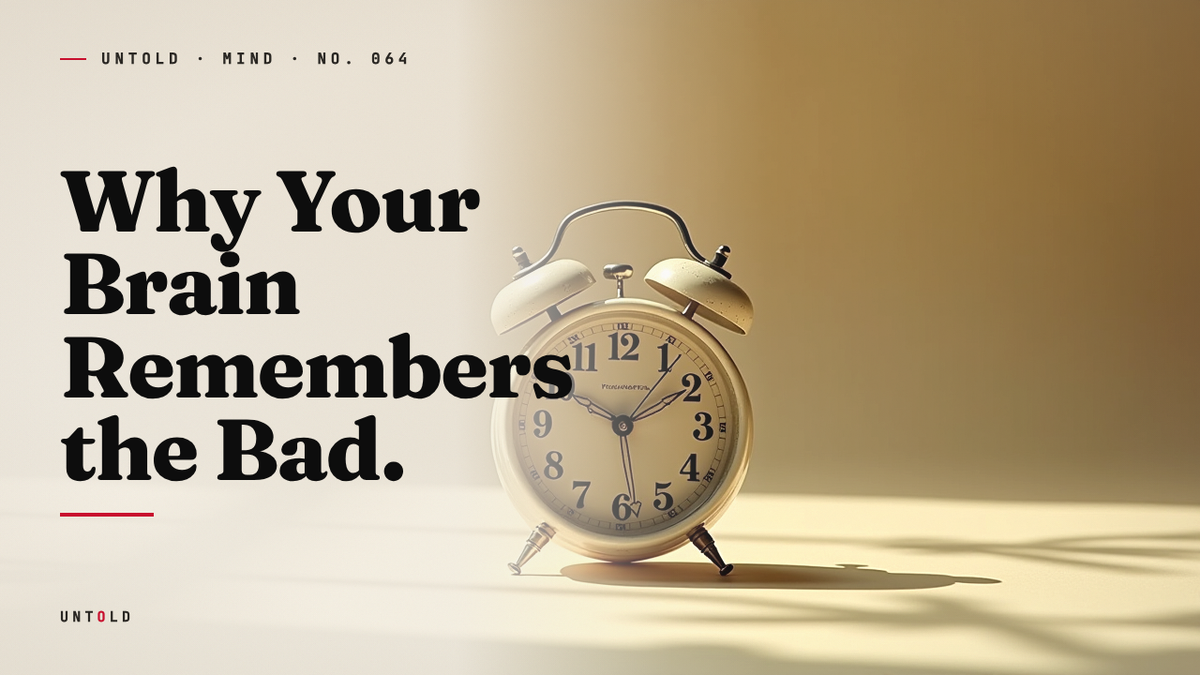
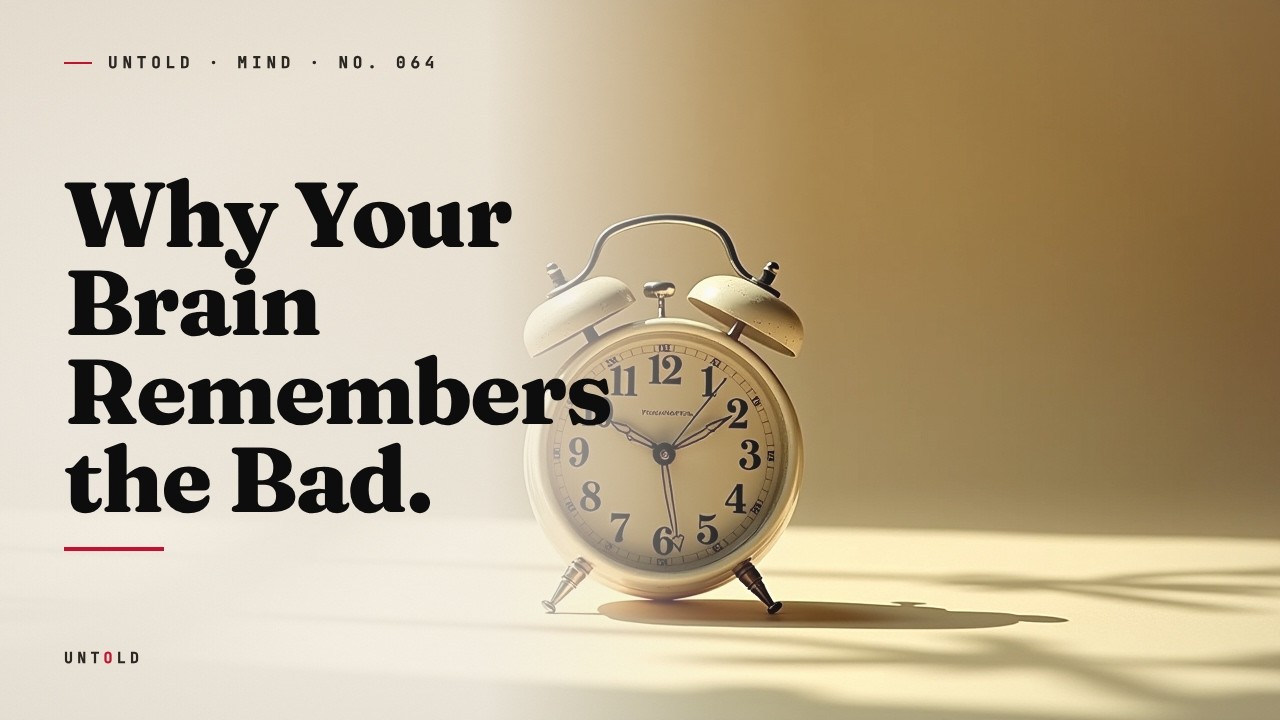
Count the day backward. Somewhere in it, there were probably five small kindnesses: a colleague who held a door, a message from a friend, a stranger who let a car merge, a compliment about a jacket, a joke that landed. And somewhere in it, there was one bad moment. A curt reply. A criticism. A tone in an email that read as cold. Ask yourself, at the end of the night, which one is still playing.
The answer is almost never in doubt. The five kindnesses have evaporated. The single sting loops. This is not a personal defect, not thin skin, not a failure of gratitude. It is a structural feature of the human brain, so consistent across people and cultures that psychologists gave it a plain name: the negativity bias. Bad events, bad feedback, and bad memories carry more weight than good ones of the same size. The scale is tilted before anything is placed on it.
The uncomfortable part is that you cannot argue your way out of it in the moment. The bias is older than reasoning, older than language, older than the species itself in some respects. It runs beneath awareness, on machinery built for a world that no longer exists. To understand why the mind behaves this way, it helps to stop asking what is wrong with us and start asking what the bias was originally for.
The Ancestors Who Worried Lived Longer
Imagine two early humans on a grassland, hundreds of thousands of years ago. The grass rustles. One of them assumes it is the wind and keeps walking. The other assumes it is a predator and moves away. Most of the time, it is the wind, and the cautious one has wasted a little energy and a little dignity for nothing.
But consider the asymmetry of the mistakes. If the relaxed one is wrong, they are eaten. If the cautious one is wrong, they are merely embarrassed. Over enough repetitions across enough generations, the cost of a false alarm is trivial and the cost of a missed threat is total. Evolution does not reward being right on average. It rewards not dying. A brain that treats every rustle as a possible lion will be wrong constantly and alive frequently, and it is the alive ones who leave descendants.
We are those descendants. The lineage of humans who assumed the worst outlasted the lineage that assumed the best, and they handed down a nervous system tuned to prioritize the negative. This is the deep logic behind the bias: in an environment where errors are not symmetric, a mind that overweights danger is the mind that survives.
The formal case for this reaches its clearest expression in a 2001 review by the social psychologist Roy Baumeister and his colleagues, published under a title that needs no explanation: “Bad Is Stronger Than Good.” 1 The paper is less an experiment than a reckoning. It gathers decades of findings across an enormous range of human life and asks whether the asymmetry holds. It does, with striking regularity. Bad emotions are processed more thoroughly than good ones. Bad impressions form faster and resist change more stubbornly. Bad feedback shapes behavior more than praise. A single trauma can reshape a life; no single good day tends to.
The pattern turns up even in the way people handle money. Decades of research in behavioral economics, beginning with Daniel Kahneman and Amos Tversky’s work on loss aversion, found that losing a sum of money hurts roughly twice as much as gaining the same sum pleases. 2 The prospect of losing a hundred dollars looms larger in the mind than the prospect of winning a hundred. We are not weighing the outcomes rationally. We are weighing them the way a survival machine would, treating loss as a threat and gain as a decoration.
Where the Bias Lives
If the negativity bias is genuinely built into us, it should be possible to point at the hardware. And it is. Deep in each temporal lobe sits a small, almond-shaped cluster of neurons called the amygdala. For decades it has been described, a little too neatly, as the brain’s fear center. The truth is more interesting: the amygdala is less a center of fear than a rapid detector of significance, and it is disproportionately tuned to significance of the bad kind. A large share of its neurons respond to threatening or aversive input, giving the brain an early-warning system that fires before the conscious mind has assembled a thought.
The clearest map of how this happens comes from the neuroscientist Joseph LeDoux, who spent his career tracing the circuitry of fear in the brain. 3 LeDoux described what he called the low road: a fast, crude pathway that carries sensory information from the thalamus straight to the amygdala, bypassing the slower cortical route that produces conscious awareness. When you flinch at a shape on the trail before you have decided whether it is a snake or a stick, that flinch is the low road at work. The amygdala has already triggered the alarm milliseconds before the thinking brain arrives to evaluate the evidence. By the time you realize it is a stick, your heart is already pounding.
This architecture is not a bug. A brain that waited for certainty before reacting to a possible snake would occasionally be a dead brain. So evolution built a shortcut that errs toward the alarm, and the price of that shortcut is that we startle at sticks. The reaction comes first; the questions come later.
The bias is not confined to sudden fear, though. It shapes something quieter and more pervasive: the ordinary processing of everyday experience. The psychophysiologist John Cacioppo demonstrated this by measuring the brain’s electrical response as people looked at images of various kinds, positive, negative, and neutral. 4 Recording the electrical activity of the cortex, he found that negative images produced a larger, sharper surge than positive images of comparable intensity. The brain’s own voltage betrayed the asymmetry. Cacioppo described this as a negativity bias visible directly in the cortex, an amplification of the bad that happens automatically, before any conscious judgment about what the image means.
The negative signal, in other words, is louder. It arrives faster and is harder to tune out. And this is measurable not in reported feelings, which are easy to distort, but in the raw electrical behavior of neurons.
Why Bad Memories Stick
Detecting a threat quickly is only half the survival problem. The other half is remembering it, so the same danger is not walked into twice. Here the brain deploys a second mechanism, one that stamps bad experiences into memory with a chemical seal.
When something frightening or painful happens, the body releases a cascade of stress hormones, including adrenaline and cortisol. These hormones do more than prepare the body to fight or flee. They act on the memory systems of the brain, particularly the hippocampus and its connections to the amygdala, and they enhance the encoding of what is happening. The neurobiological message is blunt: this mattered, remember it, do not let it happen again. This is why emotionally charged events, especially bad ones, are laid down as vivid, durable memories while the neutral hours around them fade. It is also why an embarrassment from years ago can still make you wince, physically, in the present. The hormonal seal has held.
The neuropsychologist Rick Hanson turned this asymmetry into an image that has since become the shorthand for the whole phenomenon: the brain, he wrote, is like Velcro for bad experiences and Teflon for good ones. 5 Negative experiences stick almost instantly, requiring no effort at all. Positive experiences slide off unless we deliberately hold on to them. A criticism embeds itself in seconds. A compliment, unless we pause and let it register, is gone before it lands.
Hanson’s point is not merely poetic. It reflects the underlying encoding difference. The brain does not need to be told to remember the bad; the stress machinery does that automatically. It does need help remembering the good, because there is no evolutionary emergency attached to a pleasant afternoon.
The same asymmetry scales up into human relationships, where it has been quantified. Research on married couples by the psychologist John Gottman and the mathematician Robert Levenson identified what became known as the magic ratio: stable, lasting relationships tended to maintain roughly five positive interactions for every negative one. 6 Below that ratio, partnerships slid toward dissolution. The finding is a domestic echo of the same principle Baumeister catalogued. One harsh exchange carries the emotional weight of about five warm ones, so keeping a relationship in balance requires a lopsided investment in the good simply to offset the disproportionate power of the bad.
The bias even reaches into perception itself, into how we read a single human face. Studies of visual attention have repeatedly found that an angry face pops out of a crowd faster than a happy one, an effect sometimes called the face-in-the-crowd phenomenon. 7 The visual system, like the amygdala, prioritizes the threat we most need to avoid. A room full of smiling people and one scowl, and the scowl is what catches the eye first. We are wired to find the danger before we find the welcome.
The Lion in the Inbox
Everything described so far was a gift. In the environment where the human brain took shape, a mind that overweighted threats, encoded bad experiences deeply, and scanned crowds for anger was a mind well suited to staying alive. The bias earned its place across hundreds of thousands of years of selection.
Then the environment changed, faster than the brain could. And this is where the ancient wiring turns against the person carrying it.
There are no lions in a modern inbox. There is no predator in a critical comment posted by a stranger online, no physical danger in a piece of upsetting news read on a phone in bed. But the Stone Age alarm system cannot tell the difference. The amygdala does not distinguish between a threat to the body and a threat to the ego, between a stalking predator and a disapproving reply. It responds to the pattern of threat, and a harsh word carries that pattern. The same circuit that once fired at a rustle in the grass now fires at a notification.
The result is a mismatch between the machinery and its surroundings. In the ancestral world, threats were rare, physical, and quickly resolved: the danger either killed you or passed. In the modern world, threats are constant, symbolic, and unresolvable, a steady stream of alarming headlines, social slights, and imagined worst cases, none of which the body can fight or flee. The alarm keeps sounding with nowhere to run. News, social media, and rumination all feed the same hungry ancient system, and the system was never built to be fed continuously. A brain optimized for occasional bursts of vigilance is now marinating in low-grade threat all day. What once protected life now quietly corrodes it, in the form of chronic anxiety, stress, and the sense that the world is more hostile than it is.
The negativity bias, in short, is a well-calibrated instrument for a world that has vanished, still running at full sensitivity in a world it was never designed for.
Loosening the Grip
None of this can be switched off. The bias is not a habit or an attitude; it is structural, wired into the fast pathways and hormone systems that operate beneath conscious control. Willpower does not reach the low road. Telling yourself to stop dwelling on the bad thing is like telling yourself to stop the flinch after the reflex has already fired.
But structural does not mean untouchable. The first and most reliable lever is simply knowing the bias exists. When one insult drowns out five kindnesses, it changes the experience to be able to name what is happening: this is the negativity bias, the old alarm doing its old job, not a neutral report on reality. Recognizing the loop as a mechanism rather than a truth loosens its grip, because it separates the feeling from the verdict. The alarm is telling you something felt threatening. It is not telling you the world is against you.
The second lever addresses the Teflon problem directly. If good experiences slide off because the brain has no automatic reason to encode them, then the remedy is to give it a reason: attention and time. Hanson’s practical suggestion is to deliberately hold on to a positive moment for ten to fifteen seconds, long enough for the experience to move from fleeting sensation into durable memory. 5 Notice the small good thing, the warmth of the coffee, the friend’s laugh, the finished task, and stay with it deliberately for a slow count, feeling it rather than letting it pass. The instruction sounds almost too simple, but it works with the grain of the memory system rather than against it. Bad experiences encode themselves; good ones must be encoded on purpose. Hanson’s phrase for the practice is to let yourself be changed by the good, deliberately, because the brain will not do it for you.
This is not positive thinking in the greeting-card sense, and it is not a denial of real problems. The bias exists for good reason, and there are genuine threats worth attending to. The goal is not to silence the alarm but to stop mistaking its volume for accuracy, and to give the good moments the few seconds of attention they need to survive in a mind built to forget them.
The Voice Is Old, Not True
The brain you carry was assembled by a long line of ancestors who lived because they assumed the worst. Their vigilance is the reason you exist, and it is still humming inside your skull, treating a curt email like a predator and a compliment like decoration. That is not a flaw in you. It is a survival gift that has outlived the emergency it was built for.
So the next time a single criticism plays on a loop while the day’s kindnesses vanish, it is worth remembering what that voice actually is. It is not the truth about your worth, or your relationships, or the state of the world. It is a very old alarm, wired to fire first and ask questions later, still scanning the grass for a lion that is no longer there.
Sources
- Baumeister, R. F., Bratslavsky, E., Finkenauer, C., & Vohs, K. D., “Bad Is Stronger Than Good,” Review of General Psychology, 2001. — https://journals.sagepub.com/doi/10.1037/1089-2680.5.4.323
- Kahneman, D., & Tversky, A., “Prospect Theory: An Analysis of Decision under Risk,” Econometrica, 1979. — https://www.jstor.org/stable/1914185
- LeDoux, J. E., The Emotional Brain: The Mysterious Underpinnings of Emotional Life, Simon & Schuster, 1996. — https://www.simonandschuster.com/books/The-Emotional-Brain/Joseph-Ledoux/9780684836591
- Ito, T. A., Larsen, J. T., Smith, N. K., & Cacioppo, J. T., “Negative information weighs more heavily on the brain,” Journal of Personality and Social Psychology, 1998. — https://pubmed.ncbi.nlm.nih.gov/9825526/
- Hanson, R., Hardwiring Happiness: The New Brain Science of Contentment, Calm, and Confidence, Harmony, 2013. — https://www.rickhanson.net/books/hardwiring-happiness/
- Gottman, J. M., & Levenson, R. W., “The Timing of Divorce: Predicting When a Couple Will Divorce Over a 14-Year Period,” Journal of Marriage and Family, 2000. — https://onlinelibrary.wiley.com/doi/10.1111/j.1741-3737.2000.00737.x
- Hansen, C. H., & Hansen, R. D., “Finding the face in the crowd: An anger superiority effect,” Journal of Personality and Social Psychology, 1988. — https://pubmed.ncbi.nlm.nih.gov/3418489/
Related reading