The Fruit That Outlived Its Giant
The avocado was built for an animal that has been gone for thirteen thousand years.
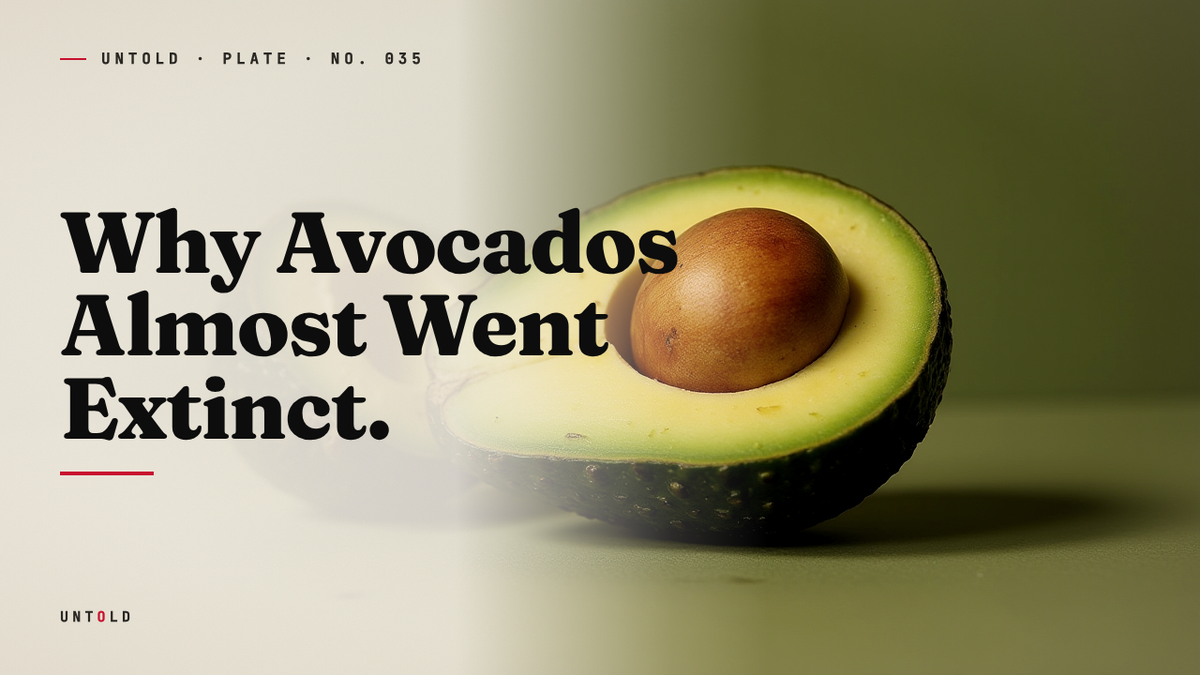
There is a small act of violence built into the avocado, and almost nobody notices it. You slice the fruit lengthwise, twist the two halves apart, and there it sits: a seed the size of a golf ball, smooth and absurdly large, occupying nearly a third of the interior. You scoop it out with a spoon or stab it with a knife and flip it into the compost. The gesture is so routine that the strangeness never registers. But that seed is the heart of one of the stranger stories in botany. It is a relic of a partnership that ended before the first cities were built, a clue left behind by an animal that no longer exists.
The avocado you ate this morning is, in a real biological sense, a ghost. It was shaped over millions of years to suit the appetite of a creature that vanished at the close of the last Ice Age. By every reasonable rule of ecology, the tree that bears it should have followed that creature into extinction. It did not. The reason it survived is one of the more accidental rescues in the history of food, and it implicates us directly.
A Seed Too Big to Make Sense
Start with the obvious problem. Fruit, in evolutionary terms, is a bribe. A plant cannot walk, so it pays an animal to do its traveling for it. The flesh is the fee. The animal eats the sweet or fatty pulp, swallows the seed, wanders off, and eventually deposits that seed somewhere far from the parent tree, conveniently wrapped in a packet of fertilizer. Both parties win. The animal gets a meal, and the plant gets its offspring carried away from the shadow of its own canopy, where they would otherwise compete with the parent for light and water.
For this arrangement to function, the seed has to be swallowable. That is the quiet logic behind the size of most fruits and their pits. A cherry pit is small because a bird or a small mammal must be able to pass it. A berry is tiny for the same reason. Even larger fruits tend to scatter their seeds in manageable pieces. The system is calibrated to the gullets of the animals that exist.
The avocado breaks this rule spectacularly. Its seed is enormous, far too large for any bird to swallow and far too bitter and faintly toxic for most small mammals to bother with. The flesh, meanwhile, is unlike almost any other fruit on earth. It contains no meaningful sugar. Instead it is loaded with fat, roughly fifteen percent of its weight, an extravagant and expensive reward to manufacture 1. Plants do not produce rich, fatty flesh by accident. Fat is metabolically costly. A tree only invests in it if there is a payoff, which means the avocado was paying for something. The size of the seed and the richness of the pulp point to the same conclusion. This fruit was designed for a large animal: an animal big enough to swallow that pit whole and hungry enough to be drawn by all that fat.
The trouble is that no such animal lives in the wild today. Walk through the forests of Central America where wild avocados still grow, and you will not find anything that eats them in the way the fruit seems to demand. The seeds fall, roll a few feet, and sprout directly beneath the parent tree, crowded into the shade, exactly the fate the whole apparatus of fruit was supposed to prevent. The avocado looks like a key cut for a lock that has been thrown away.
The Ghost in the Fruit
The person who gave this puzzle a name was an ecologist named Daniel Janzen. In 1982, working with the paleoecologist Paul Martin, Janzen published a paper in the journal Science with a title that sounds more like poetry than research: “Neotropical Anachronisms: The Fruits the Gomphotheres Ate” 2. Their argument was elegant and slightly haunting. Certain fruits in Central and South America, they proposed, made no sense in the context of the animals living there now. They were too big, too dense, too laden with seeds that nothing could disperse. These fruits, Janzen and Martin suggested, were not failures of design. They were anachronisms: structures perfectly adapted to a world that had disappeared.
The key was time. If you wound the clock back far enough, the forests of the Americas were not the relatively tame landscapes we know. They were inhabited by giants. During the Pleistocene, the long stretch of the Ice Ages, North and South America teemed with megafauna, large mammals on a scale that is difficult to picture today. There were mammoths and mastodons, of course. There were also gomphotheres, elephant relatives with strange shovel-shaped tusks. There were glyptodonts, armored creatures the size of small cars. And there were ground sloths.
The ground sloth deserves particular attention, because it is probably the animal the avocado was waiting for. The largest species, Eremotherium, could rear up on its hind legs to a height of around twenty feet. These were not the slow, tree-hanging sloths of modern nature documentaries. They were ground-dwelling browsers, massive and powerful, capable of pulling down branches and stripping vegetation on an industrial scale. To an animal of that size, an avocado was not a meal to be savored. It was a single, casual bite, swallowed fruit and seed together without a thought. The giant pit that we so carefully discard was, to a ground sloth, simply something to be gulped down and passed.
This is where the avocado’s design suddenly clicks into focus. The enormous seed was never meant to be chewed or split. It was meant to survive a journey through an enormous digestive tract intact, to be carried for miles inside a wandering giant, and to be deposited far from the parent tree in a heap of warm, nutrient-rich dung. The bitter compounds in the pit may even have discouraged smaller animals from destroying the seed, reserving the whole package for the big eaters that could disperse it properly. The fat-rich flesh was the bribe, calibrated not to a bird or a monkey but to a beast that needed serious calories. The avocado and the ground sloth were partners, each shaping the other across deep time. Janzen and Martin called these pairings evolutionary anachronisms, relationships out of step with the present because one half of the partnership had been erased.
The Great Dying
The erasure came suddenly. Around the end of the last Ice Age, somewhere in the window of roughly thirteen thousand years ago, the great mammals of the Americas vanished in one of the most dramatic extinction events in recent geological history. The ground sloths, the mastodons, the gomphotheres, the glyptodonts, the giant armadillos, all of them disappeared. Estimates vary, but a large share of North America’s big mammal genera, on the order of seventy percent or more, were lost in this collapse 3.
Why this happened remains one of the most debated questions in paleontology. Two broad culprits dominate the discussion. The first is climate. The end of the Pleistocene brought sweeping environmental change as the glaciers retreated, transforming the habitats these animals depended on. The second is us. The timing of the extinctions corresponds closely with the arrival and spread of human hunters across the Americas, and many researchers argue that human predation, possibly combined with the climatic upheaval, pushed already stressed populations over the edge 3. The debate has run for decades and shows no sign of a clean resolution. What is not in dispute is the outcome. The giants were gone, and they were not coming back.
For the avocado, the consequences were catastrophic in slow motion. Its partner, the animal it had spent millions of years coaxing and feeding and depending upon, had been wiped from the earth. The tree was now stranded. It continued to do what it had always done: produce large, fatty fruits with enormous seeds, dangling them hopefully from its branches. But there was no longer anything to eat them in the right way. The fruits fell. The seeds germinated in the gloom directly beneath the canopy, where the seedlings competed with their own parent and with each other, choking in their own shade. A tree designed for long-distance travel had been reduced to dropping its children at its feet.
This is the kind of situation that ends a species. An organism so tightly bound to a single partner, so committed to a strategy that suddenly has no audience, is in serious evolutionary trouble. The avocado had a few small, opportunistic dispersers, the odd animal willing to gnaw at fallen fruit, but nothing capable of replacing the giant it had lost. By the ordinary logic of extinction, the avocado should have dwindled, its range collapsing, its populations thinning out until they flickered and went dark. It was a tree that had fallen out of step with its world, and the world does not usually wait.
A New Giant Arrives
And yet the avocado is everywhere. It is one of the most commercially successful fruits on the planet, the foundation of a global industry, the green smear on a hundred million breakfasts. Something rescued it. That something was the very animal that may have helped kill its original partner.
The humans who arrived in the Americas during the Pleistocene, the same hunters implicated in the megafaunal extinctions, eventually settled into the landscapes of Mesoamerica and began to pay attention to the strange, fatty fruit growing in the forests. They gathered it. They ate it. And crucially, they began to move its seeds around: carrying pits back to their settlements, dropping them near their homes, eventually planting them deliberately. Where the ground sloth had carried the seed in its gut, humans carried it in their hands. The avocado had found a new disperser. We became the giant.
The archaeological record bears this out. Evidence from caves in central Mexico shows that people were using and eventually cultivating avocados thousands of years ago, with signs that the size and character of the fruit shifted over time as humans selected for the trees they preferred 4. By roughly five thousand years ago, avocado cultivation was well established in Mesoamerica. People were not just stumbling on wild trees. They were choosing the best fruit, protecting the most productive trees, and carrying their seeds into new ground. The very thing that had doomed the avocado, its dependence on a large disperser, was quietly resolved when a new large disperser appeared and took an interest.
The fruit even carried the imprint of its rescuers in its name. The English word “avocado” descends, through Spanish, from the Nahuatl word ahuacatl, the name used by the Aztecs and other speakers of the Nahuatl language 5. When Spanish colonizers encountered the fruit, they adopted and mangled the word, and then they did what the ground sloths could never do at scale. They carried the tree across oceans, planting it in new continents and climates, scattering its descendants far beyond the forests where it had nearly been stranded.
The Clone in Your Kitchen
The modern chapter of the story compresses this dependence into something almost absurd. Most of the avocados sold in the world today are a single variety: the Hass. And nearly every Hass avocado on earth traces its lineage back to one tree, a chance seedling grown by a man named Rudolph Hass in California in the 1920s 6. That original tree, propagated by grafting, became the parent of an entire global crop. The billions of Hass avocados consumed each year are, in effect, clones of one lucky plant.
This is dependence taken to an extreme. The avocado does not simply rely on humans to spread its seeds in the loose, opportunistic way that the ground sloth once did. The commercial avocado relies on us to graft it, to cultivate it, to irrigate it, to ship it, and to choose, deliberately and at industrial scale, which single genetic line will dominate the world’s plates. Left entirely to its own devices in the wild, the avocado would still be that stranded tree dropping its fruit into the shade. It survives in its current abundance only because a species of clever bipeds decided it was worth keeping.
That abundance has grown extraordinarily fast. In the United States alone, avocado consumption rose by well over a hundred percent in the span of a couple of decades, transforming what was once a regional curiosity into a staple of supermarkets far from any avocado tree 7. A fruit that nature had effectively abandoned has become a symbol of modern eating, marketed, memed, and shipped around the globe. The ghost has gone mainstream.
What the Spoon Disturbs
There is something quietly profound in all of this, beyond the trivia value of a fruit built for sloths. The avocado is a reminder that the living world we move through is not a finished, self-contained system. It is a palimpsest, layered with the marks of vanished creatures and broken partnerships. The forests of the Americas are full of these silences, of plants still calling out to animals that stopped answering thousands of years ago. Janzen and Martin’s insight was to hear that silence and recognize it for what it was: not the natural order, but the wreckage of an older one.
It is also a story about us, and not a flattering one made simple. The same lineage of humans that may have helped destroy the avocado’s original partner is the lineage that saved the avocado itself. We did not set out to rescue it. We simply found it useful, and in our usefulness we accidentally stepped into the giant-shaped hole that the ground sloths had left behind. The relationship that nature abandoned, we resumed without quite meaning to, and we have maintained it ever since out of nothing more noble than appetite.
So the next time you twist an avocado open and dig out that improbable seed, it is worth pausing over the small violence of the gesture. You are handling a fruit that was engineered, over millions of years, for the gut of a twenty-foot sloth. You are completing a meal that the giants of the Ice Age left unfinished. The pit in your hand is a message from a lost world, and you are, for a moment, the creature it was always waiting for.

Sources
- Dreher, M. L. and Davenport, A. J., Hass Avocado Composition and Potential Health Effects, Critical Reviews in Food Science and Nutrition, 2013. — https://www.ncbi.nlm.nih.gov/pmc/articles/PMC3664913/
- Janzen, D. H. and Martin, P. S., Neotropical Anachronisms: The Fruits the Gomphotheres Ate, Science, 1982. — https://www.science.org/doi/10.1126/science.215.4528.19
- Koch, P. L. and Barnosky, A. D., Late Quaternary Extinctions: State of the Debate, Annual Review of Ecology, Evolution, and Systematics, 2006. — https://www.annualreviews.org/doi/10.1146/annurev.ecolsys.34.011802.132415
- Smith, C. E., Archaeological Evidence for Selection in Avocado, Economic Botany, 1966. — https://link.springer.com/article/10.1007/BF02904013
- Online Etymology Dictionary, Avocado. — https://www.etymonline.com/word/avocado
- California Avocado Society, The Hass Mother Tree and the History of the Hass Avocado. — https://www.californiaavocado.com/avocado101/the-hass-mother-tree
- U.S. Department of Agriculture, Economic Research Service, Fruit and Tree Nuts Yearbook (avocado consumption data). — https://www.ers.usda.gov/data-products/fruit-and-tree-nuts-data/
Related reading