The Sauce That Remembers Two Winters
Authentic soy sauce is not cooked but cultivated, a slow collaboration between mold, yeast, and the turning seasons.
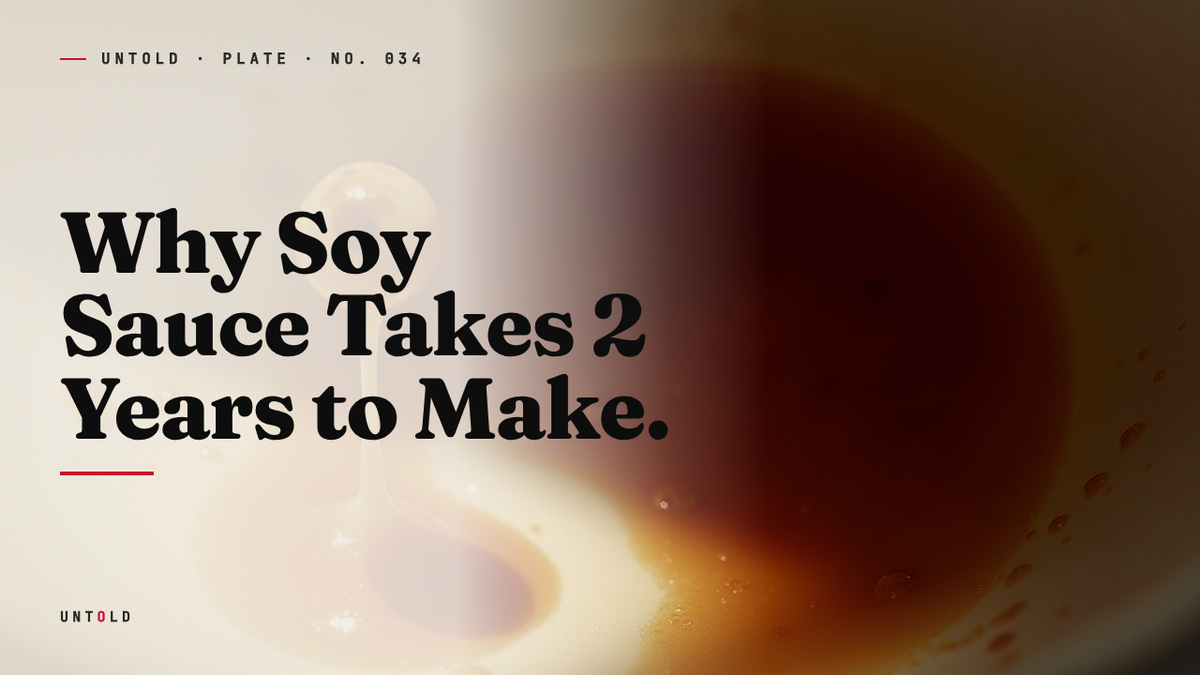
The bottle on the table gives nothing away. Dark, glossy, faintly viscous when tipped, it pours like any ordinary condiment and disappears into a dish without ceremony. Most people never wonder how it came to be. They assume, reasonably enough, that soy sauce is a manufactured product, mixed and bottled on some efficient timeline, the way ketchup or mustard is. And for a great deal of what sits on supermarket shelves, that assumption is correct. There exists a version of soy sauce that can be made, start to finish, in roughly three days.
But there is another version, older and stranger, that takes two years. Two full turns of the calendar, through two summers and two winters, before a single drop is pressed from the vat. Nothing is being cooked during that time. Nothing is being stirred toward a boil or reduced over heat. The liquid is simply waiting, and inside it, an invisible population of living things is at work. To understand why anyone would wait that long for a sauce, you have to abandon the idea that soy sauce is made at all. The good kind is not made. It is grown.
The mold that became a national treasure
The story begins with something most people would throw away on sight: mold. Specifically, a filamentous fungus named Aspergillus oryzae, known in Japan by the affectionate, almost domestic name of koji. It is a relative of the molds that spoil bread and rot fruit, but this particular strain has been coaxed and selected over more than a thousand years into something closer to livestock than to a contaminant. In 2006, the Brewing Society of Japan formally designated Aspergillus oryzae the country’s national fungus, an honor that says a great deal about how central this organism is to Japanese food culture 1. Rice wine, miso, mirin, and soy sauce all depend on it.
Koji has been domesticated in the truest sense of the word. Like wheat or cattle, it has been bred away from its wild ancestors toward traits humans find useful. Genetic studies comparing Aspergillus oryzae with its wild cousin Aspergillus flavus, a notorious producer of carcinogenic aflatoxins, have found that the domesticated strain has effectively lost the ability to produce those toxins 2. Over centuries of selection, brewers unknowingly favored the colonies that fermented cleanly and discarded the ones that turned poisonous. The result is a fungus genetically tuned to break down food into something delicious and safe, a microscopic farm animal bred for a single purpose.
The process opens with humble ingredients. Soybeans are soaked and steamed until soft. Wheat is roasted and cracked. The two are mixed together and spread across shallow wooden trays, where koji spores are dusted over the surface like flour scattered onto dough. Then the trays are moved into a warm, humid room and left alone. Within about two days, the grains bloom. A fuzz of green-gold mold spreads across every surface, and the mixture begins to smell sweet and mushroomy, almost like fresh chestnuts. This stage is called making the koji, and everything that follows depends on getting it right.
The invisible toolmaker
What the mold is doing during those two days is not, strictly speaking, flavor. It is building tools. As koji grows, it secretes a battery of enzymes into the grain, molecular scissors designed to cut large, flavorless molecules into smaller, intensely flavorful ones. Two families of enzyme matter most. Amylases break down the starches in the wheat into simple sugars. Proteases break down the proteins in the soybeans into individual amino acids.
One of those amino acids is the entire reason soy sauce tastes the way it does. Its name is glutamate, and it is the molecular basis of umami, the so-called fifth taste that sits alongside sweet, sour, salty, and bitter. The discovery of umami belongs to a single chemist working in Tokyo in 1908. Kikunae Ikeda had long been puzzled by the deep savory quality of dashi, the seaweed and bonito broth at the heart of Japanese cooking. He suspected a specific compound was responsible, and after painstaking extraction from kelp broth, he isolated it: glutamic acid, in its salt form, monosodium glutamate 3. He coined a word for the sensation it produced, combining the Japanese umai, meaning delicious, with mi, meaning taste. Umami.
For decades, Ikeda’s fifth taste was treated by Western science as a curiosity, even a marketing invention. That changed in the early 2000s, when researchers identified specific receptors on the human tongue that respond to glutamate, confirming that umami is a genuine, distinct taste with its own biological hardware 4. Soy sauce, viewed through this lens, is essentially a glutamate factory. The soybeans supply the raw protein, and koji builds the machinery to convert that protein into free glutamate. By the time the process is finished, the sauce is saturated with the molecule that makes savory food taste savory.
When the salt arrives
The finished koji is not yet soy sauce. It is a sweet, enzyme-loaded mass with no preservation and no depth. The next step is brine. The koji is mixed with a heavy salt solution into a thick, porridge-like slurry called moromi. The salt concentration is startling: in traditional brewing it can reach around eighteen percent of the mixture, a level that would kill nearly any organism that tried to grow in it 5.
This is deliberate. The brutal saltiness functions as a filter, a way of clearing the field so that only the right microbes can take over. The koji mold itself does not survive long in such conditions, but its enzymes keep working, slowly dismantling proteins and starches over the months ahead. Meanwhile, a new cast of organisms moves in, the salt-tolerant specialists that thrive where almost nothing else can.
First come halophilic bacteria, chiefly a genus called Tetragenococcus, which ferment the sugars into mild lactic acid. This gentle acidification lowers the pH and lays a foundation of sourness that will later balance the salt. Then, as conditions shift, a salt-loving yeast named Zygosaccharomyces rouxii takes the lead. This yeast performs a kind of alcoholic fermentation, converting sugars into ethanol and, more importantly, into a sprawling family of aroma compounds, esters, alcohols, and phenols that give soy sauce its complex, slightly fruity, slightly smoky bouquet 6. None of this could happen without the salt that kept the moromi sterile enough for these specialists to dominate. The harshness of the brine is precisely what makes the eventual subtlety possible.
Why the seasons matter
Here we reach the heart of the two-year question. If enzymes are doing the cutting and microbes are doing the fermenting, why can’t the whole thing be hurried along in a warm room? The answer is that flavor in soy sauce is not a single reaction but an enormous, overlapping cascade of them, and many of the most desirable compounds form slowly, at low temperatures, over long stretches of time.
Temperature acts as the conductor of this microscopic orchestra. In the heat of summer, the moromi comes alive. Enzymes work quickly, microbes multiply, fermentation accelerates, and the raw building blocks of flavor accumulate. In the cold of winter, everything slows almost to a standstill. The fast, aggressive reactions pause, and slower processes take over: harsh edges soften, volatile compounds settle and recombine, and the whole mixture matures the way a wine or a cheese does in a cool cellar. A traditional brewer needs at least two of these cycles, two summers to build and two winters to refine, before the sauce reaches its full character.
The chemistry justifies the patience. Analyses of mature soy sauce have identified more than three hundred distinct volatile aroma compounds, a complexity that rivals fine wine 7. Among them are the products of slow, heat-independent reactions known as Maillard reactions, the same browning chemistry that gives roasted coffee and seared meat their depth, here proceeding gently over months rather than seconds. No shortcut reproduces this. Hurrying the process with heat produces a different, cruder set of compounds and skips the long, low-temperature aging where the real refinement happens.
Throughout the two years, brewers periodically stir or aerate the moromi so that oxygen reaches every layer and the microbial population stays balanced. The vessels matter too. Some of the oldest breweries still use enormous cedar vats that have been in continuous service for a century or more, their wooden staves colonized by resident populations of yeast and bacteria. These house microbes seep into every batch, giving each brewery a flavor signature that cannot be transplanted. In this sense, a two-hundred-year-old soy sauce house is not just a building. It is a living culture, in both senses of the word.
When the two years are finally up, the matured moromi is wrapped in layered cloth and pressed under slow, mounting pressure. A dark, fragrant liquid runs out, and this is raw soy sauce at last, a substance that carries within it the chemical memory of every season it lived through.
The three-day impostor
This brings us to the bottle that took three days. It is worth being precise about what that fast product actually is, because the difference is not merely one of quality but of kind. The rapid version is not fermented at all. It is made by a process called acid hydrolysis: defatted soybean meal is boiled in concentrated hydrochloric acid, which violently rips the proteins apart into amino acids in a matter of hours, doing chemically and brutally what koji’s proteases do slowly and gently. The acid is then neutralized, the liquid is filtered, and coloring, flavoring, and corn syrup are often added to approximate the look and taste of the real thing 8.
The result mimics soy sauce convincingly enough to fool most palates in a finished dish. But it skips every living stage. There is no mold, no yeast, no bacteria, no seasons, none of the slow architecture of flavor. What it gains in speed it loses in everything that made the original interesting, and it introduces a problem the slow method never had.
The aggressive acid hydrolysis can generate a class of contaminants called chloropropanols, the most studied of which is 3-MCPD, a compound that has shown carcinogenic potential in animal studies. In the late 1990s and early 2000s, surveys in several countries found troubling levels of 3-MCPD in some acid-hydrolyzed soy sauces, prompting regulators in the European Union and elsewhere to set strict legal limits on the compound 9. Naturally brewed soy sauce, by contrast, never encounters the conditions that produce it, because microbes, not acid, do the work of breaking down the beans. Time, it turns out, is not only the more flavorful path but the safer one.
Tasting time itself
There is a quiet lesson tucked inside a bottle of properly brewed soy sauce, and it has to do with the things industrial efficiency cannot replicate. We are good, as a species, at speeding processes up. We can hydrolyze a protein in an afternoon, synthesize a flavor, mimic a color. What we cannot do is compress the slow, parallel chemistry of a living system that needs to pass through warmth and cold, growth and rest, in their proper order. Some transformations have a minimum duration built into them, a tempo set by biology rather than by schedule.
The label tells the story for anyone willing to read it. A bottle marked naturally brewed, listing only soybeans, wheat, salt, and water, holds the work of mold, yeast, bacteria, and two full years of seasons. A bottle made by hydrolysis lists acid and additives and was finished before a week was out. Both pour the same dark stream. Only one carries the memory of two summers and two winters, folded down into a single fragrant drop. To tip that bottle is, in a small and literal way, to taste time itself.

Sources
- Brewing Society of Japan, designation of Aspergillus oryzae as the national fungus (koku-kin), 2006. — https://www.jozo.or.jp/
- Machida, M. et al., “Genome sequencing and analysis of Aspergillus oryzae,” Nature, 2005. — https://www.nature.com/articles/nature04300
- Ikeda, K., “New Seasonings” (translation of 1909 paper on glutamate and umami), Chemical Senses, 2002. — https://doi.org/10.1093/chemse/27.9.847
- Chaudhari, N. et al., “The taste of monosodium glutamate: membrane receptors in taste buds,” Journal of Neuroscience / Nature Neuroscience, 2000. — https://www.nature.com/articles/nn0200_113
- Devanthi, P. V. P. and Gkatzionis, K., “Soy sauce fermentation: Microorganisms, aroma formation, and process modification,” Food Research International, 2019. — https://doi.org/10.1016/j.foodres.2019.01.030
- Tanaka, Y. et al., “Microbial ecology and aroma compounds of soy sauce moromi: roles of Zygosaccharomyces rouxii and Tetragenococcus halophilus,” Journal of Bioscience and Bioengineering, 2012. — https://doi.org/10.1016/j.jbiosc.2011.12.012
- Steinhaus, P. and Schieberle, P., “Characterization of the key aroma compounds in soy sauce using approaches of molecular sensory science,” Journal of Agricultural and Food Chemistry, 2007. — https://doi.org/10.1021/jf070944o
- Luh, B. S., “Industrial production of soy sauce,” Journal of Industrial Microbiology, 1995. — https://doi.org/10.1007/BF01569767
- European Food Safety Authority, “Risks for human health related to the presence of 3- and 2-monochloropropanediol (MCPD) in food,” EFSA Journal, 2016. — https://doi.org/10.2903/j.efsa.2016.4426
Related reading