The Color That Was Against the Law
For nearly a century, American legislatures waged war on a sandwich spread, and the front line was the color yellow.
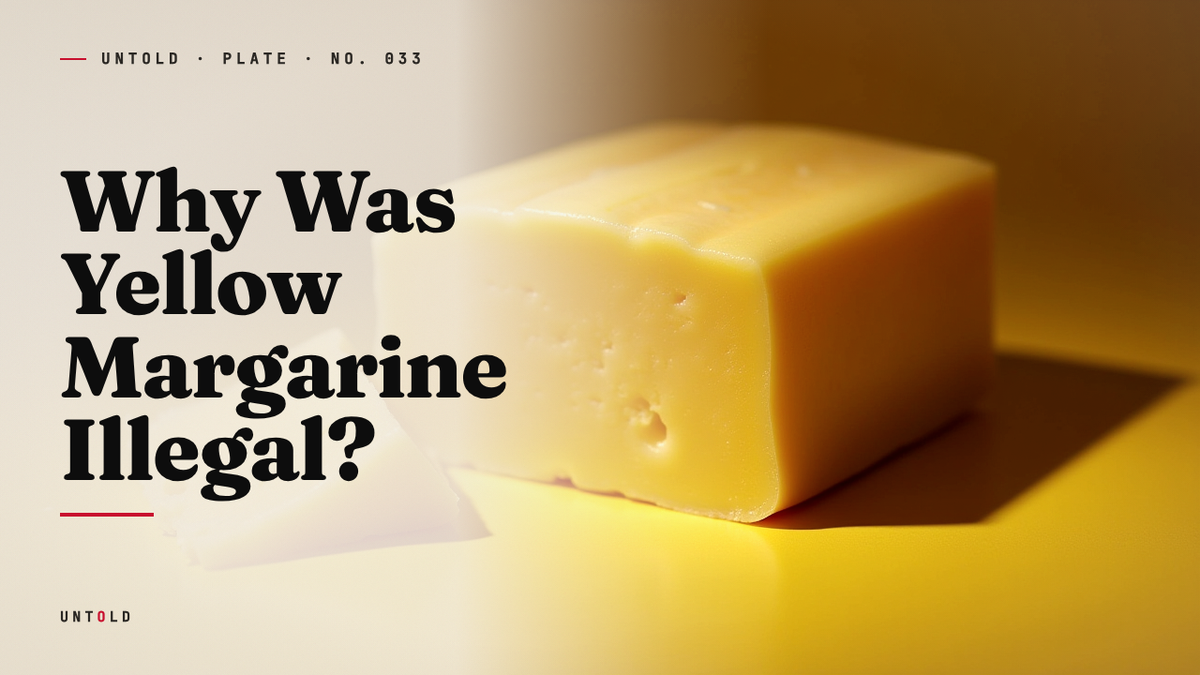
There was a stretch of American history, longer than most people would guess, when the color of your breakfast spread was a matter of state law. Not its safety. Not its labeling. Its color. A grocer in Wisconsin or New Hampshire could be fined for selling a pale tub of fat tinted the wrong shade of yellow. Across state lines, the same product sat legally on a shelf. The substance was identical. Only the pigment had crossed into criminality.
The spread was margarine, and for roughly a hundred years it was the most legislated food in the country. Thirty-two states passed laws designed to cripple it 1. Some taxed it into uncompetitiveness. Some forbade its yellow color outright. A few, in a flourish of legislative spite, demanded it be dyed pink so no shopper would mistake it for butter. Behind every one of these statutes stood the same coalition: dairy farmers who saw in this cheap, factory-made fat an existential threat to the cow.
It is easy to read this now as a quaint episode, a footnote about overzealous lawmakers and a color. But the margarine wars were genuinely vicious, and they ran for generations. They pulled in the Supreme Court, the United States Congress, a French emperor, and eventually a First Lady. And the strangest part of the story is that the people fighting hardest to protect butter may have, by delaying margarine’s rise, accidentally spared millions of hearts from a danger no one had yet learned to fear.
A Prize Offered by an Emperor
The story begins, as odd stories often do, with a shortage and a man willing to solve it. In the late 1860s, France was preparing for war and struggling to feed both its army and its urban poor. Butter was expensive, perishable, and prone to turning rancid in the heat. Napoleon III, the nephew of the more famous Bonaparte, offered a prize to anyone who could produce a cheap, stable substitute that would keep his soldiers and the working classes fed 2.
The man who claimed it was a chemist named Hippolyte Mege-Mouries. Working through the problem, he rendered beef fat, separated out its softer fractions, and churned the result with milk and water. What emerged was a pale, faintly pearlescent solid that spread like butter and cost a fraction as much. The shimmer of it reminded him of pearls, and so he reached for the Greek word for pearl, margarites. He patented the invention in 1869 2. By 1873 he had secured a United States patent as well, and the product crossed the Atlantic into a country that would spend the next century trying to destroy it 3.
What France had treated as an ingenious feat of chemistry, the American dairy industry treated as an act of war. Within a few years, factories were producing the spread by the thousands of tons, undercutting butter on price and, worse, looking very much like it. To a dairy farmer watching his market erode, margarine was not a competitor. It was a counterfeit. The trade press of the era described it in the language of fraud: an imitation dressed up to deceive the honest buyer. The dairy lobby, then one of the most organized agricultural interests in the country, resolved that this newcomer had to be stopped before it could put down roots.
The First Federal Strike
The campaign moved quickly from rhetoric to statute. In 1886, after sustained lobbying, the United States Congress passed the Margarine Act, the first federal law aimed squarely at a single grocery product 4. It imposed a tax of two cents on every pound sold and required manufacturers, wholesalers, and retailers to purchase annual licenses. A grocer who wanted nothing more than to stock the spread alongside the butter had to pay the government for the privilege.
The taxes stung, but they were not the heart of the matter. The real battlefield, the one that would define the conflict for decades, was color. And to understand why color mattered so much, you have to understand a small accident of dairy chemistry. Pure margarine, like lard or candle tallow, is naturally white. Butter is yellow only some of the time, and only because of what cows eat. Cows grazing on fresh spring grass take in beta-carotene, the same pigment that colors carrots, and that pigment passes into the milk and the butterfat. Winter butter, made from cows fed on hay, is far paler. The deep golden yellow that consumers came to associate with quality was, in truth, a seasonal artifact.
Margarine makers, naturally, added yellow dye so their product would resemble the butter people expected. To the dairy industry, that single act was the whole crime. Strip away the color, they argued, and margarine revealed itself as the greasy white impostor it really was. The yellow was the deception. The yellow was the fraud. If they could force margarine to stay white, they reasoned, no one would buy it.
The Pink Years
Before the white laws, there was an even stranger experiment. In 1884, Vermont passed a law requiring that all margarine sold within the state be colored pink 5. The logic was perversely elegant. If yellow margarine deceived shoppers into thinking they were buying butter, then pink margarine would deceive no one. Faced with a tub of bubblegum-colored fat, the reasoning went, any reasonable person would recoil and reach for the genuine article. New Hampshire and West Virginia soon adopted the same approach.
The pink laws were a bridge too far. Manufacturers sued, and the matter eventually reached the Supreme Court. In 1898, in Collins v. New Hampshire, the Court struck the pink mandates down 6. Forcing a wholesome food product to be dyed an unnatural and repellent color, the justices reasoned, was not a legitimate exercise of public health power. It was simply a backdoor prohibition, a way of banning a legal product by making it unsellable. The pink era ended in legal embarrassment.
So the lawmakers reversed their tactic. If margarine could not be forced to be pink, it could at least be forbidden from being yellow. The anti-color laws spread rapidly through the dairy states. Selling yellow margarine became a fineable offense. The spread had to remain in its natural pale, off-putting white, while butter kept its golden monopoly on the color of appetite.
Federal law tightened the screw further. In 1902, Congress amended the Margarine Act to draw a sharp line between colored and uncolored product. Colored margarine was taxed at ten cents per pound, a punishing rate for a cheap commodity. Uncolored margarine was taxed at only a quarter of a cent 4. The message could not have been blunter. Keep it white and pay almost nothing. Make it yellow and pay a fortune.
The Yellow Bag
What the dairy lobby underestimated was the ingenuity of people determined to have butter-colored food at a butter-beating price. Manufacturers found a loophole that was, depending on your sympathies, either brilliant or maddening. They sold the margarine white, exactly as the law demanded, but tucked into each package a small capsule or sealed pouch of yellow dye. Coloring was illegal in the factory. It was perfectly legal at the kitchen table.
And so a peculiar domestic ritual took hold across mid-century America. Families bought their pale white margarine and then, at home, broke the dye capsule and kneaded the color through by hand. The product usually came in a soft plastic bag. You squeezed and worked it, over and over, until the streak of orange-yellow dye dispersed evenly through the white mass and it finally looked like the butter it was pretending to be. It was a chore, and it often fell to the children. Decades later, people still recalled it with a strange fondness, the way the bag warmed in your hands, the slow bloom of color, the turns taken around the kitchen. A whole generation grew up literally mixing the dye into dinner because their government would not let the factory do it for them.
The kneading ritual is the perfect emblem of the whole conflict. The law had not stopped anyone from eating yellow margarine. It had merely added a tedious step and a moral theater, a small daily reminder that this food was suspect, second-class, a thing you had to finish making yourself because the state disapproved of letting it arrive complete.
How the War Was Lost
What finally broke the dairy lobby’s grip was not a court ruling or a clever loophole. It was scarcity. The two World Wars did what no manufacturer’s lawsuit could. When butter vanished from shelves under rationing, margarine stopped being a cheap trick and became a patriotic necessity. Governments encouraged its use to free up dairy fat for the troops. Millions of people who had absorbed years of propaganda about margarine being a greasy fraud tried it for the first time, often during the First World War and then again during the Second, and discovered that it was, simply, fine. The forbidden product quietly became a kitchen staple in homes that had once sworn by butter alone.
The cultural ground had shifted, and the legal scaffolding began to follow. The most public blow came from an unexpected quarter. In the late 1940s, Eleanor Roosevelt, by then one of the most admired women in America, appeared in an advertisement endorsing margarine 7. For the dairy states, the sight of a former First Lady lending her name to the enemy was close to treason. But it signaled where public sentiment had landed.
In 1950, Congress finally repealed the federal margarine taxes and the licensing regime that had hounded the product for sixty-four years 4. The state color laws, deprived of their federal anchor, crumbled one stubborn legislature at a time. Wisconsin, the great dairy state, was famously among the last to relent, holding onto its yellow ban until 1967 8. By then, the war was effectively over. Margarine had won the right to look like what people wanted it to look like.
The Victory That Hid a Danger
And here the story curdles into irony. The triumph of margarine arrived just as it was poised to harm the very people it had finally been allowed to feed.
To turn liquid vegetable oil into a solid that spreads like butter, manufacturers had long relied on a process called partial hydrogenation, which forces hydrogen atoms into the oil and stiffens it. The process worked beautifully on a chemical level. It also created a class of fats that occur only rarely in nature: artificial trans fats. For decades, no one had reason to suspect they were dangerous. Doctors, alarmed by emerging research on saturated fat and the cholesterol in butter, often urged patients to make the switch. Drop the butter, they advised. Choose the modern, vegetable-based spread. It is better for your heart.
It was not. Beginning in the 1990s, careful epidemiological work, much of it from the Nurses’ Health Study at Harvard, began to link trans fats to coronary heart disease with disturbing consistency 9. Trans fats raised the harmful LDL cholesterol while lowering the protective HDL, a double insult that made them, gram for gram, worse for the heart than the saturated fat people had been told to avoid. The spread that had been sold as the healthy alternative to butter turned out to carry its own quiet toll, and it had been spreading through the national diet for the better part of a century.
The regulatory reckoning came slowly and then decisively. In 2015 the United States Food and Drug Administration declared partially hydrogenated oils, the main source of artificial trans fats, no longer generally recognized as safe, and set a deadline for removing them from the food supply. By 2018 the ban was effectively in force 10. The modern margarine that sits in supermarket coolers today is a reformulated product, made from softer plant oils and free of artificial trans fats, a far cry chemically from the hydrogenated spread that won the war.
A Color, a Tax, and a Fear
By the time the dust settled, both combatants had changed almost beyond recognition. Margarine had reinvented its chemistry twice over. Butter, the old enemy, never lost its loyal place in the kitchen and would later enjoy a full rehabilitation as nutritional science grew more skeptical of the demonization of natural fats. The hundred-year war ended not with a clear winner but with both sides altered by the fight.
What remains is one of the more revealing parables in the history of food. A war fought over a color, a tax, and a fear of being deceived. The dairy farmers were not entirely wrong that margarine was an imitation engineered to pass for something it was not. But the energy they poured into the question of pigment was, in the end, energy spent on the wrong problem. The real danger in margarine had nothing to do with whether it was yellow or white or pink. It was hidden in a molecule no legislature thought to regulate until the bodies had already accumulated.
The next time you spread it across toast without a second thought, it is worth remembering that someone once broke the law to make this exact shade of yellow. The freedom to color a humble spread cost decades of lobbying, a Supreme Court case, two world wars, and a former First Lady’s reputation. We argued for a century about the surface of our food and missed, almost entirely, what was happening underneath.
Sources
- Riepma, S. F., The Story of Margarine, Public Affairs Press, 1970. — https://catalog.hathitrust.org/Record/001621820
- Encyclopaedia Britannica, Hippolyte Mege-Mouries and the invention of margarine, 2023. — https://www.britannica.com/topic/margarine
- United States Patent Office, Improvement in Treating Animal Fats (Mege-Mouries), 1873. — https://patents.google.com/patent/US146012A/en
- Dupre, Ruth, ‘If It’s Yellow, It Must Be Butter: Margarine Regulation in North America Since 1886,’ Journal of Economic History, 1999. — https://www.jstor.org/stable/2566554
- Wikipedia, Margarine (history and color laws), accessed 2024. — https://en.wikipedia.org/wiki/Margarine
- Collins v. New Hampshire, 171 U.S. 30, United States Supreme Court, 1898. — https://supreme.justia.com/cases/federal/us/171/30/
- Smithsonian Magazine, ‘The Butter Wars: When Margarine Was Pink,’ 2014. — https://www.smithsonianmag.com/arts-culture/butter-wars-when-margarine-was-pink-180949690/
- Wisconsin Historical Society, ‘Oleomargarine in Wisconsin,’ accessed 2024. — https://www.wisconsinhistory.org/Records/Article/CS3865
- Willett, W. C. et al., ‘Intake of trans fatty acids and risk of coronary heart disease among women,’ The Lancet, 1993. — https://pubmed.ncbi.nlm.nih.gov/8095569/
- U.S. Food and Drug Administration, Final Determination Regarding Partially Hydrogenated Oils, 2015/2018. — https://www.fda.gov/food/food-additives-petitions/final-determination-regarding-partially-hydrogenated-oils-removing-trans-fat
Related reading