The Garden in Your Gut Has a Monoculture Problem
Eating the same meals every day quietly starves the trillions of microbes that keep you well.
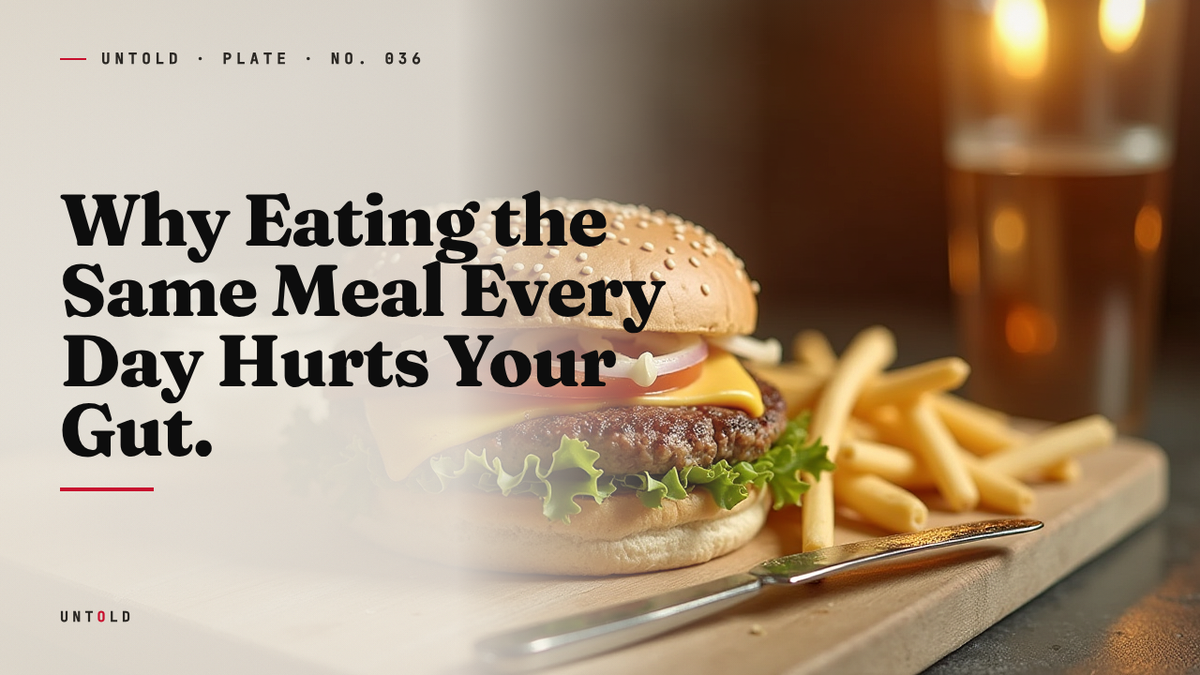
There is a particular kind of person who prides himself on his routine. He eats the same oatmeal every morning, the same chicken-and-rice bowl at noon, the same dinner pulled from the same three recipes he has perfected over the years. He buys in bulk. He never wastes food. He has, by any reasonable measure, optimized eating into a solved problem. He feels efficient, disciplined, in control.
He is also, in a sense he cannot feel, slowly starving. Not himself. The trillions of organisms that live inside him.
This is the quiet paradox of dietary monotony. A meal can be nutritionally complete by the standards printed on the side of the box, hitting every macronutrient and micronutrient target, and still leave a vast portion of your internal ecosystem hungry. Because the body you feed at the dinner table is not just yours. It is shared real estate, home to a population of microbes that outnumbers the stars you can see on a clear night, and they do not all want the same thing for dinner.
The Tenants You Cannot See
Deep in the large intestine, where digestion finishes its long work, lives an ecosystem so dense and varied that scientists have spent two decades simply trying to take its census. It is called the gut microbiome, and it is composed of bacteria, fungi, viruses, and other single-celled life. The most cited estimate puts the number of bacterial cells alone at around 38 trillion, a figure that, depending on how you count, rivals or exceeds the number of human cells in your own body.1 By mass, the whole community weighs roughly as much as the human brain.
For most of medical history, these organisms were treated as freeloaders at best and pathogens at worst, things to be flushed, sterilized, or ignored. We now understand them as something closer to organ tissue, distributed and invisible, but performing work the human body cannot do on its own. They synthesize vitamins, including certain B vitamins and vitamin K. They train the immune system to distinguish friend from foe. They occupy space and consume resources that would otherwise feed harmful invaders. And, most relevant here, they finish a job our own digestive enzymes abandon.
The human gut cannot break down most dietary fiber. The complex carbohydrates in beans, oats, onions, and leafy greens pass through the stomach and small intestine largely intact, arriving in the colon as raw material. There, the microbes take over. Through fermentation, they convert that fiber into short-chain fatty acids, a class of compounds that turn out to be quietly essential. One of them, butyrate, is the preferred fuel for the cells lining the colon itself. The cells of your gut wall are, in a real sense, fed by the waste products of the bacteria living inside it. It is a closed loop of mutual dependence, and fiber is the currency that keeps it running.
But here the story complicates. The microbiome is not a single hungry mouth that will eat whatever you provide. It is a community of specialists.
A Rainforest, Not a Vat
Think of the gut less like a fermentation tank and more like a rainforest. In a rainforest, no single species does everything. There are creatures that eat one kind of leaf, insects that live on one species of tree, fungi that decompose one type of fallen wood. The system’s richness comes from this division of labor, thousands of organisms each occupying a narrow niche.
The gut works the same way. Different bacterial species have evolved to ferment different substrates. Some thrive on the particular soluble fiber in oats. Others specialize in the resistant starch of cooked-and-cooled potatoes, or the inulin in onions and garlic, or the pectin in apples and pears. The polyphenols in berries, coffee, and dark chocolate feed yet another crowd. Each plant you eat, with its unique chemical signature, sends a meal to a particular subset of the population.
The implication is uncomfortable for the man with his three perfected recipes. If you eat only a narrow range of foods, you feed only a narrow range of microbes. The specialists who feast on the fibers you never eat have nothing to consume. And in biology, an organism with no food source does not politely wait. It declines. The colonies shrink. Over time, species that once held a stable place in the ecosystem fade toward the vanishing point.
Monotony, in other words, does not keep the garden tidy. It thins it out.
The Number That Mattered Most
For a long time, the connection between specific eating habits and microbial diversity was more intuition than data. That changed in 2018, when one of the largest investigations of the human gut ever attempted began publishing its results.
The American Gut Project was co-founded by Rob Knight, a microbiome scientist at the University of California, San Diego, and built on an unusual premise: ordinary people would mail in samples of their own stool, along with detailed records of what they ate. More than 11,000 participants did exactly that. The researchers sequenced the bacterial DNA in each sample and cross-referenced it against the dietary diaries, searching for patterns in the noise.2
What emerged surprised even the people running the study. The single dietary factor most strongly associated with a diverse, robust microbiome was not whether someone was vegan, paleo, ketogenic, or omnivorous. It was not the proportion of fat to carbohydrate, nor the total quantity of vegetables consumed. It was the number of distinct plant types a person ate in a given week.
Participants who reported eating 30 or more different plants per week had markedly more diverse gut microbiomes than those who ate 10 or fewer. The diet label barely registered by comparison. A vegan eating the same five vegetables on repeat could have a less varied microbiome than an omnivore who happened to range widely across grains, legumes, herbs, nuts, and fruit. As the researchers framed it, it was the diversity of plants, not the sheer quantity, that counted.
That number, 30, has since become a kind of folk target in nutrition circles, a memorable benchmark in a field that rarely offers clean ones. It is worth pausing on what makes it useful. It does not ask you to eliminate anything, count calories, or follow a regime. It simply asks you to expand the variety of what already passes your plate.
Why Variety Buys Resilience
There is a deeper reason diversity matters, and it has to do with what ecologists call resilience.
Imagine a workforce in which every role has at least two people trained to do it. If someone gets sick, the work continues. Now imagine a workforce stretched so thin that each task rests on a single individual. The moment one person falters, an entire function disappears, and there is no one to absorb the loss. The first organization is resilient. The second is fragile.
A diverse microbiome is the first kind of organization. Because many species perform overlapping functions, the loss or temporary decline of any one of them does not cripple the whole. Some other organism can step into the gap, fermenting the fiber, producing the butyrate, holding the line against pathogens. A microbiome reduced to a handful of overworked species has no such redundancy. When stress arrives, in the form of antibiotics, illness, or a sudden dietary shift, a rich ecosystem bends and recovers, while a depleted one can collapse.
The speed of that collapse is what makes the next piece of evidence so striking.
Ten Days of McDonald’s
Tim Spector, an epidemiologist at King’s College London, spent years studying identical twins to untangle how much of our health is written in our genes and how much is shaped by what we eat and how we live. The microbiome became one of his central interests, in part because it revealed how dramatically two people with identical DNA could diverge based on diet alone.
To test the microbiome’s sensitivity for himself, Spector ran a now-famous self-experiment. For ten days, he ate nothing but fast food, much of it from McDonald’s, while his son monitored the changes in his gut by sequencing samples before, during, and after. The diet was not starvation. It delivered plenty of calories. What it lacked was variety and fiber.
The results, recounted in his book The Diet Myth, were sobering. Within those ten days, Spector lost an estimated 40 percent of his bacterial species.3 Nearly half of the diversity he had built over a lifetime of eating dropped away in less than two weeks of monotony. The microbiome, it turned out, was not a slow-moving system that took years to shift. It responded to diet on the timescale of days. Diversity in, diversity out.
That plasticity cuts both ways, and it carries a hopeful corollary: if the gut can lose diversity quickly, it can also begin to rebuild it quickly. But Spector’s experiment came with a darker question lurking underneath. What happens if the monotony lasts not ten days, but a lifetime, or generations?
What Gets Lost Stays Lost
For that question, the most unsettling answer comes from a series of experiments conducted by Justin Sonnenburg and his colleagues at Stanford University. Sonnenburg studies how diet shapes the microbiome over the long term, and to do so he turned to mice, animals that can be raised across multiple generations under controlled conditions.
He fed mice a diet low in the fermentable fiber that gut microbes depend on, then watched what happened to their internal ecosystems over time. As expected, microbial diversity dropped. But the troubling finding came across generations. Mice raised on the low-fiber diet passed a depleted microbiome to their offspring, who, raised on the same poor diet, lost still more species. With each generation, the ecosystem grew thinner.4
Then came the crucial test. Sonnenburg’s team reintroduced fiber, restoring the rich diet the mice had been missing. Some of the lost species recovered. But others did not. They were simply gone, extinct within that lineage, unable to return no matter how generous the menu became afterward. The microbiome had crossed a threshold from which a better diet alone could not retrieve it.
The parallel to the human story is impossible to ignore. Populations eating traditional, fiber-rich diets, such as some hunter-gatherer communities, tend to harbor far more microbial diversity than people in industrialized societies, whose processed, repetitive diets may have already pruned away species that no amount of kale will bring back. Monotony, sustained long enough, does not just suppress the ecosystem. It can erase parts of it permanently.
The Trap of the Single Superfood
Here the modern wellness industry runs into a wall of its own making. The dominant message of the last two decades has been the superfood: the one ingredient, the one supplement, the one green powder that will fix everything. Blueberries one year, turmeric the next, then kale, then matcha. The promise is always singular, a hero food to be eaten faithfully and often.
The microbiome science quietly dismantles this. There is no single food that builds a diverse gut, because diversity is, by definition, the opposite of singularity. The most expensive, antioxidant-dense smoothie in the world will do little for your microbial richness if you drink the identical blend every morning. You will feed the same crowd of microbes, generously, while everyone else goes hungry. A perfect monoculture is still a monoculture.
The healthiest guts, the research keeps suggesting, belong not to the people with the most disciplined diet or the most fashionable supplement, but to the people who simply eat the widest range of plants. Variety itself is the active ingredient.
Rebuilding the Garden
The practical surprise in all of this is how easily variety can be assembled, once you stop thinking of plants as only the vegetables on your dinner plate.
In the counting that matters for your microbiome, plants are defined broadly. Herbs and spices count. So do nuts, seeds, whole grains, legumes, fruits, and even coffee, tea, and dark chocolate, each carrying its own polyphenols and fibers. A single dish seasoned with a mix of oregano, thyme, and rosemary has just added three plants to the week’s tally. A handful of mixed seeds scattered over a salad adds several more. Suddenly the number 30 looks less like a chore and more like a natural consequence of eating with curiosity.
The path there is built from small substitutions rather than grand overhauls. Swap the usual apple for a pear, the white rice for barley or farro, the single type of bean for a mixed three-bean blend. Rotate the greens. Throw a different vegetable into the same familiar stew each week. None of these changes asks you to abandon the meals you love. They ask only that you stop eating the exact same version of them every single time.
Over weeks, these rotations accumulate into something the gut can feel, even if you cannot. Species that had dwindled find their food source returning. The redundancy rebuilds. The ecosystem grows back toward the kind of richness that can weather a course of antibiotics or a stomach bug without collapsing.
It is worth holding the science honestly here. Much of the link between low microbial diversity and disease, including obesity, type 2 diabetes, inflammatory bowel conditions, and chronic inflammation, remains correlational. Researchers have observed that people with these conditions tend to have less diverse guts, but observing a pattern is not the same as proving that the depleted gut caused the illness rather than the other way around. The causal arrows are still being mapped. What is no longer seriously disputed is that diet shapes the microbiome, that variety shapes it for the better, and that monotony narrows it.
So the man with his three perfected recipes is not wrong to value efficiency. He has simply been optimizing for the wrong organism. The body he is feeding so carefully is not one diner but a teeming, specialized, easily impoverished crowd. The next time the same familiar meal calls, the more interesting question is not whether it will nourish him. It is which of the quiet residents inside him will go hungry tonight.

Sources
- Sender, R., Fuchs, S., Milo, R., Revised Estimates for the Number of Human and Bacteria Cells in the Body, PLOS Biology, 2016 — https://journals.plos.org/plosbiology/article?id=10.1371/journal.pbio.1002533
- McDonald, D. et al., American Gut: an Open Platform for Citizen Science Microbiome Research, mSystems, 2018 — https://journals.asm.org/doi/10.1128/mSystems.00031-18
- Spector, T., The Diet Myth: The Real Science Behind What We Eat, Weidenfeld & Nicolson, 2015 — https://www.penguin.co.uk/books/255984/the-diet-myth-by-spector-tim/9781780229003
- Sonnenburg, E. D. et al., Diet-induced extinctions in the gut microbiota compound over generations, Nature, 2016 — https://www.nature.com/articles/nature16504
- Valdes, A. M., Walter, J., Segal, E., Spector, T. D., Role of the gut microbiota in nutrition and health, BMJ, 2018 — https://www.bmj.com/content/361/bmj.k2179
- Sonnenburg, J. & Sonnenburg, E., The Good Gut: Taking Control of Your Weight, Your Mood, and Your Long-term Health, Penguin Press, 2015 — https://www.penguinrandomhouse.com/books/313947/the-good-gut-by-justin-sonnenburg-and-erica-sonnenburg/
Related reading