The Grass That Ate America
A single domesticated plant became the chemical foundation of the American body, mostly without anyone noticing.
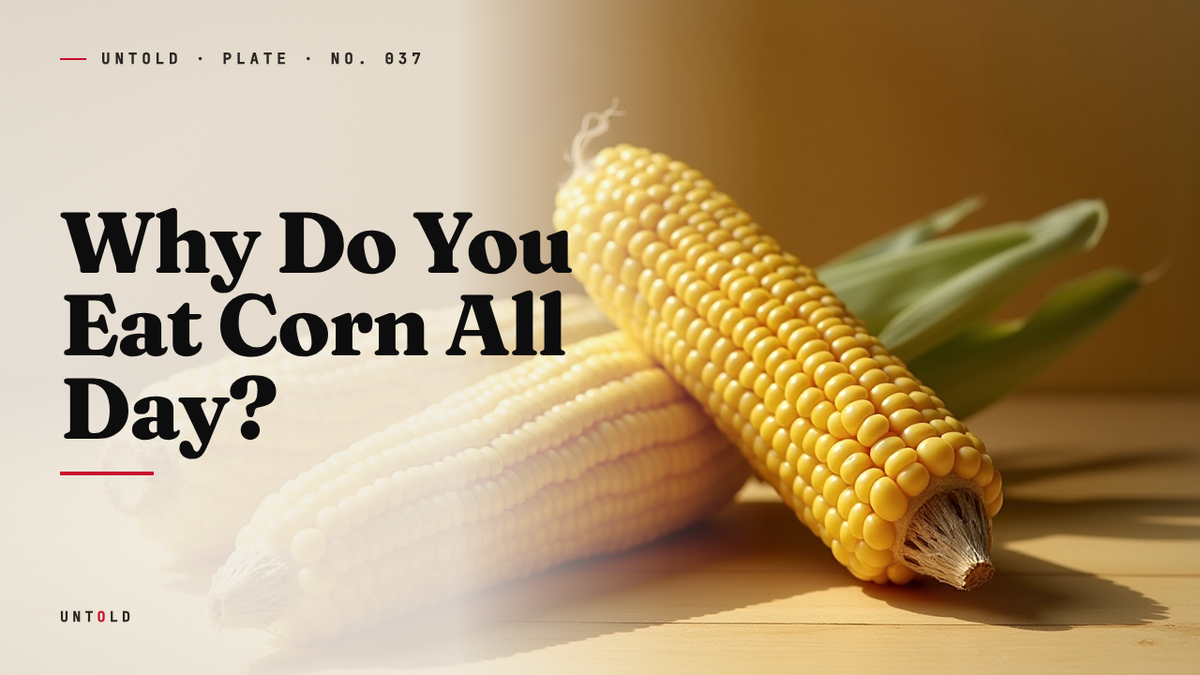
Look closely at a typical American breakfast. The toast, the scrambled eggs, the glass of orange juice, the soda someone is drinking before nine in the morning. Statistically, a startling share of it began as a single plant. Not wheat. Not rice. A grass first coaxed out of the highlands of southern Mexico roughly nine thousand years ago.
It is corn, and it is hiding.
The hiding is the remarkable part. Most people picture corn as the yellow ears stacked at a summer cookout, or the can of kernels in the pantry. That image is almost beside the point. The vast majority of American corn never reaches a plate as anything recognizable. It is dismantled in factories, fed to livestock, fermented into fuel, and reassembled into the soda, the ketchup, the salad dressing, and the bread. When a team of scientists analyzed the carbon locked inside American hair and tissue, they found something that sounds like a metaphor but is meant literally. Chemically, the average American is built more from corn than from any other single food.
The science writer Michael Pollan put it more bluntly. “We are,” he wrote, “corn chips with legs.” 1 How one grass managed to quietly colonize the diet of an entire nation is a story less about agriculture than about policy, chemistry, and the strange economics of abundance.
A Grass Made by Human Hands
Corn, or maize, does not exist in the wild. There is no field anywhere on Earth where it grows on its own. This is unusual for a major crop, and it points to something most people never consider: corn is one of the most thoroughly engineered organisms in human history, and the engineering began long before genetics had a name.
Its ancestor is a scraggly Mexican grass called teosinte. To a modern eye, teosinte barely resembles corn at all. Its “ears” are perhaps an inch long, holding a dozen or so kernels encased in shells hard enough to crack a tooth. 2 Over thousands of years, farmers in the Balsas River valley selected, replanted, and gradually transformed this unpromising plant. Kernels grew larger and softer. Ears grew longer. The plant surrendered the ability to scatter its own seed, becoming wholly dependent on human hands to reproduce. By the time Europeans reached the Americas, maize was already feeding sophisticated civilizations from the Andes to the Great Lakes. It was, by any measure, one of the great agricultural achievements of the ancient world.
But corn’s true conquest of America did not happen in a field. It happened in Washington.
From the Field to the Statehouse
The figure who bridges the agricultural and political halves of the corn story is Henry A. Wallace. The grandson and son of farm-press editors, Wallace was obsessed with corn from boyhood. As a young man in Iowa he ran breeding experiments, and in the 1920s he helped pioneer commercial hybrid corn, founding the company that would become Pioneer Hi-Bred. 3 Hybridization, by crossing carefully selected inbred lines, produced plants of startling vigor and uniformity. Yields that had hovered around twenty bushels per acre for generations began an ascent that has still not stopped. Today the figure exceeds 170 bushels per acre. 4
Wallace went on to become Franklin Roosevelt’s Secretary of Agriculture and then his Vice President, and the policies he helped shape during the Depression were designed, in part, to manage the consequences of the very productivity he had unleashed. The original New Deal farm programs paid farmers to grow less, an attempt to prop up prices in a world drowning in surplus. The arithmetic of modern corn was already clear. American farmers could grow far more of it than Americans could conceivably eat. A mountain of grain had appeared, and a mountain needs somewhere to go.
Fence Row to Fence Row
For decades that surplus was carefully restrained. Then, in 1973, the restraints came off.
Earl Butz, Richard Nixon’s Secretary of Agriculture, looked at the price-support system and saw waste. A blunt, plainspoken agricultural economist from Indiana, Butz believed the future belonged to scale. He told farmers to plant “fence row to fence row” and to “get big or get out.” 5 The policy machinery was rebuilt around his philosophy. Instead of paying farmers to idle land, the government began making direct payments that rewarded maximum production. The more a farmer grew, the more support flowed.
The results were exactly what the incentives demanded. The corn river became a flood. Prices fell, sometimes below the cost of growing the crop, and the subsidies absorbed the difference. By the late twentieth century, a bushel of corn was one of the cheapest sources of calories the world had ever produced. And this created a peculiar problem that would reshape the American diet: the nation was now obligated, by its own policy, to find new things to do with an ocean of cheap grain.
The chemists were ready.
The Invention of Sweetness
In the late 1960s, a Japanese researcher named Yoshiyuki Takasaki was working on enzymes. His contribution sounds technical and is, but its consequences were enormous. Takasaki refined an industrial process using an enzyme, glucose isomerase, capable of converting the glucose in corn starch into fructose, a far sweeter sugar. 6 The result was high-fructose corn syrup: a liquid sweetener that was cheap, shelf-stable, easy to blend into beverages, and, crucially, made from the one commodity America had in catastrophic abundance.
The timing could not have been better for the syrup or worse for anyone hoping the American diet might grow simpler. Just as Butz’s policies were drowning the country in corn, here was a way to turn that corn into the sweetness that food manufacturers craved. The economics were irresistible. Domestic sugar was protected by quotas and tariffs that kept its price high. Corn syrup was cheap and getting cheaper. By 1984, Coca-Cola and Pepsi had switched their American formulas almost entirely from sugar to high-fructose corn syrup. 7 Between 1970 and 2000, American consumption of the sweetener rose by more than a thousand percent. 8
It went everywhere. Not only into the obvious places, the sodas and the candy, but into bread, into yogurt, into pasta sauce, into salad dressing, into things no one would think to call sweet. Sweetness had become structural, an ingredient in the architecture of processed food. And sweeteners were only the most visible of corn’s disguises.
Read the Label
Turn over almost any packaged food and read the ingredient list slowly. A surprising number of the words, especially the long chemical-sounding ones, trace back to the same grass.
Maltodextrin, a common thickener and filler, is made from corn. So is dextrose. So, frequently, are citric acid and xanthan gum, both produced by fermenting corn-derived sugars. Cornstarch thickens the canned soup and dusts the shredded cheese to keep it from clumping. Corn oil fries the food in countless restaurant kitchens. The grain has been broken into its molecular components and reassembled into an entire vocabulary of additives, each with a name that gives no hint of its origin. One estimate suggests that roughly a quarter of the products in a typical American supermarket contain corn in some form, amounting to thousands of items. 9
Then there is the corn no one sees at all, because something else ate it first.
The Animals Ate It First
The single largest destination for American corn, after fuel, is the stomach of an animal. Most American beef, pork, and chicken is raised on corn-based feed. The modern feedlot exists because corn made it possible. A steer that would naturally graze on grass for years can, on a diet engineered around cheap corn, reach slaughter weight far faster and far more cheaply. 10 The same logic governs the chicken house and the hog barn.
The consequence is that corn enters the human diet through a side door. The burger, the eggs, the glass of milk, the rotisserie chicken: each is, in a real biochemical sense, repackaged corn. The kernels were never tasted, but the carbon passed through. The American food system had become, almost without anyone planning it, a vast machine for converting subsidized grain into every conceivable form of calorie.
This is precisely why scientists were eventually able to read corn directly in human bodies.
You Are What Your Food Ate
The evidence comes from a quirk of plant chemistry. Corn belongs to a group of plants that use a particular photosynthetic pathway, called C4, which leaves a distinctive ratio of carbon isotopes in its tissues. Most other plants in the human diet, including wheat, rice, vegetables, and fruit, use a different pathway and carry a different signature. The carbon a plant lays down is faithfully passed up the food chain, into the animals that eat it and into the people who eat those animals. 11
Todd Dawson, a biologist at the University of California, Berkeley, and colleagues used this principle to ask a simple question: how much corn was actually built into the American body? They measured carbon isotopes in human hair and tissue. The corn signature was overwhelming, far stronger in Americans than in people from countries where corn does not dominate the food supply. In a memorable phrasing of the finding, the chemical evidence pointed to a single conclusion. “When you look at the isotopic signature of North Americans,” Dawson observed, in effect, we are corn. 11 The metaphor of being a corn person turned out not to be a metaphor at all.
An Economic Accident, Not a Choice
It is tempting to assume that a diet so saturated with one ingredient must reflect a national appetite, some deep American craving for corn. It does not. Almost no one chose this. Corn did not conquer the American diet because it was the most nutritious option, or the most delicious, or the one people demanded. It won because it became, through a particular sequence of breeding, policy, and chemistry, the cheapest source of calories available.
Every link in the chain was a decision made for reasons that had little to do with what anyone would eat. Wallace bred for yield. New Deal planners managed surplus. Butz pushed production to its limit. Takasaki solved an industrial chemistry problem in a laboratory. Food manufacturers responded, rationally, to the prices in front of them. The cumulative result was an outcome no single person designed: a country whose population is, at the level of carbon atoms, partly composed of one engineered grass.
What Cheap Calories Bought
None of this makes corn a villain. It remains one of the most extraordinary agricultural achievements humans have ever managed, a plant of our own making that feeds billions. The unease around it has less to do with the crop than with what cheap, abundant corn made possible.
When calories become extraordinarily cheap, they become extraordinarily plentiful, and not always in nourishing forms. Some researchers have pointed to the striking parallel between the rise of inexpensive corn-based sweeteners and the rise in American obesity over the same decades. 12 The honest caveat matters here: correlation is not proof, and the causes of obesity are tangled, involving portion sizes, sedentary lives, and far more than any single ingredient. A glass of corn syrup and a glass of cane sugar deliver similar calories. But the timing is difficult to dismiss entirely, and the broader point holds regardless. A food economy organized around producing the maximum number of the cheapest possible calories will tend to produce a great many cheap calories, whatever the consequences downstream.
More than ninety million acres of American farmland, an area larger than many countries, are planted with corn each year. 13 The crop shapes the landscape, the rivers that carry its fertilizer runoff, the economics of rural towns, and the contents of nearly every grocery cart in the nation. And almost none of this is visible from inside the supermarket.
That invisibility is perhaps the real subject of the corn story. A modern eater can move through an entire day, an entire life, sustained largely by a single plant, and never once see it. The grass is dismantled, renamed, and rebuilt into forms that betray nothing of their origin. The next time the ingredient list on a package runs long, it is worth reading slowly and counting how many of those words trace back to one grass domesticated nine thousand years ago in a Mexican valley. The number is the story. The fact that it took scientists reading the carbon in human hair to make it visible is the rest of it.
Sources
- Pollan, Michael, The Omnivore’s Dilemma: A Natural History of Four Meals, Penguin Press, 2006. — https://michaelpollan.com/books/the-omnivores-dilemma/
- Doebley, John, “The Genetics of Maize Evolution,” Annual Review of Genetics, 2004. — https://www.annualreviews.org/doi/10.1146/annurev.genet.38.072902.092425
- Crow, James F., “90 Years Ago: The Beginning of Hybrid Maize,” Genetics, 1998. — https://www.ncbi.nlm.nih.gov/pmc/articles/PMC1460319/
- USDA National Agricultural Statistics Service, Corn Yield Historical Data. — https://www.nass.usda.gov/
- Hamilton, Shane, “Earl Butz and the Industrialization of American Agriculture,” Agricultural History. — https://www.jstor.org/stable/3744897
- Takasaki, Yoshiyuki, “Production of High-Fructose Syrup by Immobilized Glucose Isomerase,” Agricultural and Biological Chemistry, 1969. — https://www.tandfonline.com/doi/abs/10.1080/00021369.1969.10859475
- Bray, George A. et al., “Consumption of high-fructose corn syrup in beverages may play a role in the epidemic of obesity,” American Journal of Clinical Nutrition, 2004. — https://academic.oup.com/ajcn/article/79/4/537/4690128
- U.S. Department of Agriculture, Economic Research Service, Sugar and Sweeteners Yearbook Tables. — https://www.ers.usda.gov/data-products/sugar-and-sweeteners-yearbook-tables/
- Pollan, Michael, “When a Crop Becomes King,” The New York Times, 2002. — https://www.nytimes.com/2002/07/19/opinion/when-a-crop-becomes-king.html
- Jahren, A. Hope and Kraft, Rebecca A., “Carbon and nitrogen stable isotopes in fast food,” PNAS, 2008. — https://www.pnas.org/doi/10.1073/pnas.0809870105
Related reading