The Wine Tasted Red Because the Eyes Said So
A famous Bordeaux experiment exposed how color, price, and labels write our flavors before the glass reaches our lips.
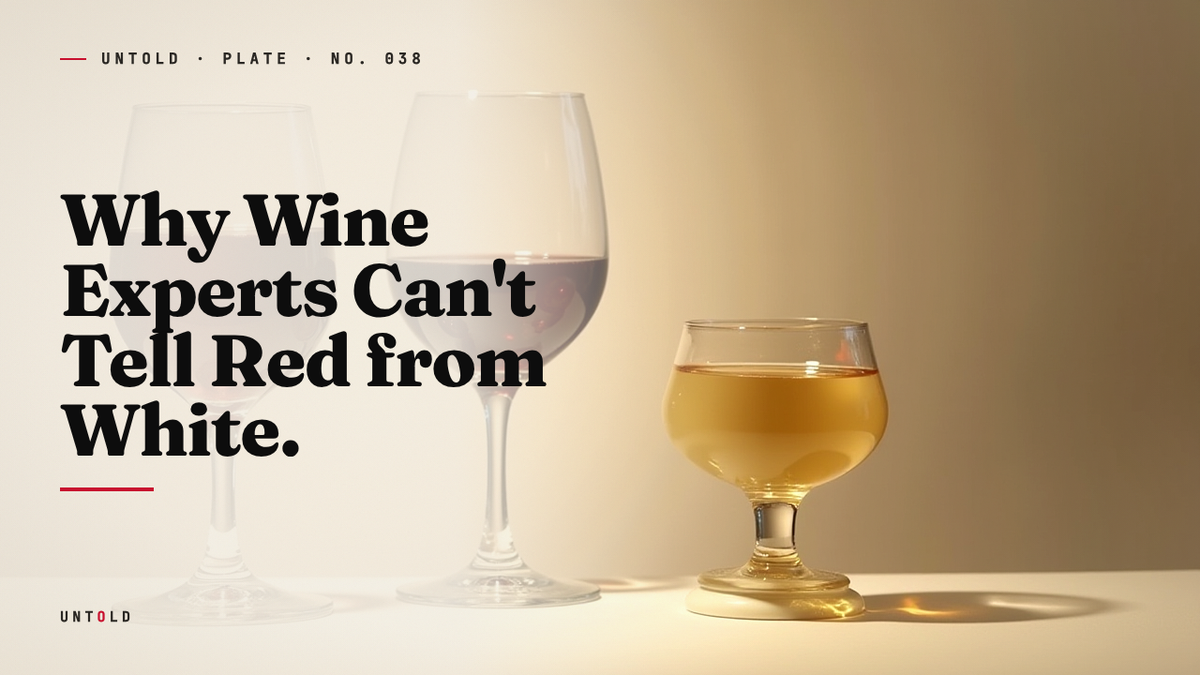
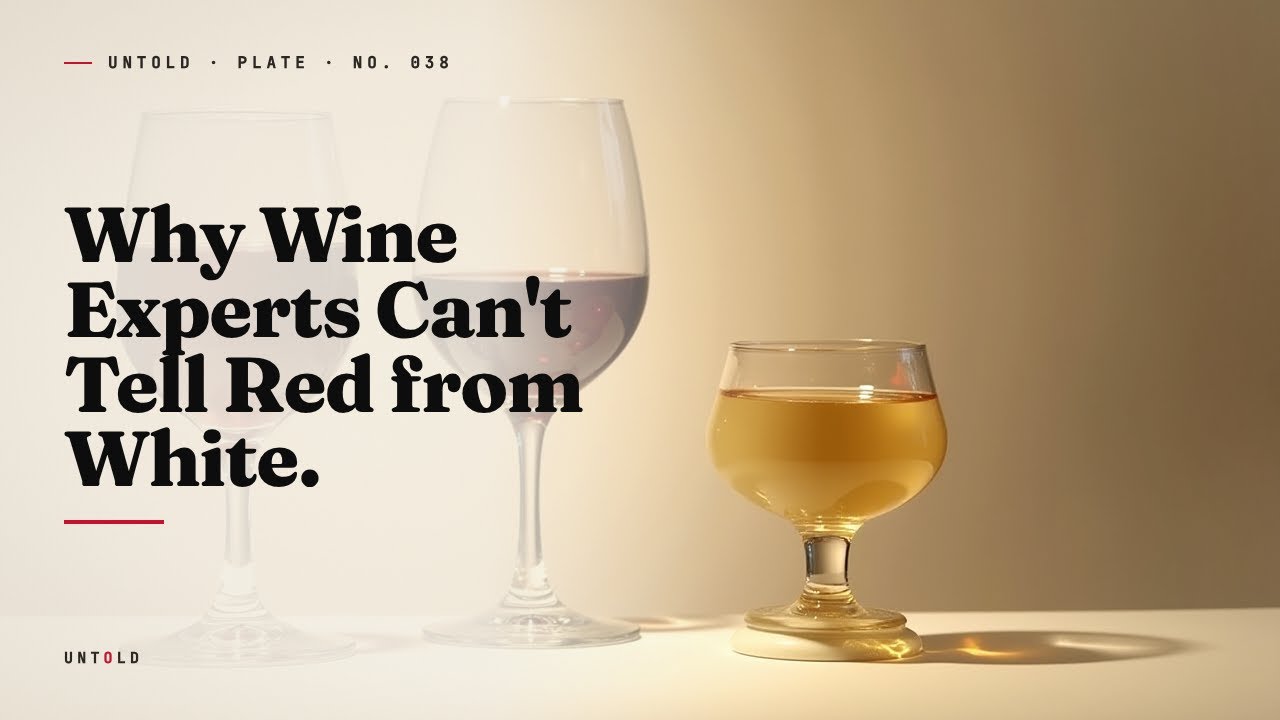
In 2001, in a tasting room at the University of Bordeaux, fifty-four students of oenology bent over their glasses and began, with great seriousness, to describe a wine that did not exist. The liquid in front of them was real enough. It was white wine, a perfectly ordinary one, that a researcher had quietly dyed red with an odorless, tasteless additive. The color was a lie. The students never caught it.
Days earlier, the same young palates had tasted the same wine in its honest pale form and reached, almost unanimously, for the standard vocabulary of whites: honey, citrus, straw, flowers, the faint mineral note that French tasters call pierre à fusil, gunflint. Now, presented with a glass that looked like a young red, they wrote of crushed raspberry, cherry, tobacco, the leathery darkness of red fruit. Not one student noted that the new wine smelled suspiciously like the old one. Not one suspected the trick. The color had told them what to find, and their noses had obediently found it.
The experiment, designed by Frédéric Brochet and reported with his colleagues Gil Morrot and Denis Dubourdieu, became one of the most quoted and most misunderstood studies in the science of perception 1. It is easy to read it as a takedown, proof that wine snobbery is theater and that experts are frauds dressed in tasting jargon. That reading is wrong, and it misses the more interesting and more humbling point. The students were not fooled because they were incompetent. They were fooled because their brains were doing exactly what every human brain does at every meal, every cup of coffee, every glass of water. They tasted with their eyes first.
The vocabulary of expectation
What made Brochet’s dyed-wine study unusual was not the trick itself but the method he used to read its results. He did not simply ask whether the students liked the wine. He collected their written descriptions and subjected the words to statistical analysis, building a kind of map of the language each color summoned. The pattern was clean and almost eerie. When the wine was white, the descriptors clustered in one region of word-space, the familiar territory of light fruit and floral notes. When the same wine wore red, the descriptors leapt across to the opposite region, the lexicon reserved for reds 1.
The shift was not subtle. Morrot, Brochet, and Dubourdieu reported that the students used the vocabulary of red wines to describe a white wine simply because it had been colored red. The authors put the conclusion plainly: odors were named according to the color of the drink. The visual information had not merely nudged the tasters. It had effectively dictated the categories into which their olfactory impressions were sorted.
This is worth pausing on, because it overturns a common assumption about how the senses cooperate. We tend to imagine perception as a fair committee, each sense submitting its report and the brain weighing the evidence. The study suggests something closer to a hierarchy, with vision sitting near the top and the nose deferring to it when the two disagree. When color and aroma conflicted, color won, and it won decisively, in people who had spent years training their palates precisely to resist such interference.
What flavor actually is
To understand why sight should hold such sway, it helps to dismantle a word we use carelessly: taste. The human tongue is a remarkably limited instrument. It detects roughly five qualities: sweet, sour, salty, bitter, and the savory depth the Japanese named umami. That is the entire repertoire of taste in the strict sense. Everything else, the raspberry, the tobacco, the gunflint, the long finish, belongs not to taste but to flavor, and flavor is a construction.
Flavor is assembled in the brain from at least three streams of information. There is taste from the tongue. There is aroma, most of it arriving not through the nostrils but retronasally, drifting up the back of the throat from the mouth to the olfactory receptors as we chew and swallow. And there is everything else the brain knows or expects: the color of the liquid, the weight of the glass, the price on the menu, the name on the label, the company at the table. The finished sensation we call the taste of a wine is the brain’s best guess, a single coherent experience stitched together from sources that have no obligation to agree.
Under normal conditions this synthesis serves us well. The streams usually reinforce one another, and the resulting prediction is accurate enough to keep us alive and well fed. A ripe strawberry is red, smells of strawberry, and tastes sweet, and the brain has no reason to question the consensus. The trouble begins only when an experimenter deliberately uncouples the channels, dyeing a white wine red so that the eyes report one thing while the nose, if anyone bothered to consult it, reports another. In that artificial conflict the brain’s ordinary shortcut becomes visible, and the shortcut, it turns out, runs through the eyes.
There is a deep logic to this. Vision is fast, high-resolution, and forward-looking. It tells us about the world before we touch or taste it, which is exactly the kind of advance warning a foraging animal needs. Smell and taste, by contrast, are intimate and slow, confirming what is already in the mouth. Evolution had every reason to let the eyes set the expectation and let the slower senses fall in line. The wine students inherited that arrangement, and no amount of certification could switch it off.
The grand cru and the table wine
If the color study revealed how a single visual cue could rewrite aroma, Brochet’s second experiment showed that the cue need not even be the wine itself. The expectation could ride in on a piece of paper.
He took one ordinary mid-range Bordeaux and decanted it into two different bottles. One bottle carried the label of a humble vin de table, the cheap everyday stuff. The other wore the label of a grand cru classé, the aristocracy of Bordeaux. The liquid was identical, down to the vintage. Only the social standing of the bottle differed 1.
The tasters, again experienced students, reviewed the two wines as if they were genuinely separate creatures. The grand cru drew the language of praise: complex, balanced, full, rounded, woody, long. The supposed table wine drew the language of dismissal: weak, short, flat, simple, and in some cases faulty. One wine, two opposite verdicts, and the only thing that had changed was a name and the prestige it carried.
The label, in other words, behaved exactly like the dye. It arrived before the wine, it set an expectation, and the brain folded that expectation into the flavor it eventually assembled. The tasters were not lying about their experience. They genuinely perceived the grand cru as rounder and the table wine as flatter, because perception is not a passive recording of the glass but an active prediction shaped by everything the taster brings to it.
When the brain pays more
For a long time the obvious objection to these studies was that they measured reports, not experiences. Perhaps the students were simply saying what they thought a red wine or a grand cru should taste like, performing the expected role while privately perceiving the same dull liquid. The words might be biased even if the underlying sensation was not.
That objection lost much of its force in 2008, when a team led by the neuroscientist Hilke Plassmann put the question to a brain scanner 2. Volunteers tasted wines while lying in a functional MRI machine, and were told the price of each before they sipped. The crucial manipulation was that some wines were poured twice under different price tags. A single wine might be introduced once as a ten-dollar bottle and later as a ninety-dollar one. Same wine, different number.
When subjects believed they were drinking the expensive wine, they reported enjoying it more, which was unsurprising. The striking finding lay deeper in the brain. Activity in the medial orbitofrontal cortex, a region associated with the experience of pleasantness, rose when the price was high 2. The brain was not merely claiming to enjoy the pricier wine. Its pleasure machinery was actually responding more strongly to a liquid that had not changed in any chemical respect. The expectation of quality, planted by a price tag, reached into the neural circuitry of enjoyment and turned the dial.
This is the finding that closes the loop. Color, label, and price are not separate curiosities. They are all variations on a single phenomenon: the brain forms an expectation from whatever information arrives first, and then constructs the experience to match. The expectation is not a comment we add after tasting. It is woven into the tasting itself, sometimes at the level of the neurons that register delight.
Expertise as a sharper bias
There is a comforting story one might tell about all of this, in which the experts are the victims of a trick that ordinary drinkers, with their lower expectations, might somehow escape. The research suggests the opposite. Expertise does not dissolve the bias. In certain ways it can sharpen it.
Consider what training does to a wine taster. It furnishes the mind with an enormous, organized vocabulary and a dense web of associations: this color implies this grape implies these aromas implies this region and this style. That structure is exactly what makes an expert useful. It is also exactly what makes the visual cue so powerful. When the dyed wine looked red, the student’s well-stocked mind did not hesitate. It instantly retrieved the entire red-wine schema and projected it onto the glass. A novice with a poorer vocabulary might, paradoxically, have less to project. The more wine words one knows, the more elaborately one’s eyes can mislead one’s nose.
This is not a flaw peculiar to sommeliers. It is the price of expertise in any perceptual domain. Radiologists see the pathology they are primed to find. Experienced birders hear the song they expect from the habitat. The trained brain is efficient precisely because it predicts aggressively, filling in detail from a small cue, and aggressive prediction is brilliant when the cue is honest and treacherous when it is not. The wine students were not betraying their training. They were demonstrating it.
This is why the institution of blind tasting exists at all, and why serious wine competitions go to such lengths to strip away context. Black or opaque glasses hide the color. Bottles are bagged or decanted to hide the label. Prices are concealed. The whole apparatus is an attempt to amputate the visual and social cues that the brain so eagerly consumes, leaving, in theory, only the aroma and the taste. The very existence of these precautions is an admission of how much the unblinded brain is influenced by everything other than the liquid.
And even blind tasting is imperfect. The senses still leak into one another, expectation still creeps in through the texture or the temperature or the simple knowledge that one is being tested. Skilled tasters in genuinely blind conditions have, on occasion, confused reds and whites, which should not shock anyone who has followed the argument this far. Once the color is gone, the brain loses the very cue it most relies on, and it is left to do the harder, less natural work of judging by smell alone.
The color, the price, the story, then the wine
It would be a mistake to walk away from Brochet’s dyed glasses thinking only about wine. The wine is incidental. What the experiments expose is a general feature of how perception works, and it operates at every table, in every cup, in glasses that hold nothing more exotic than water.
The phenomenon has since been demonstrated across the sensory landscape. A drink served in a heavier glass is judged richer. A dessert on a round white plate tastes sweeter than the same dessert on a black square one. A coffee with a premium name on the cup is rated smoother than the identical brew in a plain one. Food coloring can make a beverage taste of fruits it does not contain. The eyes, and the mind behind them, are always at the table first, setting expectations before a single molecule reaches the tongue.
None of this means our experiences are fake or that flavor is an illusion to be ashamed of. The construction is the experience. There is no purer, truer taste hiding beneath the influence of color and price, waiting to be liberated. The brain has no other way of working. It builds the world from prediction and correction, and a glass of wine is simply one small, delicious instance of that endless construction.
So the next time a wine is swirled and sniffed and pronounced upon, it is worth remembering the fifty-four students in Bordeaux who tasted raspberries in a white wine and never doubted what their eyes had told them. They were not weak-minded. They were human. We drink the color, and the price, and the story written on the label, and only after all of that, somewhere near the bottom of the glass, do we finally get around to the wine.
Sources
- Morrot, G., Brochet, F., Dubourdieu, D., The Color of Odors, Brain and Language, 2001. — https://www.sciencedirect.com/science/article/abs/pii/S0093934X01925933
- Plassmann, H., et al., Marketing actions can modulate neural representations of experienced pleasantness, Proceedings of the National Academy of Sciences, 2008. — https://www.pnas.org/doi/10.1073/pnas.0706929105
- Brochet, F., Chemical Object Representation in the Field of Consciousness, application presented for the Grand Prix of the Academie Amorim, 2001. — https://web.archive.org/web/20070928231853/http://www.academie-amorim.com/us/laureat_2001/brochet.pdf
- Spence, C., Gastrophysics: The New Science of Eating, Viking, 2017. — https://www.penguin.co.uk/books/181228/gastrophysics-by-spence-charles/9780241278703
- Shepherd, G. M., Neurogastronomy: How the Brain Creates Flavor and Why It Matters, Columbia University Press, 2012. — https://cup.columbia.edu/book/neurogastronomy/9780231159111
- Piqueras-Fiszman, B., Spence, C., The influence of the color of the cup on consumers’ perception of a hot beverage, Journal of Sensory Studies, 2012. — https://onlinelibrary.wiley.com/doi/10.1111/joss.12010
Related reading