The Ape That Cooked Its Way to a Bigger Brain
Before language, before tools, a flame held to raw flesh quietly rewrote what a primate could become.
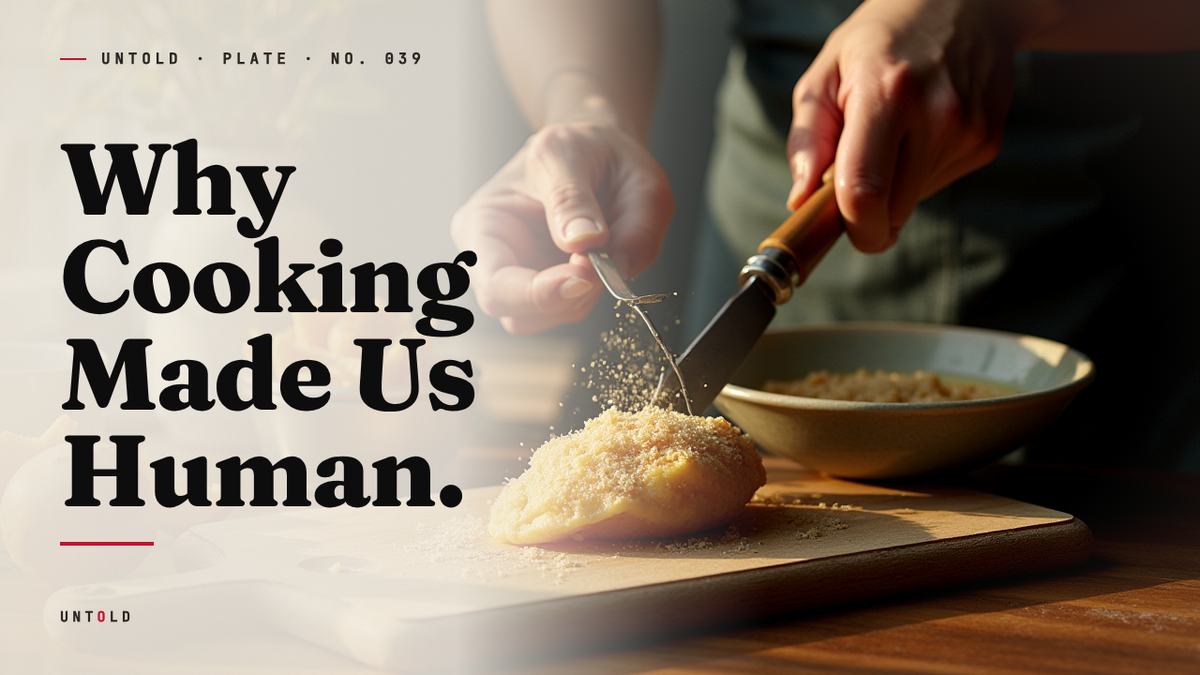
A wild chimpanzee spends roughly six hours of every waking day doing one thing: chewing. Not foraging, not climbing, not grooming, but the slow grinding labor of breaking down raw leaves, fruit, and the occasional scrap of meat into something its body can actually use. The work is relentless because raw food is stubborn. It resists. Cellulose, tough fiber, and tightly folded proteins do not surrender their calories easily, and a chimpanzee’s gut is a long, expensive fermentation chamber built to extract what it can from a diet that fights back at every stage.
A modern human, by contrast, can eat a full meal in twenty minutes and walk away to do something else with the rest of the day. We spend less than an hour chewing in a typical twenty-four hours, perhaps a tenth of what our closest living relatives manage 1. Our teeth are small, our jaws comparatively feeble, our guts short and unimpressive next to the cavernous intestines of a gorilla. By the ordinary logic of survival, we are badly equipped animals. We should not be able to feed ourselves on what nature provides in its raw state.
And yet there is the brain. That organ, roughly three pounds of folded tissue, consumes about a fifth of the body’s entire energy budget at rest, more than twice the share a chimpanzee’s brain demands 2. It is the single most expensive thing we carry. Something had to pay for it. Something had to feed an organ that hungry while simultaneously freeing us from the six-hour chew. The most provocative answer to that puzzle is not a tool, not a word, not a clever social trick. It is a controlled fire held under a piece of meat.
The Man Who Lit the Idea
In the late 1990s, the Harvard primatologist Richard Wrangham proposed something that struck many of his colleagues as close to heretical. Cooking, he argued, was not a refinement that civilized people layered on top of an already-human existence. It was the thing that made us human in the first place. Fire, applied to food, was the original transformative technology, older than agriculture, older than the wheel, older arguably than language itself in any form we would recognize.
The argument, which Wrangham laid out most fully in his 2009 book Catching Fire: How Cooking Made Us Human, rests on a simple physical fact that is easy to overlook. Heat does the work of digestion before food ever reaches the mouth 3. Apply enough warmth to a protein and it unfolds, its tightly wound structure loosening into something the gut can dismantle quickly. Heat a starch granule and it swells and bursts, its energy spilling out in a form the small intestine can absorb almost completely. Raw starch might pass through the body only partly digested. Cooked starch can reach ninety-five percent digestibility 4. The same is true, in its own way, for meat: gently cooked flesh gives up its calories with far less chewing and far less effort from the gut behind it.
Wrangham’s claim followed naturally from that chemistry. If cooking made food dramatically easier to digest, then an animal that cooked could afford to shrink the costly machinery of digestion and divert the saved energy elsewhere. It could grow a smaller gut and, with the surplus, a larger brain. Cooking, in this telling, was the hidden subsidy that paid for the human mind.
The idea was elegant. It was also, from the start, a source of fierce disagreement, because everything depended on a question that turned out to be maddeningly hard to answer. When did our ancestors first start cooking?
The Body Cannot Fund Everything
To see why Wrangham’s hypothesis caught fire among anthropologists, it helps to understand a problem they had been wrestling with for years before he arrived. The human brain is metabolically extravagant, and evolution does not hand out extravagance for free. A brain that large should have come at a punishing cost, and the obvious question was where the body found the energy to pay it.
In 1995, the anthropologists Leslie Aiello and Peter Wheeler offered an answer they called the expensive-tissue hypothesis 5. They noticed that across primates, two organs are unusually greedy for energy: the brain and the gut. Both are metabolically active far beyond their weight. And they observed a striking trade-off. Animals with large brains tended to have small guts, and animals with large guts tended to have small brains. The total energy spent on costly tissue stayed roughly constant. You could fund one organ or the other, but you could not lavishly fund both.
Humans, Aiello and Wheeler pointed out, have exactly the configuration you would expect from such a trade-off: an enormous brain sitting atop a notably reduced gut. The intestines we carry are far shorter than those of an ape our size. Somewhere in our past, the argument ran, our ancestors shrank their digestive tracts and rerouted the savings to the skull.
But this only deepened the mystery, because shrinking your gut is a perilous move. A reduced digestive system can only extract enough energy from food if that food is already rich, soft, and easy to break down. An animal cannot simply decide to have shorter intestines while still eating the fibrous, resistant diet of a chimpanzee; it would starve. Something had to change about the food itself. The diet had to become dramatically more digestible before the gut could safely contract. Wrangham’s answer slotted into that gap with almost suspicious neatness. The thing that softened and enriched the diet was the flame.
An Ape Built Around Softened Food
Look closely at the human body and the signs of this bargain are written everywhere. Our chewing time is the most obvious tell. Chimpanzees, gorillas, and orangutans devote vast stretches of the day to mastication because their food demands it. We do not, and our anatomy reflects the difference. Our teeth are small relative to body size. Our jaw muscles are modest. We lack the powerful crushing apparatus that other great apes deploy against tough plant matter.
Researchers have tried to quantify what raw food costs the human body. In one set of experiments, the Harvard biological anthropologist Daniel Lieberman and colleagues fed subjects raw goat meat and various plant foods, measuring the muscular effort of chewing. They found that processing food, whether by pounding it with stone tools or applying heat, sharply reduced both the number of chews required and the force each one demanded 6. A diet of cooked and processed food, in other words, would have relaxed the selective pressure that kept teeth and jaws large. Over evolutionary time, our faces could afford to soften because our food already had.
This is the quiet logic running beneath the human form. We are an ape constructed around the assumption that something has already done part of our digesting for us. Strip that assumption away and the body struggles. People who commit to strict raw-food diets in the modern world, with all the advantages of cultivated produce and blenders and refrigeration, frequently find it difficult to maintain a healthy weight 7. Women on long-term raw diets often see their menstrual cycles falter, a sign the body is not extracting enough energy. Our ancestors, eating wild raw food without any of those conveniences, would have faced the problem in a far harsher form. The body we inherited expects the gift that cooking gives.
The Hunt for the First Hearth
If cooking truly reshaped our lineage, there ought to be evidence of it in the ground, and archaeologists went looking. The trouble is that fire is a fugitive thing. A campfire leaves behind ash, charred bone, reddened soil, and cracked stone, but these traces are fragile and easily confused with the residue of a natural blaze. A lightning strike or a brush fire can scorch a landscape without any hominin involvement at all. To prove that ancient people controlled fire, you have to show that the burning happened where wildfire could not plausibly reach, and that it happened repeatedly in the same spot.
One of the strongest early candidates came from Wonderwerk Cave in South Africa. There, a team led by Francesco Berna examined sediments deep inside the cave and found burned bone fragments and charred plant ash dating back roughly one million years 8. The location mattered as much as the date. These were not surface scorch marks open to the sky; they lay deep within the cave, far enough from the entrance that a wildfire could not have produced them. Fire does not wander into the back of a cave on its own. Someone had to carry it there, tend it, and let it burn.
An even more vivid picture emerged from Gesher Benot Ya’aqov, a waterlogged site in Israel where preservation was extraordinary. Excavators found burned wood, scorched seeds, and tiny heat-cracked flint flakes clustered together in concentrated patches dating to around 780,000 years ago 9. The clustering was the crucial detail. Rather than scattered randomly across the site, the burned material gathered in distinct spots, suggesting fixed places where fire was made and maintained again and again. These were hearths in the original sense: stable points in the landscape where a group returned to burn, to warm, perhaps to cook.
There is something quietly profound in that arrangement. A hearth is not merely a fire. It is a place, a center, somewhere people gathered and waited and lingered. The home, in a very literal sense, organized itself around the flame.
Fire, or Flesh, or Both
Not everyone accepts that cooking is as ancient as Wrangham’s theory requires. The disagreement is not trivial, because the entire hypothesis hinges on timing. The dramatic enlargement of the brain in our lineage, particularly in Homo erectus, began well over a million and a half years ago. If routine, controlled cooking did not appear until much later, then cooking cannot have been the thing that triggered the brain’s expansion. The dates have to line up, and several scholars argue that they do not.
The archaeologists Wil Roebroeks and Paola Villa surveyed the European evidence and concluded that habitual fire use only becomes consistently visible in the record around 400,000 years ago 10. Before that, traces of fire are sporadic and ambiguous. If their reading is correct, early Homo erectus was growing its brain for hundreds of thousands of years before fire became a daily fixture, which would leave cooking unable to account for the crucial early stages of brain growth.
So what filled the gap, if not the flame? The leading alternative points to meat and to stone. Around two million years ago, our ancestors began incorporating far more animal flesh into their diets, and they invented sharp tools to process it. Meat is energy-dense in a way that no leaf can match. And the simple acts of slicing flesh and pounding tough plants with stone, even without any heat at all, make food substantially easier to chew and digest. Lieberman’s chewing experiments showed exactly this: mechanical processing alone, no fire involved, meaningfully reduced the effort of eating. Perhaps the first great dietary shift was not cooking but butchery, with fire arriving later to amplify a transformation already underway.
The most reasonable reading may refuse to choose. The path to the human brain was probably not a single invention but a sequence: better tools, then more meat, then eventually fire, each step lowering the cost of eating and freeing a little more energy for the skull. Cooking need not have started the process to have been the thing that pushed it furthest.
What the Flame Rebuilt
For a long time the debate stayed focused on the stomach, on calories and digestion and the energetic ledger of brain versus gut. But the more interesting consequences of cooking may lie elsewhere, in the parts of us that have nothing obvious to do with metabolism.
Consider the face. As food grew softer and chewing demands fell, the heavy architecture of the jaw was no longer needed and could change. Some researchers have proposed that this relaxation of the chewing apparatus had consequences for the vocal tract, the flexible space behind the mouth where the sounds of speech are shaped. A face freed from the demands of grinding tough food is a face with more room to remodel. The same softening that fed the brain may have, indirectly, helped make the mouth a more capable instrument of sound. The claim remains speculative, but it points at something real: cooking did not just feed the mind, it reshaped the body that carried it.
Then there is the social dimension, which may be the deepest of all. A stomach is a private organ; digestion happens alone, inside the body. But a hearth is shared by definition. Cooking takes time. Food must be gathered, brought to a central place, prepared, and waited for. The act of cooking imposes a delay between catching food and eating it, and into that delay flows everything we recognize as social life. Food was divided. It was distributed according to rules. People sat together in the firelight, waited together, and, almost certainly, talked. The hearth turned eating from a solitary scramble into a coordinated, communal event, and in doing so it may have laid the groundwork for the cooperation and exchange that define human groups.
This is the part of the story that no chimpanzee shares. A chimp eats where it finds food, on the spot, alone or in competition with others. There is no gathering, no waiting, no sharing of a transformed meal. The fire changed the rhythm of eating, and with it the rhythm of being together.
Coda
The next time a kitchen fills with the smell of dinner, it is worth pausing over what that smell actually is. It is the trace of the oldest technology that ever altered what an animal could become, far older than writing or farming or any tool we keep in a museum. Long before our ancestors had words for what they were doing, they were holding food to a flame and, without knowing it, financing the very brain that would one day wonder why. We are, as Wrangham put it, the creatures of the flames: an ape that learned to cook, and in the cooking, quietly became something the world had never seen.
Sources
- Wrangham, R., Catching Fire: How Cooking Made Us Human, Basic Books, 2009. — https://www.basicbooks.com/titles/richard-wrangham/catching-fire/9780465020416/
- Aiello, L. C. & Wheeler, P., The Expensive-Tissue Hypothesis, Current Anthropology, 1995. — https://www.journals.uchicago.edu/doi/10.1086/204350
- Carmody, R. N. & Wrangham, R. W., The energetic significance of cooking, Journal of Human Evolution, 2009. — https://www.sciencedirect.com/science/article/abs/pii/S0047248409000827
- Zink, K. D. & Lieberman, D. E., Impact of meat and Lower Palaeolithic food processing techniques on chewing in humans, Nature, 2016. — https://www.nature.com/articles/nature16990
- Berna, F. et al., Microstratigraphic evidence of in situ fire in the Acheulean strata of Wonderwerk Cave, South Africa, PNAS, 2012. — https://www.pnas.org/doi/10.1073/pnas.1117620109
- Goren-Inbar, N. et al., Evidence of Hominin Control of Fire at Gesher Benot Ya’aqov, Israel, Science, 2004. — https://www.science.org/doi/10.1126/science.1095201
- Roebroeks, W. & Villa, P., On the earliest evidence for habitual use of fire in Europe, PNAS, 2011. — https://www.pnas.org/doi/10.1073/pnas.1018116108
- Koebnick, C. et al., Consequences of a long-term raw food diet on body weight and menstruation, Annals of Nutrition and Metabolism, 1999. — https://pubmed.ncbi.nlm.nih.gov/10436305/
Related reading