The Twitch at the Edge of Sleep
Why most of us lurch awake just as we drift off, and what the reflex remembers.
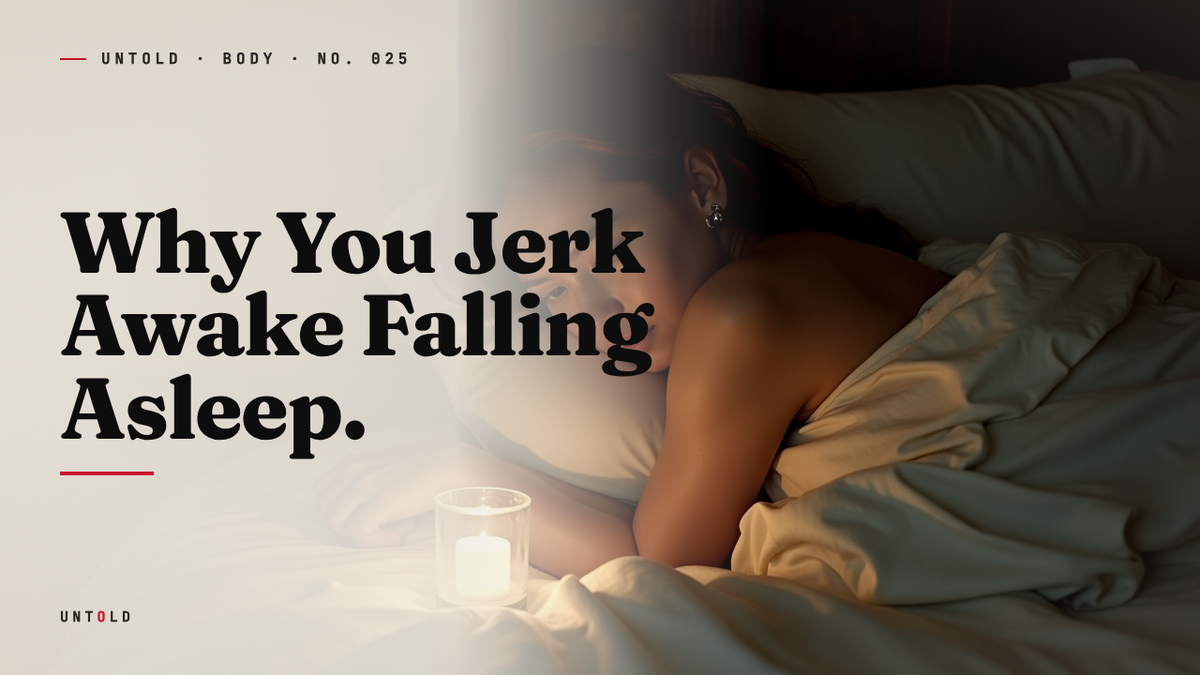
You are almost gone. The day has finally loosened its grip, the weight of your limbs has begun to feel pleasantly foreign, and somewhere behind your eyes the lights are dimming one by one. Then, without warning, your whole body lurches. A leg kicks out. An arm flings sideways. Your heart slams against your ribs, and you are wide awake again, staring into the dark, vaguely convinced that you were falling off something high.
Nothing fell. The room is exactly where you left it. The mattress is solid beneath you, and you were never in any danger. Yet for a fraction of a second your nervous system was certain otherwise, certain enough to override the careful surrender it had spent several minutes negotiating, and to yank you back into consciousness with a violence that feels faintly absurd in the morning.
This small nocturnal betrayal is so common that it is almost universal. Surveys suggest that around 60 to 70 percent of people experience it at least occasionally, and many feel it far more often than that 1. It is harmless, it is brief, and it has a clinical name that sounds far grander than the event itself: the hypnic jerk, sometimes called a sleep start or a hypnagogic jerk. Doctors have catalogued it for over a century. And yet, for something that happens inside the heads of billions of people every night, it remains one of the more quietly mysterious experiences the body produces. We are still arguing about why it happens at all.
The fragile handover
The first thing worth dispelling is the intuition that falling asleep is a single event, like flicking off a light. It is not. Sleep is not a switch. It is a slow surrender, a handover negotiated between competing systems in the brain, and the hypnic jerk lives in the seam where that negotiation goes briefly wrong.
As you begin to drift, a cascade of changes rolls through the body. The muscles, which spend the waking day in a state of low background tension, begin to release their grip. Heart rate slows. Breathing softens and deepens. The brain, which generates the fast, busy electrical chatter of wakefulness, starts producing slower, larger waves. None of this happens instantly or in perfect coordination. There is a window, sometimes lasting several minutes, in which the body is suspended between two states, neither fully awake nor fully asleep.
Neuroscientists describe this transition as a contest between two opposing drives. One is the arousal system, a network rooted in the brainstem that keeps you alert, vigilant, and upright during the day. The other is the sleep-promoting system, which works to switch that arousal off. Through most of the day and night, one clearly dominates the other. But at the threshold of sleep, for a brief and unstable interval, both are partially active at once. They are wrestling for control of the same nervous system, and the outcome is not yet decided.
In that overlap, signals can cross. The motor pathways that command your muscles are caught between an arousal system that is still firing and a sleep system that is trying to silence it. A stray burst of excitation slips through, ripples down the spinal cord, and a limb jerks. From the inside it feels like a malfunction. From the outside, on an electrode trace, it looks like exactly what it is: a system losing its footing for an instant during a difficult transition.
Watching sleep begin
For most of human history, the moment of falling asleep was simply unobservable. You could watch a person lie down and go quiet, but the actual event, the crossing of the border, happened in a place no one could see. That changed in 1924, when a German psychiatrist named Hans Berger placed electrodes on a human scalp and recorded the brain’s electrical activity for the first time. His invention, the electroencephalogram or EEG, did something that had never been possible before. It let researchers watch the brain dim its own lights in real time 2.
With the EEG, sleep stopped being a black box. Researchers could now wire a sleeping volunteer to a machine and follow, second by second, the descent from alertness into unconsciousness. They saw that sleep is not uniform but layered, a sequence of distinct stages each with its own electrical signature. And crucially, they could pinpoint exactly when in that descent the hypnic jerk arrives.
The answer is: right at the beginning. The jerk belongs to the very first and lightest stage of sleep, known today as N1. This is the threshold stage, the doorway, and it is astonishingly brief. For most sleepers N1 lasts only one to seven minutes before the brain slides deeper. During N1 the boundary between waking and sleeping is paper-thin. Wake someone in this stage and they will often insist they were never asleep at all, even though their brainwaves told a different story. It is precisely this thin, unstable membrane between consciousness and oblivion that makes N1 the natural home of the twitch.
Much of the framework for understanding these stages comes from the work of Nathaniel Kleitman, the Russian-born physiologist often called the founder of modern sleep science. From his laboratory at the University of Chicago in the middle of the twentieth century, Kleitman and his students mapped the architecture of human sleep, charting its cycles and stages with a patience that bordered on obsession 3. Kleitman himself was known for subjecting his own body to extreme experiments, including a famous stint spent living deep inside Mammoth Cave to study his internal clock cut off from daylight. His work transformed sleep from a poetic mystery into a measurable terrain, and it is on that terrain that the hypnic jerk can finally be located.
The misread silence
Knowing when the jerk happens still leaves the harder question of why, and in particular why it so often comes wrapped in that vivid, stomach-dropping sensation of falling. You were lying flat in bed. Nothing about your situation involved height, or motion, or any plausible cliff. Where does the falling come from?
One of the more compelling explanations turns on what happens to the brain’s sense of the body as the muscles let go. Throughout the waking day, the brain receives a constant stream of feedback from the muscles and joints, a quiet background hum that tells it where the limbs are and what they are doing. This is your sense of proprioception, your felt map of your own physical self. As sleep approaches and the muscles go slack, that stream of feedback thins out and falls quiet.
The falling sensation, on this account, is the brain misreading its own silence. Confronted with a body that has suddenly gone limp and signal-less, a brain that is itself half-asleep can misinterpret the absence of feedback. The most dangerous everyday situation that produces sudden limpness and a loss of bodily signal is a fall: the moment your support gives way and gravity takes over. So the half-conscious brain, scrambling to make sense of the quiet, may reach for the explanation that fits the sensation best. It concludes, wrongly, that the body is falling.
And then it acts. To catch a falling body you need your muscles back online immediately, so the brain fires an emergency command, a sudden burst of motor activity intended to brace, grab, or right yourself. That burst is the jerk. It can fire in under a tenth of a second, faster than conscious thought, a reflex that operates well below the level of deliberate decision. The dream of falling, when there is one, is often stitched on afterward, the dreaming mind inventing a narrative to explain a sensation it did not author. The lurch comes first. The cliff is a story the brain tells to justify it.
When the systems collide harder
If hypnic jerks are simply the friction of a difficult handover, then anything that makes the handover more abrupt should make the jerks worse. This turns out to be exactly what researchers find. The twitch is not random. It clusters around certain conditions, and most of those conditions involve a brain that is being forced into sleep too fast or against too much background arousal 1.
Exhaustion is one of the clearest triggers. When you are profoundly overtired, the sleep-promoting system is so strong that it does not ease the arousal system down so much as crash into it. The transition that should unfold gradually instead happens in a rush, and the collision between the two systems is harder and more violent. The result is a stronger, more frequent jerk. There is a grim irony here that anyone running on too little sleep will recognize: the more desperately the body needs sleep, the more dramatically it may startle itself out of it.
Stimulants work the same way from the other direction. Caffeine keeps the arousal system artificially switched on, so that even as the sleep system tries to take over, the brain is still humming with chemical alertness. The two drives overlap for longer and with greater intensity. Vigorous exercise late in the evening can do something similar, leaving the nervous system revved up just as it is supposed to be powering down. And anxiety, that familiar bedtime companion, keeps the arousal circuits primed for threat precisely when they ought to be standing down. Stress, stimulation, and exhaustion all push the same lever. They widen and roughen the window where the two systems coexist, and they make the misfire more likely.
The reassuring counterpoint to all of this is that for the overwhelming majority of people, hypnic jerks mean nothing is wrong. They are not a symptom of disease, not a warning sign, not evidence of a damaged nervous system. They are, if anything, evidence of a healthy one going about an ordinary and slightly clumsy task. A normal hiccup in a normal brain. Only in rare cases, when the jerks become frequent and severe enough to disrupt sleep night after night, do they warrant a closer look, and even then the underlying issue is usually treatable.
An inheritance from the trees
Here the story takes a stranger turn, because some researchers suspect the hypnic jerk is not merely a glitch at all. It may be an inheritance, a reflex carried forward from a time when going limp at the edge of sleep was a genuinely dangerous thing to do.
Consider the predicament of a primate dozing on a tree branch. For our distant arboreal ancestors, the trees were home and also a safe distance from the predators that prowled the forest floor. But sleeping in a tree posed an obvious problem. The same muscle relaxation that comes with falling asleep, the loosening grip and the slackening limbs, is exactly what would send a sleeping animal tumbling off its perch. To relax fully was to risk a fatal fall.
The hypothesis runs like this: evolution favored a built-in safety reflex tuned to that exact danger. As the body began to relax and the grip began to slip, a sharp involuntary jerk would snap the muscles back into action, catching the slipping hold before it failed entirely 4. An animal that startled awake at the first sign of going limp tightened its grip and lived to sleep another night. An animal that did not might never wake at all. Over countless generations, the startle would be selected for, woven into the deep machinery of the transition into sleep.
It is worth being honest about the status of this idea. It is a hypothesis, not an established fact, and it is difficult to test directly. We cannot rerun the evolution of sleep, and we cannot interview a Miocene primate about its nighttime twitches. But the logic is suggestive, and it fits neatly with the rest of what we know. The jerk arrives at the exact moment of muscle release. It comes packaged with a sensation of falling. It is fast, automatic, and older than conscious thought. Everything about it looks like a reflex designed for a body that had real reason to fear the loss of its grip.
If the hypothesis holds, then your modern bed inherits a reflex built for the trees. The mattress beneath you tonight is perfectly safe. There is no branch, no drop, no predator below. But the ancient circuit does not know that. It runs on a body plan that predates beds, and it still fires across roughly seven in ten human beings, faithfully rehearsing a rescue from a danger that no longer exists.
So the next time you lurch awake at the threshold of sleep, heart pounding in the dark, it may help to know that nothing has broken. You are not malfunctioning. You are, for an instant, watching a very old survival instinct rehearse itself one more time, a leftover echo from a body that once lived in branches and could not afford to let go.

Sources
- Sander, H. W. et al., “Hypnic jerks and related disorders of sleep onset,” Sleep Medicine Reviews / clinical reviews of sleep starts, 2006. — https://www.ncbi.nlm.nih.gov/books/NBK534819/
- Berger, H., “Uber das Elektrenkephalogramm des Menschen,” Archiv fur Psychiatrie und Nervenkrankheiten, 1929. — https://en.wikipedia.org/wiki/Hans_Berger
- Kleitman, N., Sleep and Wakefulness, University of Chicago Press, 1939/1963. — https://en.wikipedia.org/wiki/Nathaniel_Kleitman
- Coolidge, F. L. & Wynn, T., “The effects of the tree-to-ground sleep transition in the evolution of cognition in early Homo,” Before Farming, 2006. — https://en.wikipedia.org/wiki/Hypnic_jerk
- American Academy of Sleep Medicine, International Classification of Sleep Disorders, 3rd Edition (sleep-related movement disorders), 2014. — https://aasm.org/clinical-resources/international-classification-sleep-disorders/
- Carskadon, M. A. & Dement, W. C., “Normal Human Sleep: An Overview,” Principles and Practice of Sleep Medicine, 2011. — https://www.sciencedirect.com/science/article/pii/B9781416066453000028
Related reading