The Quiet Vindication of the Appendix
For a century, medicine dismissed it as evolutionary debris. The microbiome rewrote the story.
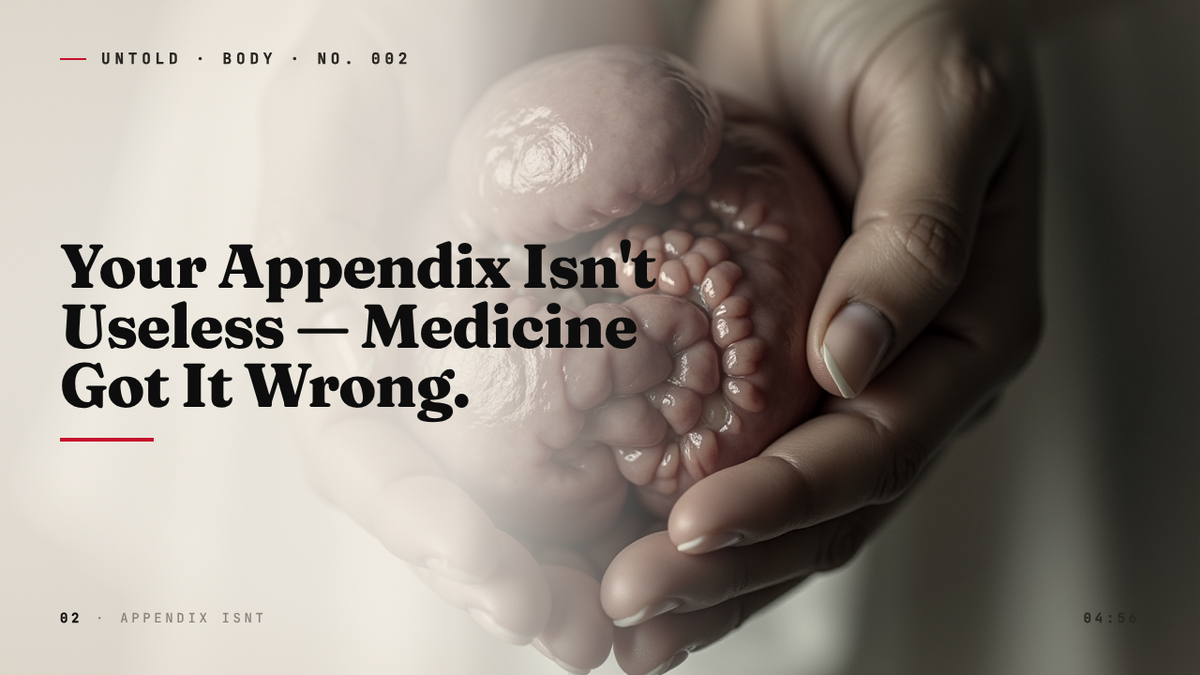
The cut takes minutes. A small incision in the lower right abdomen, a careful dissection through layers of muscle and fat, and there it is: a finger of pink tissue, four inches long, attached to the cecum at the junction of small and large intestine. The surgeon ties it off, snips it loose, and drops it into a steel tray. Nobody studies it. Nobody saves it. In most American hospitals, the specimen will travel briefly to pathology to confirm inflammation, and then it will be incinerated.
Roughly 300,000 of these procedures take place in the United States every year. About one in twenty Americans will, over a lifetime, lose their appendix to a surgeon’s knife.1 For most of the twentieth century, the operation carried a quiet philosophical certainty: nothing of value was being lost. The appendix, medicine taught its students, was a vestige — a fragment of evolutionary inheritance from herbivorous ancestors, retained by the body the way an attic retains old furniture. Useless. Disposable. Occasionally dangerous.
That certainty is now collapsing. Over the past two decades, a quiet reckoning has been underway in immunology, microbial ecology, and comparative anatomy. The organ that medicine spent more than a century discarding turns out to have been doing work the textbooks failed to notice — sheltering the bacterial communities on which human health depends. The appendix has not been vindicated in the dramatic way of a wronged man freed from prison. It has been vindicated quietly, in the manner of organs: by accumulating evidence, paper by paper, until the old story no longer holds.
A Vestige By Default
The modern dismissal of the appendix begins, like much else in nineteenth-century biology, with Charles Darwin. In the second edition of On the Origin of Species, and more thoroughly in The Descent of Man (1871), Darwin proposed that the human appendix was a rudimentary organ — a shrunken remnant of the long, capacious cecum found in herbivores like rabbits and koalas, where fibrous plant matter is fermented by resident microbes.2 In his view, as human ancestors shifted toward a more varied, less leaf-heavy diet, the cecum dwindled. The appendix was what remained: an attic of an organ, no longer used for anything.
It was a tidy theory, and it had the rare virtue of fitting both anatomy and evolutionary logic. Darwin saw the appendix as proof of descent with modification — a body part that made no sense on its own terms but made perfect sense as a historical residue. The argument became foundational not just to evolutionary biology but to the medical imagination. If an organ was a leftover, then losing it was no loss at all.
Within two decades, that logic met its surgical opportunity. In 1886, the Boston pathologist Reginald Heber Fitz published a paper in the Transactions of the Association of American Physicians that gave a name to a long-misunderstood condition. He called it appendicitis — an inflammation of the appendix that, untreated, frequently ruptured and killed. Fitz urged early surgical removal as the only reliable cure.3 His recommendation was not just sound; it was lifesaving. Before antibiotics, a burst appendix carried a mortality rate that, in some series, exceeded fifty percent.
But Fitz’s clinical guidance traveled with a quieter passenger: the assumption that nothing was being sacrificed when the organ came out. Surgeons, who in the early twentieth century were forging a new professional identity around bold intervention, took to appendectomy with enthusiasm. By the 1940s and 50s, the operation was among the most common procedures performed in American hospitals. Some surgeons removed healthy appendixes prophylactically during unrelated abdominal operations, on the theory that the patient might as well be spared a future emergency. Medical students were taught, with confidence verging on dogma, that the organ served no purpose. To suggest otherwise was to mark oneself as eccentric.
A Side Road Off the Highway
The first serious challenge came not from a surgeon but from an immunologist. In 2007, William Parker and his colleagues at Duke University Medical Center published a paper in the Journal of Theoretical Biology proposing a different reading of the appendix’s anatomy.4 Parker had spent years studying the gut’s immune architecture and the dense biofilms of bacteria that line the intestinal wall. When he looked at the appendix, what struck him was not its smallness but its position.
The colon is a thoroughfare. Food residue, bile, dead cells, and the constantly shifting populations of trillions of microbes pass through it in a slow churn. The appendix, by contrast, branches off the cecum like a side road off a busy highway — a narrow blind pouch, tucked just out of the main current. To Parker’s eye, this was not the geometry of a forgotten relic. It was the geometry of a hiding place.
The human gut, by current estimates, harbors something on the order of 38 trillion microorganisms, the vast majority of them either benign or actively beneficial.5 These resident communities digest plant fibers we cannot break down on our own, synthesize vitamins, train the developing immune system, and — perhaps most importantly — occupy ecological niches that would otherwise be available to pathogens. A healthy microbiome is, in part, a defensive wall built of competitors.
The trouble is that the wall can be breached. Severe diarrheal illness — cholera, dysentery, rotavirus, foodborne infection — empties the colon violently. The microbial community is flushed out in hours. In the developing world, and historically everywhere, such evacuations were both common and dangerous. Once the resident bacteria are gone, the gut is vulnerable to recolonization by whatever happens to arrive next, which is often something worse than what left.
Parker’s hypothesis, which he developed with the surgeon R. Randal Bollinger and others, was that the appendix functioned as a safe house for beneficial gut bacteria — a reserve population, protected from the violence of mass evacuation by its anatomical isolation. When the storm passed, the bacteria sheltering in the appendix would emerge and repopulate the colon. The organ was not a leftover. It was a reservoir.
What the Tissue Was Doing
The safe-house hypothesis was, at first, a structural argument: the appendix looked like a place where bacteria could hide. To become more than speculation, it needed evidence at the level of tissue. That evidence had, in fact, been accumulating for decades — it had simply been waved away.
Anatomists had long known that the appendix is unusually rich in lymphoid tissue. Its walls are studded with gut-associated lymphoid tissue, or GALT, the same kind of immune apparatus found in the tonsils and Peyer’s patches of the small intestine. By the time a person reaches their twenties, the appendix is densely packed with B and T lymphocytes — the cellular machinery of antibody production and immune memory.6 Roughly seventy percent of the body’s immune cells are estimated to reside in the gut, and the appendix punches well above its weight in immunological density.
In 2013, Parker’s group, working with collaborators, documented that the appendix produces and harbors thick microbial biofilms — sticky polysaccharide mats in which beneficial bacteria adhere to the intestinal wall, protected from being washed away.7 These biofilms were particularly concentrated in the appendix relative to the rest of the colon. Immune cells in the surrounding tissue secreted antibodies, especially immunoglobulin A, which appeared to support rather than attack the resident bacteria — coating them, organizing them, keeping the right communities in place.
The organ, in other words, was not silent tissue. It was actively manufacturing the conditions under which beneficial bacteria could persist. And it was doing so in precisely the anatomical location where such a reserve would be most useful: shielded from the main current, immunologically armed, biochemically equipped to host a population that could, if needed, refound a depleted gut.
The clinical implications came next. Several studies, beginning around 2011 and continuing through the late 2010s, examined whether patients without appendixes fared differently when their gut bacteria were disrupted. The clearest signal involved Clostridioides difficile, a hospital-acquired infection that flourishes after antibiotic treatment wipes out competing microbes. C. difficile causes severe colitis and contributes to roughly 30,000 deaths in the United States each year.8 In a 2011 study published in the Journal of Theoretical Biology, researchers found that patients who had undergone appendectomy were roughly four times more likely to experience recurrent C. difficile infection than those whose appendixes were intact.9 Later analyses have refined the figure and produced mixed results in different populations, but the broad direction has held: the absence of an appendix appears to compromise, at least modestly, the gut’s ability to recover from microbial catastrophe.
This is not a small finding. It means the organ medicine had spent a century calling useless was, for many people, doing measurable work — work that became visible only when it was gone.
The Verdict of Thirty Independent Inventions
The immunological evidence was suggestive, but the deepest blow to the vestige theory came from comparative anatomy. If the appendix is a useless relic, it should behave like other vestiges: shrinking and disappearing across evolutionary time, retained only by lineages that have not yet purged it. If, on the other hand, it is doing something useful, evolution should favor its persistence — and perhaps even reinvent it independently in different lineages.
In 2017, the evolutionary anatomist Heather F. Smith and her colleagues published the most exhaustive comparative survey of the appendix yet attempted. Working at Midwestern University, Smith assembled anatomical and ecological data on 533 mammal species, mapped the presence and absence of the appendix onto a robust mammalian phylogeny, and ran statistical models to ask how the organ had moved through evolutionary time.10
The results were not subtle. The appendix had evolved independently at least 30 separate times across mammalian lineages. Once it appeared in a lineage, it almost never disappeared. Species with appendixes tended to have higher concentrations of lymphoid tissue in the cecum — consistent with an immune function — and the organ was statistically associated with ecological factors related to social grouping and pathogen exposure rather than diet. In other words, the appendix did not pattern with herbivory, as Darwin had supposed. It patterned, weakly but suggestively, with the kinds of conditions under which a bacterial reservoir might matter most.
Thirty independent origins is not the signature of a useless organ. Evolution does not reinvent furniture by accident. When a structure appears repeatedly across distantly related lineages — convergent evolution, in the technical phrase — it almost always means selection is acting on it. The appendix had been convergent all along; the field had simply not been looking.
Darwin, it should be said, was not wrong about evolution. He was working with the anatomical knowledge of his century and the reasonable inference that an organ smaller than its herbivore counterpart was a degenerate form. He could not have known about gut microbiomes, lymphoid biofilms, or C. difficile. What is striking is not that he made the call he did but that the medical establishment held on to it so long after the evidence began to drift.
What Medicine Lost By Not Looking
None of this means that an inflamed appendix should be left alone. Acute appendicitis remains a genuine emergency. A ruptured appendix can release fecal bacteria into the peritoneal cavity, producing peritonitis and sepsis; before modern surgery and antibiotics, this was a common cause of sudden death in young adults. Removing the inflamed organ is still, in most cases, the right clinical call. Some recent trials have suggested that uncomplicated appendicitis can sometimes be treated with antibiotics alone, sparing the organ in roughly two-thirds of cases over five-year follow-up, though a substantial fraction of those patients eventually require surgery anyway.11 The conservative option is real but limited.
The deeper lesson lies not in the surgical decision but in the conceptual one. For more than a century, medicine operated within a framework that classified certain organs as superfluous. The tonsils were removed by the millions in mid-century America on the theory that they served no purpose and merely invited infection; later research established their role in early immune education, and routine tonsillectomy fell sharply. The spleen was long regarded as expendable; we now know that splenectomized patients face a lifelong elevated risk of overwhelming bacterial infection, particularly from encapsulated organisms. The gallbladder, the thymus, even sections of the colon: each has, at various times, been treated as disposable, and each has been partly reclaimed by later evidence.
The pattern is worth naming. Medicine’s confidence in declaring tissue useless has tended to outrun its actual understanding of what tissue does. The body is not a machine assembled from clearly labeled parts; it is an ecosystem, dense with redundancies and quiet collaborations whose function only becomes legible when they fail. To call a structure vestigial is, often, to admit that we do not yet know what it is for.
This is not an argument against surgery, or against the careful clinical judgment that has saved millions of lives by removing appendixes at the right moment. It is an argument against a certain kind of intellectual posture — the confidence that what we cannot see must not exist, that what we cannot explain must not matter. The appendix did not change between 1859 and 2017. Our capacity to perceive it did.
A Coda for the Quiet Organs
There is something almost moral in the story, if one is willing to look for it. The appendix sat for a century in the medical imagination as a kind of evolutionary embarrassment — a small, awkward thing that occasionally tried to kill its owner and otherwise did nothing. It was the punchline of a thousand textbook chapters. And all the while, in millions of bodies, it was quietly doing work that only became visible once researchers learned to ask the right question. The organ did not advocate for itself. It did not announce its function. It simply persisted, across thirty independent evolutionary inventions and across a century of dismissal, until the science caught up.
The body has more such organs than we have yet counted. The current revolution in microbiome science is, in part, a revolution in humility — a slow reckoning with the fact that the human organism is, on a cellular level, more bacterial than human, and that the structures hosting that bacterial life are not afterthoughts but essential infrastructure. Somewhere in a hospital basement, a tray of appendixes is being prepared for incineration. Most of them needed to come out. But the next time someone calls a part of the body useless, it is worth pausing to ask who is making the call, and what they are not yet equipped to see.

Sources
- Addiss, D.G. et al., ‘The Epidemiology of Appendicitis and Appendectomy in the United States,’ American Journal of Epidemiology, 1990. — https://academic.oup.com/aje/article-abstract/132/5/910/116941
- Charles Darwin, The Descent of Man, and Selection in Relation to Sex, John Murray, 1871. — https://www.gutenberg.org/files/2300/2300-h/2300-h.htm
- Reginald H. Fitz, ‘Perforating Inflammation of the Vermiform Appendix,’ Transactions of the Association of American Physicians, 1886. — https://www.ncbi.nlm.nih.gov/pmc/articles/PMC2364999/
- Bollinger, R.R., Barbas, A.S., Bush, E.L., Lin, S.S., Parker, W., ‘Biofilms in the Large Bowel Suggest an Apparent Function of the Human Vermiform Appendix,’ Journal of Theoretical Biology, 2007. — https://pubmed.ncbi.nlm.nih.gov/17936308/
- Sender, R., Fuchs, S., Milo, R., ‘Revised Estimates for the Number of Human and Bacteria Cells in the Body,’ PLOS Biology, 2016. — https://journals.plos.org/plosbiology/article?id=10.1371/journal.pbio.1002533
- Kooij, I.A. et al., ‘The Immunology of the Vermiform Appendix: A Review of the Literature,’ Clinical & Experimental Immunology, 2016. — https://pubmed.ncbi.nlm.nih.gov/26527044/
- Randal Bollinger, R. et al., ‘Human Secretory Immunoglobulin A May Contribute to Biofilm Formation in the Gut,’ Immunology, 2003. — https://pubmed.ncbi.nlm.nih.gov/14962250/
- CDC, ‘Clostridioides difficile Infection Surveillance Data,’ Centers for Disease Control and Prevention, 2023. — https://www.cdc.gov/cdiff/php/data/index.html
- Im, G.Y. et al., ‘The Appendix May Protect Against Clostridium difficile Recurrence,’ Clinical Gastroenterology and Hepatology, 2011. — https://pubmed.ncbi.nlm.nih.gov/21856451/
- Smith, H.F., Parker, W., Kotzé, S.H., Laurin, M., ‘Morphological Evolution of the Mammalian Cecum and Cecal Appendix,’ Comptes Rendus Palevol, 2017. — https://www.sciencedirect.com/science/article/pii/S1631068316301257
- Salminen, P. et al., ‘Five-Year Follow-up of Antibiotic Therapy for Uncomplicated Acute Appendicitis (APPAC Trial),’ JAMA, 2018. — https://jamanetwork.com/journals/jama/fullarticle/2702269
Related reading