The Code Hidden in a Baby's Face
A reflex older than language tells us what to protect, and industries have learned to forge it.
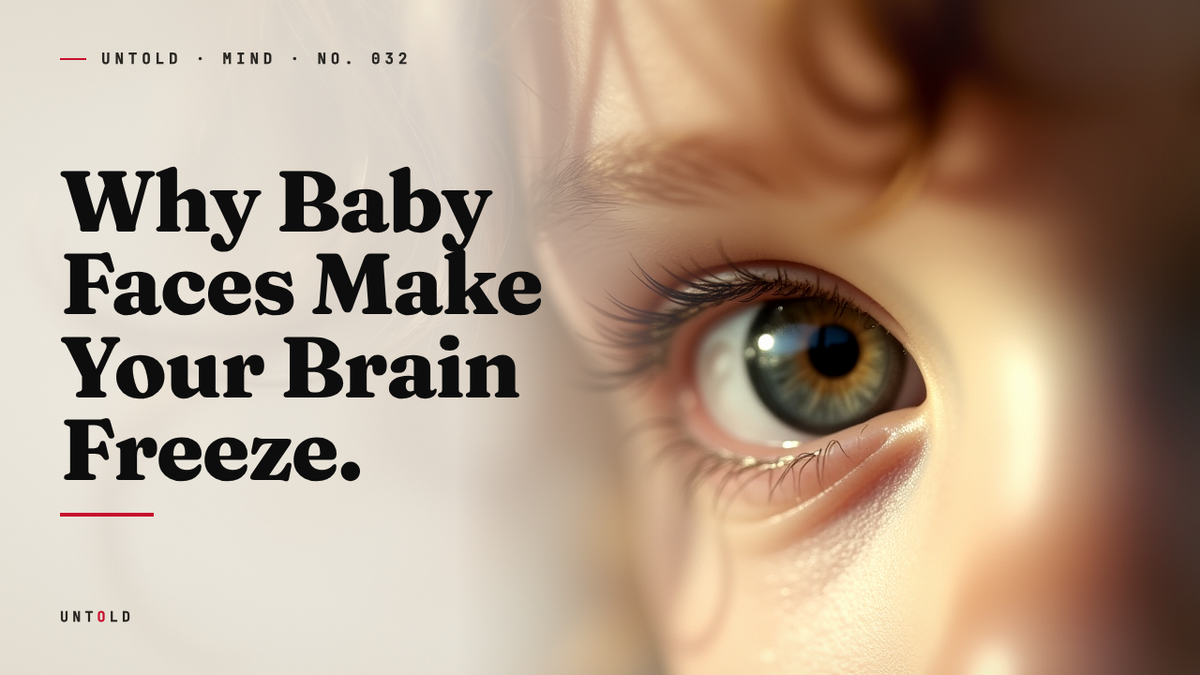
Before you decide anything, your body has already responded. A baby comes into view: round cheeks, an oversized forehead, eyes set low and wide, a button of a nose. Something in your chest loosens. Your face, without instruction, begins to soften. You did not choose this. You could not have chosen it, because the reaction arrived faster than choice itself.
This is not a sentimental observation. It is a measurable physiological event, and an unusually fast one. Adults register and respond to infant faces within roughly 130 milliseconds of seeing them, well before conscious recognition has time to assemble. The same melting happens whether you are a new parent, a lifelong skeptic of children, or a stranger glancing into a stroller on a crowded train. And it does not stop at human infants. Puppies, kittens, baby seals, cartoon animals, and even automobiles with round, wide-set headlights can set off some version of the same warm pull.
The consistency is the strange part. A response that crosses cultures, languages, and species, and that fires before thought, is not a matter of taste. It looks more like a piece of installed equipment. The question is what that equipment is for, who installed it, and what happens when someone learns to operate it deliberately.
A zoologist’s drawing
The first person to take cuteness seriously as a biological problem was the Austrian zoologist Konrad Lorenz, one of the founders of ethology, the study of animal behavior in natural conditions. In 1943, in the middle of a continent at war, Lorenz published a paper that asked a question most adults never think to ask: why do certain shapes make us want to care for the things that have them? 1
Lorenz had noticed a pattern that ran across the young of wildly different species. Baby animals tended to share a cluster of physical features regardless of what they would eventually grow into. A head that was large relative to the body. A high, domed forehead. Eyes positioned below the vertical midline of the face, which is to say large and low-set. Full cheeks. Short, thick limbs. A soft, rounded body that moved with clumsy, uncoordinated effort.
He gave this cluster a name: Kindchenschema, the baby schema. His claim was that these features were not incidental. They functioned, in his words, like a key fitting a lock. The sight of them released a caregiving response in the adult brain more or less automatically, the way a precise stimulus can trigger a fixed reaction in an animal. Lorenz called it an innate releasing mechanism, and he believed the cute response belonged to that category. You did not learn to find babies appealing. The appeal was built in, waiting for the right shape to arrive.
To make the argument visible, Lorenz drew. He sketched a human infant beside a puppy, a chick, a young rabbit, and then placed those next to their adult counterparts and a few deliberately unappealing creatures. The contrast was immediate and a little uncanny. The babies, across species, shared proportions so similar they could almost be swapped. The adults did not. The drawing made his point more efficiently than the prose: cuteness was a geometry, and that geometry pointed at one word. Infant.
It was an elegant idea. It was also, for a long time, only an idea. A persuasive sketch is not a tested fact, and Lorenz’s schema sat for decades as a piece of intuitive theory, admired but unproven. The tools to look directly at what a cute face did inside a human head did not yet exist.
Watching the reward light up
Those tools eventually arrived, and in 2009 the neuroscientist Melanie Glocker used them to test Lorenz’s claim with unusual precision. Rather than rely on the cute and the plain faces that nature happened to provide, she manufactured the variable. Using image software, Glocker took photographs of real infant faces and digitally dialed the baby schema up and down. In one direction she rounded the cheeks, enlarged the eyes, and lifted the forehead, pushing the face toward maximum infant geometry. In the other she did the reverse, flattening those features and draining the babyishness away. The same child could be made to score high or low on the schema while remaining recognizably itself. 2
Then she put adults inside a functional MRI scanner and showed them the faces.
The high baby-schema images produced a clear signal in the nucleus accumbens, a structure buried deep in the brain that sits at the heart of its reward system. This is not a region associated with judgment or aesthetics. It is the circuitry that responds to food, to sex, to money, to the anticipation of something we want. A cute infant face activated it. The brain was not merely noting that a baby was present. It was treating the sight as a reward, a small hit of the same neural currency that drives us toward the things evolution most wants us to pursue. 2
This reframed cuteness entirely. The warm feeling was not decorative. It was a motivational signal, a nudge toward action wearing the costume of an emotion. Cuteness made caretaking feel good, which is precisely how you would build a system to ensure that caretaking happens. And the response did not depend on parenthood. Adults with no children of their own showed it too. Whatever the baby schema was doing, it was not narrowly tuned to mothers and fathers. It reached anyone with the right hardware, which is to say nearly everyone.
A backstage pass past your defenses
Glocker had shown what lit up. At Oxford, the neuroscientist Morten Kringelbach became interested in when. Functional MRI is precise about location but sluggish about time, measuring blood flow that lags behind the electrical activity it tracks by seconds. To catch the brain in the act of recognizing a baby, Kringelbach turned to magnetoencephalography, a technique that reads the faint magnetic fields produced by neural activity and resolves events millisecond by millisecond. 3
What he found was a specific burst of activity in the orbitofrontal cortex, a region involved in emotion and reward, firing at roughly 130 milliseconds after an infant face appeared. To appreciate how fast that is, consider that conscious face recognition, the moment you consciously think that is a baby, generally takes longer to complete. The brain was flagging the infant before the owner of the brain knew an infant had been seen. The caregiving circuit was not waiting for permission from awareness. It went first. 3
Kringelbach’s work also widened the channel. The trigger was not only visual. A baby’s laugh, the particular babble of infant vocalization, even the distinctive scent of a newborn’s head, activated overlapping parts of the same system. Cuteness, it turned out, was not a property of a face so much as a multisensory signal broadcast on several frequencies at once. Kringelbach described the result as a fast and privileged pathway, a route by which infant cues reach the adult brain ahead of the slower, more deliberative processing that handles most of what we see. The baby, in effect, is handed a backstage pass that lets its signal slip past the usual defenses and straight into the part of us that decides what matters.
A reflex that fast, that consistent, and that deeply wired into the reward system is not an accident. It is expensive equipment, and evolution does not build expensive equipment without a reason.
The strategy of helplessness
The reason has to do with a peculiar problem unique to our species. Human infants are born catastrophically helpless, far more so and for far longer than the young of comparable animals. A foal can stand and walk within hours of birth. A wildebeest calf can keep pace with a fleeing herd before the day is out. A human baby cannot lift its own head, cannot regulate its temperature reliably, cannot feed itself, and cannot move toward safety or away from danger. It will not walk for roughly a year. It will depend on adults, totally and continuously, for longer than most mammals are even alive.
This helplessness is the price of our brains. The human head is so large, swollen by the cortex that makes us what we are, that a fully developed infant could not pass safely through the birth canal. The evolutionary compromise was to be born early, while the brain is still small enough to deliver, and to finish the work outside. We arrive, in a sense, unfinished. That early, fragile birth left a long and dangerous window of dependence, a stretch of time during which the infant cannot do anything to keep itself alive.
Faced with that vulnerability, evolution did not make babies more capable. It made them more compelling. If the infant cannot protect itself, the next best thing is to guarantee that the adults around it will. Cuteness became that guarantee. The baby schema is, in this light, the infant’s first and most powerful tool: a signal engineered to convert its helplessness into a hold on everyone nearby. The big eyes and round cheeks are not just side effects of an immature face. They are a recruitment device.
And the device works on the world, not only on parents. The research bears this out. Infants rated higher on the baby schema tend to draw more attention, more willingness to care, and more positive judgment from adults across the board, including strangers with no genetic stake in the child. 4 The signal does not check whether you are the mother. It reaches the parent, the aunt, the neighbor, the passerby, broadcasting the same message to anyone whose gaze it catches: protect me. In a species that survives by communal care, a baby who can move strangers to help is a baby more likely to live.
The signal does not serve you
There is an uncomfortable turn in this story, and it is worth naming plainly. The cute response feels like generosity, like something warm we extend to the helpless out of the goodness in us. The biology suggests something more pointed. The signal did not evolve for the caregiver’s benefit. It evolved for the infant’s. Cuteness is, in the cold language of selection, a form of manipulation, a set of cues shaped over millions of years specifically because they reliably move adults to act against their own immediate interests, surrendering sleep, time, food, and safety for a creature that offers nothing in return but the promise of a future.
That the manipulation is benign, even beautiful, does not change its mechanics. And once you understand that cuteness is a lock that the right shape can open, an obvious possibility follows. If the key is just a geometry, then the key can be forged. You do not need a real baby to pull the trigger. You only need the proportions.
The cuteness industry
Industries figured this out long ago, sometimes without quite understanding why it worked. The clearest case study is also one of the most famous corporate mascots in history. Mickey Mouse did not always look the way he looks now. Across the decades of Disney’s design, Mickey changed in a consistent direction. His eyes grew larger. His head rounded and grew proportionally bigger relative to his body. His snout shortened, his features softened, his whole form drifted toward the high baby schema. The biologist Stephen Jay Gould traced this evolution in a now-classic essay and noted that Mickey’s transformation followed, step by step, the exact features Lorenz had identified as the markers of cuteness. The mouse was being neotenized, made to look ever more like an infant, because audiences responded more warmly to the babyish version. 5
Once the principle is visible, it appears everywhere. The big-eyed plush toys lining store shelves are exercises in applied Kindchenschema. Brand mascots, emoji, the rounded faces of cartoon characters, the wide headlights and short hoods of cars marketed as friendly rather than aggressive: all of them are, in varying degrees, picking the same evolutionary lock. Designers may use the language of charm and appeal, but the underlying engineering is identical to what nature built into the infant face. They are forging a key that opens a door in your brain, and the door was installed for someone else.
The technique reaches into causes we would call noble, too. Conservation campaigns have long understood that some species are easier to save than others, and that the difference is often a matter of facial geometry. The giant panda, with its large head, round body, and dark patches that read as enormous low-set eyes, became one of the most recognizable conservation symbols on the planet. Its appeal is not accidental. The panda looks, to the human caregiving circuit, a great deal like a baby, and that resemblance has helped channel attention and money toward its survival in a way that less cuddly endangered creatures rarely receive. The schema, in other words, has become a tool not only for selling toys but for deciding which animals the public will fight to protect.
A reflex worth understanding
The next time a puppy stops you mid-stride, or a stranger’s baby pulls an involuntary smile out of you, it is worth noticing the speed of the thing. The softness arrives before you do. You are not being weak or sentimental. You are running a piece of inherited software tens of millions of years old, a caregiving reflex shaped by the long, fragile dependence that our oversized brains imposed on us, and refined into a signal precise enough to move strangers.
That reflex built families. It kept helpless infants alive across the deep history of our species, recruiting whole communities to the care of the young. And in the modern world it has been studied, mapped, measured to the millisecond, and quietly copied by anyone with something to sell or something to save. Understanding it does not switch it off. The face still melts. But it changes what the melting means: not a small private weakness, but the visible trace of one of the oldest bargains our species ever made, the one where helplessness learned to make itself loved.

Sources
- Lorenz, K., “Die angeborenen Formen moglicher Erfahrung” (The Innate Forms of Possible Experience), Zeitschrift fur Tierpsychologie, 1943. — https://onlinelibrary.wiley.com/doi/10.1111/j.1439-0310.1943.tb00655.x
- Glocker, M. L. et al., “Baby schema modulates the brain reward system in nulliparous women,” Proceedings of the National Academy of Sciences, 2009. — https://www.pnas.org/doi/10.1073/pnas.0811620106
- Kringelbach, M. L. et al., “A Specific and Rapid Neural Signature for Parental Instinct,” PLoS ONE, 2008. — https://journals.plos.org/plosone/article?id=10.1371/journal.pone.0001664
- Glocker, M. L. et al., “Baby schema in infant faces induces cuteness perception and motivation for caretaking in adults,” Ethology, 2009. — https://onlinelibrary.wiley.com/doi/10.1111/j.1439-0310.2008.01603.x
- Gould, S. J., “A Biological Homage to Mickey Mouse,” Natural History (collected in The Panda’s Thumb), 1979. — https://faculty.uca.edu/benw/biol4415/papers/Mickey.pdf
- Kringelbach, M. L. et al., “On Cuteness: Unlocking the Parental Brain and Beyond,” Trends in Cognitive Sciences, 2016. — https://www.cell.com/trends/cognitive-sciences/fulltext/S1364-6613(16)00021-7
Related reading