The Locked Door Problem
The forbidden tastes sweeter for a reason older than reason itself.
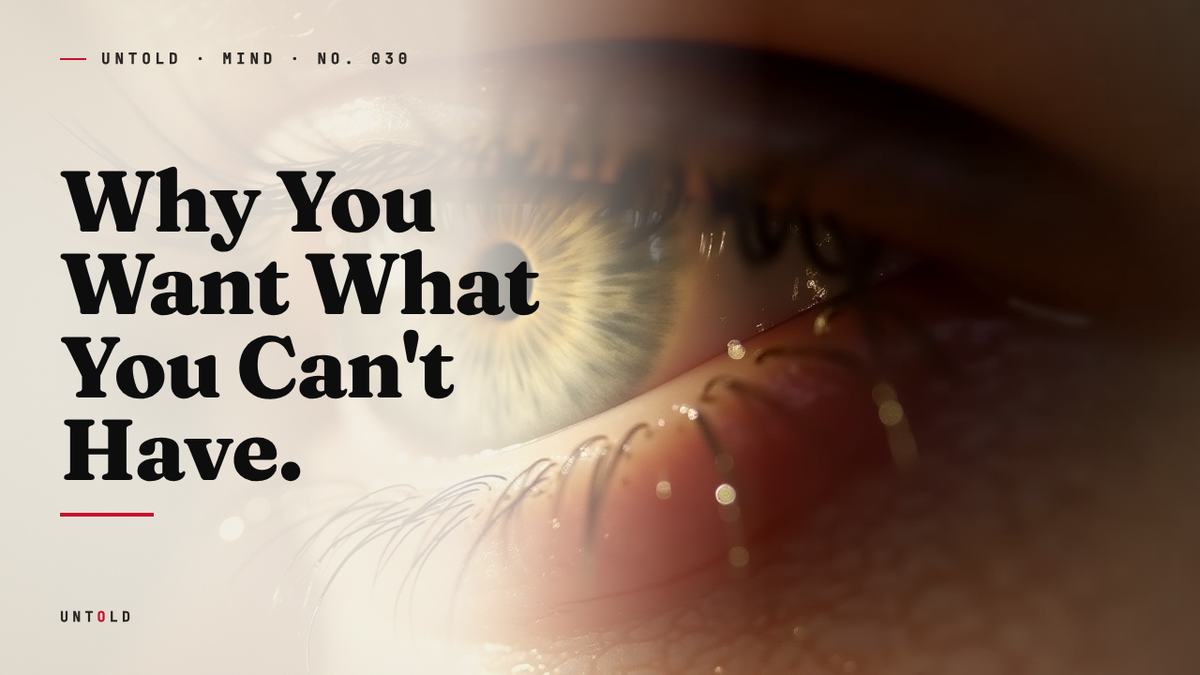
Consider the moment a parent says no. Not a gentle no, the kind that comes with an explanation, but a flat and final one. The toy goes back on the shelf. The candy stays in the jar. And something curious happens inside the child standing there: the object, which a second ago was one item among many, becomes the only thing in the room that matters. The crying is not really about the toy. It is about the wall that has just appeared between the child and the toy, and the wall is unbearable.
Most of us assume we grow out of this. We tell ourselves that the tantrum belongs to childhood, that adults weigh options coolly, that we want things because they are good and avoid things because they are not. The evidence says otherwise. The locked door stays interesting our whole lives. The person who leaves becomes more luminous in absence than they ever were in the room. The limited-edition release, the sold-out show, the table for two that requires a three-week wait: scarcity does not just describe these things, it manufactures a hunger for them. And the strange part, the part that should unsettle us, is that the hunger often has almost nothing to do with the thing itself.
A psychologist names the feeling
In 1966, a psychologist at Duke University named Jack Brehm published a small book called A Theory of Psychological Reactance1. The word he chose, reactance, sounds clinical, but the thing it describes is intimate and familiar. Brehm argued that human beings perceive their freedoms, their ability to choose this option or that one, as something close to a possession. We feel we own our choices. And when one of those choices is taken away or threatened, we react the way we would to any theft. We push back. We want the lost freedom returned, and we want it intensely.
The crucial move in Brehm’s theory is what happens to the forbidden option once it is forbidden. It does not simply become unavailable. It becomes more attractive. The act of removing a choice raises its value, not because anything about the choice has changed, but because reclaiming it has become a way of restoring the freedom that was lost. The object inherits the urgency that properly belongs to the freedom.
Brehm tested this with the unglamorous tools available to a mid-century psychology lab: records, questionnaires, undergraduates. In one early demonstration, participants were shown several items and asked to rank how much they wanted each one. Later they were told that one of the options was no longer available. When they ranked the items again, the eliminated option climbed in their estimation. Nothing about it had improved. It had simply become unreachable, and unreachability, it turned out, was its own kind of appeal1.
This was not a fringe idea that flickered and died. Reactance theory became one of the durable engines of social psychology, cited and extended across thousands of studies in the decades that followed2. It explained why warning labels sometimes increase the behavior they warn against, why censorship can boost interest in the censored material, why a teenager told to be home by ten will arrive at eleven on principle. The theory had located a structural feature of the human mind: a reflex that treats restriction as an emergency.
Why a mind would work against itself
There is something genuinely odd here, and it deserves to be stated plainly. Reactance can make us want things that are bad for us, pursue people who do not want us, and value objects we would otherwise ignore. From the outside it looks like a malfunction, a brain working against its own interests. Why would evolution build a mind that lunges at whatever it cannot have?
The answer is that the mind is not really chasing the object. It is defending the freedom. For most of human history, the ability to make your own choices, where to go, what to eat, whom to ally with, was not a luxury. It was survival. An organism that allowed its options to be quietly stripped away, that accepted every restriction without protest, was an organism at the mercy of whoever did the restricting. A degree of stubbornness, a built-in resistance to having one’s choices narrowed, would have been protective. The animal that fights to keep its options open keeps more options.
Seen this way, reactance is not a bug. It is an old alarm system, tuned to a world where a closing door might mean a closing future. The trouble is that the alarm cannot tell the difference between a genuine threat to your autonomy and a marketing email announcing that only three units remain. It fires either way. The ancient circuitry meets the modern world and produces a person staring at a countdown timer, heart rate climbing, reaching for a credit card.
The toy behind the barrier
The clearest demonstration of how early this reflex appears comes from studies of young children, where the reasoning of adults cannot complicate the picture. In experiments built on Brehm’s framework, children were placed in a room with several toys. Some toys sat in the open, freely available. One toy was placed behind a barrier, sometimes a transparent screen the child could see through but not reach around easily, sometimes a more substantial obstacle.
The results were consistent and a little comic in their predictability. The toy behind the barrier became the one the children wanted most. When the barrier was small and easy to circumvent, the forbidden toy held no special pull. But when the barrier was tall enough to represent a real obstruction, a real denial, the children’s desire for the blocked toy surged above their desire for everything else in the room3. The barrier added nothing to the toy. It did not make the toy more colorful or more fun. It only made the toy harder to get, and that was enough to crown it.
What the experiment isolates is striking. Strip away every other variable, control for the qualities of the toys themselves, and pure inaccessibility still generates desire. The wanting is produced by the wall, not the thing behind it. Children, who have not yet learned to narrate their motives, show us the mechanism naked.
Adults do not escape this. They only get better at explaining it to themselves. Sharon Brehm, who collaborated with and extended Jack Brehm’s work over many years, helped show how reactance scales with stakes. The theory predicts, and research supports, that the intensity of our pushback depends on how much the threatened freedom matters to us2. A trivial restriction produces a trivial irritation. But threaten a freedom we care about, a meaningful choice central to how we see ourselves, and the urge to reclaim it can become overwhelming. The bigger the rule, the louder the temptation to break it.
Forbid the love and watch it burn
Nowhere does this play out more dramatically than in romance, and here the research becomes almost literary. In 1972, the psychologist Richard Driscoll and his colleagues published a study with a title that has outlived most of its contemporaries. They surveyed 140 couples, some married and some dating, and asked about the strength of their feelings and about how much their parents interfered in the relationship4.
The pattern they found ran against simple intuition. Couples whose parents opposed the relationship reported more intense love for each other, not less. Greater parental interference predicted stronger romantic feeling. Driscoll and his coauthors named the phenomenon after literature’s most famous doomed lovers: the Romeo and Juliet effect. Opposition, it seemed, did not extinguish love. It fanned it.
The study has been complicated and debated in the years since, as good studies should be. Some later work suggested the effect is weaker or more conditional than the original framing implied, and that interference can also corrode relationships over time. But the core observation survived: external resistance to a romance can intensify the experience of it, at least in the moment. And the explanation slots neatly into reactance theory. When a parent or a circumstance threatens your freedom to be with someone, the relationship absorbs the urgency of the threatened freedom. The love feels hotter because the wanting is now doing double duty, carrying both the affection and the protest.
There is a melancholy footnote to the Romeo and Juliet effect, one the script of any breakup will recognize. The flame that opposition feeds is not necessarily a stable one. When the resistance disappears, when the parents relent or the obstacle dissolves, the borrowed intensity can drain away. What felt like grand passion was partly the friction of the barrier. Remove the barrier, and you sometimes find less heat than you expected. The ex who became unbearably desirable the moment they pulled away can become ordinary again the moment they return.
The cookies in the jar
The commercial world did not need to read Brehm to discover reactance, but the experiments that confirmed its power for marketers are worth knowing. In 1975, the psychologist Stephen Worchel and his colleagues ran a deceptively simple study involving cookies5. Participants were given a cookie to evaluate. Some took their cookie from a jar that held ten. Others took an identical cookie from a jar that held only two.
The cookies were the same. Same recipe, same batch, same taste. The only difference was the apparent abundance of the supply. And yet participants rated the cookies from the nearly empty jar as more desirable. Scarcity alone, the impression that the cookies were running out, raised their perceived value5. In a further twist, when participants saw a jar’s supply shrink from abundant to scarce in real time, the effect was even stronger than when the jar had simply always been scarce. The transition mattered. Watching a freedom disappear stung more than finding it already gone.
This is the experimental bedrock under every “only three left in stock,” every “limited edition,” every “sale ends tonight.” The brain uses rarity as a shortcut for quality, a heuristic that often served well: in a world before mass production, the rare thing genuinely was more often the valuable thing. Gold is scarce and valuable. Fresh water in a desert is scarce and precious. The mind learned to read “hard to get” as “worth getting.” The heuristic is ancient, and like all heuristics it can be gamed. A countdown timer manufactures artificial scarcity to trigger a reflex evolved for real scarcity. Estimates of scarcity’s influence vary, but research consistently shows it can substantially raise an item’s perceived value, by something on the order of half in some experimental settings5. The shirt everyone owns feels worthless. The same shirt, sold as one of a hundred, feels like a find.
The freedom, not the thing
Here is where the whole structure turns, and where the practical lesson hides. The desire produced by reactance was never really about the object. It was about the freedom the object came to represent. The toy behind the barrier, the lover the parents forbid, the cookie in the dwindling jar: in each case the mind dressed up a defense of autonomy as a longing for a specific thing. The wanting is a disguise.
This explains the deflation that so often follows acquisition. The forbidden object, once obtained, loses its glow with startling speed. The sold-out item, bought at last, sits unused. The person who was irresistible while unavailable becomes merely a person once they stay. If the desire had really been about the thing, possession would satisfy it. Instead, possession dissolves it, because the actual need, the freedom to choose, was met the moment the barrier came down. The object was incidental all along.
Understanding this does not make the reflex vanish. Knowing how a magic trick works does not stop the illusion from being convincing. But it does offer a small lever. The intervention is almost embarrassingly simple: when you feel desire spike at exactly the moment something becomes unavailable, pause and ask whether you want the thing or just the freedom. The timing is the tell. If the wanting arrived with the restriction, rather than before it, the restriction is probably what you are reacting to.
There is research suggesting that the mere act of naming an emotion can loosen its grip on behavior. Studies of what psychologists call affect labeling have found that putting a feeling into words is associated with reduced activity in the brain’s threat circuitry and a calmer response overall6. Applied here, the practice is to name the reflex as it happens. This is reactance. I want this because I cannot have it, not because I need it. Naming the mechanism does some of the work of dissolving it. The craving, robbed of its disguise, often cools within seconds.
Much of what we call longing turns out to be reactance wearing a costume. The job that rejected us glows brighter for the rejection. The opportunity that closed seems, in hindsight, like the one that mattered. The door that slammed becomes, by virtue of slamming, the door we most want to open. In each case it is worth separating the two questions the mind insists on fusing: do I actually want what is behind this door, or do I only want the door not to be closed to me?
The open door
Wanting is not the same as needing, and the forbidden is not the same as the valuable. The whole apparatus of reactance, this old alarm built to defend our autonomy in a dangerous world, has a way of misfiring in a world full of artificial barriers and engineered scarcities. The toy on the high shelf, the lover behind the parents’ objection, the cookie in the emptying jar: the desire they generate is real, but it is borrowed. It belongs to the freedom, not the object.
The next time a door slams shut and you feel the sudden pull to chase whatever is behind it, the most useful thing you can do is wait a moment before moving. Ask whether the thing was ever interesting before the door closed. Often it was not. The hunger you feel is the hunger to keep your options open, an honorable impulse that has simply attached itself to the wrong target. Recognize it, and the locked door becomes just a door again. Most of the time, you discover you never wanted to walk through it at all.
Sources
- Brehm, J. W., A Theory of Psychological Reactance, Academic Press, 1966. — https://psycnet.apa.org/record/1967-08061-000
- Brehm, S. S. & Brehm, J. W., Psychological Reactance: A Theory of Freedom and Control, Academic Press, 1981. — https://www.sciencedirect.com/book/9780121298401/psychological-reactance
- Brehm, J. W. & Weintraub, M., Physical barriers and psychological reactance, Journal of Personality and Social Psychology, 1977. — https://psycnet.apa.org/record/1978-08405-001
- Driscoll, R., Davis, K. E. & Lipetz, M. E., Parental interference and romantic love: The Romeo and Juliet effect, Journal of Personality and Social Psychology, 1972. — https://psycnet.apa.org/record/1972-23476-001
- Worchel, S., Lee, J. & Adewole, A., Effects of supply and demand on ratings of object value, Journal of Personality and Social Psychology, 1975. — https://psycnet.apa.org/record/1976-01793-001
- Lieberman, M. D. et al., Putting feelings into words: Affect labeling disrupts amygdala activity, Psychological Science, 2007. — https://journals.sagepub.com/doi/10.1111/j.1467-9280.2007.01916.x
Related reading