The Muscle Evolution Forgot to Remove
A slim tendon in your forearm may be vanishing from our species, and surgeons have found a use for its disappearance.
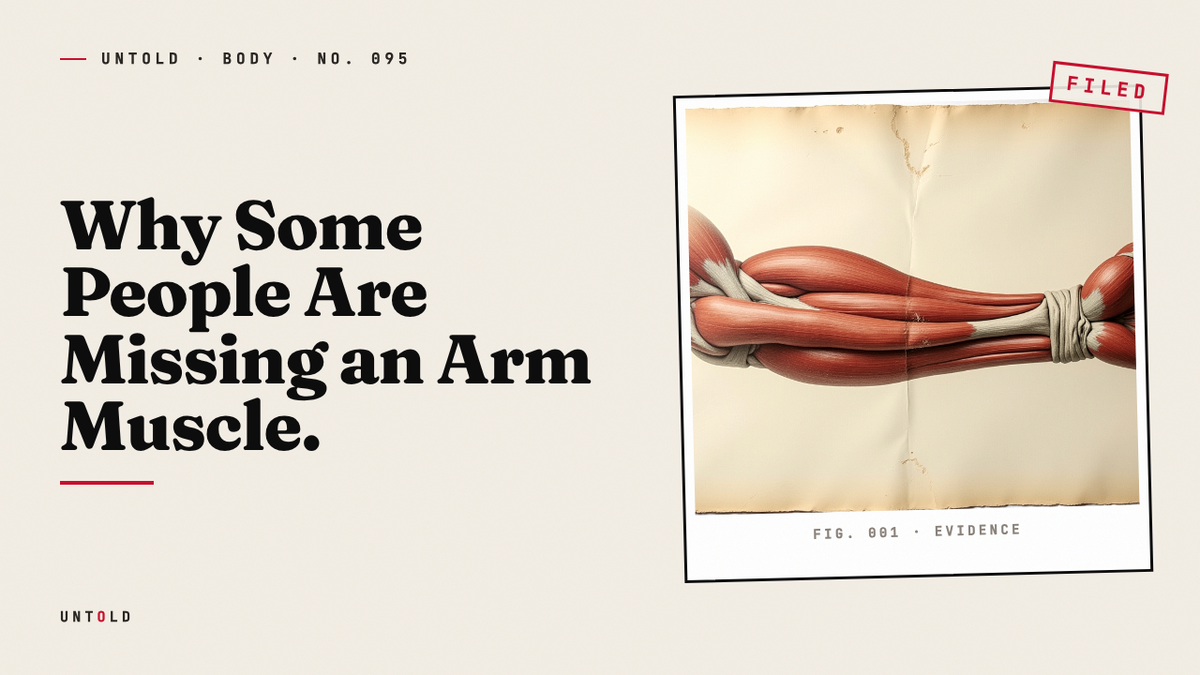
Press your thumb to your little finger. Now bend your wrist gently toward your face and look at the middle of your inner forearm. For most people, a thin cord rises under the skin, a taut string running from the wrist toward the elbow. It looks like a guitar string plucked beneath the flesh.
For a sizable minority, nothing appears. The forearm stays smooth. No cord, no string, no evidence of the muscle that is standing at attention in the arm next to yours. Neither result is a defect. One is simply the presence of a muscle called the palmaris longus, and the other is its absence.
Roughly one in seven people has no palmaris longus at all, and the overwhelming majority of them will go their entire lives without ever learning this fact about their own body 1. It is one of the more curious features of human anatomy: a piece of equipment that is optional, unevenly distributed, and, for the purposes of daily life, almost entirely beside the point.
We tend to imagine the body as a standard product, assembled to a fixed specification. Same bones, same organs, same muscles, all of it stamped out to a single blueprint. The palmaris longus is a small, quiet reminder that this assumption is wrong. Human anatomy is not a finished design. It is a work in progress, and this thin forearm muscle is one of the places where the editing is still visible.
A Muscle That Does Almost Nothing
The palmaris longus is a slender strap of muscle that begins near a bony bump on the inner elbow and tapers into a long, cord-like tendon that crosses the wrist and fans out into a sheet of connective tissue in the palm. Its full name translates roughly as “the long muscle of the palm,” which promises more than the muscle delivers.
When it is present, its contribution to hand function is barely perceptible. In theory it helps flex the wrist and tighten the fascia of the palm. In practice, its effect is so slight that anatomists and surgeons treat its loss as functionally irrelevant. Studies measuring grip strength and wrist flexion in people who have the muscle against those who lack it find no meaningful difference 1. Removing it entirely, which surgeons do routinely, produces no measurable weakness. A person can lose the whole muscle and never notice.
This raises an obvious and slightly unsettling question. If the muscle does nothing that matters, why is it there in the first place? The answer requires looking past the human arm to the arms of our distant relatives, because the palmaris longus was not built for us. It was inherited from ancestors who needed it far more than we do.
In many primates, particularly those that spend their lives climbing, swinging, and clinging to branches, the palmaris longus does real work. It helps tension the palm and stabilize the grip during locomotion through trees. For an animal that hangs its full body weight from a branch by one hand, a muscle that tightens and secures the palm is not a luxury. It is load-bearing hardware.
Humans, having descended from the trees and taken up walking on the ground, no longer place those demands on the forearm. The grip we use to hold a coffee cup or turn a doorknob draws on other, stronger muscles. The palmaris longus, deprived of the pressures that once justified it, has drifted toward irrelevance. Anatomists describe it as a muscle on its way out of the human body, a piece of ancestral equipment slowly being decommissioned. Its variable presence in the population is, in a sense, evolution caught in the act of removing something it no longer needs.
Two Centuries of Disagreement
Early anatomists took the human body apart with extraordinary care. In the seventeenth and eighteenth centuries, dissectors mapped every muscle, tendon, and ligament they could isolate, producing atlases of remarkable precision. The Dutch anatomist Bernard Siegfried Albinus, working in Leiden in the 1700s, set a standard for anatomical illustration that would stand for generations. His work reflected a confident assumption: that the body had a definite structure that careful observation would reveal.
The palmaris longus refused to cooperate with that assumption. Dissections kept disagreeing with one another. One cadaver would have a clean, well-formed palmaris longus in each forearm. The next would have none. A third would have the muscle on one side and nothing on the other. Over time it earned a reputation as one of the most variable muscles in the human body, a structure that seemed to follow no reliable rule at all 2.
The variations were not limited to simple presence or absence. The muscle could be doubled, appearing as two separate strands. It could be reversed, with the fleshy belly at the wrist end and the tendon at the elbow. It could be tucked into unexpected positions or split into unusual shapes. One muscle produced dozens of documented forms. For two hundred years, it filled the footnotes and appendices of anatomy textbooks, a standing exception to the tidy diagrams on the main pages.
Modern surveys have put numbers to what those early anatomists observed. Studies across different populations place the absence of the palmaris longus anywhere from about 4 percent to as high as 26 percent, depending on the group being measured 1. The rate varies by ancestry, by sex, and even by which arm is examined. In many populations, the muscle is more likely to be missing from the left arm than the right. A single person can lack it entirely on one side while carrying a perfectly ordinary one on the other. Your two arms, it turns out, may not be built from the same parts.
That variability makes the palmaris longus a small case study in a larger truth. The human body does not come off an assembly line with every component in place. It is assembled from a genetic program that tolerates a wide margin of variation, and the palmaris longus sits near the edge of that margin, present or absent almost as a matter of chance.
The Simple Test in Your Own Arm
Because the muscle is so variable, there is a standard method for checking whether a given person has one. It is called Schaeffer’s test, named after the American anatomist J. Parsons Schaeffer, and it is exactly the maneuver described at the start of this essay. Oppose the thumb to the little finger, flex the wrist, and look for the tendon standing up near the center of the inner forearm 3.
If a cord rises under the skin, the muscle is present. If the forearm stays flat, it is almost certainly absent. The test is not perfect, since the tendon can occasionally be hidden or hard to provoke, but in clinical studies it identifies the tendon correctly more than 95 percent of the time 3. Several variations on the maneuver exist, developed precisely because the muscle’s habit of hiding in unusual positions can occasionally fool the standard version. Anyone can run the test on themselves in a few seconds, and the result is oddly personal: a small, private fact about your own construction that you likely never knew.
For most of medical history, that fact was little more than a curiosity. The palmaris longus was catalogued, tested, and largely ignored, a muscle notable mainly for being unreliable and useless. Then a group of surgeons realized that its uselessness was not a flaw. It was the entire point.
The Spare Part Hiding in Your Forearm
Surgeons who repair damaged tendons and ligaments face a recurring problem. When a tendon in the hand, the thumb, or the elbow is torn beyond simple stitching, they need replacement tissue to bridge the gap. Ideally that tissue should be strong, long, and shaped like a tendon. And crucially, it should come from a place where its removal costs the patient nothing.
The palmaris longus is nearly perfect for the job. Its tendon is long, sometimes stretching more than 15 centimeters, and it has the right mechanical properties to serve as a graft 4. Because the muscle does no meaningful work, harvesting it leaves the patient with no functional loss. The surgeon removes a spare part the body was never really using and repurposes it to fix something that matters. This is why hand surgeons check for the palmaris longus before certain operations. The presence of that thin cord in the forearm tells them a ready graft is available.
The applications are wide. Palmaris longus grafts are used to reconstruct torn tendons in the thumb and fingers, to repair damaged ligaments in the elbow, and even in delicate reconstructions around the eyelid and the face, where its slim, pliable tendon suits the fine work 4. A muscle that spent centuries dismissed as an evolutionary leftover turned out to be an ideal source of donor tissue, precisely because it was expendable. As one way of putting it goes, the perfect donor tissue is the tissue you never needed.
The most famous version of this repair belongs to baseball. The operation formally called ulnar collateral ligament reconstruction is known everywhere as Tommy John surgery, after the pitcher who first underwent it in 1974 and returned to throw for many more years. The procedure rebuilds a blown-out ligament on the inner elbow, an injury that once ended careers, using a tendon graft to replace the torn ligament. In many cases, the graft comes from the patient’s own palmaris longus 5. A muscle that helped our tree-dwelling ancestors cling to branches now helps pitchers throw ninety-mile-an-hour fastballs, threaded into the elbow to do a job it was never designed for.
This is where the story of the palmaris longus quietly inverts itself. The muscle that evolution has been discarding, the one so vestigial that its absence goes unnoticed, has become genuinely valuable. Not for what it does in the forearm, which is almost nothing, but for what it can become once removed. Its uselessness in place is exactly what makes it useful somewhere else. Evolution left it fading, and surgery gave it a second career.
A Body Still Being Edited
The palmaris longus is not the only piece of the human body caught in transition. Anatomists have long catalogued a whole class of structures that vary from person to person, some fading like the palmaris longus, others appearing as extras that most people lack. There are small muscles in the leg and foot that are present in some people and absent in others. There are accessory muscles that turn up unexpectedly during surgery. The body’s inventory is not fixed. It shifts across the population, with features arriving and departing on timescales far longer than any single life.
This is a genuinely different way of understanding your own anatomy. The standard textbook diagram, with every muscle labeled and in place, is a useful average rather than a literal specification. The reality is a distribution. Some people carry the palmaris longus in both arms, some in one, some in neither. Some carry variant muscles that never make the diagrams at all. Anatomy is less a blueprint than a snapshot, a single frame from a process that has been running for hundreds of millions of years and shows no sign of stopping.
Seen this way, the small cord in your forearm, or its absence, is not a trivial quirk. It is a legible piece of evolutionary history written into your own body. The muscle traces a line back to ancestors who needed it to survive in the trees, forward through the slow relaxation of that need as our lineage came down to the ground, and sideways into the operating room where its expendability makes it precious. One in seven people carry the absence as quiet proof of change still underway.
So run the test again. Thumb to little finger, wrist bent toward you, eyes on the center of the forearm. Whether or not the cord appears, you are looking at deep time. You are looking at a body that was never standard issue, assembled instead from features inherited, discarded, and occasionally repurposed. The palmaris longus asks nothing of you and gives you almost nothing in return. But in its small, unreliable presence, or its equally ordinary absence, it holds a fact worth sitting with: your anatomy is not a fixed thing you were handed. It is a moving record of where your species has been, and, faintly, of where it is still going.

Sources
- Ioannis, D. et al., “Palmaris longus muscle’s prevalence in different nations and interesting anatomical variations: review of the literature,” Journal of Clinical Medicine Research, 2015. — https://www.ncbi.nlm.nih.gov/pmc/articles/PMC4568539/
- Reimann, A. F. et al., “The palmaris longus muscle and tendon: a study of 1600 extremities,” The Anatomical Record, 1944. — https://onlinelibrary.wiley.com/doi/10.1002/ar.1090890106
- Schaeffer, J. Parsons, “On the variations of the palmaris longus muscle,” The Anatomical Record, 1909. — https://onlinelibrary.wiley.com/doi/10.1002/ar.1090030502
- Sebastin, S. J. & Lim, A. Y. T., “Clinical assessment of absence of the palmaris longus and its association with other anatomical anomalies,” Annals of the Academy of Medicine Singapore, 2006. — https://pubmed.ncbi.nlm.nih.gov/16829996/
- Jobe, F. W. et al., “Reconstruction of the ulnar collateral ligament in athletes,” The Journal of Bone and Joint Surgery, 1986. — https://pubmed.ncbi.nlm.nih.gov/3782205/
Related reading