The Reset Breath Your Brainstem Takes Without You
Every few minutes a hidden circuit forces a deep breath to keep your lungs from quietly collapsing.
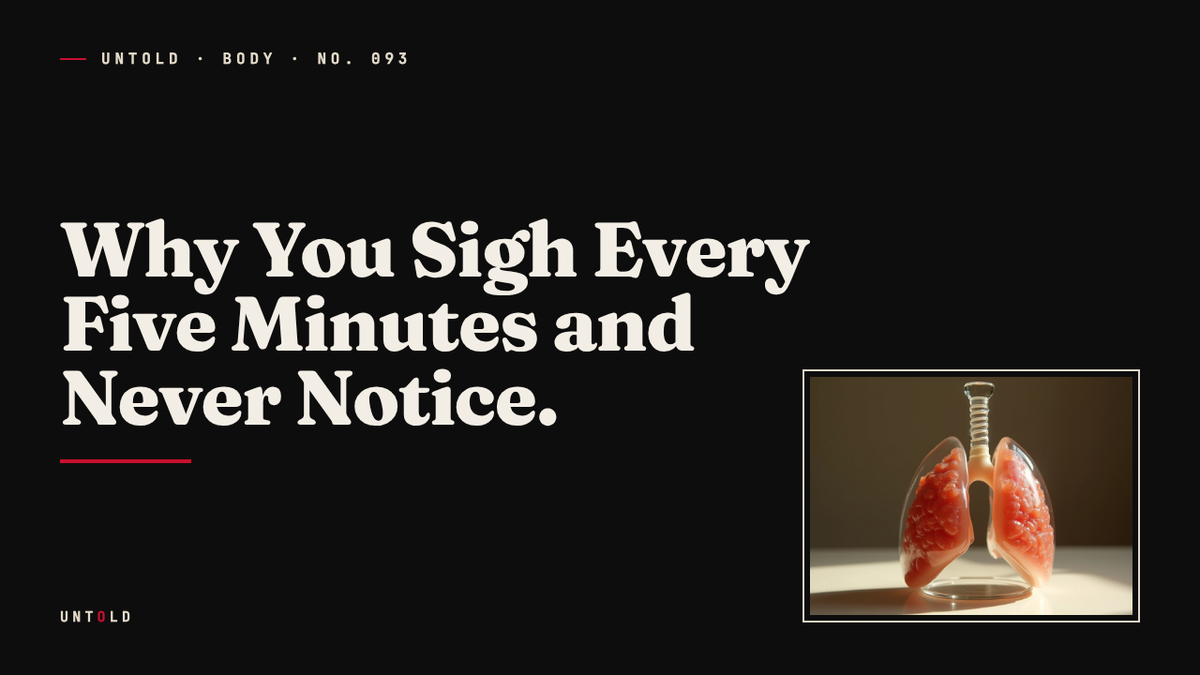
Breathe in now. Then, before you let any of it go, breathe in again, stacking a second inhale on top of the first. That doubled, slightly awkward intake is a sigh. You did not decide to take it. A cluster of neurons deep in your brainstem, no bigger than a grain of rice, produces the same maneuver on its own timetable roughly twelve times an hour, whether you feel anything or not. Awake at your desk, asleep and dreaming, bored in traffic, calm on a walk: the double breath keeps arriving. And almost every single time, you fail to notice it happen.
We have inherited a tidy story about what a sigh means. It is a feeling escaping through the chest. Sadness leaking out. Relief pushing free. Exasperation venting into the room when a meeting runs long. Poets have leaned on the image for centuries, and everyday language enshrines it: we sigh with longing, sigh with resignation, breathe a sigh of relief. The sigh, in this telling, is the involuntary punctuation of mood, the body confessing what the face tries to hide.
The trouble is that the arithmetic does not fit. If each sigh were a small emotional event, you would be having something like seventeen thousand emotional events a year, most of them while you slept or stared blankly at a screen. No inner weather could keep that pace. Something far more mechanical is going on, and it has nothing to do with sadness at all. The sigh is closer to scheduled maintenance: a fixed-interval procedure your lungs cannot run without, carried out by a circuit that operates below the floor of awareness.
The physics of a collapsing lung
To understand why the maintenance is necessary, you have to look inside the chest at a scale that is easy to forget exists. Your lungs are not two simple bags. They are a branching forest that terminates in hundreds of millions of microscopic air sacs called alveoli, each one a thin-walled bubble where oxygen crosses into the blood and carbon dioxide crosses out. Spread flat, the total surface would cover something close to the area of a tennis court, folded into a space the size of your torso.
Those bubbles are under a constant threat that has nothing to do with disease. Surface tension, the same force that lets a water strider stand on a pond, pulls the moist inner walls of each tiny sac inward, always trying to zip it shut. A specialized soapy film called surfactant fights this tension and keeps the sacs open, but the fight is never fully won. When you breathe in a shallow, unremarkable way for a stretch of time, as everyone does for most of the day, a small population of alveoli gives in. They collapse. The medical word for a region of collapsed lung is atelectasis, and in a healthy person it happens in miniature, constantly, all day long.
A collapsed sac is dead weight. It stops trading oxygen, and as more of them fold shut the lung as a whole grows stiffer and harder to inflate. Physiologists have a precise measure for this quality: compliance, meaning how easily the lung stretches to accept a given volume of air. High compliance is a supple, efficient lung. Low compliance is a lung you have to work to fill. Left to breathe gently and only gently, your lungs slowly slide down that scale, trading efficiency for creeping stiffness. The remedy is not subtle. It is a single breath larger than all the others, deep enough to pop the collapsed sacs back open and restore the surfactant film across their walls. That oversized, restorative breath is the sigh.
Jere Mead and the stiffening lung
The insight that a periodic deep breath is a physical necessity rather than a psychological quirk is older than most people assume. It traces back to a physiologist working at the Harvard School of Public Health in the middle of the twentieth century. Jere Mead spent his career on the unglamorous but foundational question of lung mechanics: how the tissue stretches, how pressure and volume trade off, what it actually costs to move air.1
In work published in the 1950s, Mead and his colleagues confined breathing to a narrow, shallow range and watched what happened over time. Held to gentle tidal breaths with no large inflations allowed, the lungs behaved exactly as the physics predicted. Compliance dropped. The tissue grew progressively stiffer, harder to expand, as more of its small sacs closed. Then came the telling move. A single large, forced inflation, one breath much deeper than the rest, and the stiffness reversed almost at once. Compliance snapped back. The collapsed regions reopened, and the lung recovered its supple, efficient state as if nothing had happened.1
The implication was quietly radical. A lung that only ever breathes shallowly degrades. To stay healthy it requires the periodic insult of a much bigger breath, delivered often enough to keep the collapse from accumulating. This was not a mood or a metaphor. It was a maintenance requirement written into the mechanics of the tissue itself. What Mead could not say was where in the body the order came from, or what set its rhythm. He had established that the deep breath was needed. The question of who scheduled it remained open for the better part of half a century.
The search moves into the brainstem
Breathing is one of the few things your body does that straddles the border between the automatic and the willed. You can hold your breath, speed it up, slow it, shape it into speech or song. But the instant your attention wanders, the rhythm runs itself, all night and all day, without a single conscious command. That autonomy has to live somewhere, and by the late twentieth century researchers had localized it to a small knot of neurons in the brainstem called the preBötzinger complex.
Discovered and characterized largely through the work of the neuroscientist Jack Feldman and his collaborators at the University of California, Los Angeles, the preBötzinger complex functions as the pacemaker of breathing.2 It is the metronome that sets the basic in-and-out beat, the cluster that keeps firing when everything else falls silent in sleep. Damage it and ordinary breathing falls apart. Feldman spent decades mapping how this compact circuit generates rhythm and how various signals tune it faster or slower. Somewhere in or near this hub, presumably, the sigh had to be organized too. But no one had found the specific trigger, and it was not obvious the sigh even had a separate one. It might simply be an occasional oversized version of a normal breath, the same machinery straining harder now and then.
The answer, when it came, said otherwise. In February 2016, Feldman’s group joined forces with the Stanford biochemist Mark Krasnow and the researcher Peng Li to report, in the journal Nature, that the sigh is not an amplified ordinary breath at all. It has its own dedicated hardware: a small, identifiable population of neurons whose sole job is to convert the occasional normal breath into a double one.3
Two hundred neurons and a chemical order
The team traced the command to a nearby brainstem region that projects into the breathing center, sending it two chemical messengers, a class of signaling molecules called neuropeptides. The pair in question carry unwieldy names: neuromedin B and gastrin-releasing peptide. These peptides land on the receptors of a strikingly small target: roughly two hundred neurons within the preBötzinger complex. That handful of cells, out of the billions in the brain, forms the entire command line for the sigh.3
What makes the result convincing is the sequence of experiments the team ran in mice. First they blocked both peptide receptors at once. The result was clean and specific: the sighing stopped completely, while ordinary breathing continued unchanged, in the same steady rhythm as before. Flip that one switch off, and only the double breath vanished; everything else about respiration carried on. Then they went further and destroyed the peptide-sensitive neurons themselves. Sighs disappeared entirely, even when the animals were placed in low-oxygen conditions that would normally provoke them. Yet the basic breathing rhythm held its pace, untouched.3
The logic ran in the other direction too. When the researchers gave the mice extra doses of the peptides, sighing shot up sharply. The neurons behaved like a dial. Turn the chemical signal down and the double breath faded; turn it up and the sighs multiplied. This is the signature of a dedicated control system, not an accidental byproduct. The sigh is generated by its own circuit, on its own schedule, running in parallel with the breathing it briefly interrupts. It is a programmed maintenance command, issued in a chemical language, aimed at a couple hundred cells whose whole purpose is to occasionally say: take one deeper.3
What emotion actually borrows
Here is where the tidy old story quietly inverts. The sigh you assumed was sadness was never fundamentally about feeling. It is a physiological routine that keeps your lungs from stiffening shut, and it runs whether your inner life is turbulent or perfectly flat. The circuit does not wait for grief. It does not require relief. It simply fires, roughly once every five minutes, on a timer set deep below awareness.
None of this means the emotional sigh is imaginary. Feeling can absolutely reach into the circuit and turn its dial. Stress raises the sigh rate; the anxious breath tends to grow ragged and punctuated by deep pulls. Relief does the same in the opposite mood, the long exhale that follows a danger passing. Researchers have documented that psychological states shift how often we sigh, and there is a plausible loop in it: a deep breath that resets the lungs may also nudge the nervous system toward calm, which is one reason the deliberate sigh has become a fixture of breathing exercises and stress advice.4
But the emotional sigh is a passenger, not the driver. It borrows an older, more basic machine, one that predates any particular mood and keeps operating long after the mood has passed. Evolution built the reset breath to solve a mechanical problem, the slow collapse of alveoli, and only later did feeling learn to reach in and pull the same lever for its own purposes. When sadness sighs, it is not inventing the gesture. It is commandeering a housekeeping reflex that was already there, already firing, indifferent to whether anyone is watching.
The rounds your body keeps
Consider what this means for the ordinary hours of a life. Roughly twelve times an hour, without consultation, a small circuit in your brainstem reaches down into your chest and forces a breath larger than the rest, reopening whatever tiny sacs have begun to fold shut since the last one. That is somewhere near seventeen thousand sighs a year, the overwhelming majority of them unfelt, unremembered, and entirely uninvited. You did not agree to this schedule. You do not maintain it. Two hundred neurons keep the appointment on your behalf.
There is something oddly consoling in the mechanics of it. The parts of the body we most romanticize, the ones we assign to the heart and the mood, often turn out to rest on humble scaffolding, quiet systems that ask nothing and announce nothing. The sigh of relief is real, and it feels like release because release is exactly what the deep breath physically delivers. But underneath that meaning sits a machine built for a far more modest task: keeping millions of microscopic bubbles from surrendering to the pull of their own surface tension.
So the next time a deep breath escapes you for no reason you can name, in a moment of no particular feeling at all, you might resist the urge to read it as your heart speaking. It is your brainstem, doing its rounds. Somewhere below the level of thought, a handful of cells has decided the lungs have gone too long without a full stretch, and has issued the only order that fixes it. The sigh arrives. The sacs reopen. And you, most likely, will never notice.

Sources
- Mead, J., “Mechanical properties of lungs,” Physiological Reviews, 1961. — https://journals.physiology.org/doi/10.1152/physrev.1961.41.2.281
- Feldman, J. L., Del Negro, C. A., “Looking for inspiration: new perspectives on respiratory rhythm,” Nature Reviews Neuroscience, 2006. — https://www.nature.com/articles/nrn1871
- Li, P., Janczewski, W. A., Yackle, K., Kam, K., Pagliardini, S., Krasnow, M. A., Feldman, J. L., “The peptidergic control circuit for sighing,” Nature, 2016. — https://www.nature.com/articles/nature16964
- Vlemincx, E., Van Diest, I., Van den Bergh, O., “A sigh of relief or a sigh to relieve: The psychological and physiological relief effect of deep breaths,” Physiology & Behavior, 2016. — https://www.sciencedirect.com/science/article/pii/S0031938416302700
- Bartlett, D., “Origin and regulation of spontaneous deep breaths,” Respiration Physiology, 1971. — https://www.sciencedirect.com/science/article/abs/pii/0034568771900209
- Ferris, B. G. Jr., “Jeremiah Mead and the mechanics of breathing,” American Journal of Respiratory and Critical Care Medicine (biographical), 2010. — https://www.atsjournals.org/
Related reading