The Warmest Lie the Body Ever Told
A drink feels like fire against the cold, but the glow is heat leaving the body for good.
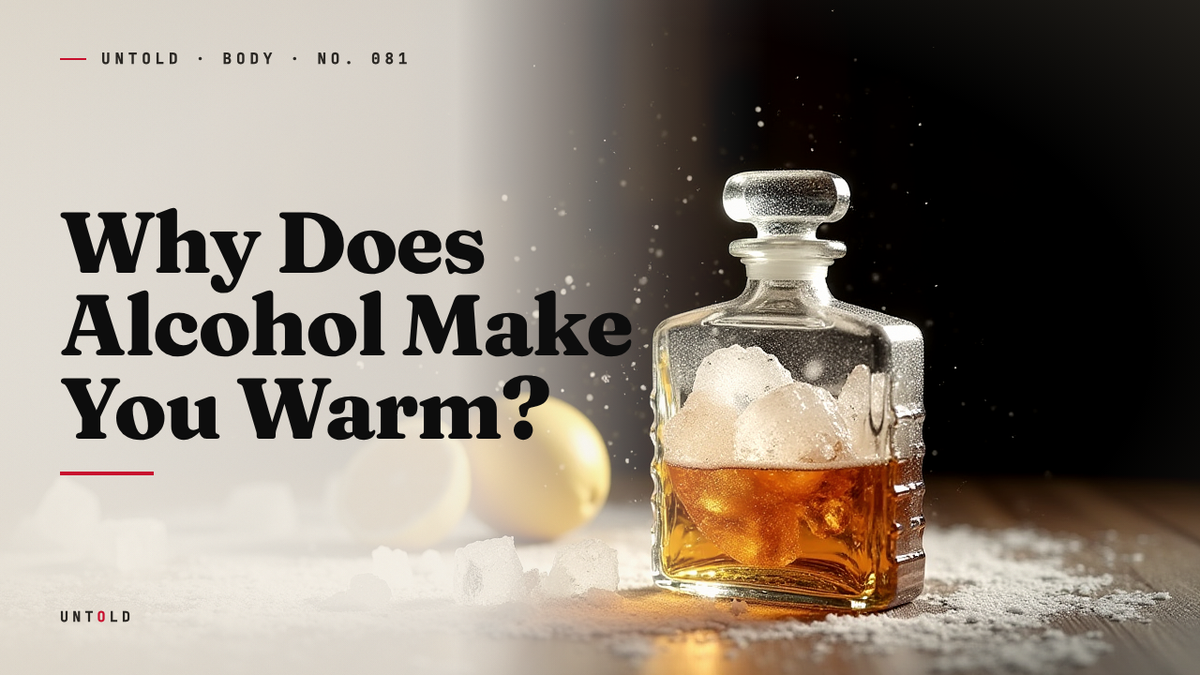
A shot of whiskey goes down, and within a minute or two something happens that feels unmistakably physical. A warmth blooms across the cheeks. The chest loosens. On a cold night, the sensation is close to luxurious, as if the drink had lit a small furnace somewhere behind the ribs. For most of human history, this feeling has been trusted absolutely. Brandy for the traveler caught in a storm. A nip of rum for the sailor on the frozen deck. A glass of something strong before facing the wind.
The feeling is real. The interpretation is wrong. That flush of heat is not your body warming up. It is your body throwing warmth away. Every degree of warmth you feel spreading across your skin is heat that is, at that very moment, leaving you and radiating into the cold air around you. The drink that feels like fire is quietly lowering your core temperature. And in the wrong conditions, on a winter night, on a walk home, this misunderstanding has killed a great many people who died believing they were being kept warm.
To understand why, you have to understand what heat actually is inside a human body, and how easily the machinery that manages it can be fooled.
A Body Divided Into Two Temperatures
The human body is not one temperature. It is at least two, and the difference between them is the whole story.
Deep inside, in the organs that keep you alive, the body defends a remarkably narrow band of warmth. The heart, the liver, the brain, the gut: this is the core, and it runs at roughly thirty-seven degrees Celsius, close to the familiar 98.6 degrees Fahrenheit. Life at the cellular level is a chemistry set of enzymes and reactions tuned to work at exactly this temperature. Push the core more than a few degrees in either direction and the chemistry starts to fail. Too hot, and proteins begin to unravel. Too cold, and the reactions slow, the heart falters, and the brain grows confused. The core temperature is not a comfort setting. It is a survival threshold.
The skin is a different country. The surface of the body sits cooler, closer to whatever the surrounding air happens to be. It is the border between the warm interior and the cold world, and like any border, it is where the important negotiations happen. Running between the hot core and the cool skin is a vast plumbing network of blood vessels, and it is this network, not any internal furnace, that decides moment to moment where the body’s heat is allowed to go.
Much of the foundational understanding of how this works belongs to the nineteenth-century French physiologist Claude Bernard, one of the founders of modern experimental medicine. In the 1850s Bernard studied how nerves control the width of blood vessels, demonstrating that the vessels could be actively widened or narrowed by the nervous system 1. Cut a particular nerve on one side of a rabbit’s face and the vessels there dilated, flooding the ear with warm blood. This was not a passive pipe network. It was a controlled system, a set of valves the body could open and close to route heat toward the skin or hold it deep inside.
That control is the entire mechanism of temperature regulation. When you are cold, the vessels near the skin constrict, pulling the warm blood inward, sacrificing your fingers and toes to protect the core. This is why extremities go pale and numb in the cold. When you are hot, the vessels near the skin dilate, sending warm blood rushing to the surface where the heat can escape into the air. Your skin flushes, and you cool down. The body is constantly adjusting these valves, dozens of times an hour, to hold that one crucial number steady.
Alcohol jams the switch open.
The Vasodilator
Alcohol is what pharmacologists call a vasodilator. It relaxes the smooth muscle in the walls of the blood vessels, particularly the ones near the surface of the skin, forcing them to widen 2. It does this regardless of what the body actually needs. On a hot day it hardly matters. On a cold night it is a catastrophe dressed up as comfort.
Here is the sequence. You drink. The alcohol reaches your bloodstream and your peripheral vessels dilate. Warm blood that had been kept deep in the core, exactly where the body wanted it, now rushes outward toward the skin. The skin, which had been cool, suddenly floods with warmth. The temperature-sensing nerves in the skin, which are the ones your conscious mind actually feels, report a surge of heat. Your brain receives this report and concludes, reasonably enough, that you are getting warmer.
But it has the direction exactly backwards. Something like seventy percent of the body’s heat can be lost through the skin under the right conditions, and warm blood delivered to a cold surface does not stay warm. It radiates its heat into the surrounding air and disappears. Bringing heat to the skin, in cold surroundings, is the single most efficient way to lose it. The glow you feel is the sensation of your core’s carefully hoarded warmth being spent, all at once, on the coldest part of you.
Meanwhile, deep inside, the core has quietly begun to cool. The warmth that was protecting your organs is now dispersing into the winter air, and there is no furnace refilling it fast enough to keep up. Studies in cold environments have consistently found that drinkers lose core heat faster than sober people, and that core temperature can fall measurably within an hour of drinking in genuinely cold conditions 3. The subjective experience and the physiological reality have come completely apart. You feel warmer while you become colder.
The Alarm That Never Rings
If the story stopped at blood vessels, it would be dangerous enough. But alcohol does something worse. It disables the body’s emergency response to cold at exactly the moment it is needed.
When your core temperature starts to drop, the body has a powerful defense: shivering. Shivering is not a symptom of being cold so much as a solution to it. It is the rapid, involuntary contraction of muscles, and because muscle contraction generates heat, vigorous shivering can dramatically increase the body’s heat production. It is, in effect, the body’s built-in emergency heater, switching on automatically when the core is threatened.
Alcohol suppresses shivering 4. It blunts the reflex, so the body’s most important heat-generating response is turned down precisely when the cold is winning. Put the pieces together and you have a genuinely lethal combination. The vessels are dilated, dumping heat out through the skin. The shivering that should compensate is muted. And the conscious mind, feeling the warm flush at the surface, believes everything is fine.
The physiologist Robert Pozos spent much of his career studying hypothermia and the ways the human body loses heat, and his work helped establish how thoroughly alcohol undermines the body’s defenses against dangerous cold 5. The cruelty of it is precise. The very thing that feels like protection is what removes the protection. As the danger of alcohol in the cold has often been summarized by those who study it, the feeling of warmth is exactly what makes it so dangerous.
There is a psychological layer on top of the physiological one. Alcohol impairs judgment, and one of the things it impairs judgment about is your own condition. A sober person growing cold feels increasingly, insistently uncomfortable, and that discomfort is a warning system: it drives you indoors, toward a fire, into a coat. Alcohol quiets that warning. It numbs the very signals that would otherwise send you to safety. So the drink performs a double theft. It steals the heat you need, and it silences the alarm that would tell you the heat is gone. The body knows it is cold. The alcohol simply talks over the alarm.
The Brandy Barrel That Never Existed
One of the most durable images in the folklore of cold-weather rescue is the Saint Bernard dog, that enormous, gentle animal of the Swiss Alps, trotting through the snow with a small wooden cask of brandy strapped beneath its chin. The story is that the dog would find a traveler buried in the drifts, and the brandy would revive and warm the freezing man until help arrived.
It is a lovely image, and it is entirely fiction. The monks at the Great Saint Bernard Hospice, who really did breed and train rescue dogs for centuries, never sent them out with brandy. The barrel was invented by a seventeen-year-old English painter named Edwin Landseer, who included it in a painting of two Alpine dogs in 1820, apparently for visual interest 6. The public loved it, the detail stuck, and a myth was born from a brushstroke.
What makes the invention more than a charming footnote is that the medical advice embedded in it is exactly wrong. Had those dogs actually carried brandy, and had freezing travelers actually drunk it, the alcohol would not have warmed them. It would have dilated their vessels, dumped their remaining core heat out through their skin, suppressed their shivering, and accelerated their slide into hypothermia. The brandy barrel is a monument to a mistake, a picture of the precise thing you must not do.
The real-world consequences of that mistake show up in the statistics. Studies of cold-weather deaths repeatedly find alcohol present in a striking proportion of victims 7. The pattern is grimly consistent. A person drinks, feels warm, and either underestimates the cold or wanders into it. The false warmth lasts just long enough to strip away caution. People lie down in the snow feeling comfortable, even pleasant, and do not get up.
Paradoxical Undressing
There is a final, disturbing chapter in the story of how the body handles cold, and alcohol can push a person toward it faster.
In the late stages of hypothermia, a strange and horrifying thing sometimes happens. The victim, whose core temperature has fallen dangerously low, suddenly feels unbearably hot and begins to tear off their clothing, even in freezing conditions. It is called paradoxical undressing, and it is one of the reasons hypothermia deaths are sometimes initially mistaken for something more sinister: bodies are found half-naked in the snow.
The leading explanation involves the very vessels this whole story turns on. In deep hypothermia, the muscles controlling the peripheral blood vessels can become exhausted or fail, and the vessels that had been clamped tightly shut to protect the core suddenly relax and dilate. A rush of warm blood floods to the skin, and the victim’s cold-numbed nerves register this sudden surge as a wave of intense heat, a burning sensation that makes clothing feel intolerable 8. It is the same mechanism that produces the warm flush after a drink, only now it is the last gasp of a failing system, and by exposing the skin the victim only speeds their own death. Alcohol, having already primed the vessels to dilate and already loosened the grip on judgment, can nudge a cold body further down this road.
The Debt Comes Due
So where does this leave the pleasant glow of a drink on a cold evening?
It is worth being clear that the warmth is not a hallucination. The skin really does heat up; the sensation is genuine. Indoors, by a fire, wrapped in the warmth of a heated room, that glow is comfort and very little else. There is no danger in feeling cozy when you are, in fact, safe and warm. The problem is not the feeling. The problem is trusting the feeling to mean protection when it means the opposite.
Outdoors, in the cold, the same glow becomes a quiet danger. The comfort is real, but the warmth is borrowed, drawn out of the core and delivered to the surface where the cold air collects it. The drink moves your heat to the one place you can most easily lose it, and then dulls the awareness that would tell you it is gone. What feels like a fire lit inside you is in truth a door held open, letting the warmth out.
The body, for all its ancient wisdom about the cold, has one blind spot: it feels its temperature at the skin, not the core. Alcohol exploits that blind spot perfectly. It floods the skin with warmth, tells the brain everything is fine, and lets the vital interior slip quietly toward the cold. The glow is real, the comfort is real, and neither of them is protection. Your skin can be flushed and warm while your core is quietly slipping away, and the last thing a person in that state usually feels is warm.
Sources
- Bernard, Claude, Introduction to the Study of Experimental Medicine, 1865 (English trans.) — https://www.gutenberg.org/ebooks/16234
- Rosenberg, H. et al., ‘Ethanol and vasodilation,’ Alcohol and vascular physiology overview, PubMed — https://pubmed.ncbi.nlm.nih.gov/
- Yoda, T. et al., ‘Effects of alcohol on thermoregulation during mild heat and cold exposure,’ Journal of Physiological Anthropology, 2005. — https://pubmed.ncbi.nlm.nih.gov/15930806/
- Freund, B. J. & Sawka, M. N., ‘Influence of cold stress on human fluid balance and alcohol thermoregulation,’ US Army Research Institute of Environmental Medicine. — https://apps.dtic.mil/
- Pozos, R. S. & Danzl, D. F., ‘Human Physiological Responses to Cold Stress and Hypothermia,’ in Medical Aspects of Harsh Environments, 2001. — https://ke.army.mil/bordeninstitute/published_volumes/harshEnv1/HE1ch10.pdf
- Ormerod, W., ‘The Saint Bernard and the brandy barrel: origin of a myth,’ historical accounts of Edwin Landseer’s 1820 painting. — https://en.wikipedia.org/wiki/St.Bernard(dog)
- Wick, D. E. & Byard, R. W., ‘Alcohol and hypothermia deaths,’ Forensic Science, Medicine, and Pathology, review of alcohol in cold-exposure fatalities. — https://pubmed.ncbi.nlm.nih.gov/
- Wedin, B. et al., ‘Paradoxical undressing in fatal hypothermia,’ Journal of Forensic Sciences, 1979. — https://pubmed.ncbi.nlm.nih.gov/438830/
Related reading