The Language of Fire and Ice
Your nervous system was never built to measure temperature. It was built to sound one alarm.
On a windless January morning, a bare hand closes around a metal railing. For a fraction of a second, before the mind catches up to what is happening, the sensation is not cold at all. It is heat. The palm reports a searing, urgent burn, as though the iron had been pulled from a forge rather than left out overnight in the frost. Only afterward, once the hand has been snatched away and the brain has reconciled the contradiction, does the correct label arrive: that railing was freezing.
This is not a rare glitch reserved for the unlucky or the distracted. It is a near-universal human experience, one that most people have felt and dismissed without ever asking what it means. Touch dry ice with an unprotected finger and the skin can blister in a pattern indistinguishable from a thermal burn. Frostbite victims, their tissue crystallizing from the inside out, frequently insist that the damaged flesh feels hot. Burn patients, in the opposite direction, sometimes describe a strange icy chill spreading across scorched skin. The two sensations that we treat as absolute opposites keep bleeding into each other.
The reason is not that our nerves are faulty. The reason is that the human body never evolved a reliable thermometer. It evolved something cruder and far more useful: a single alarm that fires whenever temperature approaches the point of doing harm, at either end of the scale. Fire and ice, to the nervous system, are not opposites. They are two dialects of the same warning.
A mosaic, not a thermometer
The first thing to abandon is the intuition that the skin measures temperature the way a mercury column does, smoothly and continuously from cold to hot. It does nothing of the kind. The skin is studded with thousands of discrete sensory endings, and they do not agree with one another. Some respond only to innocuous warmth. Others fire only when the surface cools. A separate population, the nociceptors, stays silent until temperature crosses into the territory of potential tissue damage, whether from heat or from cold.
These different sensors are not evenly distributed. They sit in overlapping, irregular patches, more like a mosaic than a grid, so that the map of temperature across even a single fingertip is a patchwork of specialized points rather than a uniform field. Press a warm probe against your forearm and move it a few millimeters, and the sensation can shift or vanish, because you have stepped off one sensor’s territory and onto another’s. What feels like a smooth, continuous sense of warmth is in fact the brain’s summary of a noisy, discontinuous chorus of individual reporters, each shouting about its own small patch of skin.
This architecture has a consequence that becomes central to the whole story. Because warmth, cold, and pain travel along partly separate channels, and because those channels influence one another before their signals ever reach conscious awareness, the final sensation is not a direct readout of the world. It is an interpretation. And interpretations, as any illusion demonstrates, can be manipulated.
The Swedish physiologist and his grill
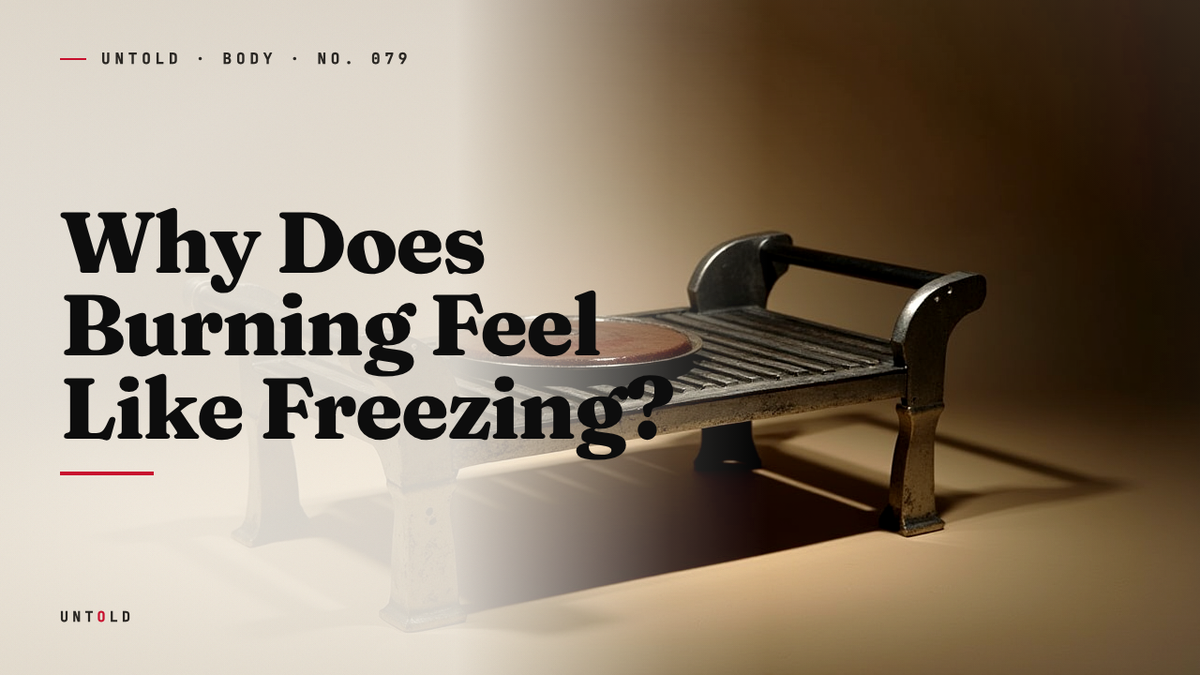
The person who first turned this manipulation into a controlled experiment was a Swedish physiologist named Torsten Thunberg, working in the closing years of the nineteenth century. In 1896 he built a deceptively simple device. He took a set of thin metal bars and interlaced them, alternating them so that a hand laid flat across the surface would touch each in turn. Then he ran warm water through half the bars and cool water through the other half.1
The crucial detail is the temperatures he chose. The warm bars sat at roughly forty degrees Celsius, pleasant but nowhere near hot enough to injure skin. The cool bars sat at around twenty degrees, cool to the touch but harmless. Presented one at a time, either bar would have produced nothing more than a mild, unremarkable sensation. A volunteer could have held a single warm bar indefinitely, and the same for a single cool one.
Yet the moment a hand pressed down across the interlaced grill, touching warm and cool in alternating stripes, something extraordinary happened. Volunteers reported an intense, painful heat, a burning sensation sharp enough that many yanked their hands away in reflex. There was no burning object anywhere in the apparatus. Nothing on the grill was hot enough to cause pain. The heat was entirely manufactured by the nervous system out of two ingredients that were, individually, completely safe.
Thunberg had produced a genuine illusion of injury from raw materials that could not injure. The effect came to be known as the thermal grill illusion, and for a long time after him it remained a curiosity that nobody could adequately explain. Everyone could reproduce it. Nobody could say why it worked.
The brake that fails
The explanation, when it finally arrived, came from a neuroscientist named A. D. (Bud) Craig, who in 1994 published an account of the illusion in the journal Nature, working with colleagues on the neural pathways that carry temperature and pain.2 Craig’s insight reframed the problem. The question was never really about the skin. It was about how the different signals interact on their way up to the brain.
The key is that cold and heat-pain are not independent. Under ordinary circumstances, the pathway that carries cold information also exerts a quieting influence on the pathway that carries burning pain. Think of the cold signal as a brake pedal pressed lightly against the pain alarm. When you feel a moderate coolness, that cold signal is simultaneously holding back the heat-pain channel, keeping it from firing. This is why a genuinely cold surface feels cold rather than painful: the cold pathway is doing its normal job and, in the process, suppressing any spurious sense of burning.
The grill sabotages this arrangement. When warm and cool stripes are interlaced across the skin, the pattern of activity confuses the cold-sensing pathway and disrupts its inhibitory grip. The brake, in effect, is released. And once the brake comes off, the heat-pain channel is free to fire even though nothing hot is present. The brain receives the unmistakable signature of burning and does the only thing it knows how to do with that signal. It reports fire.2
What makes Craig’s account more than a clever hypothesis is that later brain-imaging work supported it directly. When volunteers experienced the grill illusion inside a scanner, the regions of the brain that lit up were the same regions activated by genuine painful heat. The illusion was not a matter of confused verbal report or suggestion. At the level of the brain, the manufactured burn and a real burn looked strikingly alike. The brain could not tell the difference, so it invented one, and the one it invented was pain.
The molecular code
Craig had explained how the wiring produces the illusion. But a deeper question remained. Where, exactly, do these hot and cold signals begin? What physical event, at the level of a single molecule, translates a temperature into a nerve impulse in the first place? The answer to that question earned a Nobel Prize, and it revealed just how tightly fire and ice are bound together at the most fundamental level.
The biologist David Julius, working at the University of California, San Francisco, approached the problem from an unexpected direction: through chili peppers. Capsaicin, the compound that makes peppers taste hot, does not raise the temperature of anything. Yet it produces a genuine sensation of burning. Julius reasoned that the molecule must be latching onto some specific receptor in the nerve, and if he could find that receptor, he might find the very machinery that detects real heat. In 1997 his laboratory identified it: a protein embedded in the membrane of sensory nerve endings, a channel now known as TRPV1.3
TRPV1 turned out to be exactly what he suspected. It is a heat sensor. It opens when the surrounding temperature climbs into the painful range, around forty-three degrees Celsius and above, allowing a rush of charged particles into the nerve and firing off the burning signal. Capsaicin simply hijacks the same channel chemically, which is why a pepper feels hot without any actual heat, and why the sensation is so convincingly identical to a burn. The mouth is not being fooled by taste. It is receiving the authentic heat-pain signal from the authentic heat-pain receptor.3
The story did not stop at heat. Julius and, independently, the neuroscientist Ardem Patapoutian went looking for the cold equivalent, and they found it. A related protein, TRPM8, responds to falling temperature. And just as capsaicin fools the heat channel, menthol fools the cold one. TRPM8 is the reason mint feels cool on the tongue and why a menthol lozenge produces a chill that no thermometer would register.4 These proteins, the TRP channels, are the actual molecular thermometers of the body, a whole family of them tuned to different bands of the temperature scale.
And here the deepest symmetry appears. Extreme cold, pushed far enough, does not merely activate the gentle TRPM8 cold receptor. It reaches into the pain-signaling machinery itself, engaging the same nociceptive channels that fire in response to extreme heat. Both ends of the temperature scale, dangerous heat and dangerous cold, converge on overlapping populations of pain-carrying nerves. In 2021 Julius and Patapoutian shared the Nobel Prize in Physiology or Medicine for uncovering this molecular basis of temperature and touch, and with it the ancient confusion of fire and ice finally acquired a physical explanation.5
One alarm for both extremes
Step back from the molecules and the wiring, and a single principle emerges. The body did not evolve to know the temperature of things. It evolved to survive them. A precise thermometer would have been metabolically expensive and, for most of human history, nearly useless. What actually kept ancestors alive was a fast, unambiguous signal that said only one thing: this could damage you, stop touching it now.
Heat above a certain point damages tissue by denaturing its proteins. Cold below a certain point damages it by freezing and rupturing cells. From the standpoint of survival, these are the same emergency with the same required response, immediate withdrawal. It would be strange, even wasteful, for evolution to build two entirely separate warning systems for a single category of threat. Instead it built one. The nervous system runs, in effect, a unified threat detector, and both fire and frost feed into it.
This is why pain, in this domain, is best understood not as information but as instruction. When the hand grabs the frozen railing, the burning it reports is not an error to be corrected. It is the alarm doing precisely what it was designed to do, converting a dangerous stimulus into an irresistible command to let go. The specific quality of the sensation, its resemblance to heat, is almost beside the point. What matters to the body is that the alarm is loud, fast, and impossible to ignore. Accuracy about the direction of the temperature was never the goal. Speed of escape was.
Seen this way, the twist that felt so paradoxical at the start dissolves. Hot pain and cold pain were never two systems that happened to overlap. They are one system approached from two directions. Fire and ice were never opposites at all. They were always the same warning, spoken in the same language, and our surprise comes only from the fact that our conscious minds insist on categories the body never bothered to keep separate.
From curiosity to clinic
None of this remains confined to laboratory demonstrations and philosophical satisfaction. The thermal grill illusion has become a genuine research tool, precisely because it manufactures the sensation of pain from harmless components. Because the illusion depends on the interplay between cold inhibition and heat-pain, it offers a controlled way to probe how that interplay goes wrong.
And it goes wrong in real and debilitating conditions. Some patients with chronic pain disorders experience allodynia, in which stimuli that should be entirely innocuous are registered as pain. A cool breeze across the skin, the light drag of a bedsheet, the ordinary coolness of a room, can be felt as burning. In these people the ordinary brakes on the pain pathway seem to have failed in a way that echoes, in the body’s permanent wiring, what the grill produces artificially for a few seconds in a healthy volunteer. Studying the illusion offers a window into what that failure might look like at the level of circuits.6
The molecular story carries clinical weight too. If TRPV1 and its relatives are the gateways through which painful heat and painful cold enter the nervous system, then those channels are natural targets for a new generation of painkillers, drugs that might quiet a specific gateway without the sweeping effects of opioids. Efforts to develop such compounds have proven harder than early optimism suggested, in part because these same channels also regulate body temperature, but the underlying logic remains one of the most promising avenues in pain research. The confusion that Thunberg first bottled in 1896 turns out to sit very close to the mechanisms that medicine most wants to control.
So the next time a cold surface delivers its brief, convincing lie of heat, it is worth resisting the instinct to treat the sensation as a malfunction. Nothing has broken. The nerves in the hand are performing flawlessly, running an ancient program refined over hundreds of millions of years to accomplish a single task: keep the body away from anything that could destroy it. The burn that is not a burn is not a failure of the senses. It is the senses succeeding, in the only language they have ever needed to speak.

Sources
- Thunberg, T., Untersuchungen über die Temperaturempfindungen (thermal grill), 1896. — https://en.wikipedia.org/wiki/Thermal_grill_illusion
- Craig, A. D. and Bushnell, M. C., ‘The thermal grill illusion: unmasking the burn of cold pain,’ Science/Nature-era research on pain pathways, 1994. — https://pubmed.ncbi.nlm.nih.gov/8290958/
- Caterina, M. J. et al. (Julius lab), ‘The capsaicin receptor: a heat-activated ion channel in the pain pathway,’ Nature, 1997. — https://www.nature.com/articles/40329
- McKemy, D. D., Neuhausser, W. M., Julius, D., ‘Identification of a cold receptor reveals a general role for TRP channels in thermosensation,’ Nature, 2002. — https://www.nature.com/articles/nature719
- The Nobel Prize in Physiology or Medicine 2021, David Julius and Ardem Patapoutian, Nobel Foundation. — https://www.nobelprize.org/prizes/medicine/2021/summary/
- Bouhassira, D. et al., ‘Investigation of the paradoxical painful sensation (‘illusion of pain’) produced by a thermal grill,’ Pain, 2005. — https://pubmed.ncbi.nlm.nih.gov/15733636/
Related reading