The Tongue You Taste With Tonight Is Younger Than a Fortnight
Taste cells live and die on a rolling schedule, and the reason your buds hide inside your mouth is written in the body of a fish.
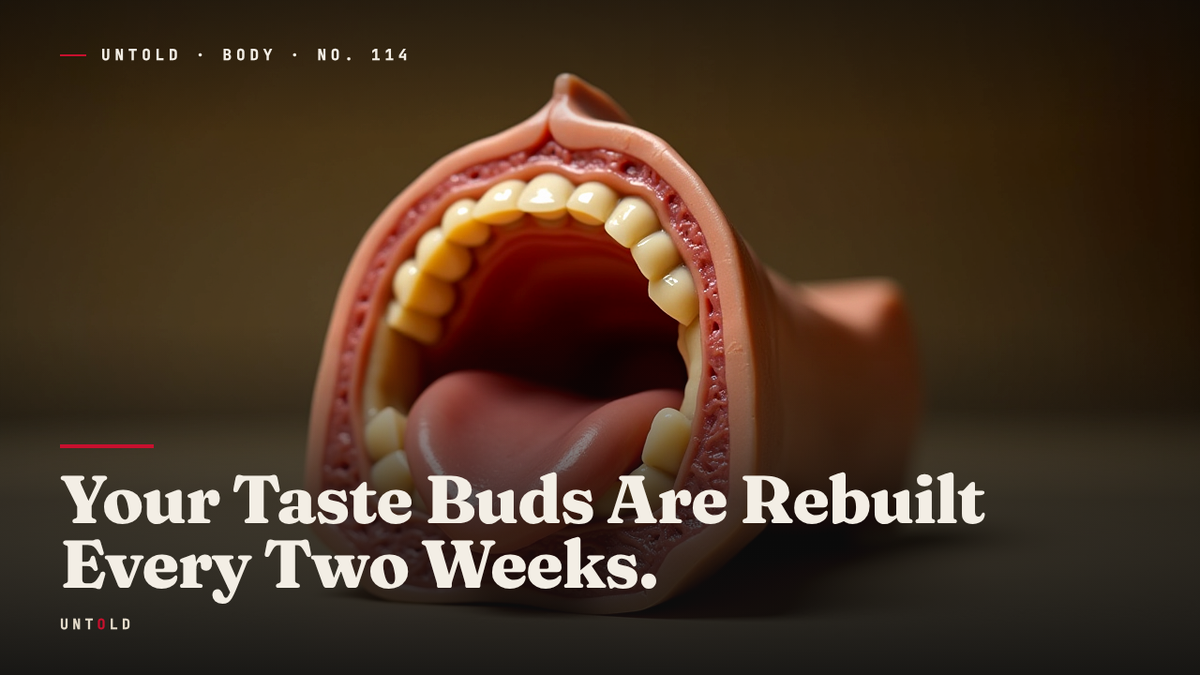
Press the top of your tongue against the roof of your mouth and drag it slowly forward. There is a grain to it, a faint sandpaper texture that most people never think to notice. Those bumps are papillae, and they are visible, tangible, easy to see in a bathroom mirror. What you cannot see is the more remarkable fact hiding inside them. The cells that actually let you taste anything at all are, on average, less than two weeks old. The tongue you are using to read this sentence is not the tongue you were born with. It is not even the tongue you had last month.
This runs against almost everything people assume about taste. Ask most adults what a taste bud is and they will point to the pink bumps. Ask whether hot coffee can permanently burn out your ability to taste and many will nod, having felt that scalded numbness after a rushed sip. Both beliefs are wrong, and the truth is stranger and more reassuring than either. The bumps are not the buds. The buds are microscopic structures buried within the papillae, each one about fifty micrometres across, smaller than a single grain of table salt. You carry thousands of them, and they are being torn down and rebuilt on a schedule that never pauses, not while you sleep, not while you eat, not for a single day of your life.
A Question Nobody Had Thought to Ask
For most of the history of physiology, the tongue was treated as a fixed instrument. You had your taste apparatus, the reasoning went, and you kept it, the way you keep the bones of your skull. If a sense faded, that was age or damage doing its slow work. The idea that the machinery of taste might be in constant flux, dismantling and reassembling itself faster than you can notice, was simply not on the table.
That began to change in a laboratory in 1965, when a physiologist named Lloyd Beidler decided to test the assumption directly. Beidler had spent his career studying taste at the level of individual cells, trying to understand how a molecule of sugar or quinine translated into a nerve signal. Working with his colleague Ronald Smallman, he posed a question that sounds almost naive until you realize no one had answered it: are the cells that let an animal taste permanent fixtures, or are they replaced over time? 1
The experiment they designed was elegant in its simplicity. They fed rats a chemical tracer called tritiated thymidine, a radioactive version of one of the building blocks of DNA. The logic was straightforward. Any cell that is actively dividing has to copy its DNA, and to copy its DNA it must pull in fresh thymidine from the bloodstream. So any newly born cell would incorporate the radioactive marker and, in effect, light up under the microscope. Cells that were sitting still, not dividing, would stay dark. Beidler and Smallman then did the patient work of the era: they sacrificed animals at intervals, sliced their tongues into thin sections, and watched, day after day, to see where the glow appeared and where it travelled.
What they found rewrote the textbook. The labelled cells did not appear randomly scattered through the taste buds. They showed up first at the outer rim of each bud, in the ring of tissue surrounding it, not inside the bud at all. These rim cells, the basal cells, were the ones dividing. Their offspring did not stay put. Over the following days the newly minted cells migrated inward, crawling slowly toward the center of the bud, where they matured into working taste receptors. They did their job of tasting for a while, and then they simply died and were cleared away, replaced by the next wave arriving from the edge.
The Rolling Assembly Line
Beidler and Smallman put a number on it. The average taste cell in their rats lasted about two hundred and fifty hours before it vanished. That is a little over ten days. Published in the Journal of Cell Biology in 1965, the finding described something no one had pictured before: the tongue as a rolling assembly line, a conveyor belt that feeds fresh tasting cells inward from a ring of dividing stem cells at the perimeter, discards the old ones from the middle, and never once stops running. 1
The consequence is quietly astonishing. The true agent of your sense of taste is not the bud you might imagine as a stable little cluster. It is the ring of basal cells around it, an engine of constant renewal. The bud is more like a flame than a lightbulb. A lightbulb is a fixed object that eventually burns out. A flame looks steady but is composed of gas that is entirely different from one moment to the next, continuously supplied from below and continuously consumed at the top. Your taste buds are flames. The shape persists; the material passing through it is always new.
This renewal is why the folk belief about scalding your buds is so misguided. When you burn your tongue on coffee that was hotter than you gauged, you do kill some cells. The numbness that follows is real. But you have not destroyed anything permanent, because nothing on your tongue is permanent. The rim keeps dividing exactly as it did before the burn, and within a few days the fresh cells arrive, mature, and restore the taste you thought you had lost. The damage feels alarming precisely because the system is built to absorb it. Injury to a self-renewing tissue is, almost by definition, temporary.
Not One Clock, but Several
For decades after Beidler, scientists tended to assume the conveyor belt ran at a single speed. One belt, one clock, one lifespan for every cell on the tongue. It was a reasonable simplification, but it turned out to be wrong in an interesting way, and the reason is that taste is not really one sense. It is a bundle of several distinct senses that happen to share the same organ.
Inside a single taste bud you will find different cell types tuned to different qualities. Some cells detect sweet and bitter compounds. Others detect sour. Salt and the savory quality we call umami round out the familiar five. These are not variations on a theme; they are genuinely different receptor systems packaged together, the way an eye contains separate cells for color and for dim light. If the cells are that different in function, a natural question follows: do they all live and die on the same schedule?
In 2013, a team led by Nirupa Chaudhari at the University of Miami set out to time each cell type separately rather than lumping them together. Using more modern labelling techniques than Beidler had available, they tracked the lifespans of the individual populations within the mouse taste bud. 2 The results split the old single clock into several. The type II cells, which sense sweet and bitter, turned over quickly, with a half-life in the neighborhood of eight days. The type III cells, which detect sour, lived far longer, closer to twenty-two days. Other estimates in the field have placed the overall average bud cell lifespan somewhere between ten and fourteen days, which is why the two-week figure has become the popular shorthand, but the deeper story is that no single number captures it.
The implication is subtle and strange. A taste bud is never quite the same population of cells twice. The sweet detectors are being swapped out almost twice as fast as the sour detectors. At any given moment your bud is a mixture of cells of wildly different ages, some newly arrived, some approaching the end of their brief tenure. Some of your capacity to taste is fleeting, refreshed every week or so; some of it lingers for the better part of a month. You do not have a tongue so much as a slowly cycling federation of tongues, each subsystem keeping its own time.
A Fish That Wears Its Tongue
All of this raises a question that the renewal story alone cannot answer. If taste cells are so cheap to produce, if the body can churn out fresh ones every few days without apparent difficulty, why are they tucked away inside the dark, wet interior of the mouth? Why hide an organ that is so easy to replace? Surely a sense of taste would be more useful spread across the skin, sampling the world before it ever reaches the lips.
As it happens, that is exactly how it works in one of the animals that has fascinated taste researchers most. The answer to why your buds are hidden lies not on the human tongue but in the body of a fish.
John Caprio, a sensory biologist at Louisiana State University, spent years studying the channel catfish for one reason above all: it may be the most extraordinary taster on the planet. The catfish does not keep its taste buds inside its mouth. It keeps them everywhere. Its skin, its fins, and especially its whisker-like barbels are covered in taste receptors, hundreds of thousands of them, in some estimates well over a hundred thousand distributed across the animal. 3 A catfish is, in a quite literal sense, a swimming tongue, a phrase Caprio and his colleagues used to describe the phenomenon in their work in the early 1990s. 4
The advantage is obvious once you picture the animal’s world. A catfish hunts in murky, low-light water where vision is nearly useless. But the water carries dissolved chemicals from potential food, faint gradients of amino acids leaking from a wounded creature or a scrap of decaying matter. Because its taste buds coat its entire body, the catfish can detect and localize that food from a distance, tasting the water around it long before anything touches its mouth. Its whole surface reads the chemistry of the river.
Deep Time Only Moved Them
Here is the twist that ties the fish to your dinner. Deep time did not invent your taste buds. It only moved them.
The common ancestors of fish and land animals were aquatic, immersed in a chemical broth in which external taste made perfect sense. Skin that could taste was an asset when you lived surrounded by dissolved signals. But when vertebrates hauled themselves onto land, that broth vanished. Air does not carry dissolved amino acids the way water does; the chemical world of a terrestrial animal arrives mostly through the nose as scent, not through the skin as taste. External taste buds lost their purpose, and evolution did what it usually does with expensive equipment that no longer earns its keep. It withdrew it to the one place where it still mattered: the mouth, the gateway where food is actually evaluated before being swallowed.
The same organ that once coated the body of an aquatic ancestor was pulled inward. On your tongue, your palate, and down into your throat sit roughly four thousand taste buds, each packing somewhere between thirty and one hundred cells. 5 They are the descendants, in an evolutionary sense, of a sensory system that a catfish still wears on the outside. You did not lose the ancestral abundance so much as concentrate it, folding a body-wide sense into a single specialized checkpoint.
And every one of those concentrated cells, all four thousand buds and their tens of thousands of component cells, is riding the same conveyor belt Beidler described in 1965. The ring divides, the offspring migrate inward, the old cells die, the sense persists unbroken through it all. It is a strange kind of permanence: an organ that stays constant precisely because none of its parts do.
What the Coffee Cannot Take
There is something almost consoling in all of this. The tongue is often treated as a trivial organ, the seat of mere pleasure, less serious than the eye or the ear. But it turns out to embody one of the body’s most elegant strategies for staying alive in a hostile environment. The mouth is a place of constant assault, scraped by food, scalded by heat, flooded with acid and enzymes. A fixed sensory organ would degrade there within months. So the body does not build a fixed organ. It builds a flame, endlessly resupplied, and accepts that individual cells will be sacrificed so long as the flame itself endures.
So the next time you burn your tongue on a drink you should have let cool, you can hold two facts at once. The numbness is real, and it will pass, because the rim is already dividing to replace what the heat destroyed. The cells doing the tasting a week from now have not yet been born. The catfish carries its tongue openly, reading the whole river with its skin. You keep yours hidden, folded into the dark of your mouth, and you rebuild it, quietly and completely, for as long as you live.

Sources
- Beidler, L. M. and Smallman, R. L., Renewal of cells within taste buds, Journal of Cell Biology, 1965. — https://rupress.org/jcb/article/27/2/263/2686/RENEWAL-OF-CELLS-WITHIN-TASTE-BUDS
- Perea-Martinez, I., Nagai, T. and Chaudhari, N., Functional cell types in taste buds have distinct longevities, PLOS ONE, 2013. — https://journals.plos.org/plosone/article?id=10.1371/journal.pone.0053399
- Caprio, J. et al., The taste system of the channel catfish: from biophysics to behavior, Trends in Neurosciences, 1993. — https://pubmed.ncbi.nlm.nih.gov/7688164/
- Atema, J., Structures and functions of the sense of taste in the catfish (Ictalurus natalis), Brain, Behavior and Evolution, 1971. — https://www.karger.com/Article/Abstract/125464
- Chaudhari, N. and Roper, S. D., The cell biology of taste, Journal of Cell Biology, 2010. — https://rupress.org/jcb/article/190/3/285/54711/The-cell-biology-of-taste
Related reading