The Alarm That Spreads Through a Room
Contagious itch was long dismissed as suggestion. A single receptor in the brain proved otherwise.
Read two words: head lice.
Something just happened at the back of your scalp. A faint prickle, perhaps behind the ear, perhaps at the crown. You did not decide to feel it. You did not weigh the idea of lice, judge it plausible, and then instruct your skin to respond. The prickle arrived first, unbidden, ahead of any reasoning. By the time you noticed it, the reaction was already underway.
The same thing happens with sight. Watch a stranger drag their fingernails across a forearm and your own skin begins, quietly, to crawl. Watch long enough and your hand will drift toward your neck or your wrist before you catch it. We tend to explain this away with gentle, social words. We call it empathy, or suggestion, or being a little squeamish. We treat it as a small failure of composure, the kind of thing a more disciplined person would not indulge.
But it is none of those things. What passes between the scratcher and the watcher is not a mood or a manner. It is a dedicated piece of biological machinery, older than etiquette and faster than deliberate thought, and for most of scientific history nobody had bothered to test what it actually was.
A reflex mistaken for a feeling
For decades, contagious itch sat in an awkward corner of medicine, filed under the heading of the psychological. The reasoning went something like this: there is no flea on your arm when you watch a video of someone scratching, no allergen, no physical irritant. The itch has no external cause. Therefore it must be imaginary, a trick played by a suggestible mind on a nervous body. It belonged, so the thinking went, with blushing and yawning and other small embarrassments of the social animal.
The trouble with calling something psychological is that the label quietly implies control. If an itch is born in the mind, then in principle the mind should be able to unmake it. Just stop thinking about it. Everyone has heard that advice, usually from someone who has never had lice, and everyone knows it does not work. Telling a person not to think about an itch is a reliable way to make them think about nothing else. The advice fails so consistently that its failure should have been a clue. A reaction you cannot suppress by choosing to suppress it may not be a matter of choice at all.
The deeper problem was that the empathy theory had never been examined. It was an assumption dressed as an explanation. It sounded reasonable, it fit our intuitions about ourselves as feeling creatures, and so it went unchallenged for a long time. To find out whether an itch could genuinely be caught, and whether feeling for another person had anything to do with it, someone would have to strip the phenomenon down to its bones. That meant taking it out of the human world entirely.
Someone did. He asked the mice.
The neuroscientist who chased an itch
Zhou-Feng Chen, a neuroscientist at Washington University in St. Louis, had spent years pursuing a question most people never think to ask: where, exactly, does an itch live? Not in the skin, though that is where we feel it, but in the nervous system. What carries the signal, what molecule announces it, what part of the brain receives the message and translates it into the maddening urge to scratch?
Chen’s laboratory had already made one of the field’s landmark discoveries. In earlier work, his team identified a molecule that seemed to act as a dedicated messenger for itch: a small protein called gastrin-releasing peptide, or GRP, and the receptor it binds to in the spinal cord 1. This mattered because it suggested that itch was not simply a mild flavor of pain, as some had argued, but a sensation with its own labeled lines running through the nervous system. Itch, in other words, had a private channel.
Having found a molecule that carried ordinary itch, Chen turned to a stranger question. If an itch has a physical language inside the body, could that language be spoken by sight alone? Could an itch be caught the way a yawn seems to be caught, passing from one individual to another with nothing physical crossing between them? Working with his colleague Yao-Qing Yu, Chen set out to test it in the one subject that could settle the empathy debate for good.
What the mice could not fake
The experiment, published in the journal Science in 2017, was disarmingly simple in its setup 2. The researchers placed a mouse in an enclosure with a small screen. On the screen played a video of another mouse scratching itself, again and again, in a continuous loop. Beside the screen sat the test animal: healthy, with no irritant on its skin, no reason of its own to scratch. It only watched.
Within seconds, the watching mouse began to scratch.
The power of the result lay in everything it ruled out. A mouse does not feel social pressure. It has no reputation to protect, no company to impress, no manners to perform for an audience. It cannot be embarrassed into copying a neighbor. Nor could the response be explained by scent, the sense that dominates so much of rodent behavior, because the trigger was a video. A screen carries no smell. There was no chemical drifting across the cage, no pheromone, no trace of another animal’s distress on the air. There was only an image, light arranged into the shape of a scratching mouse, and the sight of it was enough.
Every convenient human excuse fell away. The itch had crossed from screen to skin with nothing physical passing between them. The mouse saw, and the mouse scratched, and that was the entire story. Whatever contagious itch is, it clearly does not require the elaborate inner life we had assumed. It does not need a theory of other minds or a capacity to feel another creature’s suffering. It runs on something more basic than any of that.
So Chen and Yu went looking for the wire.
A signal in the body’s clock
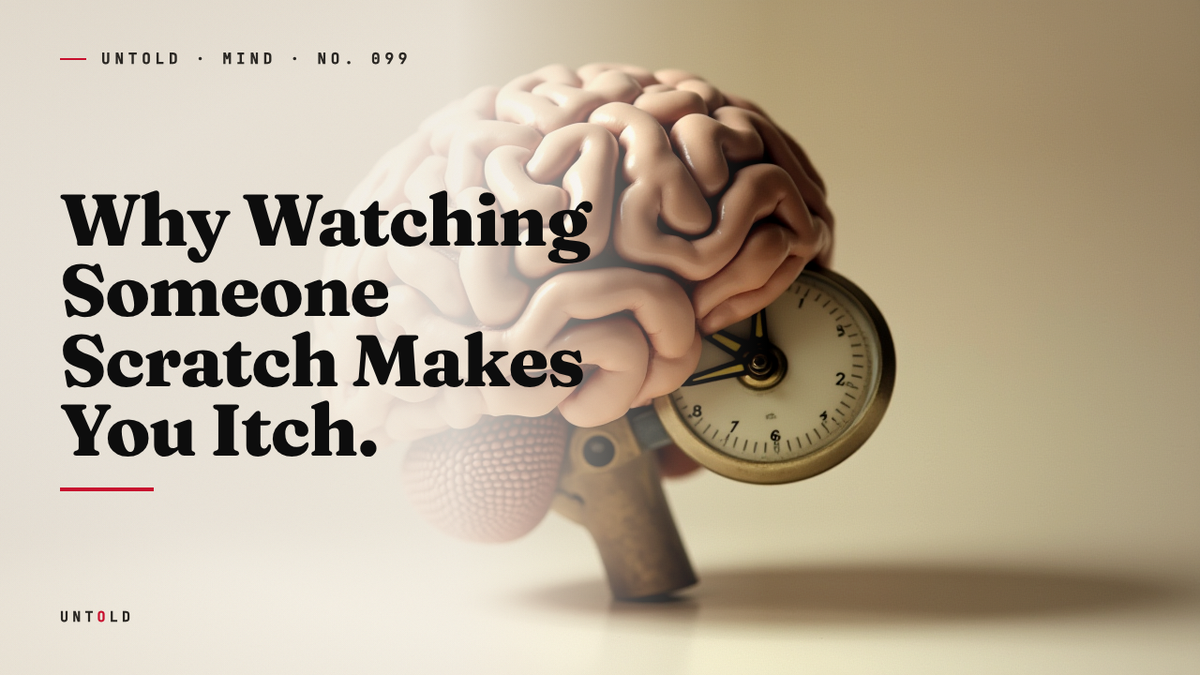
When the team traced the neural activity set off by watching another mouse scratch, the trail led somewhere no one had predicted. The signal converged on a tiny cluster of cells deep in the brain called the suprachiasmatic nucleus.
This structure is famous, but not for anything to do with the skin. The suprachiasmatic nucleus is the body’s master clock, the pacemaker of the circadian rhythm. It keeps time for the entire organism, governing the cycle of sleep and waking, tuning the daily rise and fall of hormones, telling the body when it is night and when it is day. It is one of the last places a researcher would expect to find implicated in scratching. There is no obvious reason the organ that manages your sense of time should have anything to say about parasites on your arm.
Yet when a mouse watched another mouse scratch, this clock structure lit up. And it was not firing at random. It was releasing GRP, the very same itch peptide Chen’s lab had identified years before. The brain’s timekeeper, it turned out, was quietly speaking the language of itch, broadcasting the same molecular signal that the body uses to say something is crawling on you.
Why the master clock should be the relay station for contagious itch remains an open question. But the correlation alone did not satisfy the team. Correlation never does. A region lighting up during a behavior does not prove the region causes it. To be certain, they needed to remove the wire and see if the behavior disappeared.
One switch, and only the contagion turned off
The decisive experiment used engineered mice that lacked the GRP receptor specifically in that clock region. In these animals, the molecular message could still be sent, but there was nothing there to receive it. The channel had been cut at exactly one point.
The researchers ran the video again. The scratching mouse looped on the screen, the same footage that had reliably set healthy animals scratching within seconds. This time, the watching mice sat unmoved. They saw the scratching and did nothing. The contagion had simply vanished. There was no gradual fading, no reduced response: contagious scratching dropped to essentially zero 2.
Here is the detail that turns a striking result into a conclusive one. When those same receptor-lacking mice were given an actual itch, when their skin was genuinely irritated, they scratched perfectly normally. Ordinary itch survived completely intact. The animals could still feel and respond to a real physical trigger. Only the caught itch, the one that arrived through the eyes, had been erased.
That single dissociation is the heart of the whole story. Cutting one receptor in one region abolished contagious itch while leaving normal itch untouched. Two kinds of scratching that look identical from the outside turned out to run on separate wiring underneath. And the contagious kind could be switched off with the precision of flipping a breaker. Empathy does not live in a receptor. You cannot delete a mouse’s capacity for fellow-feeling by knocking out a single protein in its internal clock and leave everything else in place. What the experiment removed was not a feeling. It was a circuit.
The same hardware in a human skull
A mouse is not a person, and no responsible account of contagious itch can stop at the rodent. But human evidence had actually arrived first, from a different direction, several years earlier.
In 2012, the psychologist Henning Holle and his colleagues put people inside an MRI scanner and showed them videos of others scratching 3. The point was to watch the human brain in the act of catching an itch. The results echoed what the mouse work would later confirm. Roughly two-thirds of the volunteers started scratching themselves while they watched, a strikingly high rate for a reaction we like to think of as controllable. And in their brains, regions of the somatosensory cortex, the areas that register touch and sensation on the body, became active as they watched, mapping the phantom itch onto the corresponding parts of their own skin.
Most telling of all was what did not predict the effect. The researchers measured how much disgust and empathy their volunteers reported, expecting that the most sensitive, most squeamish, most emotionally attuned people would catch the itch most readily. They did not. Contagious itch appeared in viewers regardless of how much empathy they said they felt, including in people who reported feeling none at all. The urge to scratch did not track with the tender emotions we had assumed were driving it. It arrived on its own schedule, in its own channel, indifferent to how the person felt about the stranger on the screen.
Two species, two methods, one conclusion. The itch you catch from watching is not a delicate expression of your capacity to feel for others. It is inherited hardware, running below the level where feelings are made.
An old alarm, still ringing
Why would a brain build and keep such a thing? A circuit that makes you scratch at the mere sight of scratching seems, on its face, like a design flaw, a glitch that spreads discomfort for no reason. But it is far more plausibly a feature, and an ancient one.
Consider what a scratching animal signals in the wild. One member of a group clawing at its fur is often the first visible sign of parasites: fleas, mites, ticks, lice moving through the shared space of a nest or a troop. These are creatures that travel between bodies, and a group that huddles together for warmth and safety is exactly the kind of place they thrive. An individual that noticed a companion scratching and immediately checked its own coat would have a real advantage over one that ignored the sign. The contagion, in this light, is an early-warning system: a shared alarm wired beneath conscious thought, rippling outward through the group so that when one animal detects a threat crawling on its skin, the others begin inspecting themselves before the infestation can spread.
An alarm like that only works if it fires automatically. A warning you can talk yourself out of is not much of a warning. This is precisely why willpower fails against a caught itch, and why the advice to simply stop thinking about it is worse than useless. The circuit was never routed through the parts of the brain that deliberate and decide. It bypasses them entirely, by design, because in the environment that shaped it, hesitation could mean a body full of parasites. The system kept our distant ancestors alive not by asking permission but by refusing to.
So the next time a scratch on a screen sends a crawling sensation across your own arm, and your hand begins its quiet drift toward your skin, you can stop scolding yourself for it. You have not fallen for a trick, and you are not betraying some excess of feeling. A structure deep in your brain, one that also happens to keep your sense of day and night, has spotted a signal it was built to answer and has answered it, exactly as it answered for the animals you descend from. It is not weakness, and it is not empathy. It is a very old circuit doing precisely the job it was made to do.

Sources
- Sun, Y. G. & Chen, Z. F., ‘A gastrin-releasing peptide receptor mediates the itch sensation in the spinal cord,’ Nature, 2007. — https://www.nature.com/articles/nature06029
- Yu, Y. Q., Barry, D. M., Hao, Y., Liu, X. T., Chen, Z. F., ‘Molecular and neural basis of contagious itch behavior in mice,’ Science, 2017. — https://www.science.org/doi/10.1126/science.aak9748
- Holle, H., Warne, K., Seth, A. K., Critchley, H. D., Ward, J., ‘Neural basis of contagious itch and why some people are more prone to it,’ PNAS, 2012. — https://www.pnas.org/doi/10.1073/pnas.1216160109
- Chen, Z. F., ‘A neuropeptide code for itch,’ Nature Reviews Neuroscience, 2021. — https://www.nature.com/articles/s41583-021-00526-9
- Reardon, S., ‘Contagious itch spreads through brain’s timekeeping centre,’ Nature News, 2017. — https://www.nature.com/articles/nature.2017.21580
- Feldman, E. L. & Mochly-Rosen, D., ‘The suprachiasmatic nucleus and circadian control,’ overview in Principles of Neural Science, 2013. — https://en.wikipedia.org/wiki/Suprachiasmatic_nucleus
Related reading