The Molecule That Escaped the Orchid
Almost all the vanilla you taste never touched a flower. Here is where it actually comes from.
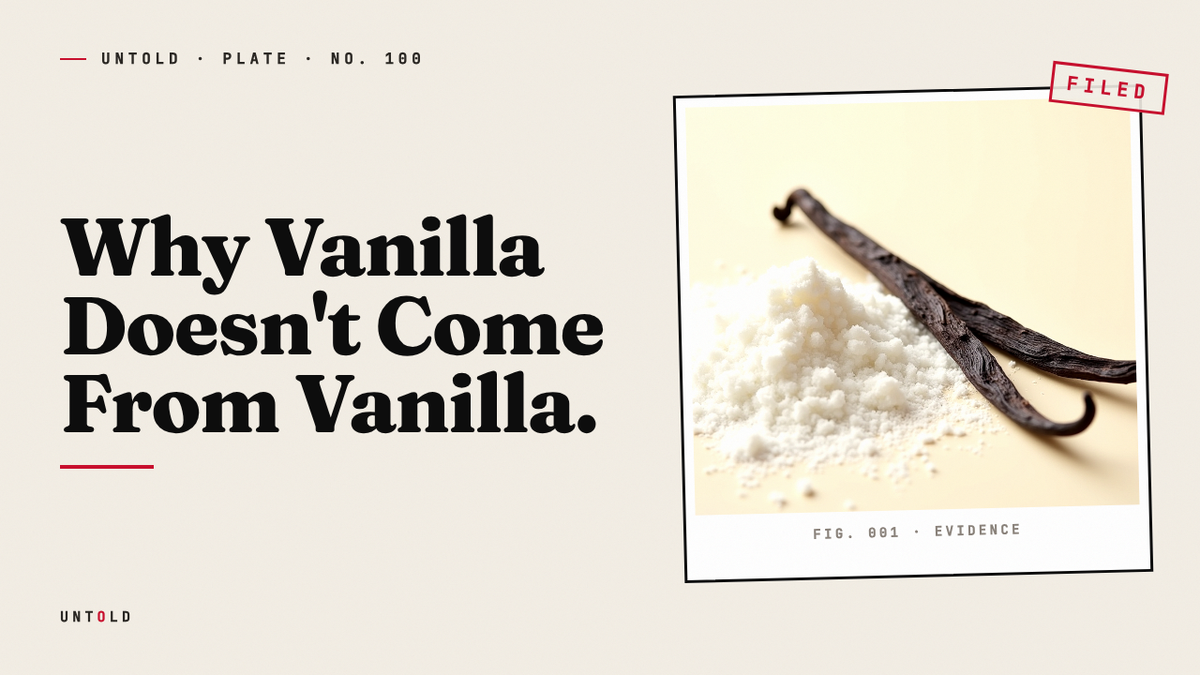
At a mill in the small Norwegian town of Sarpsborg, a dark liquid drains off crushed wood. It is thick, brown, and faintly acrid, the color of strong coffee left too long on the burner. To anyone watching, it looks like exactly what it is: industrial runoff, the byproduct of turning spruce trees into paper. Nobody would mistake it for food.
And yet, refined and purified and reduced to fine white crystals, some of that liquid will end up in a scoop of vanilla ice cream. Possibly the one in your freezer. The transformation from sawmill waste to dessert is not a metaphor. It is a supply chain, running quietly and profitably for the better part of a century.
Most people carry a simple picture of vanilla in their heads. A tropical orchid, a slender green pod, a farmer’s patient hands. It is a lovely image, and it is not wrong so much as it is rare. The overwhelming majority of the vanilla flavor consumed on Earth never comes anywhere near an orchid. It is a single molecule, manufactured at industrial scale, and its origins run through pine bark, paper mills, crude oil, and more recently, vats of genetically engineered microbes.
The world’s favorite flavor turns out to be, above all, a chemistry problem that was solved a long time ago.
The flower that makes nothing
To understand why synthetic vanilla exists, you have to start with how difficult the real thing is.
Vanilla planifolia is a climbing orchid native to the tropical forests of Mexico and Central America. In the wild it is pollinated by a narrow set of insects, and for centuries this dependence kept vanilla cultivation confined to its home range. When Europeans tried to grow the vine elsewhere, the plants flowered beautifully and produced nothing at all. The pollinators simply were not there.
The problem was solved in 1841 on the island of Réunion, then called Bourbon, by a twelve-year-old enslaved boy named Edmond Albius. He devised a method of hand-pollinating the flower using a thin sliver of bamboo and a deft flick of the thumb, lifting the flap that separates the male and female organs and pressing them together.1 The technique was so effective that it is still used, essentially unchanged, on vanilla farms around the world today. Albius received no lasting reward for the innovation that built an industry. He died poor.
Hand-pollination is only the beginning of the labor. Each vanilla flower opens for a single day, sometimes only a few hours, and must be pollinated in that narrow window or it drops from the vine. A worker walks the rows every morning during flowering season, pollinating flower after flower by hand, one at a time.
Even then, the pods that result are useless as flavor. A freshly picked green vanilla bean smells of almost nothing. It contains no vanilla taste whatsoever. The characteristic aroma appears only after months of curing, a slow ritual of blanching the pods in hot water, sweating them under blankets, drying them in the sun by day and wrapping them by night, and finally conditioning them for weeks or months. During this process, enzymes inside the pod break down stored compounds and release the molecules responsible for what we recognize as vanilla.
The result is one of the most expensive spices on the planet, second only to saffron. When crop failures and speculation struck the vanilla market in the late 2010s, prices for cured beans briefly rose above the price of silver.2 All of this for a flavor that most people encounter daily, in ice cream and cola and cake mix and scented candles, at pennies per serving. The arithmetic does not add up unless something else is going on. Something else is.
Isolating the essential
The green pod holds hundreds of trace compounds, a chemical bouquet that gives fine vanilla extract its rounded, layered character. But one molecule does the heavy lifting. It dominates the aroma so completely that, isolated on its own, it reads unmistakably as vanilla.
That molecule was pulled from the bean in 1858 by the French chemist Nicolas-Théodore Gobley, who crystallized it in pure form and gave it a name derived from the plant itself.3 He called it vanillin. Its structure was later worked out to be a relatively simple aromatic compound, a benzene ring dressed with a few functional groups. Compared to the sprawling complexity of a living pod, vanillin is almost austere.
That simplicity was an invitation. Once chemists knew what the molecule looked like, a dangerous and irresistible question presented itself. If a single, well-defined compound was responsible for most of the flavor, why bother with the orchid at all? Why endure the hand-pollination, the year of curing, the tropical growing conditions, the brutal economics, when you could perhaps just build the molecule directly?
The logic was the same logic that had already begun to reshape the dye industry and the pharmaceutical trade in the second half of the nineteenth century. Isolate the active thing. Understand its structure. Then find a cheaper way to make it from scratch. Vanilla was about to become one of the first flavors to undergo that transformation, and it would not be the last.
From pine bark to profit
The breakthrough came in 1874, in Germany. Two chemists, Ferdinand Tiemann and Wilhelm Haarmann, worked out both the full structure of vanillin and a route to synthesize it.4 Their starting material was coniferin, a compound they extracted from the sap and bark of coniferous trees. In other words, they had found a way to turn material from pine forests into the flavor of a tropical orchid.
The first synthetic vanillin cost a fraction of what real cured beans commanded. Within a year, Haarmann and Tiemann founded a company to produce and sell it, a firm that would eventually become part of the modern flavor and fragrance giant Symrise. For the first time, the taste of vanilla was decoupled from the plant that gave it its name.
The coniferin route was clever, but it depended on a raw material that was itself somewhat scarce and finicky to obtain. Chemists soon found something far more abundant, and far cheaper, hiding in plain sight at the world’s paper mills.
Trees are held rigid and upright by a natural polymer called lignin, the biological glue that binds the cellulose fibers of wood together. To make paper, mills must strip the lignin away, leaving behind the clean cellulose fibers that become the page. What remained after this process was a dark, foul-smelling waste stream known as lignosulfonate liquor, or brown liquor. For decades, mills simply dumped it.
Then chemists noticed something about lignin’s molecular architecture. Its building blocks were structurally close cousins of vanillin. With the right oxidation, under heat and pressure in an alkaline solution, lignin could be broken down and coaxed into yielding vanillin directly.5 By the 1930s, paper mills had begun converting a pollutant into a premium flavor compound. The waste that had been an environmental liability became a second revenue stream.
This is the origin of the Norwegian mill. The Borregaard plant in Sarpsborg has been producing vanillin from wood for generations and remains one of the last major manufacturers to do so.6 It markets the product on precisely the grounds that once seemed absurd: that vanillin made from spruce lignin is closer, chemically and in flavor complexity, to the trace-rich profile of a real bean than the alternatives. What began as a way to dispose of garbage has become, in the modern marketing of it, almost a boutique claim.
The petrochemical century
Lignin had a rival, and for most of the flavor market, the rival won.
As the twentieth-century petrochemical industry matured, chemists developed routes to vanillin that began not with trees but with crude oil derivatives. The key intermediate is a compound called guaiacol, which can be produced from petrochemical feedstocks and then converted into vanillin through a series of well-controlled reactions. This process was more consistent, more scalable, and cheaper than wringing the molecule out of variable, messy wood pulp.
Today the great majority of the world’s synthetic vanillin is made this way, from guaiacol traced back to oil.7 The lignin route, once dominant, now accounts for a modest share of global production. The molecule that flavors most of the planet’s vanilla begins its life in a petrochemical plant.
Here the science insists on a point that many people find unsettling. Vanillin is vanillin. A molecule of it synthesized from guaiacol is atom-for-atom identical to a molecule of it that formed inside a curing vanilla pod on a farm in Madagascar. They have the same structure, the same properties, the same taste. There is no chemical test, and certainly no human tongue, that can distinguish a single molecule of one from a single molecule of the other. The difference lies entirely in the history of the molecule, not in the molecule itself.
That is worth sitting with. When you taste synthetic vanillin, you are not tasting an imitation of vanilla flavor. You are tasting the exact compound that carries most of real vanilla’s flavor, arrived at by a different path.
The scale of the deception, if it is one
The numbers are what make the whole story land.
The world consumes something on the order of tens of thousands of tonnes of vanillin every year. Cured vanilla beans, by contrast, supply only a tiny sliver of that total demand. The most commonly cited figure is that roughly 99 percent of vanilla flavor is produced without any orchid involved at all.8 The remaining one percent, the genuine article from cured pods, is reserved for premium products and the small population of cooks and manufacturers willing to pay a steep premium for the full aromatic complexity of the real extract.
Consider what this means in practice. The vanilla in a mass-market ice cream is almost certainly synthetic. The vanilla note in a soft drink, a boxed cake mix, a cheap cologne, a scented candle: synthetic, nearly every time. The reason is not corporate deceit so much as simple physics and economics. There are not enough vanilla orchids on Earth, and could not plausibly be, to satisfy even a fraction of global demand at a price ordinary people would pay. The world wants vastly more vanilla than the world’s farmers can grow. Synthesis is not a shortcut around an available supply. It is the only way the demand can be met at all.
What is striking is how invisible this has remained. The picture in the popular imagination, the orchid and the pod and the patient farmer, is entirely accurate. It is simply describing the one percent, while the ninety-nine percent flows through pipes and reactors and paper mills with no image attached to it at all.
When natural stops meaning anything
There is a final turn, and it scrambles the categories completely.
A reasonable person, having absorbed all of the above, might settle on a tidy rule of thumb. Natural vanilla means the orchid. Artificial vanilla means the wood or the oil. Read the label, and you know what you are getting.
Except the rule no longer holds. Over the past two decades, biotechnology companies have engineered strains of yeast and other microbes to produce vanillin through fermentation, converting sugars or plant-derived precursors into the molecule inside a bioreactor.9 No orchid, no pine bark, no crude oil. Just microorganisms doing what microorganisms do, tuned to excrete the compound we want.
And here is the twist that matters for anyone who reads food labels. Because the vanillin is produced by a biological organism from a plant-based starting material, rather than by conventional chemical synthesis, it can in many jurisdictions be legally labeled as natural flavoring.10 The word natural, on a great many products, now points to a vat of engineered microbes rather than to a flower. The same molecule can be labeled artificial when it comes from oil and natural when it comes from fermentation, even though it is the identical compound in both cases.
This is not fraud. It reflects the legal definitions, which turn on the process of manufacture rather than on the final molecule. But it does mean that the single most important word on a vanilla label, natural, carries far less information than most shoppers assume. It tells you something about the biography of the molecule. It tells you nothing about what the molecule is.
The taste is real
None of this makes vanilla fake. That is the easy and wrong conclusion to draw, and it is worth resisting.
The vanillin in your ice cream is the genuine flavor compound, chemically indistinguishable whether it was born in a Madagascan pod, a Norwegian paper mill, a petrochemical reactor, or a bioreactor full of yeast. Your pleasure in it is not an illusion. What varies from one source to another is not the truth of the flavor but the things that surround it: the price, the labor, the environmental footprint, the trace compounds that a real bean carries and a pure synthetic molecule does not, and the story that a label chooses to tell.
So the next time you taste vanilla, the interesting question is not whether it is real. It almost certainly is. The interesting question is where the molecule was born. And the honest answer, most of the time, is somewhere you would never guess: a tree, a barrel of waste, and a chemist’s stubborn idea that you do not need the flower to have the flavor.

Sources
- Ecott, Tim, Vanilla: Travels in Search of the Ice Cream Orchid, Grove Press, 2004. — https://groveatlantic.com/book/vanilla/
- Neimark, Jill, “The Vanilla Crisis: Why the World’s Favorite Flavor Is in Trouble,” NPR/The Salt, 2018. — https://www.npr.org/sections/thesalt/2018/05/21/612446402/why-vanilla-prices-have-gone-wild
- Gobley, N.-T., “Recherches sur le principe odorant de la vanille,” Journal de Pharmacie et de Chimie, 1858. — https://en.wikipedia.org/wiki/Nicolas-Th%C3%A9odore_Gobley
- Tiemann, F. and Haarmann, W., “Ueber das Coniferin und seine Umwandlung in das aromatische Princip der Vanille,” Berichte der deutschen chemischen Gesellschaft, 1874. — https://onlinelibrary.wiley.com/doi/10.1002/cber.18740070209
- Fache, M., Boutevin, B., Caillol, S., “Vanillin Production from Lignin and Its Use as a Renewable Chemical,” ACS Sustainable Chemistry & Engineering, 2016. — https://pubs.acs.org/doi/10.1021/acssuschemeng.5b01344
- Borregaard, “Vanillin from Wood,” Company Product Documentation. — https://www.borregaard.com/product-areas/aroma-chemicals/
- Havkin-Frenkel, D. and Belanger, F. C. (eds.), Handbook of Vanilla Science and Technology, Wiley-Blackwell, 2011. — https://onlinelibrary.wiley.com/doi/book/10.1002/9781444329353
- Gallage, N. J. and Møller, B. L., “Vanillin: Bioconversion and Bioengineering of the Most Popular Plant Flavor and Its De Novo Biosynthesis,” Molecular Plant, 2015. — https://www.cell.com/molecular-plant/fulltext/S1674-2052(14)00028-4
- Hansen, E. H. et al., “De Novo Biosynthesis of Vanillin in Fission Yeast and Baker’s Yeast,” Applied and Environmental Microbiology, 2009. — https://journals.asm.org/doi/10.1128/AEM.02681-08
- U.S. Food and Drug Administration, “Code of Federal Regulations Title 21, Sec. 101.22: Natural Flavor Definitions.” — https://www.accessdata.fda.gov/scripts/cdrh/cfdocs/cfcfr/CFRSearch.cfm?fr=101.22
Related reading